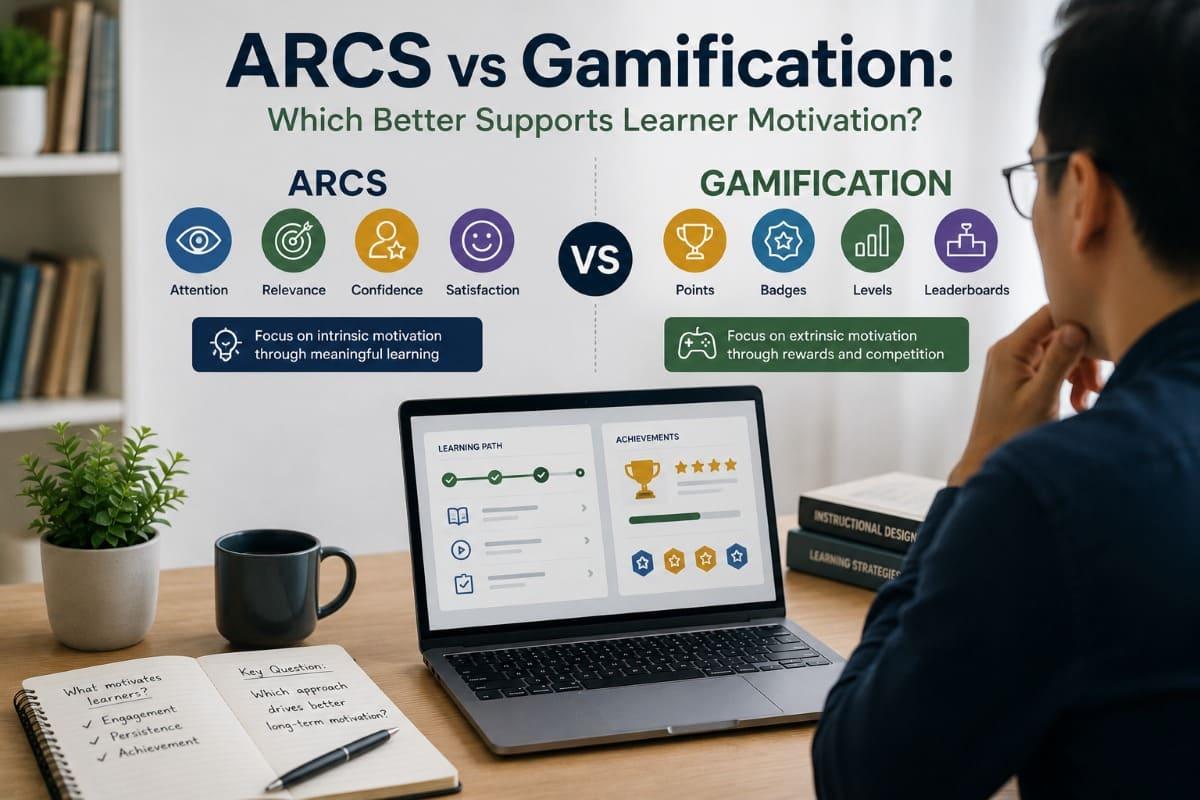
ARCS and gamification are often discussed together because
both relate to learner motivation, but they are not the same kind of approach.
The ARCS Model is a motivational design framework that helps learning teams
diagnose and support Attention, Relevance, Confidence, and Satisfaction.
Gamification uses game-like elements such as points, badges, progress bars,
leaderboards, challenges, or rewards to encourage participation and engagement.
For online learning teams, the better choice depends on the motivation problem
they are trying to solve. This article compares ARCS and gamification for
EdTech teams, program managers, teachers, and trainers who need a practical way
to design more motivating digital learning experiences.
- Quick
Answer
- What
Is the Difference Between ARCS and Gamification?
- How
ARCS Supports Learner Motivation
- How
Gamification Supports Learner Motivation
- ARCS
vs Gamification: A Practical Comparison for Online Learning
- When
ARCS Is the Better Starting Point
- When
Gamification Can Add Value
- How
to Combine ARCS and Gamification Without Creating Noise
- Common
Mistakes When Comparing ARCS and Gamification
- FAQ
- Conclusion
Quick Answer
ARCS usually provides a stronger starting point for learner
motivation because it helps teams diagnose why learners are or are not
motivated. Gamification can support motivation when it is carefully aligned
with learning goals, but it should not be treated as a complete motivation
strategy by itself.
The ARCS Model focuses on four motivational conditions:
Attention, Relevance, Confidence, and Satisfaction. It helps teachers,
trainers, instructional designers, and EdTech teams ask whether learners are
interested, whether the lesson feels meaningful, whether success feels
achievable, and whether the learning experience feels worthwhile.
Gamification, by contrast, uses game-like elements such as
points, badges, levels, challenges, streaks, progress bars, rewards, or
leaderboards. These elements can increase participation and make progress more
visible, but they may also distract learners if they reward activity more than
learning.
For online learning, the practical answer is not “ARCS or
gamification.” A better approach is to use ARCS as the motivational design
foundation, then add gamification only where it supports a clear learner need,
such as progress visibility, practice frequency, feedback, or completion
momentum.

What Is the Difference Between ARCS and Gamification?
ARCS is a motivational design framework, while gamification
is a design approach that applies game-like elements to non-game learning
experiences. The simplest difference is this: ARCS helps diagnose the
motivation problem; gamification offers possible design mechanics that may
support motivation if used well.
The ARCS Model was developed by John M. Keller and is
commonly explained through four categories: Attention, Relevance, Confidence,
and Satisfaction. The official ARCS explanation describes it as a
problem-solving approach for designing motivational aspects of learning
environments so they can stimulate and sustain learner motivation. ARCS Model official explanation
Gamification is usually defined as the use of game design
elements in non-game contexts. In learning environments, this may include
points, badges, levels, quests, streaks, leaderboards, progress bars,
achievements, challenges, or reward systems. One widely cited academic
definition comes from Deterding, Dixon, Khaled, and Nacke’s work on defining
gamification. From
game design elements to gamefulness: defining gamification
These two approaches can overlap, but they operate
differently.
ARCS asks:
- Are
learners paying attention?
- Does
the content feel relevant?
- Do
learners believe they can succeed?
- Does
the experience feel satisfying?
Gamification asks:
- What
game-like mechanics could encourage participation?
- How
can progress be made visible?
- What
rewards or feedback can reinforce action?
- How
can challenge, achievement, or competition shape behavior?
The difference matters because many organizations try to
solve motivation problems by adding gamification too early. If learners do not
see relevance, a badge may not help. If learners lack confidence, a leaderboard
may make some of them feel worse. If learners are confused, points may reward
completion without improving understanding.
ARCS asks why motivation is weak. Gamification asks which mechanics might encourage action.
For EdTech teams and program managers, this distinction can
prevent shallow engagement design. A platform can include badges, streaks, or
progress bars, but those features should support the motivational structure of
the course, not replace it.
How ARCS Supports Learner Motivation
ARCS supports learner motivation by giving learning teams a
structured way to examine the learner’s motivational experience. It does not
begin with rewards or features. It begins with the conditions that make
learners more likely to engage with learning meaningfully.
Attention: helping learners focus on what matters
Attention is about helping learners notice and stay mentally
engaged with the learning experience. In online learning, this may involve a
strong opening question, a realistic problem, a focused scenario, varied
pacing, or a clean lesson structure.
Attention is not the same as entertainment. A lesson can be
visually exciting but instructionally weak. Good attention design guides the
learner into the topic.
For a deeper practical guide, see How
to Capture Learner Attention Without Making Lessons Feel Distracting.
Relevance: connecting learning to real goals
Relevance helps learners understand why the lesson matters.
It connects content to learner goals, roles, decisions, problems, or future
opportunities.
A course about instructional design, for example, may feel
abstract if it begins with terminology. It becomes more relevant when it shows
a teacher how unclear objectives lead to confusing activities and weak
assessments.
For a deeper guide, see How
to Make Learning Feel Relevant to Real Learner Goals
Confidence: making success feel achievable
Confidence is about helping learners believe they can
succeed if they invest effort. In online learning, confidence is shaped by
clear instructions, manageable lesson progression, examples, feedback, practice
opportunities, and visible progress.
This matters because learners often disengage quietly. They
may not say, “I lack confidence.” They may simply stop opening the course.
Satisfaction: making the effort feel worthwhile
Satisfaction is the learner’s sense that the learning
experience produced value. It can come from practical application, meaningful
feedback, a completed task, recognition, a certificate, or visible improvement.
Satisfaction is not only a reward screen. For professional
learners, satisfaction often comes from leaving the course with something
usable: a better lesson plan, a clearer workflow, a skill they can apply, or a
practical decision they can make.
ARCS is useful because it separates motivation into
different design problems. A learner who is bored, confused, unconvinced, or
unrewarded may need different interventions.

How Gamification Supports Learner Motivation
Gamification supports learner motivation by using game-like
mechanics to encourage participation, make progress visible, create challenge,
provide feedback, or recognize achievement. It can be useful, but only when it
is connected to the learning purpose.
Common gamification elements in online learning include:
- points;
- badges;
- levels;
- streaks;
- leaderboards;
- progress
bars;
- missions
or quests;
- achievements;
- unlockable
modules;
- challenges;
- peer
competition;
- team-based
goals;
- immediate
feedback.
These elements can help when they reinforce meaningful
behavior. A progress bar can help learners see momentum. A badge can recognize
completion of a real skill milestone. A challenge can encourage practice.
Immediate feedback can help learners adjust their understanding. A streak can
support habit formation for short daily learning.
But gamification is not automatically motivational.
A leaderboard may motivate competitive learners but
discourage learners who are behind. Points may increase activity but not
necessarily understanding. Badges may feel meaningful when tied to real
achievement, but decorative when awarded too easily. Streaks may support
consistency, but they may also create pressure or guilt if learners miss a day.
Research on gamification has often shown that effects depend
heavily on context, implementation, user characteristics, and the design of the
gamified system. A literature review by Hamari, Koivisto, and Sarsa concluded
that gamification can provide positive effects, but those effects are greatly
dependent on context and users. Does
Gamification Work? A Literature Review of Empirical Studies on Gamification
For online learning teams, this is the practical point:
gamification should not be added because it looks modern. It should be added
because it supports a specific motivational or behavioral goal.
What gamification can do well
Gamification can be useful when the learning challenge
involves repetition, progress visibility, practice frequency, habit-building,
or sustained participation.
For example, gamification may help when learners need to:
- practice
vocabulary daily;
- complete
short microlearning modules;
- review
safety procedures regularly;
- build
confidence through repeated attempts;
- participate
in a learning community;
- track
progress across a long course;
- complete
small milestones before a final assessment.
In these cases, game-like mechanics can make effort more
visible and structured.
Where gamification becomes risky
Gamification becomes risky when the mechanic becomes more
important than the learning. This can happen when learners focus on earning
points, protecting streaks, or climbing a leaderboard without deeper
understanding.
It can also create uneven motivation. Some learners enjoy
visible competition. Others may prefer private progress. Some respond well to
badges. Others see them as childish or irrelevant. Adult learners, professional
learners, and institutional training participants may react differently
depending on culture, context, and expectations.
Gamification works best when the game element supports the learning behavior, not when it becomes the main event.
ARCS vs Gamification: A Practical Comparison for Online Learning
The most useful comparison is not whether ARCS or
gamification is more exciting. The useful comparison is what each approach
helps a learning team decide.
|
Aspect |
ARCS Model |
Gamification |
|
Primary role |
Diagnoses and designs motivational conditions. |
Adds game-like mechanics to encourage behavior or
participation. |
|
Main focus |
Attention, Relevance, Confidence, Satisfaction. |
Points, badges, levels, challenges, streaks, progress,
leaderboards, rewards. |
|
Best use |
Understanding why learners may not feel motivated. |
Reinforcing specific actions, progress, habits, or
participation. |
|
Strength |
Provides a complete motivation lens across the learning
journey. |
Makes progress, challenge, feedback, or achievement more
visible. |
|
Risk |
Can remain theoretical if not translated into course
design. |
Can become superficial if rewards are disconnected from
learning. |
|
Platform implication |
Guides course structure, onboarding, feedback, progress,
and learner experience. |
Requires feature design, rules, reward logic, and careful
learner behavior monitoring. |
|
Best question |
“What motivation condition is missing?” |
“Which mechanic supports the behavior we want?” |
|
Better starting point |
Strong for most learning design projects. |
Useful after the motivational problem is clear. |
For most EdTech teams, ARCS should come first. It helps
define the motivational problem before selecting mechanics. Gamification can
then become one possible implementation layer.
For example, if learners are not starting the course, the
issue may be Attention or Relevance. A better course title, clearer onboarding,
or stronger first lesson may help more than a badge.
If learners start but do not continue, the issue may be
Confidence, Relevance, or poor pacing. A progress bar or streak might help, but
only if the course itself feels achievable and useful.
If learners complete modules but do not feel satisfied, the
issue may be weak application. A certificate may help, but a practical final
project, feedback activity, or visible skill milestone may be more meaningful.
ARCS helps teams choose the right problem. Gamification
helps teams design selected motivational mechanics after the problem is
understood.

When ARCS Is the Better Starting Point
ARCS is the better starting point when the team does not yet
understand why learners are disengaging. It is also better when the learning
program has strategic goals beyond short-term activity, such as skill
development, course completion, professional application, learner trust, or
long-term platform growth.
Use ARCS when motivation problems are unclear
If the course has low completion, weak quiz performance,
poor feedback, or high drop-off, gamification may be tempting. But adding
points before diagnosing the issue can hide the real problem.
The course may have:
- weak
attention because the opening is slow;
- weak
relevance because examples do not match learner goals;
- weak
confidence because instructions are unclear;
- weak
satisfaction because the final activity feels meaningless.
Each problem needs a different response.
Use ARCS when learners need meaningful application
For professional education, teacher training, workforce
development, and creator-led courses, learners often care about practical
value. They want to do something better, not only finish a module.
ARCS helps keep the design focused on learning value. It
asks whether the course connects to real learner goals and whether learners
leave with a satisfying outcome.
Gamification can still help, but it should not replace
application.
Use ARCS when the audience is diverse
Different learners respond differently to game mechanics.
Some may enjoy competition. Others may feel uncomfortable with public ranking.
Some may value badges. Others may care more about practical outcomes.
ARCS provides a broader motivational foundation because it
does not depend on one style of engagement. It can be adapted to different
learner types, maturity levels, and cultural contexts.
Use ARCS when building a branded learning ecosystem
For organizations building a branded or white-label learning
platform, motivation needs to be designed across the full learner journey. That
includes discovery, onboarding, course structure, content experience, mobile
access, feedback, assessment, recognition, certificates, and follow-up learning
paths.
ARCS gives a more strategic lens for this ecosystem-level
design. It can guide platform decisions without reducing motivation to points
and rewards.
FitAcademy
Explore a White-Label Platform for Structured Learning Motivation
FitAcademy helps institutions, creators, and training providers launch branded, mobile-first learning experiences with structured courses, learner progress, practical content delivery, and platform ownership.
Explore FitAcademy White LabelWhen Gamification Can Add Value
Gamification can add value when the learning behavior is
clear, the mechanic supports the learning goal, and the platform can implement
the mechanic without creating distraction. It is most useful as a reinforcement
layer, not as the foundation of motivation.
Use gamification to make progress visible
Progress visibility is one of the safest and most useful
forms of gamification. Learners often benefit from seeing where they are, what
they have completed, and what remains.
This can be simple:
- module
completion indicators;
- progress
bars;
- milestone
badges;
- course
pathway status;
- “next
lesson” prompts;
- completion
checklists.
These features can support Confidence and Satisfaction in
ARCS when they help learners feel that progress is achievable and meaningful.
Use gamification to support repeated practice
Gamification can help when learners need repeated effort.
Language learning, skill drills, safety refreshers, product knowledge, exam
preparation, and microlearning habits may benefit from streaks, challenges,
daily goals, or progress milestones.
The key is to reward meaningful practice, not empty
activity.
For example, a teacher training platform might reward
completion of practice tasks that involve rewriting learning objectives, not
merely logging in. A workforce training program might recognize repeated
scenario practice, not only page views.
Use gamification to support feedback and mastery
Immediate feedback can feel game-like when learners try,
receive a response, and improve. This is often more valuable than points.
A quiz that explains why an answer is wrong supports
Confidence. A skill challenge that gives learners multiple attempts supports
mastery. A scenario-based activity that adapts to learner choices can make
learning more engaging without relying on superficial rewards.
Use gamification carefully for social motivation
Leaderboards and team challenges can motivate some learners,
especially when competition is friendly and the learning context supports it.
But social gamification should be designed carefully.
Public ranking can discourage beginners, slower learners, or
learners with limited time. In adult learning and professional development,
some participants may prefer private progress or team-based goals rather than
individual competition.
A safer approach may be:
- personal
progress instead of public ranking;
- team
milestones instead of individual leaderboards;
- optional
challenges instead of mandatory competition;
- recognition
for improvement, not only top performance.
Gamification adds the most value when it reinforces
progress, practice, feedback, or mastery. It adds the least value when it
rewards activity without learning substance.

How to Combine ARCS and Gamification Without Creating Noise
ARCS and gamification can work well together when ARCS
guides the motivational strategy and gamification supports selected behaviors.
The problem begins when gamification is added as decoration before the
motivational need is clear.
A practical workflow is:
|
Step |
Design Question |
Example Decision |
|
1. Diagnose with ARCS |
Which motivation condition is weak? |
Learners start but do not continue, so Confidence may be
weak. |
|
2. Clarify learner behavior |
What behavior needs support? |
Learners need to complete short practice tasks
consistently. |
|
3. Choose a mechanic |
Which gamification element supports that behavior? |
Add progress milestones and completion feedback. |
|
4. Protect learning quality |
Does the mechanic support understanding? |
Reward practice quality, not just clicks. |
|
5. Review data |
Did the change improve meaningful engagement? |
Compare completion, quiz quality, learner feedback, and
application tasks. |
Example: microlearning course for new trainers
Imagine a training provider launches a microlearning course
for new trainers. Learners watch the first few videos but do not complete the
practice tasks.
A shallow gamification response might be to award points for
every video watched.
An ARCS-guided response would ask:
- Attention:
Are practice tasks introduced clearly?
- Relevance:
Do learners understand how the task helps them train better?
- Confidence:
Do they know how to complete the task?
- Satisfaction:
Do they receive feedback or see improvement?
After diagnosis, gamification may still help. The platform
might add a progress milestone for completing the first practice task, a badge
for submitting a usable lesson outline, or feedback after each attempt. But the
mechanic is now connected to a learning behavior.
Example: workforce learning program
A workforce development team wants learners to complete
safety refreshers every month. Gamification may help through monthly
challenges, progress streaks, or team-based completion goals.
But ARCS still matters. The refresher must capture
attention, show relevance to real work risks, feel achievable, and give
learners satisfaction that the review was useful. Without that foundation,
gamification may increase compliance activity but not meaningful retention or
application.
Example: creator-led education business
A creator building a paid learning community may want badges
and leaderboards to increase engagement. That can work if the community values
visible progress and participation.
But if learners joined to build a practical skill,
gamification should recognize useful outputs: completed drafts, submitted
projects, peer feedback, or applied learning milestones. Rewarding comments or
logins alone may create activity without value.
Common Mistakes When Comparing ARCS and Gamification
The biggest mistake is treating ARCS and gamification as
direct competitors. They are different types of tools. ARCS is a design
framework for motivation. Gamification is a set of possible mechanics for
engagement and behavior reinforcement.
Mistake 1: Choosing gamification because the course feels boring
If a course feels boring, the first question should be why.
Is the opening weak? Are examples irrelevant? Is the lesson too long? Is the
platform hard to navigate? Are learners unsure how the content applies?
Gamification may help in some cases, but it may also
distract from the deeper problem.
Mistake 2: Assuming ARCS is too theoretical
ARCS can sound theoretical if it stays in planning
documents. But it becomes practical when translated into course design
questions.
For example:
- Attention:
How will the lesson begin?
- Relevance:
Which learner goal does this support?
- Confidence:
What makes success feel achievable?
- Satisfaction:
What useful outcome does the learner experience?
These are not abstract questions. They affect scripts,
slides, quizzes, platform flow, and learner support.
Mistake 3: Treating points and badges as proof of motivation
Points and badges show that learners completed or earned
something inside a system. They do not automatically prove motivation,
understanding, or application.
A learner may collect badges passively. Another learner may
learn deeply without caring about badges. Program managers should evaluate
gamification alongside better signals: practice quality, quiz performance,
completion patterns, feedback, application tasks, and repeat participation.
Mistake 4: Using leaderboards without considering learner confidence
Leaderboards can motivate competitive learners, but they can
also weaken confidence for learners who start late, learn slowly, or are new to
the topic.
If Confidence is a key ARCS concern, private progress
tracking, personal milestones, or improvement-based recognition may be better
than public ranking.
Mistake 5: Adding too many mechanics at once
A platform with points, badges, leaderboards, streaks,
quests, pop-ups, levels, coins, and rewards can become noisy. Learners may
spend more energy understanding the system than learning the content.
A better approach is to start with one or two mechanics that
support a clear behavior. For many online learning programs, progress
visibility and meaningful feedback are stronger starting points than complex
reward systems.
Mistake 6: Ignoring the business model
Learning motivation also connects to the business model. A
marketplace course, corporate training program, white-label academy, creator
community, and institutional learning platform may need different motivational
strategies.
For example, a public creator course may use visible
achievements to encourage community participation. A professional certification
program may need stronger assessment credibility. A white-label learning
platform may prioritize branded learner relationships, progress tracking,
certificates, and structured learning paths.
Motivation design should support the learning business
model, not copy mechanics from consumer apps without context.
FAQ
Is ARCS better than gamification for learner motivation?
ARCS is usually better as a starting point because it helps
diagnose the motivation problem before choosing tactics. Gamification can be
useful, but it works best when it supports a specific learning behavior. The
strongest approach is often to use ARCS as the motivational design framework
and gamification as a selective support layer.
Can ARCS and gamification be used together?
Yes. ARCS and gamification can work together when
gamification supports Attention, Relevance, Confidence, or Satisfaction. For
example, progress bars can support confidence, achievement badges can support
satisfaction, and challenges can support attention or practice. The key is to
avoid adding game elements that distract from the learning goal.
What is the main difference between ARCS and gamification?
The main difference is that ARCS is a motivational design
framework, while gamification is a design approach using game-like elements.
ARCS asks why learners may not feel motivated. Gamification asks which
mechanics might encourage action. ARCS is diagnostic and strategic;
gamification is more tactical and feature-oriented.
When should an online course use gamification?
An online course should use gamification when there is a
clear behavior to support, such as completing practice, reviewing regularly,
tracking progress, participating in a community, or finishing milestones.
Gamification should not be added only to make a course look modern. It should
reinforce meaningful learning behavior.
Can gamification reduce learner motivation?
Gamification can reduce or distort motivation when it
rewards superficial activity, creates unhealthy competition, distracts from
learning, or makes learners feel pressured. For example, a leaderboard may
motivate advanced learners but discourage beginners. This is why gamification
should be designed around learner context and reviewed with real learning data.
Is gamification necessary for a modern learning platform?
No. A modern learning platform does not need heavy
gamification to support motivation. Clear learning paths, mobile access,
progress tracking, useful feedback, relevant content, and meaningful completion
experiences may be more important. Gamification is useful when it supports
these goals, but it should not replace strong learning design.
Conclusion
ARCS and gamification both relate to learner motivation, but
they solve different parts of the problem.
ARCS gives learning teams a structured way to understand
motivation. It helps them examine whether learners are paying attention, seeing
relevance, building confidence, and experiencing satisfaction. This makes it
valuable for teachers, trainers, EdTech teams, and program managers who need to
design learning experiences with stronger motivational foundations.
Gamification can be useful when it makes progress visible,
supports repeated practice, gives feedback, or recognizes meaningful
achievement. But it becomes weak when it rewards activity without learning
value or adds complexity without purpose.
For most online learning programs, ARCS should come first.
It helps define the motivational problem. Gamification can come next, but only
when a specific mechanic supports a specific learning behavior.
The practical decision is not whether ARCS or gamification
is more modern. The better question is: what does the learner need in order to
continue, understand, apply, and feel that the effort was worthwhile?
For organizations building scalable online courses or
branded learning platforms, that question matters more than any single feature.
FitAcademy
Launch a Branded Learning Platform With Better Motivation Design
FitAcademy helps institutions, creators, and training providers build white-label, mobile-first learning experiences with structured courses, learner progress, branded ownership, and practical online training delivery.
Explore FitAcademy White Label