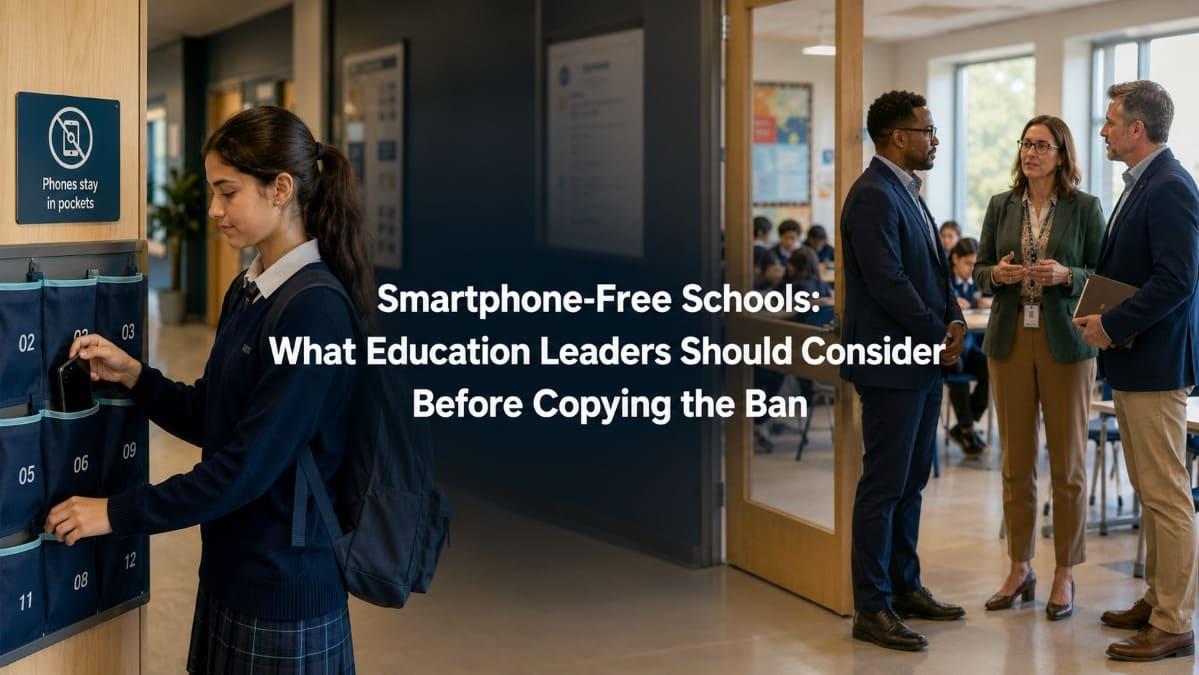
Smartphone-free school policies are spreading rapidly as
education systems respond to classroom distraction, cyberbullying, recording
without consent, and concerns about student wellbeing. Yet removing phones does
not automatically improve grades, mental health, or digital habits. Outcomes
depend on the problem being addressed, the scope of the restriction,
enforcement consistency, student needs, family communication, and the support
surrounding the policy. For teachers, counselors, and student support teams,
the central question is therefore not simply whether phones should be banned.
It is whether a school can create a workable attention policy while protecting
accessibility, safety, trust, and purposeful access to digital learning.
- Quick
Answer
- Why
Smartphone-Free Schools Are Spreading
- What
Does “Smartphone-Free” Actually Mean?
- What
Does the Evidence Really Show?
- Seven
Questions to Answer Before Copying a Ban
- How
to Implement a Policy Without Creating a Discipline Trap
- What
Should Schools Measure?
- Common
Mistakes That Weaken Smartphone Policies
- FAQ
- Conclusion
Quick Answer
A smartphone-free school is an educational setting that
restricts students’ access to personal phones during some or all of the school
day to protect attention, classroom conditions, privacy, safety, or social
interaction. The restriction may apply only during lessons, extend from arrival
to dismissal, or allow limited use under documented exceptions.
Schools should not copy a smartphone ban simply because
another school or government has adopted one. Evidence suggests that
well-enforced restrictions can reduce access to phones and may reduce classroom
distraction. However, research has not established that bans alone consistently
improve academic attainment, mental wellbeing, sleep, or online safety.
Before adopting a policy, leaders should define the specific
problem, consult students and families, establish medical and accessibility
exceptions, create reliable emergency communication procedures, provide
equitable access to approved learning technology, and decide how violations
will be handled without placing excessive enforcement work on teachers.
The most defensible approach is a clearly scoped,
support-led policy that is monitored as a school improvement intervention—not a
symbolic prohibition expected to solve every digital wellbeing problem.
Why Smartphone-Free Schools Are Spreading
The policy trend is no longer limited to a small number of
highly publicized schools. By March 2026, UNESCO’s Global Education Monitoring
team reported that 114 education systems—58% of countries worldwide—had a
national prohibition on mobile phones in schools. The figure had risen from 24%
in June 2023 and 40% by early 2025. UNESCO
monitoring of school phone bans
The growth reflects several concerns that schools encounter
every day:
- notifications
interrupting explanation and independent work;
- students
switching between learning tasks, messaging, games, and social media;
- unauthorized
photography or recording;
- conflicts
beginning online and continuing inside school;
- academic
dishonesty during assessments;
- pressure
on teachers to negotiate phone use repeatedly;
- reduced
face-to-face interaction during breaks; and
- safeguarding
incidents that are harder to investigate once content spreads.
These are legitimate operational problems. A teacher cannot
provide effective instruction if each request to put a phone away becomes a
negotiation. Counselors may also see the consequences of online exclusion,
rumor-sharing, image-based abuse, or compulsive checking long after a classroom
incident has ended.
But different problems require different responses. A school
experiencing frequent lesson disruption may need a classroom access rule. A
school dealing with unauthorized recording may need a stronger privacy and
safeguarding protocol. A student whose sleep is disrupted by overnight social
media use will not necessarily be helped by a rule operating only between the
first and last bell.
A phone ban changes access during school; it does not automatically change a learner’s relationship with technology.
The distinction matters because leaders can otherwise attach
too many expectations to one policy. Improved concentration, higher test
scores, better mental health, less cyberbullying, stronger friendships, and
safer online behavior are separate outcomes. They should not be treated as
interchangeable.

What Does “Smartphone-Free” Actually Mean?
“Smartphone-free” is an umbrella term, not a single policy
model. It can describe anything from keeping phones out of sight during
instruction to storing devices in locked pouches for the entire day.
This variation complicates both research and implementation.
Two schools may both claim to have a ban while operating completely different
systems.
|
Policy model |
What students can do |
Operational requirement |
Main trade-off |
|
Classroom-only restriction |
Keep phones switched off and stored during lessons |
Teachers communicate and enforce a common classroom rule |
Protects instruction but permits use during breaks |
|
Bell-to-bell restriction |
Cannot access phones from arrival until dismissal |
Secure storage, office communication, exception process,
and consistent supervision |
Creates a clearer boundary but requires more
infrastructure |
|
Central collection |
Hand in phones at entry or at the start of class |
Logging, secure custody, distribution, and lost-device
procedures |
Strong access control but high administrative
responsibility |
|
Locked personal pouch |
Carry the phone in a sealed pouch opened at dismissal |
Pouch procurement, unlocking points, damage and
non-compliance procedures |
Reduces collection work but introduces cost and equipment
management |
|
Managed-use policy |
Use phones only at specified times or when authorized |
Clear permission signals and close supervision |
Preserves flexibility but can be harder to enforce
consistently |
|
No-phone plus school devices |
Personal phones restricted; managed tablets or laptops
used for learning |
Sufficient devices, filtering, technical support, and
equitable access |
Separates learning from personal apps but requires
investment |
A policy must also define what counts as a restricted
device. Smartwatches, earbuds, tablets, and connected wearables can reproduce
many smartphone functions. If a rule mentions only phones, staff may quickly
face arguments about devices that can still message, record, photograph, or
receive notifications.
Schools must then decide whether “not used” means:
- switched
off in a bag;
- stored
in a locker;
- sealed
in a pouch;
- handed
to staff;
- left
at home; or
- inaccessible
except through an approved accommodation.
These are not minor procedural details. They determine cost,
staff workload, enforcement reliability, and responsibility if a device is lost
or damaged.
The strength of a smartphone policy is determined less by
the word “ban” than by what happens at arrival, during exceptions, after a
violation, and when a family urgently needs contact.
What Does the Evidence Really Show?
The evidence supports concern about distraction more clearly
than it supports every promised outcome of a ban.
OECD analysis of Programme for International Student
Assessment (PISA) 2022 data found that students who used smartphones more
frequently at school were more likely to report digital distraction in
mathematics lessons. Students were less likely to report distraction where
phones were prohibited—particularly when the restriction appeared to be
enforced. OECD
analysis of digital devices and school distraction
Enforcement remained a major weakness. Across OECD
countries, 29% of students in schools where phones were banned reported using a
smartphone several times a day at school, while another 21% reported using one
every day or almost every day. A written ban, therefore, should not be confused
with an implemented restriction.
Academic results are less conclusive. A 2024 scoping review
examined 22 studies across 12 countries and found substantial variation in
policy definitions, research methods, age groups, and outcomes. Four studies
reported academic improvements following restrictions, while three found no
academic difference. The review also identified a lack of rigorous randomized
controlled studies and concluded that evidence for one-size-fits-all bans
remained inconclusive. Scoping
review of evidence for and against school phone bans
Mental health claims require similar caution. The 2025 SMART
Schools study compared 1,227 students aged 12–15 across 30 secondary schools in
England. Restrictive policies were associated with less phone and social media
use during school hours, but not with lower overall weekday or weekend use or
better mental wellbeing. Because the study was cross-sectional and
observational, it could identify associations but not prove causal effects. SMART Schools study in The
Lancet Regional Health – Europe
The practical interpretation is not that restrictions are
useless. It is that they are better understood as an environmental
intervention: they may make access more difficult during designated hours and
reduce opportunities for distraction. They are not, by themselves, a treatment
for anxiety, poor sleep, social media dependency, bullying, or weak academic
instruction.
Cyberbullying findings are also mixed. Some
quasi-experimental studies included in the 2024 review found reductions in
reported bullying after restrictions, particularly among older students. Other
studies found no improvement or higher reported online victimization in schools
with restrictions. Online harm can migrate to evenings, weekends, gaming
platforms, and private messaging even when phones are inaccessible at school.
A school can credibly promise clearer boundaries and fewer
opportunities for in-school interruption. It cannot credibly promise that a ban
alone will improve every learner outcome.

Seven Questions to Answer Before Copying a Ban
A school should begin with diagnosis, not with the policy
used by a neighboring institution. The following questions expose whether the
proposed restriction is proportionate and operationally viable.
1. What exact problem are we trying to solve?
“Phones are a problem” is too broad to guide implementation.
Leaders should examine incident records, classroom
observations, student support referrals, staff surveys, and student feedback.
They may discover that the primary issue is concentrated in particular
settings—for example, social media use during independent work, filming in
changing areas, or online conflicts escalating during lunch.
A precise problem statement might be:
During observed independent-work periods, repeated phone
checking is reducing time on task and generating inconsistent teacher
interventions.
That can be measured. “Improve student wellbeing” is too
broad unless the school identifies specific outcomes and contributing
mechanisms.
2. Which periods, places, students, and devices are
covered?A classroom restriction and a bell-to-bell restriction solve
different problems. Leaders should determine whether the policy applies during:
- arrival
and dismissal;
- lessons;
- movement
between classes;
- lunch
and breaks;
- field
trips;
- extracurricular
activities;
- residential
time; and
- transport
provided by the school.
Age also matters. Younger learners may benefit from simpler
rules, while older students may have employment, caregiving, transport, or
independent travel responsibilities. Any flexibility should be explicit rather
than dependent on which member of staff is present.
3. Which exceptions are necessary?
A credible policy needs an accessible, confidential
exception process. Potential reasons include:
- monitoring
or managing a health condition;
- disability-related
access or communication;
- assistive
technology;
- translation
or accessibility support;
- documented
safeguarding needs;
- caregiving
responsibilities; and
- a
teacher-authorized learning activity.
Exceptions should not require students to repeatedly
disclose private medical or personal information to classroom staff. Approved
arrangements can be documented through the school’s established student support
process.
Victoria’s government school policy, for example, provides
exceptions when a phone is essential for managing a health condition or for
classroom learning, with different authorization routes for each. It directs
parents to contact children through the school office during emergencies. Victoria government
guidance on school mobile phones
4. How will emergency communication work?
“Parents can call the office” is only useful if the office
can reliably receive, prioritize, and deliver urgent messages.
Schools should test:
- whether
family contact records are current;
- who
monitors communication channels;
- how
messages reach students in different locations;
- how
the school communicates during lockdowns or evacuations;
- how
students can contact families when authorized;
- what
happens during network or power failure; and
- whether
families understand that mass calling or messaging during an emergency may
complicate official communication.
Emergency procedures must be designed with safeguarding and
emergency professionals. A phone policy should sit within the existing
emergency plan, not operate as an isolated behavior rule.
5. What learning access will replace personal devices?
Some schools have informally relied on students’ phones for
research, authentication, photography, quizzes, translation, accessibility, or
learning platform access. Removing phones without providing an alternative can
expose inequities or disrupt established teaching workflows.
Before implementation, teachers should audit where personal
devices are currently assumed. The response may involve school-managed tablets,
printed alternatives, shared equipment, approved authentication methods, or
redesigned activities.
This is where the related question of choosing
digital tools with a clear learning purpose becomes important. A smartphone
restriction should distinguish personal, interruptive access from intentional
digital learning rather than implying that all screen-based learning is
undesirable.
6. Who carries the enforcement workload?
If every breach becomes an individual teacher confrontation,
implementation will become inconsistent and emotionally expensive.
The school needs common procedures for:
- first
and repeated violations;
- refusal
to store or surrender a device;
- confiscation
and return;
- suspected
recording or harmful content;
- lost
or damaged devices;
- communication
with families; and
- incidents
involving an approved exception.
Teachers should know when to redirect, document, refer, or
request support. Counselors should not become default disciplinarians simply
because a violation appears connected to anxiety or social media use. Their
role is to identify underlying needs and provide support where appropriate.
7. What would make the school revise the policy?
A policy should have a review date and predefined evidence.
Without this, leaders may continue an ineffective model because reversing it
feels like admitting failure.
Review criteria could include:
- observed
phone access during restricted periods;
- lesson
interruptions linked to devices;
- safeguarding
and recording incidents;
- staff
time spent enforcing the policy;
- student
and staff perceptions of concentration;
- family
communication failures;
- disciplinary
disparities;
- exception
requests and response times; and
- unintended
changes in attendance or school avoidance.

FitAcademy A phone policy becomes more workable when teachers, support teams, students,
and families receive the same short guidance. FitAcademy can support schools
and education networks with a branded white-label microlearning environment for
policy orientation, scenario-based staff learning, and implementation updates.Deliver Consistent Staff and Family Guidance
How to Implement a Policy Without Creating a Discipline Trap
The most practical implementation sequence is short enough
to manage but deliberate enough to expose problems before a full rollout.
Establish a baseline
Collect two to four weeks of relevant evidence before
introducing the new rule. Avoid using only staff perceptions or raw
confiscation numbers. Combine classroom observations, incident data, student
support information, and short surveys.
The purpose is not to prove that phones are harmful. It is
to establish what is happening in this school and provide a point of
comparison.
Consult around implementation, not only approval
Consultation does not mean that every group receives veto
power. It means that leaders identify operational risks before the policy is
finalized.
Students can explain where phones are currently used, how
restrictions may be bypassed, and which situations create genuine communication
needs. Families can identify emergency concerns. Teachers can test whether
storage and referral procedures are realistic. Counselors and inclusion staff
can anticipate the effects on students with anxiety, disabilities, health
conditions, or difficult family circumstances.
The decision may remain with school leadership, but the
implementation becomes better informed.
Publish a one-page operational standard
The core rule should be understandable without reading a
long policy document. It should state:
- which
devices are covered;
- when
and where access is restricted;
- how
devices are stored;
- how
exceptions are approved;
- how
families and students communicate urgently;
- what
happens after a violation; and
- where
questions or appeals are directed.
Detailed safeguarding, confiscation, privacy, and
disciplinary procedures can sit behind the one-page standard.
Train adults through realistic scenarios
Staff consistency requires more than emailing the policy.
Brief training should cover situations such as a student
using an approved medical application, a smartwatch receiving messages,
suspected filming, refusal to hand over a device, a parent sending an urgent
message directly to a student, and a learner becoming distressed when separated
from a phone.
Short scenario-based modules can be delivered through a branded microlearning platform, followed by
discussion in staff teams. The aim is not extensive theory. It is a shared
response under real school conditions.
Use proportionate, restorative responses
Punitive escalation may be necessary for repeated or serious
violations, but it should not be the first and only mechanism.
A student who repeatedly checks a phone may be testing
boundaries, responding to family pressure, monitoring a health concern,
experiencing online harassment, or struggling with compulsive use. These
possibilities do not remove accountability. They determine what additional
response may be needed.
Schools should monitor whether sanctions fall
disproportionately on particular student groups. A neutral-looking rule can
create unequal outcomes if some learners have fewer secure storage options,
more complex family responsibilities, or support needs that have not been
formally recognized.
Teach the capability the rule cannot create
Restriction creates a protected period. It does not teach
learners how to manage notifications, recognize manipulation, respond to
harmful content, set boundaries, or seek help.
That broader capability belongs within digital
wellbeing education for learners. It should continue even in a phone-free
environment because students still make digital decisions outside school.
Restriction can protect a learning period. Education must prepare students for the hours when restriction is absent.
What Should Schools Measure?
Schools should measure whether the policy is implemented,
whether it changes the targeted behavior, and whether it produces unacceptable
unintended effects.
|
Measurement area |
Practical indicator |
Why it matters |
|
Implementation |
Percentage of observed classes following the agreed
storage procedure |
Separates policy design from implementation failure |
|
Attention |
Frequency of device-related interruptions during sampled
lessons |
Tests the most direct classroom objective |
|
Staff workload |
Minutes or incidents requiring teacher or leadership
intervention |
Shows whether enforcement is sustainable |
|
School climate |
Student and staff reports of break-time interaction and
belonging |
Detects social changes without assuming they are positive |
|
Safeguarding |
Recording, image-sharing, harassment, and related
referrals |
Tracks relevant harms while recognizing that incidents may
occur off-site |
|
Communication |
Urgent family messages delivered successfully and promptly |
Tests whether the replacement contact system works |
|
Inclusion |
Number, type, and processing time of exception requests |
Identifies barriers and unmet needs |
|
Discipline equity |
Violations and sanctions by year group and relevant
student characteristics |
Helps detect disproportionate enforcement |
|
Learning access |
Lessons disrupted because an approved digital alternative
was unavailable |
Reveals whether the school depended on personal devices |
|
Student support |
Referrals involving distress, compulsive use, or online
conflict |
Indicates where restriction needs complementary support |
A decline in confiscations does not necessarily prove
success. Students may be complying, hiding use more effectively, leaving
devices at home, or avoiding school. Similarly, an initial rise in recorded
incidents can occur because staff are enforcing and documenting a new rule more
consistently.
Use a small number of meaningful indicators and review them
after an agreed pilot period, such as eight to twelve weeks. Compare them with
the baseline, but avoid attributing every change to the phone policy when
staffing, attendance, curriculum, or other behavior initiatives changed at the
same time.
Measure the result closest to the intervention first:
access, interruption, and enforcement. Treat grades and mental health as wider
outcomes influenced by many factors.

Common Mistakes That Weaken Smartphone Policies
The most common mistake is importing the visible rule while
overlooking the operating system behind it.
A school sees another institution using locked pouches, for
example, and purchases the same equipment. It may not see the arrival
supervision, staff training, exception workflow, replacement communication
channel, budget for damaged pouches, or leadership time supporting enforcement.
Another mistake is presenting the policy as a mental health
solution. Restricting access during school may create calmer periods, but
distress related to social media, family circumstances, sleep, identity, or
peer relationships requires broader support. Overclaiming can also undermine
trust when students do not experience the promised transformation.
Inconsistent adult behavior is equally damaging. If one
teacher permits phones for quick searches, another confiscates them, and staff
use personal phones visibly in front of students, the policy becomes a
negotiation about authority rather than a shared boundary.
Schools may also make these errors:
- announcing
the rule before testing emergency communication;
- treating
all exceptions as loopholes;
- using
suspensions too quickly for ordinary non-compliance;
- collecting
devices without clear custody and liability procedures;
- removing
phones while continuing to design lessons that depend on them;
- measuring
success only through grades;
- excluding
students from policy review; and
- ending
digital citizenship education because the campus is now “phone-free.”
The better approach is narrower and more honest: define the
protected conditions the school wants to create, build the procedures required
to maintain them, and monitor whether the chosen model works for the local
community.
FAQ
Do smartphone bans improve student grades?
Not consistently. Some observational and quasi-experimental
studies have reported academic improvements, sometimes concentrated among
lower-achieving or socioeconomically disadvantaged students. Other studies have
found no significant difference. Differences in enforcement, policy scope,
student population, teaching quality, and outcome measures make universal
conclusions inappropriate. Schools should treat academic improvement as a
possible secondary outcome, not a guaranteed result.
Are bell-to-bell bans better than classroom-only restrictions?
Neither model is universally better. A bell-to-bell
restriction may create clearer boundaries and reduce access during breaks, but
it requires stronger storage, communication, supervision, and exception
procedures. A classroom-only rule protects instructional time while allowing
flexibility outside lessons, although transitions may be harder to manage. The
right choice depends on the school’s defined problem and operational capacity.
What should happen when students need phones for medical or accessibility reasons?
Schools should provide a documented exception through their
existing health, disability, safeguarding, or student support process. The
arrangement should state when and how the device may be used without requiring
repeated personal disclosure. Staff need enough information to apply the
exception consistently while protecting confidentiality. Local disability,
education, and privacy requirements must also be verified.
Are personal phones necessary for school emergencies?
A personal phone may feel reassuring, but it should not be
the school’s primary emergency communication system. Schools need reliable
channels for contacting emergency services, staff, students, and families
regardless of student phone access. Before restricting phones, leaders should
test office communication, mass notification, family contact records,
authorized student access, and procedures for outages or evacuations.
Can a smartphone-free school still support digital learning?
Yes. Smartphone-free does not have to mean technology-free.
Schools can use managed computers, tablets, interactive displays, accessibility
tools, or teacher-directed devices when they clearly support the learning
objective. The critical distinction is between purposeful, supervised
technology use and unrestricted access to personal notifications,
entertainment, messaging, recording, and social media.
Should counselors enforce the phone policy?
Counselors should understand and uphold school expectations,
but they should not become the primary enforcement mechanism. Their distinct
contribution is identifying anxiety, harassment, family pressure, compulsive
use, or support needs behind repeated incidents. Routine enforcement should
follow a school-wide procedure, while counselors provide targeted assessment
and intervention when student wellbeing or safeguarding is involved.
Conclusion
Smartphone-free schools are spreading because educators face
real problems involving attention, classroom disruption, privacy, and online
conflict. Restricting personal devices can create a clearer boundary and reduce
opportunities for in-school distraction—especially when expectations are
specific and consistently enforced.
That is the defensible case. Claims extending from a ban to
higher grades, better mental health, improved sleep, or the end of
cyberbullying are not consistently supported by current evidence.
Education leaders should therefore copy neither the slogan
nor the storage method in isolation. They should define the local problem,
choose a proportionate scope, protect medical and accessibility needs,
establish dependable communication, prepare staff, provide learning
alternatives, and review outcomes against a baseline.
The strongest policy is not necessarily the strictest. It is
the one a school can implement fairly, explain honestly, and integrate with
student support and digital wellbeing education.
FitAcademy
Turn Policy Into Consistent School Practice
FitAcademy helps schools and education networks deliver branded, mobile-first microlearning for staff orientation, family guidance, implementation scenarios, and policy updates—without reducing a complex change process to a document that may go unread.
Explore FitAcademy White Label


