A badge or certificate can confirm that a learning event
occurred, but employers, learners, and other institutions often need much more
information before they can interpret what the credential means. Credential
transparency is the practice of making the claims behind a credential
understandable: who issued it, what the learner was expected to know or do, how
achievement was assessed, what evidence supports the claim, and how the
credential can be verified.
This matters as short-form credentials expand across
professional learning, workforce training, adult education, and online
learning. Providers that want their credentials to carry useful information
need to design the evidence layer alongside the learning experience—not add a
decorative certificate at the end. Learning platforms can support that process
by connecting content, assessment, learner records, evidence, and credential
issuance within a consistent workflow.
- Quick
Answer
- What
Does Credential Transparency Actually Mean?
- What
Evidence Should Sit Behind a Badge or Certificate?
- Verification,
Validation, and Quality Are Different
- How
Providers Can Build Transparent Credential Workflows
- Common
Mistakes in Credential Design
- FAQ
- Conclusion
Quick Answer
Credential transparency means describing a credential
clearly enough that learners, employers, education providers, and digital
systems can understand what it represents and how it was earned. A transparent
credential should go beyond a title such as “Data Skills Badge” or “Leadership
Certificate.” It should make relevant information accessible, including the
issuer, learning outcomes or competencies, earning criteria, assessment method,
evidence where appropriate, issuance date, and any applicable validity, quality
assurance, or pathway information.
Transparency is different from simply making a certificate
digital. A credential can be technically verifiable yet still tell an employer
very little about the learner's capability.
Standards and policy frameworks are increasingly reflecting
this distinction. Open Badges 3.0 can carry structured information about the
issuer, achievement criteria, skills, evidence, and verification, while the
European Union's micro-credential framework calls for information such as
learning outcomes, workload, assessment, participation mode, issuer, and
quality assurance.
For training providers, the practical implication is
significant: credential design should begin with the claim being made and the
evidence required to support it.
What Does Credential Transparency Actually Mean?
Credential transparency is the availability of consistent,
understandable, and sufficiently detailed information about what a credential
represents, how it was earned, and how it relates to learning or work.
The idea sounds straightforward, but many credentials
provide only a thin information layer. A typical completion certificate may
show the learner's name, program title, provider logo, and issue date. That can
be perfectly appropriate if the claim is simply that the person attended or
completed a program. Problems begin when the same document is expected to
communicate something stronger—such as occupational competence, mastery of a
technical skill, or readiness to perform a task.
Consider a badge titled Customer Service Excellence.
Without additional information, someone reviewing it cannot tell whether the
learner watched three videos, completed a ten-week program, passed a knowledge
test, handled a simulated customer complaint, or was observed performing the
skill at work.
Transparency fills that gap.
Credential Engine approaches the problem at a broader data
level. Its Credential Transparency Description Language (CTDL) provides a
common vocabulary for describing credentials, competencies, assessments,
learning opportunities, pathways, outcomes, costs, transfer value, and
connections to occupations. The objective is not merely to display credentials
but to make information about them understandable and interoperable across
systems.
This distinction becomes more important as credential
ecosystems become fragmented. The OECD's October 2026 review of
micro-credential systems found that inconsistent definitions, uneven quality
assurance, and weak connections with labor-market needs can make it difficult
for learners to understand credentials and employers to recognize them. The
report argues that clearer structures are needed if short-form credentials are
to provide useful skill signals rather than add another layer of complexity.

Credential transparency is not about making every credential
more complicated. It is about making the strength of the claim proportional to
the evidence available behind it.
This is the consideration layer that follows the broader
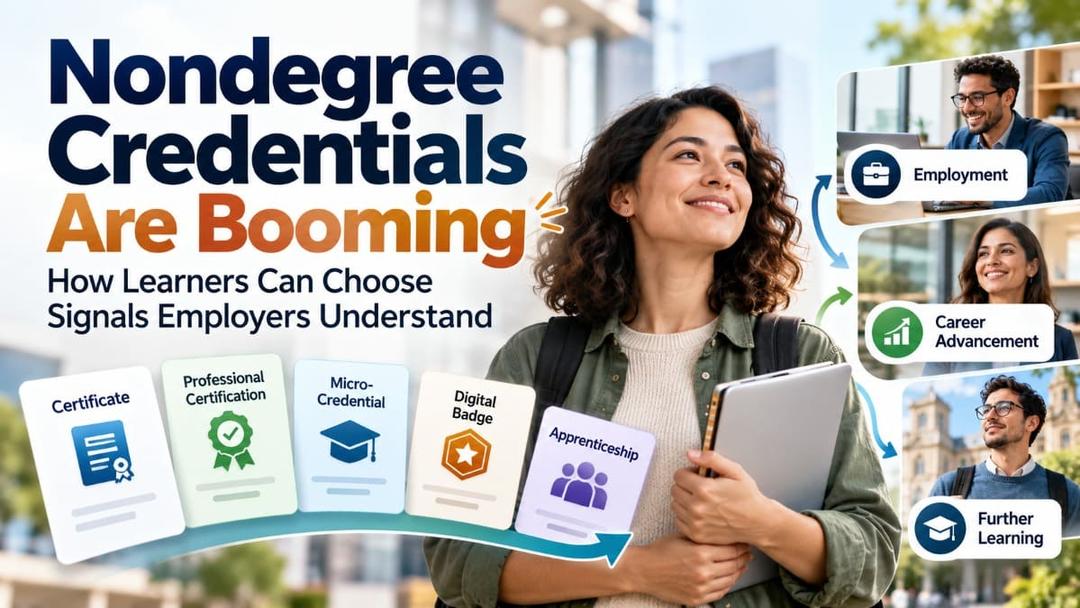
question explored in Nondegree
Credentials Are Booming: How Learners Can Choose Signals Employers Understand.
Once learners and employers begin evaluating credentials as signals, providers
have to decide what information those signals actually contain.
What Evidence Should Sit Behind a Badge or Certificate?
A useful credential can be thought of as a claim
supported by context and evidence.
The claim might be modest: this learner completed a
workplace safety orientation. Or it might be stronger: this learner
demonstrated the ability to perform a defined safety inspection according to
specified criteria. Those claims should not be documented in the same way
because the second one requires substantially more evidence.
A practical transparency framework includes several layers.
|
Credential Element |
Question It Should Answer |
Example |
|
Credential title |
What achievement is being recognized? |
Introductory SQL Querying |
|
Issuer |
Who is making the claim? |
Training provider, university, professional body, employer |
|
Learning outcomes or competencies |
What should the learner know or be able to do? |
Write basic SELECT, JOIN, and aggregate queries |
|
Earning criteria |
What had to happen before the credential was awarded? |
Complete required lessons and pass practical assessment |
|
Assessment method |
How was achievement evaluated? |
Timed practical task using a sample database |
|
Performance threshold |
What counted as successful performance? |
Meets defined rubric criteria or minimum assessment score |
|
Evidence |
What demonstrates the achievement? |
Assessed project, portfolio item, evaluator record, or
evidence reference |
|
Issue and validity information |
When was it awarded and is it still current? |
Issue date, expiry date, renewal where applicable |
|
Verification |
Can the credential's authenticity be checked? |
Signed digital credential or verifiable credential record |
|
Alignment and pathway context |
How does this achievement connect elsewhere? |
Occupational framework, advanced credential, course
sequence |
Not every credential needs every element. A participation
badge for a community webinar does not need the same assessment architecture as
an occupational credential. Transparency works best when the provider first
decides what the credential is allowed to claim.
The European Union's 2022 Recommendation on
micro-credentials provides a useful example of structured disclosure. Its
recommended standard elements include learner identification, credential title,
issuer location, awarding body, issue date, learning outcomes, workload,
applicable qualification level, assessment type, participation format, and
quality assurance. Optional information can include assessment supervision,
grades, prerequisites, and stackability.
The significance is not that every training provider
globally should copy the European model. The larger lesson is that a credential
becomes easier to interpret when important attributes are explicit rather than
hidden inside a course page that may later disappear.
Learning Outcomes Define the Claim
A vague credential frequently begins with vague learning
outcomes.
“Understands leadership,” “knows digital marketing,” or “has
AI skills” may work as promotional language, but they are weak evidence
statements. An employer or another training provider cannot tell what
observable performance sits behind them.
More useful outcomes describe something that can be
interpreted or assessed: analyze campaign performance using defined metrics,
configure a particular workflow, conduct a structured customer interview,
identify workplace hazards using an inspection checklist, or produce a
compliant report.
The skill does not need to be narrow, but the credential
should make clear what has actually been recognized.
Assessment Explains How the Claim Was Tested
Learning content and assessment answer different questions.
Content tells us what the learner encountered. Assessment
tells us what the provider attempted to evaluate.
That distinction is especially important for short-form
learning. A learner may complete a microlearning sequence on workplace
communication, for example, but watching short lessons does not by itself
establish that the learner can manage a difficult conversation. If the
credential claims applied capability, the assessment needs to address applied
capability.
Depending on the learning objective, that might involve a
scenario, project, simulation, demonstration, structured observation,
portfolio, oral assessment, knowledge test, or combination of methods.
The 2022 European framework similarly treats learning
outcomes and assessment as separate elements, while OECD analysis in 2026
emphasizes that micro-credentials become easier to interpret when skills
acquired, assessment methods, workload, and awarding-body credibility are
clear.
Evidence Shows What Happened During Assessment
Evidence is the layer that makes a credential claim
inspectable.
In Open Badges 3.0, credentials can include information
about the criteria for an achievement and evidence describing the work a
recipient performed to earn it. An achievement can also be aligned to skills or
other frameworks, giving the credential additional context.
Evidence does not always need to mean publishing someone's
full work publicly. In a design portfolio, the artifact itself may be useful
evidence. For a confidential corporate program, the appropriate evidence might
instead be an assessment record, evaluator result, rubric outcome, or
controlled-access reference.
That distinction matters operationally. Providers should not
interpret transparency as an instruction to expose personal information,
employer-confidential material, assessment answers, or sensitive learner
records. The goal is to make the credential interpretable while applying
appropriate privacy and access controls.
The badge is the visible layer. Its value depends on the information and evidence that remain accessible behind it.

Verification, Validation, and Quality Are Different
One of the most important distinctions in digital
credentials is also one of the easiest to miss: a credential can be
authentic without necessarily being useful, rigorous, or relevant.
Open Badges 3.0 makes this distinction explicit. In the
specification, verification concerns whether the credential is an authentic and
timely statement from its issuer—for example, whether its cryptographic proof
is valid and the credential has not been tampered with. Verification does not
establish that every claim contained in the credential is true or that the
credential is valuable for a particular employment decision.
That creates several separate trust questions.
|
Question |
Concept |
What It Establishes |
|
Was this credential actually issued by the claimed issuer
and left unaltered? |
Verification |
Authenticity and integrity |
|
Does the credential contain enough information for its
intended use? |
Validation / interpretation |
Fitness for a particular verifier or decision |
|
Was the learning and assessment designed to an appropriate
standard? |
Quality assurance |
Confidence in the underlying credentialing process |
|
Does this credential matter for this job, occupation, or
pathway? |
Recognition / relevance |
Contextual value to an employer or institution |
A digitally signed badge therefore solves an important
problem, but only one problem.
Imagine a badge that can be cryptographically verified but
says only Advanced Leadership Skills. The issuer is authentic, the
credential has not been altered, and the learner genuinely received it. Yet an
employer still does not know what leadership behaviors were assessed—or whether
anything was assessed at all.
Conversely, a provider may run an excellent practical
assessment but issue only a static PDF that is difficult to verify later. The
learning evidence may be strong while the credential infrastructure is weak.
Good credential design addresses both sides.
Authenticity answers, “Is this record real?” Evidence
answers, “What supports the claim?” Quality asks, “Can we trust the process?”
Recognition asks, “Does this matter here?”
This distinction also prevents providers from treating
blockchain, cryptographic signatures, QR codes, or any other verification
technology as a substitute for instructional and assessment design. Technology
can help protect and transport a claim. It cannot determine whether the claim
was meaningful in the first place.
FitAcademy
Connect Learning, Assessment, and Credentials Under Your Own Brand
A transparent credential experience starts before certificate generation. FitAcademy helps training providers and institutions manage branded learning delivery, learner progress, assessment, and credential workflows within their own white-label learning environment.
Explore FitAcademy White LabelHow Providers Can Build Transparent Credential Workflows
Credential transparency is partly a data-design problem, but
it begins as a learning-design problem.
A provider cannot create a meaningful credential record if
the program itself has never defined what learners are expected to demonstrate.
The operational sequence therefore needs to run from intended capability to
learning, assessment, evidence, and credential—not from certificate design
backward.
A practical workflow can follow seven stages:
- Define
the purpose of the credential. Decide whether it recognizes
participation, completion, knowledge, competency, authorization,
professional achievement, or another outcome. This decision sets the
ceiling for what the credential should claim.
- Write
observable learning outcomes or competencies. Describe what successful
learners should know or be able to demonstrate rather than relying on
broad course themes.
- Map
learning activities to those outcomes. Each important credential claim
should have a plausible learning pathway behind it. Providers should be
able to explain how participants had an opportunity to build the
capability being recognized.
- Design
assessment appropriate to the claim. Knowledge may be evaluated
differently from practical performance, communication skill, technical
execution, or workplace behavior. A convenient quiz should not
automatically become the assessment simply because the learning platform
can generate one.
- Capture
evidence and assessment results. Determine what records need to
persist: scores, evaluator decisions, project submissions, rubric levels,
observation records, or other evidence. Decide what learners can access
and what third parties may see.
- Generate
the credential from structured data. Credential title, issuer, issue
date, criteria, assessed capabilities, and verification information should
come from controlled records wherever possible rather than being rewritten
manually for every cohort.
- Maintain
the credential after issuance. Some credentials require expiry,
renewal, revocation, corrections, or updated links. Long-term credibility
depends on maintaining the record after the learner has left the course.
The workflow does not require every provider to implement an
international credential standard immediately. A small training organization
can make substantial progress simply by standardizing learning outcomes,
assessment records, credential descriptions, and verification pages.
What matters is that the information remains coherent.

Structured Data Matters as Programs Scale
Manual credentialing tends to look manageable at small
scale. A trainer finishes a cohort, exports the names, edits a certificate
template, creates PDFs, and emails them to participants.
Problems appear when the program grows.
Different administrators may use different credential names.
Learning outcomes can be revised without updating certificate descriptions.
Assessment criteria may change between cohorts. Old verification links
disappear. A learner's name may be corrected in one system but not another.
Credential evidence becomes disconnected from the course record that produced
it.
Structured credential data reduces this drift.
Credential Engine's CTDL illustrates the broader potential
of structured descriptions. Its schema can describe not only credentials but
also competencies, assessments, learning opportunities, pathways, transfer
relationships, employment outcomes, and other connected information, allowing
credentials to be understood by systems as data rather than only displayed as
documents.
A provider does not need to implement CTDL to learn from the
principle. The important operational idea is that the underlying credential
attributes should be managed as structured information rather than hidden in a
visual certificate.
The Learning Platform Should Preserve the Evidence Chain
For credential-bearing programs, the learning platform can
become part of the evidence infrastructure.
The useful connection is:
learner → enrollment → learning activities → assessment →
result → credential
If those records are scattered across spreadsheets, quiz
tools, email, certificate generators, and separate file storage, the provider
has more reconciliation work whenever a credential needs to be checked.
An institutional learning
infrastructure can help centralize parts of that workflow, particularly
learner identity, enrollment, course completion, assessments, progress records,
and certificate issuance. But platform capability should not be confused with
credential quality. A system can reliably issue a poorly designed credential
just as efficiently as a well-designed one.
The provider remains responsible for deciding what the
credential means.
That becomes particularly important when programs are used
to recognize skills
developed through workshops and non-formal learning. The more informal the
original learning environment, the more deliberately providers may need to
document assessment and evidence if the eventual credential is intended to
travel beyond the original community.

Common Mistakes in Credential Design
Treating the Certificate Design as the Credential
Providers often spend time on logo placement, signatures,
borders, colors, and visual prestige while the actual credential contains
almost no usable information. Design matters because learners need something
professional they feel comfortable sharing, but presentation should sit on top
of structured credential information rather than replace it. A visually
impressive document cannot explain an undefined learning outcome or an absent
assessment.
Using Skill Labels That Are Broader Than the Assessment
A two-hour course may legitimately introduce project
management principles, but that does not automatically justify a credential
claiming “Project Management Professional Skills.” The more ambitious the
label, the more likely an employer is to infer capabilities the program may
never have evaluated. Providers should keep credential wording aligned with the
scope and depth of the actual learning and assessment.
Assuming a Verification Link Solves Transparency
A QR code that opens a page saying “This certificate is
valid” establishes authenticity but little else. A more useful verification
record can also show what the credential represents, who issued it, when it was
awarded, what requirements applied, and—where appropriate—what competencies or
assessments support it. Verification should be a doorway into meaningful
information, not the end of the information architecture.
Publishing Evidence Without Considering Privacy
More evidence is not always better. Student projects may
contain proprietary employer information, personal data, client details,
assessment answers, or material the learner never intended to publish.
Credential transparency therefore requires decisions about which evidence
should be public, summarized, access-controlled, or retained only for internal
audit purposes. Trust can be damaged by excessive disclosure just as easily as
by insufficient information.
Changing the Program Without Updating the Credential
Credentials are often treated as static templates while the
training program continues to evolve. If assessments, learning outcomes,
instructors, competency frameworks, or course requirements change materially,
the provider needs a way to know which version of the credential each learner
earned. Otherwise two people holding an identically titled credential may have
completed meaningfully different requirements.
This is one reason stackable
credentials and short learning pathways require more than a sequence of
badge graphics. If credentials are expected to build toward larger goals, the
relationships among outcomes, levels, prerequisites, and subsequent learning
opportunities need to remain understandable.
Transparent credentials make their boundaries visible: what was demonstrated, what was not, and what evidence supports the distinction.
FAQ
What is credential transparency?
Credential transparency means making reliable information
about a credential understandable and accessible. That can include the issuing
organization, learning outcomes, competencies, earning criteria, assessment
method, evidence, dates, quality assurance, and pathway relationships. The
exact information needed depends on what the credential claims and who needs to
interpret it.
Is a digital badge better than a PDF certificate?
Not automatically. A standards-based digital badge can carry
richer structured metadata and support verification, portability, skills
alignment, and evidence in ways that a basic PDF often cannot. However, the
badge is only as meaningful as the achievement and assessment behind it. A
poorly defined digital badge does not become a high-quality credential merely
because it uses advanced technology.
What information should a certificate verification page show?
At minimum, it should allow the verifier to confirm the
learner, credential title, issuer, and issuance information. For credentials
making stronger competency claims, the page can also describe learning
outcomes, earning criteria, assessment type, applicable validity, and relevant
evidence or evidence summaries. The appropriate level depends on privacy
requirements and the purpose of the credential.
Does a verifiable credential prove that someone has the skill?
Not by itself. Technical verification establishes that the
credential is an authentic statement from the issuer and has not been
improperly altered. The verifier still needs to evaluate what the issuer
claimed, how the skill was assessed, and whether that evidence is sufficient
for the intended decision. Open Badges explicitly distinguishes credential
verification from broader validation of its usefulness.
Does every short course need a digital badge?
No. Credential design should follow the purpose of the
learning. Some short activities may only need a completion record, while others
benefit from an evidence-rich badge or certificate because learners need to
communicate assessed skills elsewhere. Creating a badge for every learning
interaction can increase credential noise without increasing useful evidence.
Can small training providers create credible credentials?
Yes, but credibility does not come from size alone. Smaller
providers can improve transparency by defining narrow and realistic credential
claims, documenting learning outcomes, using appropriate assessment,
maintaining consistent learner records, and providing reliable verification.
Industry partnerships, quality assurance, recognized standards, and structured
credential data can strengthen the signal further when appropriate.
Conclusion
Badges and certificates are becoming easier to generate.
Meaningful credentials are not.
The difficult work happens before the credential is issued:
deciding exactly what the provider is claiming, defining the learning outcomes
behind that claim, designing appropriate assessment, recording what happened,
and deciding what evidence another person should be able to inspect.
Standards such as Open Badges 3.0 show how digital
credentials can package achievement information, criteria, evidence, issuer
details, and verification in a portable structure. Credential Engine
demonstrates how structured credential data can connect qualifications with
competencies, assessments, pathways, and employment information. The European
framework for micro-credentials similarly places transparency, assessment,
quality assurance, and comparability at the center of credential design.
The common principle is simple: a credential should make
its meaning easier to inspect, not require the recipient to explain everything
from scratch.
For learners, that makes achievements easier to communicate.
For employers and education providers, it reduces interpretation friction. For
training organizations, it changes credentialing from a certificate-generation
task into a structured part of learning operations.
As short-form learning continues to expand, that difference
will matter. The providers that issue the most badges will not necessarily
create the strongest signals. The more durable advantage is likely to belong to
programs whose credentials explain clearly what happened, what was
demonstrated, and what evidence supports the claim.
FitAcademy
Build Credential Experiences Around the Learning Evidence
FitAcademy provides white-label learning infrastructure for institutions and training providers that want to manage branded learning journeys, assessments, learner progress, and credential experiences in one environment. Build the learning operation first, then make the achievement easier to communicate.
Explore FitAcademy White Label