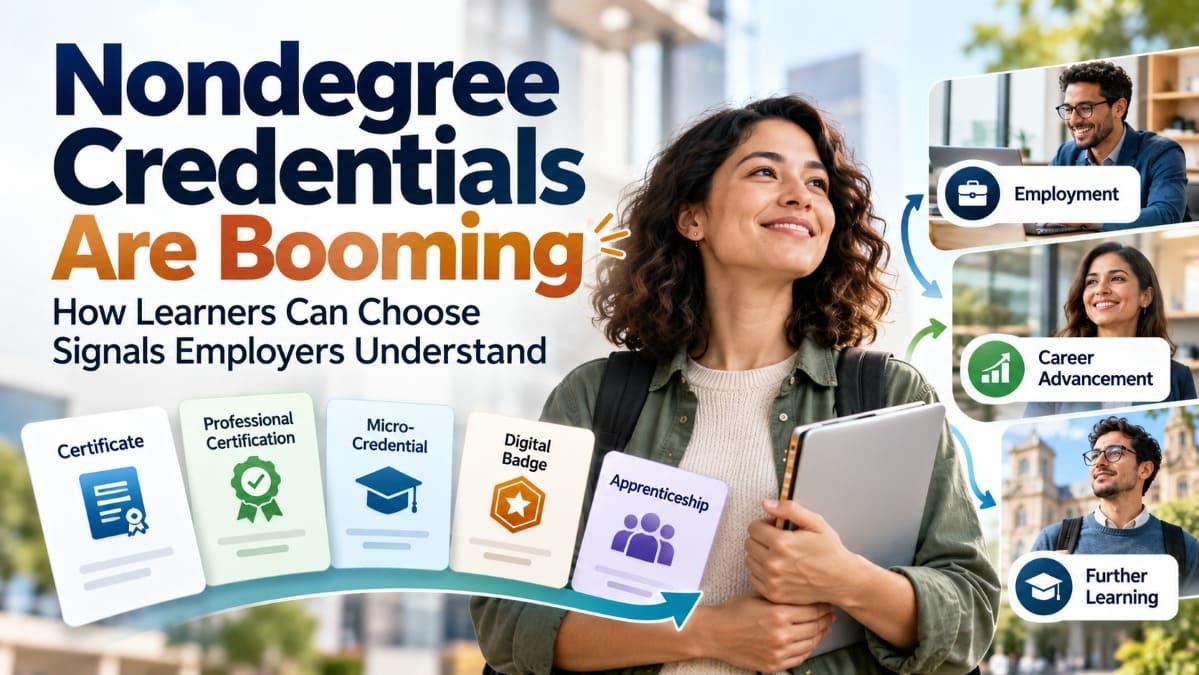
Nondegree credentials are expanding quickly across workforce
training, adult education, professional development, and online learning.
Certificates, certifications, micro-credentials, digital badges,
apprenticeships, and other short-form credentials can help people document
skills without committing to a full degree program. But abundance creates a new
problem: employers do not automatically understand what every credential
represents.
For learners, the useful question is therefore not simply,
“Will I receive a certificate?” It is, “What will this credential allow an
employer to infer about my skills?” Stronger signals tend to make the learning
outcomes, assessment method, issuer, industry relevance, and verification
process clear.
For training providers and career advisors, this shift has
an operational implication too. Learning programs increasingly need to connect
instruction, assessment, evidence, and credential issuance rather than treating
the certificate as an administrative document added at the end.
- Quick
Answer
- Why
Nondegree Credentials Are Expanding So Quickly
- A
Credential Is Not Automatically a Strong Employer Signal
- What
Makes a Credential Easier for Employers to Understand?
- How
Learners Can Evaluate a Credential Before Enrolling
- Different
Credentials Signal Different Things
- What
Training Providers and Career Advisors Should Change
- Common
Mistakes When Choosing Nondegree Credentials
- FAQ
- Conclusion
Quick Answer
Nondegree credentials are records of learning, competency,
qualification, or authorization earned outside a conventional degree pathway.
Depending on the system and provider, they can include certificates,
professional certifications, licenses, apprenticeships, micro-credentials, and
digital badges. The terminology is not perfectly standardized across countries,
industries, or providers, so the credential name alone rarely tells the whole
story.
Their growth gives adult learners more ways to upskill,
reskill, document existing capabilities, or pursue occupation-specific
preparation. The challenge is that employers must interpret an increasingly
crowded credential market. Credential Engine counted about 1.85 million unique
credentials in the United States in its 2025 landscape, including more than one
million badges and hundreds of thousands of certificates. Meanwhile, an OECD
review published in October 2026 describes rapidly expanding micro-credential
provision internationally while warning that fragmented definitions, uneven
quality assurance, and weak links to labor-market needs can make recognition
difficult.
For learners, the best credential is therefore not
necessarily the shortest, most fashionable, or most visually impressive. A
stronger choice is one whose skills, assessment, issuer, relevance, and
evidence can be understood by the people making employment decisions.
Why Nondegree Credentials Are Expanding So Quickly
Short-form credentials address a practical constraint in
adult learning: many workers need targeted learning without returning to a
multi-year education program. A technician may need a new technical competency.
A supervisor may need an updated compliance qualification. Someone changing
careers may need enough evidence to compete for an entry-level role without
starting an entirely new degree.
Digital learning has also made smaller units of education
easier to distribute. Universities, professional associations, technology
companies, employers, workforce agencies, private training providers, and
community organizations can now deliver learning at very different scales and
price points.
The resulting credential ecosystem is enormous. Credential
Engine's 2025 count identified 1,850,034 unique credentials across seven broad
categories in the United States alone. The report counted 1,022,028 badges and
486,352 certificates alongside certifications, occupational licenses, degrees,
diplomas, and other credential categories.
The development is not limited to the United States. The
OECD's October 2026 review describes micro-credentials as gaining traction
internationally for upskilling, reskilling, and lifelong learning. At the same
time, it finds that multiple definitions, inconsistent frameworks, limited
quality assurance, and weak labor-market connections can hinder recognition.
Policy is reinforcing the shift in some markets. In the
United States, for example, Workforce Pell eligibility took effect in 2026 for
approved short-term workforce programs meeting specified requirements. By
September 2026, the U.S. Department of Education had begun approving programs
in fields such as emergency medical services, healthcare, machining, electrical
power, and HVAC.
None of this means degrees are disappearing. Recent
Georgetown University research continues to find substantial labor-market value
associated with bachelor's degrees, although outcomes vary considerably by
field. Nondegree learning should therefore be understood as an expanding part
of the credential ecosystem—not as a universal substitute for higher education.

The expansion of credentials improves access to learning,
but it also transfers more evaluation work to learners and employers. More
choice only creates value when people can distinguish meaningful signals from
weak ones.
A Credential Is Not Automatically a Strong Employer Signal
A credential becomes useful in hiring when it reduces
uncertainty.
Imagine two applicants listing short courses in data
analysis. One resume says:
“Advanced Data Analytics Certificate.”
The other credential clearly states that the learner was
assessed on spreadsheet analysis, SQL queries, data cleaning, dashboard
interpretation, and a final applied project, with the credential issued by an
identifiable provider and digitally verifiable.
The second description gives the employer substantially more
information. The difference is not graphic design or certificate prestige
alone. It is evidence.
This distinction matters because employers are also
navigating credential overload. SHRM's 2025 research found that 24% of HR
professionals, 26% of HR executives, and 33% of supervisors surveyed said
determining the quality of skills obtained through skilled credentials was too
difficult. The same research found that quality verification materially
influenced whether employers considered credentials during hiring.
That tension explains why a credential can be legitimate yet
still have limited signaling power. The learner may genuinely have completed
the program, but an employer reviewing hundreds of applications may still be
unable to answer basic questions: What did the person learn? How rigorously was
it assessed? Is the skill relevant to this job? Does the credential expire? Who
recognizes it?
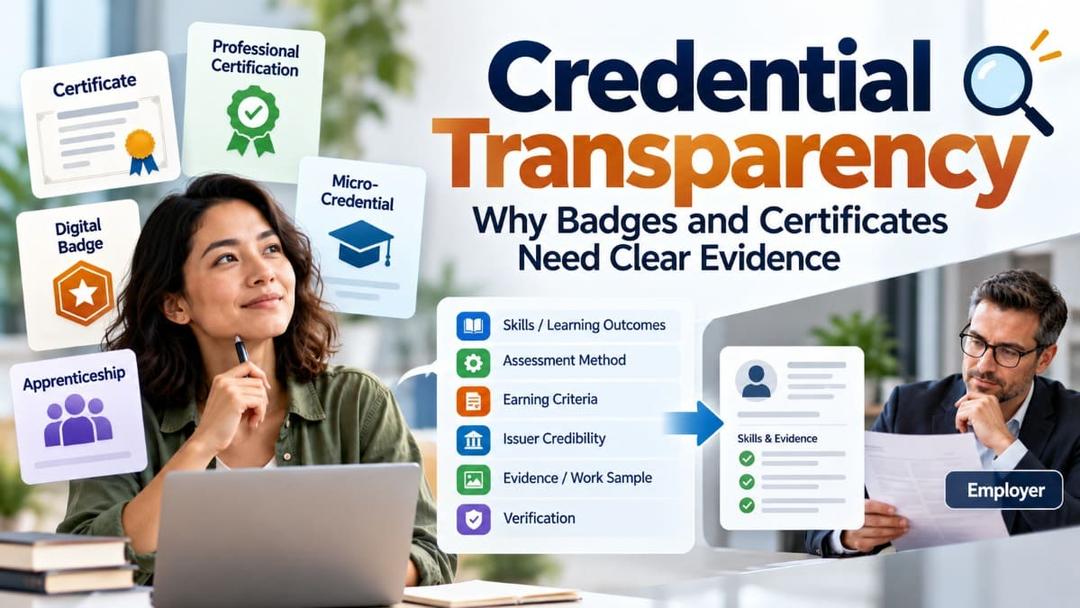
A certificate confirms something happened. A strong credential helps another person understand what the learner can actually do.
This is also why credential
transparency matters for badges and certificates. Issuing more credentials
without improving the information attached to them can simply increase the
noise employers need to interpret.
What Makes a Credential Easier for Employers to Understand?
Employer recognition is not controlled by one universal
checklist. Different industries use credentials differently, and regulated
occupations may have requirements that do not apply elsewhere. Still, several
characteristics consistently make a credential easier to interpret.
|
Signal |
What an Employer Needs to Understand |
Stronger Evidence |
|
Skill specificity |
What can this person do? |
Clearly stated competencies or learning outcomes |
|
Assessment |
Was the skill actually evaluated? |
Exam, practical task, portfolio, simulation, observed
practice, or other defined assessment |
|
Issuer credibility |
Who stands behind the credential? |
Identifiable provider, professional body, employer,
institution, or accredited credentialing organization |
|
Job relevance |
Does this capability matter for the role? |
Alignment with current occupational tasks, standards, or
employer requirements |
|
Verification |
Can the claim be checked? |
Verifiable digital record, registry, credential ID, or
authenticated certificate |
|
Currency |
Is the knowledge still current? |
Issue date, expiry or renewal requirements where relevant |
|
Progression |
Does it connect to a larger pathway? |
Credit, stackability, advanced certification,
apprenticeship, or career progression |
The European Union's approach to micro-credentials
illustrates the same logic. Its framework emphasizes information such as
learning outcomes, workload, assessment, level, quality assurance, issuer
identity, and portability so that credentials can be more easily understood and
compared.
Workcred similarly recommends examining whether industry
participated in credential development, whether assessments measure learning
outcomes, whether certifications relate to recognized occupations, and whether
third-party standards or accreditation apply where appropriate.
These frameworks should not be interpreted as saying every
short course requires formal accreditation. A two-hour internal safety
refresher and an occupation-level professional certification serve completely
different purposes. The standard of evidence should match the claim being made.

How Learners Can Evaluate a Credential Before Enrolling
A learner should evaluate the signal before buying the
learning.
Course descriptions naturally focus on curriculum,
convenience, instructors, price, duration, and learner experience. Those
factors matter, but anyone pursuing a credential primarily for employment
should investigate what will remain after the course is completed.
A practical evaluation can begin with six questions:
- What
specific capability will the credential represent? Look beyond broad
labels such as “AI skills,” “leadership,” or “digital marketing.” The
provider should explain what successful learners are expected to know or
perform.
- How
is mastery assessed? Watching videos and completing attendance
requirements demonstrate participation, not necessarily competence.
Determine whether the program includes quizzes, applied assignments,
examinations, projects, observed practice, portfolios, simulations, or another
meaningful assessment.
- Who
issues the credential, and why would the target employer recognize that
issuer? Recognition may come from institutional reputation,
professional standards, employer partnerships, regulatory status, industry
involvement, or established use within a particular occupation.
- Can
you find evidence that the credential is relevant to actual roles?
Search job descriptions, professional association requirements, employer
career pages, and conversations with practitioners. A credential
frequently mentioned in one occupation may carry little meaning in
another.
- Can
the credential be verified and explained? Employers should be able to
identify the issuer and understand what was required to earn it. Digital
verification can help, but verification of authenticity is different from
proof of labor-market value.
- Does
the credential advance your next step? For some learners, the goal is
immediate employment. Others need promotion, entry into further training,
credit toward another qualification, or documentation of competencies
already used at work.
The National Skills Coalition's quality framework uses a
related but system-level perspective: strong nondegree credentials should be
associated with substantial job opportunities, transparent evidence of
competencies, and evidence about employment and earnings outcomes, with
stackability considered highly desirable.
Outcome data will not always be available, especially for
new or small programs. Workcred notes that credential outcome information
remains fragmented and incomplete. When good outcome evidence is missing,
learners should not automatically conclude that a program is poor—but they
should distinguish between a provider's marketing claim and independently
verifiable evidence.
A useful credential decision starts with the job or
progression goal and works backward. Starting with an attractive course and
only later asking where the credential is recognized reverses the logic.
FitAcademy
Turn Short-Form Learning Into a Branded Credential Experience
Training providers need more than a certificate template. A branded learning environment can connect course delivery, learner progress, assessment, and credential issuance into one clearer experience. FitAcademy provides white-label learning infrastructure for organizations building their own training programs and learner journeys.
Explore FitAcademy White LabelDifferent Credentials Signal Different Things
One source of confusion is the tendency to use certificate,
certification, badge, and micro-credential as if they were
interchangeable.
They are not.
Terminology still varies internationally, but learners
should at minimum understand the function a credential is intended to perform.
|
Credential Type |
What It Commonly Signals |
What Learners Should Verify |
|
Certificate of completion |
Completion of a course or program |
Whether learning was assessed or only participation
recorded |
|
Assessment-based certificate |
Completion plus achievement of defined learning outcomes |
Assessment rigor, competencies measured, and issuer |
|
Professional certification |
Competency against standards defined by a certification
body |
Industry recognition, assessment validity, renewal, and
accreditation where applicable |
|
Occupational license |
Legal authorization to perform regulated work |
Jurisdiction, statutory requirements, renewal conditions |
|
Digital badge |
Digital representation of an achievement |
Criteria, issuer, metadata, evidence, and verification |
|
Micro-credential |
Assessed learning from a relatively small learning
experience |
Learning outcomes, assessment, quality assurance,
recognition, and stackability |
|
Apprenticeship credential |
Completion of structured learning combined with work-based
preparation |
Employer/industry recognition and applicable regulatory
framework |
The distinction between a training certificate and a
certification is particularly important. A certificate may be awarded by the
organization that provides instruction after a learner completes a course. A
professional certification typically involves a credentialing body evaluating
whether an individual meets defined competency requirements. Workcred
specifically distinguishes the quality considerations that apply to
certificates from those applying to certifications.
A badge introduces another layer. A digital badge can
contain useful evidence about the issuer, criteria, achievement, and underlying
competency, but a badge can also represent something as lightweight as
participation. Its visual appearance tells the employer very little unless the
accompanying evidence is accessible.
Micro-credentials are similarly diverse. The European
approach defines them around assessed learning outcomes from a small volume of
learning and emphasizes transparency, quality assurance, portability, and the
possibility of combining them into larger credentials.
This variation makes the title of a credential less
informative than many learners assume.

What Training Providers and Career Advisors Should Change
The credential boom changes responsibilities on the supply
side as well.
For training providers, issuing a PDF certificate with the
learner's name, course title, and completion date may be adequate when the
purpose is simply to acknowledge participation. It becomes insufficient when
the provider wants employers to infer competency from it.
Programs intended to carry stronger workforce value should
begin by defining what the learner will be able to demonstrate at completion.
Assessment should then be designed around those outcomes, and the credential
should accurately describe what was assessed rather than implying capabilities
the program never measured.
Employer involvement can also strengthen relevance. The
OECD's 2026 review notes that micro-credentials developed using skills
intelligence or co-developed and endorsed by industry can have stronger
labor-market credibility and uptake. It also stresses that employer recognition
is essential if micro-credentials are intended to improve employability rather
than simply expand course participation.
This does not mean providers need an employer advisory board
for every three-minute learning module. The appropriate governance depends on
the credential's stakes. A short internal orientation badge and a credential
presented as evidence of occupational readiness require very different levels
of validation.
Career advisors have a corresponding role. Advising someone
to “get a certificate in cybersecurity” or “take an AI course” is increasingly
too broad. A more useful conversation connects the learner's desired role to
observable employer requirements, current capabilities, skill gaps, possible
credentials, cost, duration, and alternative ways of demonstrating competence.
For learners who have completed informal workshops or
community-based training, the next challenge is often converting learning into
evidence. That practical process is explored further in From
Workshop to Work: How to Turn Non-Formal Learning Into Demonstrable Skills.
For providers, learning technology can support this process
when it connects enrollment, structured content, assessments, learner records,
progress tracking, and credential issuance. The platform does not determine
whether a credential has labor-market value; that still depends on program
design, evidence, quality, and recognition. But appropriate learning infrastructure for branded training
programs can make those processes more consistent as programs scale.

Common Mistakes When Choosing Nondegree Credentials
Choosing the Most Recognizable Course Brand Without Checking Role Relevance
A famous provider can reduce uncertainty about who issued
the credential, but issuer recognition does not guarantee that a particular
credential matters for a particular job. A learner considering an
occupation-specific credential should still investigate whether employers in
that role reference it, recognize its competencies, or use similar standards in
recruitment and advancement.
Treating Course Completion as Proof of Competence
Completion is meaningful when completion itself is the
relevant requirement. It is weaker when the credential is presented as evidence
that someone can perform a skill but the program never assessed that skill.
Learners should ask what successful completion actually required, while
providers should avoid making competency claims that go beyond their assessment
design.
Collecting Credentials Without a Career Logic
Because short programs are easier to access, learners can
accumulate unrelated badges and certificates without building a coherent
capability profile. A smaller set of credentials connected to a target
occupation, portfolio, work experience, or larger learning pathway may provide
a clearer story. The next article in this cluster will examine how stackable
credentials can build toward larger career goals.
Assuming Digital Verification Means Employer Recognition
Verification answers an authenticity question: Was this
credential really issued to this person? Recognition answers a different
question: Does the credential represent something useful for this employment
decision? A technically sophisticated digital credential can still have
weak labor-market value if its competencies, assessment, or relevance are
unclear.
Expecting One Credential to Replace Every Other Signal
Hiring decisions frequently combine education, work history,
interviews, assessments, licenses, portfolios, references, and other evidence.
Nondegree credentials can strengthen that evidence mix, but their importance
differs considerably by occupation and employer. Learners should be skeptical
of programs promising that a single short credential will automatically produce
employment.
Credential value is contextual: the right signal is the one relevant employers can interpret at the moment a decision is being made.
FAQ
Are nondegree credentials worth getting?
They can be, particularly when they document competencies
that are relevant to a specific occupation, advancement opportunity, or further
learning pathway. Value varies substantially by credential, industry, provider,
assessment quality, geography, and employer recognition. Learners should
therefore evaluate the specific credential rather than assuming all
certificates or badges have similar labor-market value.
Do employers recognize online certificates?
Some do, but recognition depends more on what the
certificate represents than on whether the learning occurred online. Employers
may consider the issuer, skills covered, assessment method, industry relevance,
and evidence of application. An online credential with rigorous assessment can
potentially provide a stronger signal than an in-person course that records
attendance only.
What is the difference between a certificate and a certification?
A certificate commonly indicates completion of an education
or training program, sometimes with assessment. A professional certification
typically indicates that a separate credentialing process has determined an
individual meets specified competency standards. Terminology can vary, so
learners should investigate the issuing body and requirements rather than
relying only on the credential's name.
Are micro-credentials recognized by employers?
Recognition is uneven. OECD research published in 2026 found
growing international use of micro-credentials but also significant challenges
around fragmented definitions, quality assurance, and connections to
labor-market needs. Employer recognition tends to be stronger when the
credential has a clear purpose, credible issuer, defined competencies,
meaningful assessment, and direct relevance to occupational needs.
Should I choose a credential because it is stackable?
Stackability can be valuable when a short credential
contributes to a larger qualification, advanced certification, career pathway,
or additional education. It should not be the only criterion. A stackable
credential with weak employment relevance may still provide limited immediate
value, while a specialized standalone certification can be highly useful in
occupations where employers already recognize it.
Will nondegree credentials replace college degrees?
There is no strong basis for treating nondegree credentials
as a universal replacement for degrees. They serve different purposes and
increasingly coexist. Some occupations accept alternative pathways, while
others require degrees or regulated qualifications. Georgetown University's
recent U.S. analysis continues to find significant average labor-market
advantages associated with bachelor's degrees, although outcomes vary widely by
major and occupation.
Conclusion
The growth of nondegree credentials gives adult learners
something the traditional education system has often struggled to provide: more
granular ways to learn, document skills, change direction, and continue
developing throughout a career.
But granularity creates complexity. When millions of
credentials exist, possessing a credential is less informative than
understanding exactly what that credential communicates.
For learners, the strongest starting point is a career
objective rather than a course catalog. Identify the capability an employer
needs, determine how that capability can be demonstrated, and then evaluate
credentials against that requirement. Provider reputation matters, but so do
assessment, industry relevance, verification, transparency, and evidence of
outcomes.
For training providers, the implication is equally
important. The certificate should not be the final decorative layer added after
course completion. When a program is intended to support workforce progression,
credential design begins much earlier—with learning outcomes, assessment,
evidence, and a realistic understanding of what employers will recognize.
The credential economy is likely to keep expanding. The more
crowded it becomes, the more valuable clear signals will be.
FitAcademy
Build a Branded Learning Experience Around Meaningful Skill Evidence
FitAcademy helps training providers, institutions, and organizations deliver branded learning experiences through white-label learning infrastructure. Build structured learning pathways where course delivery, learner progress, assessment, and credential experiences can be managed under your own brand.
Explore FitAcademy White Label