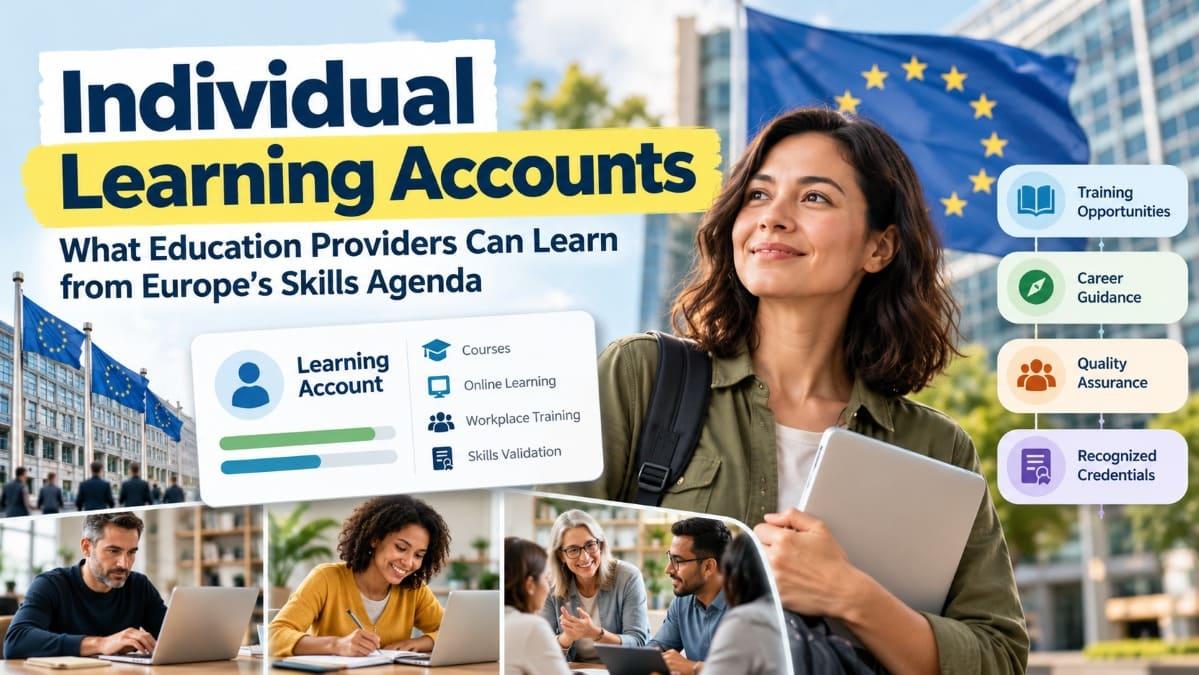
Individual Learning Accounts (ILAs) are an emerging policy
mechanism that gives individuals training entitlements they can use for
eligible learning opportunities rather than tying all adult-learning funding to
a particular employer, institution, or period of unemployment. The European
Union has encouraged Member States to consider ILAs as part of a broader effort
to increase adult participation in learning, support labour-market transitions,
and make upskilling more accessible throughout working life.
For education providers, the important lesson is larger than
the funding mechanism itself. ILA-style systems shift more choice toward
learners while increasing expectations around course discoverability, quality
assurance, transparent outcomes, digital access, and administrative
interoperability. As Europe moves from recommendation toward implementation,
training organizations can study these systems as an early indication of how
publicly supported adult learning may increasingly operate.
- Quick
Answer
- What
Is an Individual Learning Account?
- Why
Europe Is Investing in Learner-Controlled Training Entitlements
- An
ILA Is More Than a Training Voucher
- What
Individual Learning Accounts Change for Education Providers
- What
Providers Outside Europe Can Learn From the ILA Model
- Building
Learning Infrastructure for a More Learner-Directed Market
- Common
Mistakes When Interpreting Individual Learning Accounts
- FAQ
- Conclusion
Quick Answer
An Individual Learning Account is a mechanism through which
a working-age adult receives training entitlements or a learning budget that
can be used for eligible education, training, career guidance, or validation
services. In the European Union's policy framework, the concept is intended to
give individuals more direct control over lifelong learning while reducing
dependence on whether a current employer happens to provide training.
The European Council adopted a recommendation on Individual
Learning Accounts in June 2022. It encouraged Member States to consider
establishing personal training accounts together with an enabling framework
that can include career guidance, validation services, public registries of
approved learning opportunities, and digital portals through which people can
access their entitlements.
Implementation is now moving beyond policy design. In March
2026, the European Commission reported that ILA schemes were planned or being
piloted in about half of EU Member States.
For providers, this matters because learner-directed funding
changes competition. Being able to offer a course is not enough. Programs may
also need clear learning outcomes, credible quality assurance, transparent
pricing, discoverability, appropriate credentials, and systems capable of
supporting individual enrollment at scale.
What Is an Individual Learning Account?
An Individual Learning Account is a mechanism that assigns
training entitlements to an individual so that the person can use those
entitlements for eligible learning opportunities over time. In the European
model, the account is associated with the learner rather than a single employer
or educational institution.
That sounds simple, but the distinction is important.
Much adult training has historically been financed through
institutions, employers, employment programs, or targeted public initiatives.
Under those approaches, a learner may receive training because an employer
purchases it, because a government agency commissions a program, or because the
learner qualifies for a particular intervention.
An ILA introduces a stronger demand-side element. Resources
are allocated in a way that allows the individual to choose among approved
opportunities, within the rules of the scheme.
The Council of the European Union describes ILAs as a means
of providing working-age adults with a training budget that can support
lifelong skills development and employability regardless of whether the
individual is currently employed. The recommendation also envisages
entitlements that can be accumulated and used at an appropriate time.
Cedefop describes the European concept as a delivery
mechanism for individual training entitlements that may fund labour-market-relevant
training, career guidance, or validation opportunities.

The account should therefore not be interpreted merely as a digital wallet containing money. The policy concept also depends on the system surrounding that entitlement: which programs qualify, how learners discover them, what information is available, how providers are approved, how quality is monitored, and what support learners receive when choosing among options.
Individual Learning Accounts move part of adult-learning
purchasing power toward the learner, but that freedom depends on a trusted
system of eligible providers, transparent courses, guidance, and quality
assurance.
There is also no single European ILA implementation model.
The 2022 Council recommendation asks Member States to consider
establishing ILAs rather than requiring every country to build an identical
system. National financing structures, existing training programs, eligibility
rules, provider markets, and labour-market institutions differ substantially.
That variation is already visible in implementation.
Why Europe Is Investing in Learner-Controlled Training Entitlements
The policy rationale begins with a persistent problem in
adult education: the need for workers to continue learning does not guarantee
that they have access to training.
Employer-sponsored learning can work well for people in
organizations with strong learning budgets, but it is unevenly distributed.
Workers in smaller firms, atypical employment, career transitions, or periods
outside employment may have fewer opportunities to access employer-funded
development.
The EU's 2022 recommendation explicitly identified
insufficient financial support and time constraints among the barriers
affecting adult participation in training. It also noted that people in
atypical employment can have weaker access to employer-sponsored learning.
The policy sits within a broader European objective. EU
leaders endorsed a target for at least 60% of adults to participate in training
every year by 2030. ILAs were introduced as one mechanism that could help
expand participation while supporting upskilling and reskilling connected with
digital, green, and labour-market transitions.
This does not mean that financing alone solves adult
learning access. The barriers explored in Removing
Barriers to Adult Learning: Time, Cost, Confidence, and Care Responsibilities
remain relevant even when course fees are subsidized. Someone may possess a
learning entitlement and still lack time, childcare, confidence, suitable local
provision, digital access, or knowledge about which course to choose.
Europe's approach is therefore notable because the
recommendation does not treat the account as an isolated payment instrument.
It pairs financial entitlement with what the Council calls
an enabling framework, including career guidance, skills validation, an
updated public registry of training opportunities, and a national digital
portal through which learners can navigate the system.
Funding can open the door to learning. Guidance, quality, and usable learning infrastructure determine whether people can walk through it.
The policy has also continued to evolve. The European
Commission's Union of Skills agenda now places ILAs within a wider effort to
strengthen skills, competitiveness, workforce mobility, and lifelong learning.
By March 2026, the Commission reported that ILA schemes were planned or being
piloted in roughly half of EU Member States.
That makes the model increasingly relevant to education
providers rather than merely to policymakers.
An ILA Is More Than a Training Voucher
Individual Learning Accounts are often compared with
training vouchers because both can transfer purchasing power to learners. The
resemblance is real, but the European ILA concept is broader.
A conventional voucher may be issued for a specific program,
population, or period. An ILA is intended to support a more persistent
relationship between the individual and lifelong learning, potentially allowing
training entitlements to accumulate and remain available through changes in
employment status.
Cedefop's analysis emphasizes this continuity: training
entitlements can be accumulated and used over time rather than being limited to
a single employer-funded event.
|
Aspect |
Individual Learning Account Model |
Traditional Training Voucher |
|
Primary orientation |
Individual's continuing learning entitlement |
Funding for a defined training intervention |
|
Duration |
May persist or accumulate over time |
Often linked to a specific program or eligibility period |
|
Learner choice |
Usually among approved eligible opportunities |
Choice varies considerably by scheme |
|
Relationship to employment |
Intended to remain relevant across employment situations |
Frequently tied to a specific employment or support
program |
|
Supporting infrastructure |
May include portal, registry, guidance and validation |
Can be simpler and program-specific |
|
Provider participation |
Often requires inclusion in an approved ecosystem |
Depends on voucher rules |
|
Strategic objective |
Support continuing lifelong learning |
Finance a particular training need or policy intervention |
The distinction should not be overstated. National systems
can combine elements of accounts, vouchers, grants, tax incentives, employer
contributions, and publicly funded training. Cedefop's research has found that
existing adult-learning financing arrangements across European countries are
already complex, and new ILA mechanisms need to complement rather than
unnecessarily duplicate established funding channels.
This is one reason implementation is more difficult than
simply allocating a budget to every adult.
Public authorities must decide where the money comes from,
which learning opportunities qualify, whether unused entitlements can
accumulate, how much choice learners receive, how fraud is prevented, how
providers are approved, and how outcomes are monitored.
The European Commission's 2026 implementation guide reflects
that complexity. Drawing on its ILA Mutual Learning Programme from 2023–2025,
the guide specifically addresses sustainable financing, quality assurance,
national portals, and lessons from pilot implementation.

What Individual Learning Accounts Change for Education Providers
From a provider perspective, the most consequential feature
of ILA-style funding is that it can change who makes the purchasing decision.
When governments commission a training program directly, the
provider's primary customer is often an institution. When an employer purchases
workforce training, procurement may be handled centrally by HR or learning and
development teams.
Under a learner-directed entitlement system, public
financing may still fund the education, but individuals exercise more choice
among approved providers.
That can reshape provider strategy in several ways.
Course Discoverability Becomes Part of Access
If learners choose courses from an approved catalogue,
providers must make programs understandable before enrollment.
Course titles, outcomes, duration, prerequisites, delivery
format, assessment requirements, credential type, schedule, and price all
become part of the decision interface.
This may sound like marketing, but it is also an access
issue. Adults should not need expert knowledge of an education system simply to
determine whether a course fits their needs.
A provider whose curriculum is strong but whose course
information is vague may be disadvantaged in a learner-directed environment.
Quality Assurance Becomes a Market-Access Requirement
ILA systems cannot reasonably allow public learning
entitlements to be spent on every course available on the internet.
Governments therefore need mechanisms for determining which
providers and programs are eligible. The details vary by country, but the
European policy discussion consistently connects ILA expansion with registries
of approved learning opportunities and quality assurance.
Recent national experience reinforces this point. Cedefop's
analysis of the Netherlands' discontinued STAP training-budget scheme
identified strict quality assurance for eligible programs and providers as an
important lesson for future ILA design.
France likewise continues to refine quality controls around
publicly supported training. The European Commission's 2025 Education and
Training Monitor notes reforms intended to strengthen quality controls and
address fraud within the French training-provider system.
For providers, this means quality assurance should not be
treated as paperwork added after course creation. Learning outcomes, assessment
design, instructor qualifications where required, learner records, content
review, complaint handling, and evidence of delivery may increasingly influence
eligibility for publicly supported learning ecosystems.
Course Architecture May Need to Become More Modular
Cedefop's analysis suggests that ILA-type financing may be
particularly compatible with relatively short programs or programs delivered at
low intensity over longer periods.
That aligns with the broader short-course
economy for adult learners. Adults using personal learning entitlements may
not always want to commit their entire budget or schedule to a single large
program.
Providers may therefore benefit from designing bounded
courses that can stand alone but also connect to larger pathways.
The important word is connect.
A fragmented catalog of unrelated short courses is not
automatically more useful than one long program. Providers need coherent
progression routes so that a learner completing one course can understand what
additional capability can be built next.
FitAcademy
Turn Modular Training Into a Branded Learning Ecosystem
FitAcademy provides white-label learning infrastructure for organizations that want to organize short courses, learning pathways, learner progress, assessments, and branded training experiences within their own learning environment.
Explore FitAcademy White LabelWhat Providers Outside Europe Can Learn From the ILA Model
The value of studying European Individual Learning Accounts
does not depend on operating inside the European Union.
The broader lessons apply to any market where governments,
foundations, workforce agencies, employers, associations, or other
organizations want to give individuals greater choice over funded learning.
The first lesson is that funding the learner changes
provider incentives.
When funding follows an institution, providers mainly need
to satisfy institutional procurement requirements. When funding follows
individuals, providers must satisfy both the system's eligibility requirements
and the learner's own decision criteria.
That creates a dual responsibility: institutional
credibility and learner relevance.
The second lesson is that catalog design matters.
Public funding can create hundreds or thousands of eligible choices. Without
useful categorization, guidance, and clear program descriptions, the learner
receives financial freedom but also a significant navigation burden.
The third lesson is that short-course quality becomes
strategically important. When small learning experiences can be purchased
individually, providers need discipline around scope. A course should make
clear what competence it develops, what it does not cover, how learning is
assessed, and whether completion contributes toward another pathway or
credential.
The fourth lesson is that learning records need
continuity. If an adult can learn from several providers across different
points in a career, course completion cannot be treated only as a temporary
record within one cohort. Learners, funders, and providers may increasingly
need reliable evidence of what has been completed, assessed, or certified.
The fifth lesson is that public funding mechanisms and
learning platforms solve different problems.
An Individual Learning Account determines who can access
training resources and under what rules. A learning platform manages the actual
learning experience: enrollment, content delivery, progress, assessment,
communication, learner records, and administration.
Confusing those two layers can create poor system design.
An ILA can finance access to learning, but it does not
deliver the learning. Providers still need an operational system capable of
turning entitlement into a usable learner experience.

The distinction matters particularly for workforce boards, community colleges, training organizations, professional associations, and NGOs that may receive public or donor funding while operating their own learning programs.
They may not need to build a national ILA. But they can
still adopt the architecture behind the idea: learner-specific entitlements,
approved course catalogs, flexible enrollment, clear records, progression
pathways, and transparent learning outcomes.
Building Learning Infrastructure for a More Learner-Directed Market
If learner-directed funding expands, education providers
will need systems that can support more individualized participation without
making administration unmanageable.
Consider a provider that historically runs six
employer-sponsored cohorts each year. Each cohort has a fixed start date, one
client organization, and a predefined participant list.
Now imagine that the same provider becomes eligible for a
public learning-account scheme.
Learners may arrive individually rather than as a single
cohort. They may select different courses, start at different times, consume
different amounts of their entitlement, require different forms of support, and
return several months later for another program.
That is a fundamentally different operating model.
The learning infrastructure may need to support:
- individual
and cohort enrollment;
- configurable
course access;
- learner
identity and history;
- modular
learning pathways;
- mobile
and web access;
- assessment
and completion tracking;
- certificate
or credential workflows;
- course
eligibility metadata;
- administrator
and facilitator roles;
- reporting
by program, funding source, or learner segment;
- integration
with external registration, payment, or funding systems where required.
Not every provider will need every capability. A small
community training organization may operate effectively with a relatively
simple system, while a national workforce program may require complex identity
management, reporting, and integrations.
The design principle is more important than the feature
list: learning operations should be able to follow the learner rather than
assuming that every participant belongs permanently to one institutionally
defined cohort.
This is also where branded learning infrastructure becomes
strategically relevant.
A provider participating in a broader skills ecosystem may
still want learners to experience its own identity, curriculum, support
processes, communication, and community. A white-label
learning platform can allow the organization to maintain that branded
learning layer while using an existing technology foundation instead of
developing an entire learning system internally.
This does not replace the public portal or ILA
infrastructure. The layers may serve different purposes.
A national or sector portal might help a learner discover an
eligible program and use training entitlement. The provider's learning
environment might then manage onboarding, modules, assignments, assessments,
facilitator interaction, progress, and completion.
For technology teams, this separation is important because
it encourages interoperability rather than assuming one system must perform
every function.
Common Mistakes When Interpreting Individual Learning Accounts
Mistake 1: Treating ILAs as Free Training for Everyone
The European recommendation does not establish a single
unlimited training budget available identically to every adult across Europe.
It encourages Member States to consider individual learning accounts within
their national contexts, and actual eligibility, entitlement levels, financing,
approved courses, and implementation models vary.
Providers should therefore study the specific rules of any
scheme they intend to participate in rather than assuming that the existence of
an ILA policy automatically creates unrestricted learner purchasing power.
Mistake 2: Assuming More Learner Choice Automatically Produces Better Learning Decisions
Choice can improve autonomy, but it also creates information
demands. Adults may struggle to distinguish between competing programs,
understand credential value, evaluate course quality, or determine which skills
are relevant to their career goals.
This is why the EU framework includes career guidance,
validation, registries, and digital portals alongside training entitlements. A
functioning market requires not merely choice but usable information and
support.
Mistake 3: Focusing on Funding While Ignoring Provider Quality
Demand-side funding can stimulate course supply, but it may
also attract low-quality provision if eligibility standards are weak. Cedefop's
review of European experience specifically highlights the need for quality
assurance and careful interaction with existing funding mechanisms.
Providers should expect publicly funded learning markets to
demand greater documentation of outcomes, delivery standards, instructor or
organizational eligibility, learner records, and program quality rather than
less.
Mistake 4: Building Large Course Libraries Without Clear Outcomes
A funding account is useful only when learners can identify
something worth buying with it. Providers that simply upload a large catalogue
of generic courses may create more choice without creating more value.
Each eligible course should communicate a bounded learning
outcome, intended audience, expected workload, delivery format, assessment
approach, and progression opportunity. This becomes particularly important when
a learner is deciding how to allocate a limited entitlement.
Mistake 5: Assuming the Funding Portal Should Also Be the Learning Platform
Discovery, entitlement administration, and learning delivery
are related functions, but they do not have to occur in the same system.
A public portal may be optimized for identity verification,
eligibility, provider search, and entitlement management. A provider platform
may be optimized for learning content, assessment, instructor workflows,
progress tracking, community interaction, and learner support.
Separating those responsibilities can make the architecture
easier to manage and allow providers to preserve distinctive learning
experiences while still participating in a wider funded-learning ecosystem.
FAQ
What is an Individual Learning Account?
An Individual Learning Account is a mechanism that provides
an individual with training entitlements that can be used for eligible learning
opportunities. In the EU policy model, the account is intended to support
access to labour-market-relevant training throughout working life and can be
accompanied by career guidance, skills validation, an approved training
registry, and digital access infrastructure.
Does every EU country already have an Individual Learning Account?
No. The EU Council recommendation encourages Member States
to consider establishing ILAs, but implementation differs by country. As of
March 2026, the European Commission reported that ILAs were planned or being
piloted in approximately half of EU Member States, indicating significant
progress but not universal adoption.
How are Individual Learning Accounts different from micro-credentials?
An ILA is primarily a funding and access mechanism, while a
micro-credential is a record of learning outcomes achieved through a relatively
small learning experience. An ILA may be used to pay for a course that leads to
a micro-credential, but the two concepts perform different functions within the
learning ecosystem.
Can private training providers participate in ILA schemes?
Potentially, depending on the rules of the national scheme.
Providers may need to meet eligibility, accreditation, quality assurance,
reporting, or course-registration requirements before their programs can be
purchased through publicly supported learning accounts. The specific
requirements cannot be generalized across Europe because Member States design
and implement their own systems.
What does the ILA model mean for community colleges and workforce organizations?
It suggests a shift toward more learner-directed, modular,
transparent learning markets. Community colleges and workforce organizations
may need clearer course descriptions, flexible scheduling, quality-assured
short programs, transferable learning records, digital enrollment, and pathways
that help adults connect one learning experience to the next.
Do Individual Learning Accounts remove the main barriers to adult learning?
They can reduce financial barriers and may give individuals
more autonomy over training decisions, but they do not remove every barrier.
Time constraints, care responsibilities, confidence, digital access,
scheduling, course availability, and guidance still affect participation.
Financing should therefore be considered one component of a broader
adult-learning access strategy.
Conclusion
Individual Learning Accounts matter because they represent a
different way of organizing adult-learning access.
Instead of assuming that education must always be purchased
by employers, commissioned directly by governments, or financed entirely by
individuals, the ILA model gives adults a stronger role in choosing how
publicly supported learning resources are used.
Europe's experience also shows why the idea is more
complicated than distributing training credits. The 2022 EU recommendation
connects learning entitlements with guidance, quality assurance, validation,
approved course registries, and digital infrastructure. By 2026, implementation
work had progressed far enough for the European Commission to publish detailed
guidance based on several years of mutual learning and for ILA schemes to be
planned or piloted across roughly half of the Union's Member States.
For education providers, the practical lesson is not that
every market will adopt the European model. It is that adult-learning systems
can increasingly place funding, course selection, and progression decisions
closer to the learner.
That environment rewards providers that can make learning
easier to understand, easier to access, easier to verify, and easier to
continue.
Technology is only one part of that equation, but learning
infrastructure becomes more important as participation becomes more modular and
individualized. Providers need systems capable of managing the learner
relationship across multiple courses, cohorts, credentials, and points in a
person's working life.
ILA policy may be designed at national level. The learner
experience is still delivered one provider at a time.
FitAcademy
Build the Learning Layer Behind Flexible Adult Training
FitAcademy helps institutions and training providers create branded, mobile-first learning environments for modular courses, structured pathways, assessments, progress tracking, and scalable learner management.
Explore FitAcademy White Label