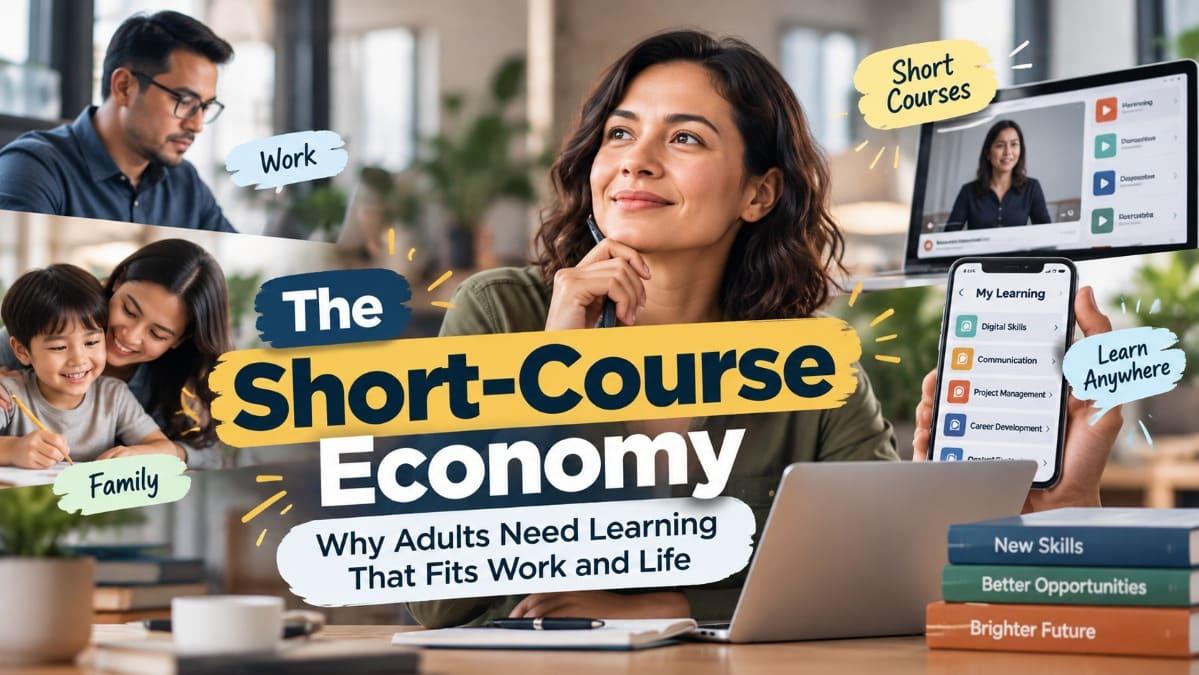
Adult upskilling increasingly has to compete with work
schedules, family responsibilities, financial pressure, commuting, and limited
attention. That changes what accessible learning looks like. Instead of
assuming that adults can reorganize their lives around education, many
workforce and training systems are moving toward shorter, modular, part-time,
online, and blended learning opportunities that can fit around existing
responsibilities.
The “short-course economy” is a useful way to describe this
expanding ecosystem of focused learning experiences, although it is not a
formal statistical category. For adult learning providers, workforce boards,
community colleges, and training organizations, the opportunity is not simply
to make courses shorter. It is to build flexible learning pathways in which
smaller learning experiences remain relevant, rigorous, manageable, and
connected to broader skills development.
- Quick
Answer
- What
Is the Short-Course Economy?
- Why
Traditional Learning Schedules Often Conflict With Adult Life
- Why
Shorter Learning Can Work — and Where It Can Fail
- What
Adults Actually Need From Flexible Learning
- How
Providers Can Design Better Short-Course Pathways
- What
the Short-Course Model Changes for Learning Operations
- Common
Mistakes When Building Short Adult-Learning Programs
- FAQ
- Conclusion
Quick Answer
The short-course economy describes the growing ecosystem of
compact, targeted learning experiences designed to help people develop specific
knowledge or skills without committing immediately to a long formal program. It
can include professional short courses, non-formal training, continuing
education modules, bootcamps, workplace learning, microlearning sequences, and
some programs that lead to micro-credentials.
Its importance is largely practical. Adults rarely approach
learning as a full-time activity isolated from the rest of their lives. Work
commitments, caregiving, cost, transportation, unpredictable schedules, and
previous educational experiences can all determine whether someone can start
and complete a program.
Recent OECD evidence reinforces this point. Among adults
reporting barriers to desired training, lack of time because of work is the
most frequently cited barrier, followed by family responsibilities and cost.
Shorter courses can reduce some of this friction, especially
when they are modular, accessible on mobile devices, supported by clear
guidance, and connected to practical goals. But short does not automatically
mean effective. Providers still need coherent learning outcomes, assessment,
learner support, quality assurance, and pathways into further learning.
What Is the Short-Course Economy?
The short-course economy is an ecosystem of relatively
compact learning opportunities that allow adults to acquire, refresh, or
demonstrate specific capabilities without necessarily enrolling first in a
multi-year qualification. The term is best treated as a descriptive shorthand
rather than an established policy classification.
Its growth reflects a broader change in how lifelong
learning is organized. Formal degrees and qualifications remain important,
particularly where occupations require substantial theoretical foundations,
regulated competencies, professional licensing, or extensive supervised
practice. Alongside them, however, institutions and employers increasingly need
ways for adults to update narrower areas of knowledge as technologies, job
tasks, standards, and organizational practices change.
A short course might therefore address spreadsheet
automation for administrative workers, supervisory communication for new
frontline managers, digital marketing for small-business owners, cybersecurity
awareness for employees, or a specific manufacturing procedure. Some courses
may take a few hours; others may run for several weeks or months. What unites
them is not a particular duration but a more bounded learning objective.
This distinction matters because short courses are sometimes
treated as interchangeable with micro-credentials. They are not. A short course
describes a learning experience. A micro-credential typically adds a defined
credential that certifies learning outcomes and may include requirements around
assessment, transparency, quality, or recognition.
The European Union, for example, defines micro-credentials
around certified outcomes from short-term learning experiences and has
developed a common approach intended to improve their quality, transparency,
recognition, and portability. European
approach to micro-credentials

The more important development, then, is not that every course is becoming smaller. It is that learning systems are becoming less dependent on a single large enrollment decision.
Adults should not have to reorganize their entire lives every time they need to learn something new.
Why Traditional Learning Schedules Often Conflict With Adult Life
Adult learners operate under different constraints from
traditional full-time students. Many are employees, parents, caregivers,
freelancers, job seekers, small-business owners, or people managing several
roles simultaneously. Participation depends not only on whether a program is
educationally valuable but also on whether the learner can realistically
accommodate it.
The OECD's 2025 analysis of the Survey of Adult Skills found
that time constraints related to work or family responsibilities accounted for
48% of the main barriers reported by adults who experienced obstacles to
non-formal job-related learning. Work-related time constraints alone accounted
for approximately 29%, while family responsibilities represented about 18% and
cost 13%.
The pattern persists in newer OECD policy analysis. In June
2026, the OECD emphasized that barriers can occur throughout the training
journey — before adults consider learning, while they search for opportunities,
when they decide whether to enroll, and after participation has begun. It
highlights flexible provision as one part of the response available to training
providers. OECD
guidance on overcoming barriers to training
This changes the meaning of accessibility.
For an employed parent, a course offered at 6 p.m. may
technically be available yet practically inaccessible because it overlaps with
childcare. For a shift worker, a weekly synchronous class may be difficult even
when tuition is affordable. A low-wage worker may be unable to participate in
unpaid daytime training because the indirect cost of lost income is greater
than the tuition itself.
A provider therefore cannot evaluate accessibility only by
asking whether enrollment is open.
It must also ask whether learners can fit participation into
the structure of their lives.
Adult-learning access is partly a scheduling problem. Course
availability means little when the delivery model conflicts with the learner's
working hours, care responsibilities, income needs, or ability to travel.
The barriers also vary across adulthood. OECD Skills Outlook
2025 notes that adults aged 30–49 can be particularly sensitive to
family-related time constraints and training costs, while older workers may
encounter different problems, including difficulty finding suitable learning
opportunities for later-career needs.
That is why removing
barriers to adult learning requires more than simply putting an existing
classroom course online. Delivery, pacing, learner support, financing,
communication, and program relevance all affect participation.
Why Shorter Learning Can Work — and Where It Can Fail
Short courses can make adult learning easier to enter
because they reduce the size of the initial commitment. A learner may find it
more realistic to complete a focused module over several evenings than to
commit to a semester-long course before knowing whether the subject, provider,
or learning format is suitable.
Modularity can also make learning more responsive to
immediate needs. A workforce board responding to an employer's changing skill
requirements may not need to create an entirely new qualification. A community
college may be able to package existing expertise into a focused
continuing-education offering. An employer may need workers to develop one new
operational capability rather than repeat an entire field of study.
There is also an important psychological dimension. Adults
who have been away from education for years may perceive a smaller commitment
as less intimidating. Completing one achievable learning experience can provide
evidence that returning to structured learning is possible, although confidence
will still depend heavily on course design, support, assessment practices, and
previous educational experiences.
Yet reducing duration can create its own problems.
Complex competencies cannot always be compressed safely.
Advanced technical work, healthcare practices, engineering knowledge, teaching
capabilities, and other areas may require sustained conceptual development,
repeated practice, feedback, supervised application, or regulated assessment.
Dividing a curriculum into smaller pieces does not eliminate those
requirements.
Short courses can also become fragmented. Learners may
accumulate unrelated certificates without developing a coherent capability
profile. Providers may launch many narrowly defined courses because they are
easy to market while failing to explain which course comes next or how several
courses connect.
|
Design Question |
Short-Course Approach |
Longer Structured Program |
|
Initial commitment |
Usually lower and easier to test |
Usually requires a larger commitment |
|
Scope |
Focused capability or topic |
Broader body of knowledge or competencies |
|
Scheduling |
Can be easier to fit around work and life |
Often requires sustained scheduled participation |
|
Responsiveness |
Can be updated quickly for emerging needs |
Curriculum revision may take longer |
|
Depth |
Appropriate for bounded objectives |
Better suited to complex, cumulative learning |
|
Learner pathway |
Must be designed deliberately to avoid fragmentation |
Usually has an established sequence |
|
Credential value |
Varies significantly by provider and recognition model |
Often clearer within established qualification systems |
|
Best use |
Targeted upskilling, continuing education, skill refresh,
entry points |
Comprehensive preparation, qualifications, regulated or
complex fields |
Europe's interest in micro-credentials illustrates both
sides of this equation. The European Commission describes short learning
experiences as a means of providing flexible, targeted learning while
simultaneously emphasizing quality, transparency, comparability, recognition,
and portability.
Flexibility without structure can create fragmentation.
Structure without flexibility can make learning inaccessible.
Effective adult-learning systems need both.

What Adults Actually Need From Flexible Learning
Flexibility is often reduced to asynchronous video, but
adult learners need more than the ability to press play whenever they want.
Useful flexibility is multidimensional.
First, adults need time flexibility. Learning may
need to happen before work, after work, during employer-provided learning time,
on weekends, or in brief periods distributed across a week. Recorded content,
asynchronous activities, sensible deadlines, downloadable resources, and short
learning units can make scheduling easier.
Second, they need pace flexibility. Some learners
already understand part of the material and need only targeted development.
Others require more examples, practice, or support. A rigid learning schedule
may unnecessarily slow one group while leaving another behind.
Third, adults need location flexibility. Online and
mobile access can reduce commuting and expand reach, particularly when learners
are dispersed geographically. But providers should not assume that digital
delivery automatically creates inclusion. Device access, bandwidth, digital
confidence, accessibility requirements, and the nature of the skill being
taught still matter.
Fourth, adults benefit from pathway flexibility. A
learner may want to begin with a small course and later continue into another
module, a certificate, professional development sequence, or formal
qualification. UNESCO has highlighted flexible learning pathways as a mechanism
for widening opportunities while also warning that quality frameworks are
needed to prevent harmful fragmentation. UNESCO
on flexible learning pathways
Finally, learners need relevance. A two-hour course
that appears disconnected from someone's work or goals can be harder to justify
than a longer program with an obvious payoff.
The most useful unit of adult learning is not necessarily
the shortest possible lesson. It is the smallest coherent learning experience
that produces a meaningful outcome and connects logically to what the learner
may need next.
This is an important distinction for providers experimenting
with microlearning. Breaking material into small units can reduce cognitive and
scheduling friction, but learning still needs sequence and context. A
collection of isolated three-minute videos is not automatically a curriculum.
The stronger model combines focused content with clear
objectives, practice, assessment where appropriate, and a visible progression
route.
FitAcademy
Design Learning Around the Realities of Adult Participation
Explore how FitAcademy approaches mobile-first microlearning and learning infrastructure that can support shorter, structured learning experiences for organizations and training providers.
Learn MoreHow Providers Can Design Better Short-Course Pathways
For providers, moving toward shorter learning does not begin
with cutting an existing 30-hour course into ten three-hour courses. The
starting point should be the capability learners are expected to develop.
A useful design process begins by defining what someone
should be able to understand, decide, demonstrate, or perform after completing
the learning experience. The provider can then determine whether that outcome
genuinely fits a short format.
Some objectives are naturally compact. Updating employees on
a revised customer-service procedure may require only a focused learning
sequence with scenarios and a knowledge check. Developing someone into an
independent cybersecurity professional clearly requires a much broader pathway.
Once the outcome is bounded, providers can design a sequence
around it:
- define
a specific learner and skill need;
- establish
measurable learning outcomes;
- identify
the minimum content and practice required;
- divide
the experience into manageable learning units;
- decide
which activities should be asynchronous, synchronous, practical, or
facilitated;
- provide
assessment appropriate to the importance of the competency;
- make
progress and completion visible;
- show
learners what progression options exist afterward.

The last step is frequently overlooked. A provider can offer dozens of short courses yet still leave learners responsible for constructing their own curriculum.
This is where learning pathways become valuable. A community
college, for example, might organize several individual courses into an
entry-level digital operations pathway. Learners could begin with spreadsheet
fundamentals, continue into data reporting, then progress toward workflow
automation. The courses remain individually useful, but their relationship is
visible.
The same logic applies to workforce organizations and
community-based programs. Short courses can become entry points rather than
dead ends.
For some learners, that pathway may eventually lead back
into more substantial education. That makes short-course design complementary
to second-chance
learning for adults returning to education, rather than a substitute for
it.
Providers should also distinguish flexibility from lack of
support. Self-paced learning can remove scheduling constraints but may create
new problems when participants become stuck, lose momentum, or cannot connect
abstract information to practice. Depending on the audience, effective support
might include facilitator check-ins, peer discussion, reminders, coaching,
office hours, or simple escalation channels.
The course may be short. The support model still needs
design.
Short courses become pathways only when learners can see how one learning achievement connects to the next.
What the Short-Course Model Changes for Learning Operations
A more modular learning portfolio changes operations behind
the learner experience.
Traditional programs often concentrate administration around
relatively few courses with longer enrollment periods. A short-course portfolio
may contain many more offerings, more frequent cohorts, repeated enrollment
cycles, smaller learning units, and learners entering the system through
different routes.
That increases the importance of content governance.
Providers need to know which courses are active, which
versions learners are using, who owns each module, when content was last
reviewed, whether assessments still match learning outcomes, and which short
courses belong to which pathways. Without this discipline, the flexibility
experienced by learners can create complexity for administrators.
Learner data becomes more important as well. A provider
offering modular learning may need to understand whether a participant
completed only one course, progressed through a pathway, stopped midway,
returned months later, or entered through another program.
A learning platform can help centralize these processes, but
software does not solve weak program architecture automatically. The platform
should support the operating model the organization intends to run.
For short-course delivery, relevant capabilities can
include:
- mobile-friendly
access;
- small-unit
content organization;
- progress
tracking;
- assessment
and completion records;
- cohort
or group management;
- learner
reminders;
- certification
where appropriate;
- facilitator
access;
- reporting
across courses and pathways;
- consistent
branding and communication.
For workforce boards or training organizations managing
several initiatives, these capabilities may also help avoid creating separate
learning systems for every new project. A shared learning infrastructure can
support different learner groups while keeping program administration and data
management more consistent.
That becomes particularly relevant as providers move from
isolated courses toward a portfolio of ongoing upskilling programs.

The financing layer matters too. Shorter courses may lower the price of an individual learning decision, but repeated participation can still become expensive. Public funding, employer contributions, subsidies, vouchers, and personal learning entitlements can therefore influence whether adults can actually use flexible provision.
Europe's development of individual
learning accounts and skills funding approaches illustrates a related
policy question: flexible course supply works best when adults also have
realistic mechanisms for paying for learning. That issue deserves separate
consideration because course format and learning finance solve different
barriers.
Common Mistakes When Building Short Adult-Learning Programs
Mistake 1: Assuming Shorter Automatically Means More Accessible
Reducing course duration may lower the time commitment, but
it does not automatically address inconvenient scheduling, care
responsibilities, digital access, tuition, lost wages, disability access,
language barriers, or lack of employer support. A ten-hour course can remain
inaccessible if all ten hours must occur during working time.
A better approach is to map the actual participation
journey. Providers should examine discovery, enrollment, scheduling, access,
study requirements, support, assessment, and completion rather than treating
course length as the only source of friction.
Mistake 2: Compressing Complex Competencies Too Aggressively
The commercial appeal of short learning can encourage
providers to promise major skill transformation from very small amounts of
instruction. That is risky. Some learning outcomes require repeated practice,
feedback, conceptual understanding, and real-world application.
Short-course design should therefore begin with scope
discipline. If an objective cannot be taught and assessed credibly within the
proposed duration, either narrow the outcome or make the course part of a
larger sequence.
Mistake 3: Creating a Catalog Instead of a Pathway
A large course library may look impressive while leaving
learners unable to decide what to take. Choice becomes another form of friction
when courses have overlapping titles, unclear prerequisites, or no visible
progression.
Providers can reduce this problem by grouping courses around
roles, competencies, or learning goals. Recommended sequences, prerequisite
guidance, and pathway maps can help adults decide what is relevant without
turning navigation into another research project.
Mistake 4: Treating Self-Paced Learning as Self-Sufficient Learning
Asynchronous learning can improve scheduling flexibility,
but some participants still need human support. A learner who repeatedly fails
an assessment or cannot relate the material to workplace practice may not
benefit from simply being given unlimited time.
The support model should match the risk and complexity of
the learning objective. Automated reminders may be enough for a simple
compliance update, while career transition programs may require coaching,
facilitator feedback, peer interaction, or practical review.
Mistake 5: Overvaluing the Certificate
A certificate can make completion visible, but the existence
of a certificate does not establish that a course is recognized, portable,
rigorous, or valued by employers. Recognition depends on the issuer, learning
outcomes, assessment, quality assurance, market context, and sometimes
qualification or regulatory frameworks.
The European discussion around micro-credentials makes this
distinction explicit: flexible credentials become more useful when there is
transparency about what was learned and assessed. Cedefop's continuing work on
micro-credentials similarly focuses on how short learning opportunities are
structured, delivered, and recognized across labor-market education and
training. Cedefop
research on micro-credentials
FAQ
What is a short course for adult learners?
A short course is a focused learning experience designed
around a relatively bounded subject or capability and completed over less time
than a conventional long-form education program. Duration varies considerably.
What matters more than an arbitrary number of hours is whether the course has
clear learning outcomes, enough instruction and practice to address them, and
an appropriate method for demonstrating completion or competence.
Are short courses the same as micro-credentials?
No. A short course is a learning format, while a
micro-credential is a credential documenting defined learning outcomes from a
relatively small learning experience. Some short courses lead to
micro-credentials, while others provide certificates of completion or no formal
credential. Recognition and quality requirements vary by provider, sector, and
jurisdiction.
Why are short courses useful for working adults?
Short courses can reduce the size of the initial time and
financial commitment and can be easier to schedule around employment and family
responsibilities. This directly addresses some of the most frequently reported
adult-learning barriers. Their usefulness still depends on delivery
flexibility, relevance, affordability, support, and whether the course provides
enough depth for the intended learning outcome.
Can short courses replace college degrees or professional qualifications?
Usually not as a universal substitute. Short courses and
longer qualifications solve different learning problems. Focused training can
be effective for skill updates or bounded competencies, while professions
requiring broad theoretical understanding, extensive practice, regulated
preparation, or formal qualifications generally need more substantial
education. Strong learning systems allow different formats to complement one
another.
Should every short course be fully self-paced?
No. Self-paced delivery can reduce scheduling barriers, but
the appropriate format depends on what is being taught and who is learning.
Some programs benefit from live discussion, instructor feedback, practical
demonstrations, mentoring, or cohort interaction. Providers should separate the
need for scheduling flexibility from the assumption that learners should study
entirely alone.
What should training providers measure beyond course completion?
Completion is useful but insufficient. Depending on the
program, providers may also examine activation, assessment performance,
progression into subsequent learning, practical application, learner
satisfaction, dropout points, support requests, and employer or stakeholder
feedback. The right measures should correspond to the purpose of the program
rather than being added simply because a learning platform can track them.
Conclusion
The expansion of short-form adult learning reflects a simple
constraint: adults cannot repeatedly put employment, family responsibilities,
income, and everyday life on hold whenever their skills need updating.
That makes flexible learning increasingly important. OECD
evidence shows that time remains one of the most persistent barriers to
participation, while cost, suitability, and other constraints continue to
exclude people from learning opportunities.
Short courses can help because they reduce the size of the
learning commitment and allow providers to respond more precisely to specific
skill needs. But shortening learning is not the same as redesigning it.
Effective adult learning still requires relevant outcomes, appropriate depth,
practice, learner support, quality assurance, and clear progression.
For adult learning providers, workforce boards, community
colleges, and training organizations, the strategic shift is therefore larger
than course duration. Learning infrastructure needs to accommodate people who
may enter for one immediate need, return later for another, and gradually build
a broader set of capabilities over time.
The strongest short-course systems make that continuity
possible without requiring every learner to start with a large educational
commitment.
FitAcademy
Build Flexible Learning Without Losing Structure
Learn how FitAcademy can support organizations delivering mobile-first microlearning, structured learning pathways, learner progress tracking, and scalable training operations.
Learn More