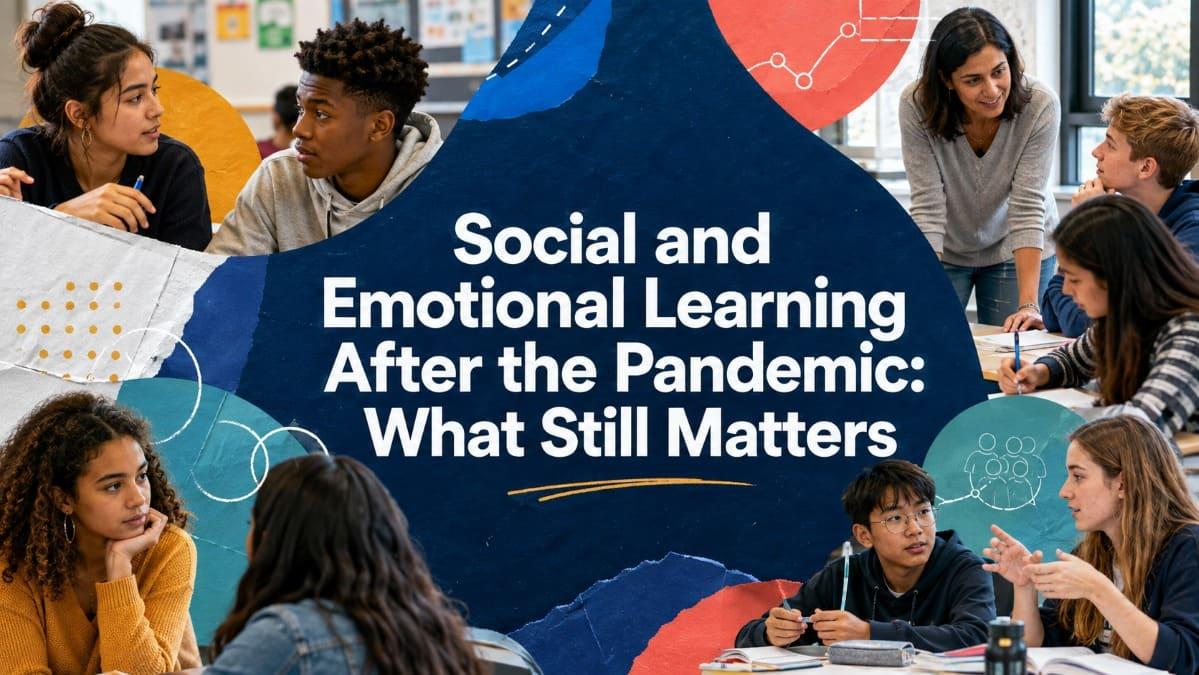
Social and emotional learning received renewed attention
during the pandemic as schools responded to isolation, disrupted routines,
grief, anxiety, and weakened peer relationships. The emergency phase has
passed, but the underlying educational need remains. Students still need to
understand emotions, manage behavior, collaborate, navigate conflict, make
responsible decisions, and participate in demanding learning. What should
change is the implementation. Effective SEL is not an occasional wellbeing activity,
a substitute for mental health care, or a way to make students individually
responsible for structural problems. It combines explicit instruction,
supportive relationships, consistent adult practice, culturally responsive
examples, and opportunities to apply skills in real academic and social
situations. Digital learning can support staff preparation and reinforce
student practice, provided it remains connected to classroom experience.
- Quick
Answer
- What
Is Social and Emotional Learning?
- Why
SEL Still Matters After the Pandemic
- What
SEL Is—and What It Is Not
- Which
Parts of SEL Matter Most?
- What
High-Quality SEL Looks Like in Practice
- Where
a White-Label Learning Platform Can Help
- A
Practical Framework for Reviewing SEL
- Common
SEL Implementation Mistakes
- How
Schools Should Evaluate SEL
- FAQ
- Conclusion
Quick Answer
Social and emotional learning, commonly abbreviated as SEL,
is an educational process through which learners develop and apply capabilities
for understanding themselves, managing emotions and behavior, considering other
perspectives, building relationships, and making responsible decisions.
SEL still matters after the pandemic because these
capabilities support classroom participation, collaboration, conflict
resolution, persistence, and engagement with learning. They were not temporary
crisis-response skills. However, schools should move beyond emergency wellbeing
activities toward planned, developmentally appropriate learning that is
reinforced across teaching, relationships, routines, and school culture.
A strong approach combines explicit instruction with
opportunities to use the skills during academic work and everyday interactions.
It prepares adults as well as students, respects cultural and contextual
differences, and connects learners who need additional help with appropriate
support.
SEL is not psychotherapy, diagnosis, discipline in softer
language, or a promise that students will remain calm and compliant. It cannot
independently resolve poverty, discrimination, unsafe conditions, disability
barriers, or inadequate mental health services.
For leaders evaluating an SEL initiative, the central
questions are whether the intended capabilities are clear, whether staff can
teach and model them, whether students can apply them in authentic situations,
and whether the wider learning environment supports the same behaviors.
What Is Social and Emotional Learning?
Social and emotional learning is a structured part of
education that helps young people and adults acquire and apply knowledge,
skills, and attitudes related to identity, emotion, goals, empathy,
relationships, and responsible decision-making.
The Collaborative for Academic, Social, and Emotional
Learning (CASEL) commonly organizes SEL into five interrelated competence
areas:
- self-awareness;
- self-management;
- social
awareness;
- relationship
skills;
- responsible
decision-making.
These categories are useful as an organizing framework, but
they are not a complete curriculum. A school still needs to decide what each
capability means for a particular age group, cultural context, learning
environment, and practical situation. See the CASEL definition and competence
framework.
For example, “relationship skills” may mean taking turns and
asking for help in an early primary classroom. In secondary education, it could
include handling disagreement in a group project, giving constructive feedback,
or setting personal boundaries. In higher education, the same broad area may
involve collaborating across cultures, responding professionally to criticism,
or resolving responsibilities within a research team.
A list of competencies therefore gives schools a common
language, not an implementation plan.
Research provides reasonable grounds for considering SEL,
but it does not justify treating every program as equally effective. A 2023
systematic review and meta-analysis examined 424 studies from 53 countries,
covering 252 universal school-based SEL interventions and more than 575,000
students. The review found positive outcomes across several areas, while also
identifying substantial variation between interventions, outcomes, contexts,
and research designs. See the contemporary
meta-analysis of universal school-based SEL.
The practical interpretation is not “SEL always works.” It
is that well-designed programs can support development, depending on program
quality, implementation, context, measurement, and sustained use.
A competence framework defines what students may need to
develop. It does not determine how those capabilities should be taught,
practiced, or assessed.

Why SEL Still Matters After the Pandemic
During periods of school closure and remote learning, SEL
was often framed around crisis response: helping students name difficult
emotions, reconnect socially, and regain routines. Those priorities were
understandable, but they sometimes narrowed public understanding of SEL to
check-ins, breathing exercises, or general wellbeing conversations.
The longer-term case is broader.
Education continuously asks learners to regulate attention,
tolerate uncertainty, collaborate with people they did not choose, receive
feedback, repair mistakes, and persist through difficulty. These are not
separate from academic learning. They are embedded in the process of learning.
A student working through a difficult mathematics problem
uses more than subject knowledge. They may need to notice frustration, decide
whether to change strategy, ask for help, and continue after an incorrect
attempt. A literature discussion requires perspective-taking and respectful
disagreement. A science investigation requires shared responsibility,
communication, and decisions about evidence.
The pandemic did, however, expose several weaknesses that
schools should not forget.
Relationships cannot be treated as background conditions
Extended disruption demonstrated how much students rely on
routine interaction with peers and trusted adults. UNESCO notes that the
pandemic affected more than 1.6 billion learners worldwide, with vulnerable
groups experiencing disproportionate disruption. Recovery therefore involves
more than restoring timetables or covering unfinished curriculum. See the UNESCO overview of
education recovery after COVID-19.
A school can deliver an SEL lesson about empathy while its
everyday practices make students feel unseen. The relationship between the
formal lesson and the lived environment matters.
Predictability supports participation
Students are better able to manage themselves when
expectations, routines, transitions, and responses are reasonably clear.
Self-management should not be framed entirely as an individual trait when the
environment is confusing or inconsistent.
A predictable classroom does not have to be rigid. It means
students know what will happen, what quality looks like, where to obtain help,
and how adults are likely to respond when problems occur.
Adults need the capabilities too
Teachers cannot credibly teach constructive disagreement
while staff meetings normalize hostility. Nor can they support emotional
regulation if the implementation leaves them overloaded and unprepared.
Adult SEL does not mean asking educators to complete another
wellness activity while leaving organizational stress untouched. It includes
usable communication practices, reflective judgment, clear boundaries,
collaboration, and access to professional support.
SEL becomes credible when students encounter the same principles in lessons, relationships, rules, feedback, and adult behavior.
What SEL Is—and What It Is Not
Several concepts overlap with SEL, but they should not be
treated as interchangeable.
|
Approach |
Primary purpose |
Typical role in education |
Important boundary |
|
Social and emotional learning |
Develop broadly applicable social and emotional
capabilities |
Universal instruction, practice, classroom integration,
school culture |
Not clinical assessment or treatment |
|
Mental health support |
Promote wellbeing and respond to emotional or
psychological needs |
Prevention, early support, counseling, referral,
specialist care |
Requires appropriate professional competence and
governance |
|
Behavior management |
Establish conditions for safe and productive participation |
Expectations, routines, reinforcement, proportionate
consequences |
Compliance alone does not demonstrate social-emotional
capability |
|
Character education |
Develop ethical, civic, or community-oriented qualities |
Discussion, modeling, habit formation, community
participation |
Values and definitions vary across cultures and
institutions |
|
Restorative practices |
Build and repair relationships after harm or conflict |
Dialogue, accountability, reintegration, community
building |
Requires preparation and is not appropriate for every
safeguarding situation |
|
Academic learning skills |
Support planning and successful participation in study |
Goal-setting, help-seeking, organization, reflection |
Should remain connected to subject-specific teaching |
SEL is not therapy
SEL can help all students develop language and strategies
for ordinary emotions, relationships, and decisions. It does not diagnose or
treat depression, anxiety disorders, trauma-related conditions, or other mental
health needs.
A student who needs professional care should not be directed
to repeat a self-management module as if the difficulty were merely a skills
gap. Schools need clear links between universal SEL, targeted support, and
qualified services. This boundary is explored further in youth
mental health and learning.
SEL is not behavior compliance
A quiet student is not necessarily self-regulated, and a
talkative or critical student does not necessarily lack social-emotional
competence. If SEL is used primarily to secure obedience, schools may reward
masking, discourage legitimate disagreement, or misinterpret cultural
differences as deficits.
Responsible decision-making can include questioning an
unfair process. Relationship skills can include setting a boundary. Social
awareness can involve recognizing power, exclusion, or competing perspectives.
SEL is not a remedy for every institutional problem
Teaching resilience cannot make an unsafe environment
acceptable. Teaching self-management does not correct an inaccessible
timetable. Teaching empathy does not replace action against bullying or
discrimination.
SEL is strongest when it develops learner capability while
the institution also examines the conditions in which students are expected to
use that capability.

Which Parts of SEL Matter Most?
No single competence should be declared universally most
important. Priorities depend on student age, context, existing strengths, and
the demands learners face. Still, several principles remain consistently
valuable.
Emotional understanding needs useful language
Students benefit from being able to distinguish frustration
from anxiety, disappointment from shame, or excitement from agitation. More
precise language can help them communicate what they need and choose an
appropriate response.
This should not become forced disclosure. A classroom
activity can help students understand emotions without requiring them to reveal
private experiences in front of peers.
Self-management should include strategy choice
Self-management is not simply remaining calm. It can involve
delaying a response, changing the environment, dividing a task, requesting
clarification, taking an authorized break, or seeking help.
The goal is not to teach one preferred technique. Students
need several strategies and opportunities to judge which one fits the
situation.
Perspective-taking must allow genuine difference
Social awareness is sometimes reduced to guessing what
another person feels. More mature practice asks students to consider different
experiences, interests, cultural assumptions, and power relationships without
pretending that all disagreements disappear through empathy.
Perspective-taking does not require agreeing with another
person. It requires understanding their position well enough to respond
responsibly.
Relationship skills need practice under pressure
Students may explain respectful communication correctly on a
quiz but struggle to use it when a group member misses a deadline or rejects
their idea. Relationship capabilities develop through rehearsed and real
interaction, feedback, repair, and reflection.
Class discussion, team projects, peer review, presentations,
practical work, and student leadership can all provide relevant practice when
teachers make the social expectations explicit.
Decision-making should be connected to consequences
Responsible decision-making is stronger when students
consider evidence, alternatives, stakeholders, risks, and likely consequences.
Older students can apply this to online behavior, academic integrity, group
responsibilities, personal goals, and community issues.
This capability will become increasingly relevant as
students make decisions involving artificial intelligence and other digital
tools, but its wider treatment belongs in human
skills in the AI age.
SEL skills become transferable when students practice
choosing and adapting them—not merely recalling the name of a preferred
strategy.
What High-Quality SEL Looks Like in Practice
High-quality SEL is both explicit and embedded. Students
need focused opportunities to learn and rehearse capabilities, but they also
need to encounter them throughout the school day.
|
Component |
Weak implementation |
Stronger implementation |
|
Learning objectives |
Broad instruction to “build resilience” |
Observable, age-appropriate capability linked to a real
context |
|
Instruction |
One-off activity or inspirational talk |
Sequenced explanation, modeling, practice, feedback, and
reflection |
|
Academic integration |
SEL language added to an unrelated lesson |
Relevant competence used to improve authentic subject
participation |
|
Adult preparation |
Teachers receive slides shortly before delivery |
Staff understand the purpose, boundaries, facilitation,
and referral procedure |
|
School environment |
Formal lessons conflict with daily practice |
Routines, discipline, feedback, and relationships
reinforce the intended capability |
|
Cultural relevance |
Imported scenarios presented unchanged |
Language and situations reviewed with students, families,
and local educators |
|
Additional needs |
The universal lesson is expected to serve everyone |
Universal SEL connects to targeted and specialist support |
|
Evaluation |
Satisfaction or completion alone |
Implementation, experience, capability, application, and
equity reviewed together |
Teach capabilities explicitly
Students should know what they are learning, why it matters,
and how it can be applied. CASEL describes explicit instruction as consistent
opportunities to cultivate, practice, and reflect on social and emotional
competencies in developmentally appropriate and culturally responsive ways. See
the CASEL
guidance on explicit SEL instruction.
A short lesson on giving constructive feedback, for example,
might define the purpose, compare helpful and unhelpful examples, model a
conversation, let students practise, and then apply the approach during peer
review.
Embed practice where the capability is needed
Integration is useful when it is authentic. A history debate
creates a natural setting for evidence-based disagreement and
perspective-taking. A design project creates opportunities for shared decisions
and conflict resolution.
Schools should avoid inserting superficial emotion questions
into every subject merely to demonstrate coverage. The link should improve
either social participation or academic learning.
Align routines and policies
A curriculum may teach responsible decision-making while
students have no meaningful voice. It may teach relationship repair while
disciplinary procedures provide no route back into the community. It may teach
help-seeking while support pathways remain unclear.
Policy alignment does not mean every conflict should be
resolved through an SEL activity. Safeguarding, serious misconduct, and legal
duties still require appropriate procedures. It means institutional practice
should not routinely contradict the capabilities being taught.
Use a tiered support structure
Universal SEL can benefit broad student groups, but some
learners need targeted intervention or specialist support. A multi-tiered
system of support can connect universal practices with increasingly intensive
assistance based on need. IES materials describe this structure as a way to
coordinate evidence-based social, emotional, behavioral, and mental health
supports. See the IES
guidance on multi-tiered student wellbeing support.

Where a White-Label Learning Platform Can Help
A white-label learning platform can support SEL when
institutions need a consistent, branded system for staff preparation, student
microlearning, family guidance, and implementation resources. It should
strengthen live practice rather than turn SEL into isolated screen consumption.
Role-based staff preparation
Teachers, counselors, leaders, support staff, and
facilitators require different levels of knowledge. Short role-based pathways
can cover:
- the
institution’s definition and goals for SEL;
- age-appropriate
facilitation;
- culturally
responsive examples;
- responding
to sensitive disclosures;
- boundaries
between SEL and mental health care;
- classroom
application;
- observation
and feedback;
- referral
and safeguarding procedures.
Microlearning can reinforce a procedure before staff use it.
A teacher preparing a group project might revisit a three-minute module on
structuring collaborative roles. A mentor could review guidance on reflective
conversations before meeting a student.
Student learning and guided practice
Students can use short content before classroom activities:
watch a modeled disagreement, identify possible responses, or compare decisions
and consequences. The important learning happens when they discuss, practise,
receive feedback, and apply the capability afterward.
For this reason, completion should not be treated as proof
of competence. Watching a module about conflict resolution is not equivalent to
resolving conflict constructively.
Consistency without rigid standardization
A shared platform helps schools distribute agreed language,
examples, facilitator notes, and updated procedures. Local teams should still
be able to adapt scenarios to age, culture, language, and institutional
context.
White-label ownership can also make the program feel like
part of the institution’s learning environment rather than a disconnected
external campaign. However, branding is not the same as contextualization.
Changing a logo while leaving irrelevant examples untouched provides limited
value.
FitAcademy
Build SEL Into Your Own Learning Environment
FitAcademy White Label helps institutions deliver branded microlearning, role-based staff preparation, guided student activities, and implementation resources across web and mobile.
Explore FitAcademy White LabelA Practical Framework for Reviewing SEL
Schools do not necessarily need to abandon existing SEL
activity. They need to determine what is useful, what is disconnected, and what
requires redesign.
1. Define the educational purpose
Decide which student experiences or capabilities need
attention. “Improve wellbeing” is too broad. A clearer priority might be
helping Year 7 students navigate transition, strengthening collaboration in
project-based learning, or improving conflict repair in residential education.
2. Map current provision
SEL may already exist across curriculum, advisory periods,
counseling, sports, arts, student leadership, behavior policies, and
extracurricular programs. Mapping prevents duplication and reveals
contradictions.
Identify:
- what
is taught explicitly;
- where
students practise it;
- which
adults reinforce it;
- how
families are involved;
- what
targeted support exists;
- where
responsibilities are unclear.
3. Select a small number of developmental outcomes
Avoid trying to teach every broad competence at once. Define
what progress would look like for the target group.
For example, an outcome such as “students improve
relationship skills” is difficult to implement. “Students can give specific,
respectful feedback and respond to disagreement during group work” is more
usable.
4. Review relevance and risk
Ask students, educators, families, counselors, and relevant
community representatives whether the content fits local language and
experience. Review activities for forced disclosure, stereotyping, inaccessible
participation, or scenarios that may be inappropriate for students affected by
trauma.
SEL should provide choices about how students participate in
sensitive reflection.
5. Prepare adults before launching student content
Staff need time to understand the framework, practise
facilitation, anticipate questions, and know when to refer a concern. If
educators receive only presentation slides, delivery is likely to become
mechanical or inconsistent.
Leaders should also examine whether workload, meeting
culture, and staff relationships support the practices they expect teachers to
model.
6. Pilot explicit instruction and authentic application together
A pilot should include the learning activity and the context
in which students will apply it. If students learn collaborative
decision-making, evaluate its use during a real project rather than relying
only on a knowledge quiz.
Observe implementation without demanding identical delivery
in every classroom. Fidelity to the learning purpose can coexist with
appropriate adaptation.
7. Evaluate and revise
Review whether the content was delivered, how students
experienced it, whether adults used the shared practices, and whether learners
could apply the capability.
If results differ between student groups, investigate the
implementation and environment before concluding that one group has weaker
skills.
The test of SEL is not whether students can describe a skill. It is whether the environment lets them practise it and adults help them improve.
Common SEL Implementation Mistakes
Beginning with a product instead of a need
Schools sometimes select an attractive curriculum before
defining the problem it should address. The result may be high-quality content
aimed at the wrong developmental priority.
Start with student experience, intended outcomes, existing
provision, and operational capacity. Then evaluate programs against those
requirements.
Treating SEL as recovery time taken away from learning
SEL and academic learning compete for time when
implementation is poorly designed. They can support each other when
capabilities are taught efficiently and applied during real learning.
Still, schools should not claim that every SEL activity
automatically improves achievement. The link depends on instructional quality,
relevance, transfer, and broader academic conditions.
Requiring personal disclosure
Inviting reflection is different from expecting students to
share private emotions, trauma, family conflict, or mental health experiences
in a group. Participation options can include fictional scenarios, private
reflection, role-play, or analysis of a character.
Teachers also need procedures for responding when a student
discloses a genuine concern.
Placing all responsibility on individual students
A student can practise emotion regulation and still
experience discrimination. They can develop communication skills and still
encounter an unsafe classroom. SEL should not be used to adapt students to
preventable institutional harm.
Evaluate the environment alongside the learner.
Ignoring developmental and cultural context
The same example, language, or expectation may not work
across early childhood, adolescence, and higher education. Communication norms
also differ between families and communities.
Adaptation should preserve the intended capability while
making the learning situation recognizable and respectful.
Measuring students too aggressively
Social-emotional data can be sensitive and difficult to
interpret. Self-reports may be influenced by mood, language, trust, culture, or
a student’s understanding of the question. Teacher ratings may reflect bias or
limited observation.
Schools should avoid using a single SEL score for diagnosis,
discipline, high-stakes decisions, or ranking students.
How Schools Should Evaluate SEL
Evaluation should answer four different questions: Was the
approach implemented? How was it experienced? Did the intended capability
develop? Was it applied in relevant situations?
|
Evaluation area |
Possible evidence |
What it helps determine |
Important caution |
|
Implementation |
Lessons delivered, staff preparation, coaching
participation |
Whether students received the intended opportunity |
Completion does not show quality |
|
Learning experience |
Student feedback, accessibility review, classroom
observation |
Whether activities felt relevant, safe, and usable |
Satisfaction alone does not show learning |
|
Knowledge and strategy |
Scenario responses, explanation of choices, skill
demonstration |
Whether students understand possible approaches |
Hypothetical answers may differ from real behavior |
|
Application |
Group-work observation, conflict repair, help-seeking,
reflection |
Whether capabilities transfer into authentic contexts |
Behavior is shaped by environment as well as skill |
|
School conditions |
Belonging, fairness, trusted-adult access, policy
alignment |
Whether the institution reinforces SEL |
Broad climate measures have multiple influences |
|
Equity |
Access, participation, and experience across groups |
Whether implementation works fairly |
Protect privacy and avoid deficit interpretations |
|
Sustainability |
Continued staff use, refreshers, curriculum integration |
Whether SEL survives beyond the pilot |
Short-term implementation may fade without ownership |
A baseline is useful, but not every outcome requires a
lengthy survey. Schools can use structured observations, scenario tasks,
student discussion, work samples, implementation logs, and focused interviews.
Avoid overclaiming causality. If disciplinary incidents
decline during an SEL pilot, the change may also reflect staffing, policy,
cohort composition, reporting practices, or other initiatives. Evaluation
should document concurrent changes.
Digital analytics can show access, progress, or completion
within the learning platform. They should be combined with evidence of
facilitation and application. A dashboard cannot observe whether a student
listens during disagreement or whether an adult repairs trust after applying a
rule unfairly.
FAQ
Is SEL still necessary now that pandemic restrictions have ended?
Yes, because SEL addresses enduring educational capabilities
rather than only pandemic recovery. Students continue to manage emotions,
relationships, conflict, decisions, and challenging learning. What should
change is the framing: schools can move from temporary crisis activities toward
deliberate, developmentally appropriate instruction connected to curriculum,
school culture, and tiered student support.
What is the difference between SEL and mental health education?
SEL develops broad capabilities such as self-awareness,
self-management, perspective-taking, relationships, and decision-making. Mental
health education focuses more specifically on mental health literacy,
recognizing concerns, reducing stigma, seeking help, and understanding
services. They overlap, but neither is equivalent to counseling, clinical
assessment, or treatment.
Should SEL be taught as a separate subject?
It can include dedicated lessons, but separate instruction
alone is usually insufficient. Students also need to apply capabilities during
academic work, relationships, extracurricular activities, and everyday
decisions. The appropriate balance depends on age, timetable, curriculum, staff
capability, and local requirements. Explicit teaching and authentic application
should reinforce each other.
Can SEL improve academic achievement?
SEL may support conditions associated with learning,
including self-management, cooperation, engagement, and help-seeking. Research
has found positive academic outcomes for some programs, but effects vary and
should not be guaranteed. Teaching quality, curriculum, attendance, prior
learning, resources, and implementation also influence achievement. Schools
should assess social-emotional and academic outcomes separately.
How should schools choose an SEL program?
Start by defining intended capabilities, target learners,
cultural and linguistic needs, staff capacity, timetable, support pathways,
data requirements, and available evidence. Then examine whether the program is
developmentally appropriate, evaluated for comparable settings, feasible to
implement, adaptable without losing its core design, and clear about boundaries
with mental health support.
Can SEL be delivered entirely through an online platform?
An online platform can explain concepts, model scenarios,
guide reflection, prepare staff, and reinforce learning. It cannot fully
replace live interaction, adult modeling, peer practice, contextual judgment,
or relationship repair. The strongest model uses digital content before,
during, or after facilitated experiences and connects platform activity to
observable practice.
Conclusion
The pandemic did not create the need for social and
emotional learning, although it made that need harder to ignore. Students have
always needed to manage frustration, seek help, collaborate, understand
different perspectives, repair relationships, and make decisions with
consequences.
What matters now is implementation maturity.
SEL should move beyond one-off wellbeing activities and
become a coherent part of teaching, relationships, routines, staff practice,
and student support. It should build capability without medicalizing ordinary
emotion, demanding compliance, or asking students to compensate for
institutional failures. Universal learning must also connect to targeted and
specialist assistance when a student needs more than skills instruction.
A white-label learning platform can strengthen consistency
by organizing student microlearning, staff pathways, facilitator guidance,
refreshers, and implementation resources within the institution’s own
environment. Its role is to prepare and reinforce. Social and emotional
capabilities ultimately develop through practice with real people, in real
situations, with feedback and opportunities to try again.
Schools addressing disengagement can continue with Chronic
Absenteeism and Student Belonging: How Schools Can Rebuild the Habit of
Attendance. The relationship between wellbeing and educational
participation is examined in Youth
Mental Health and Learning: Why Wellbeing Is Now an Education Strategy.
FitAcademy
Turn SEL Into a Consistent Learning System
Explore how FitAcademy White Label can support branded student microlearning, role-based staff preparation, guided practice, progress tracking, and flexible online or offline access.
Explore FitAcademy White Label