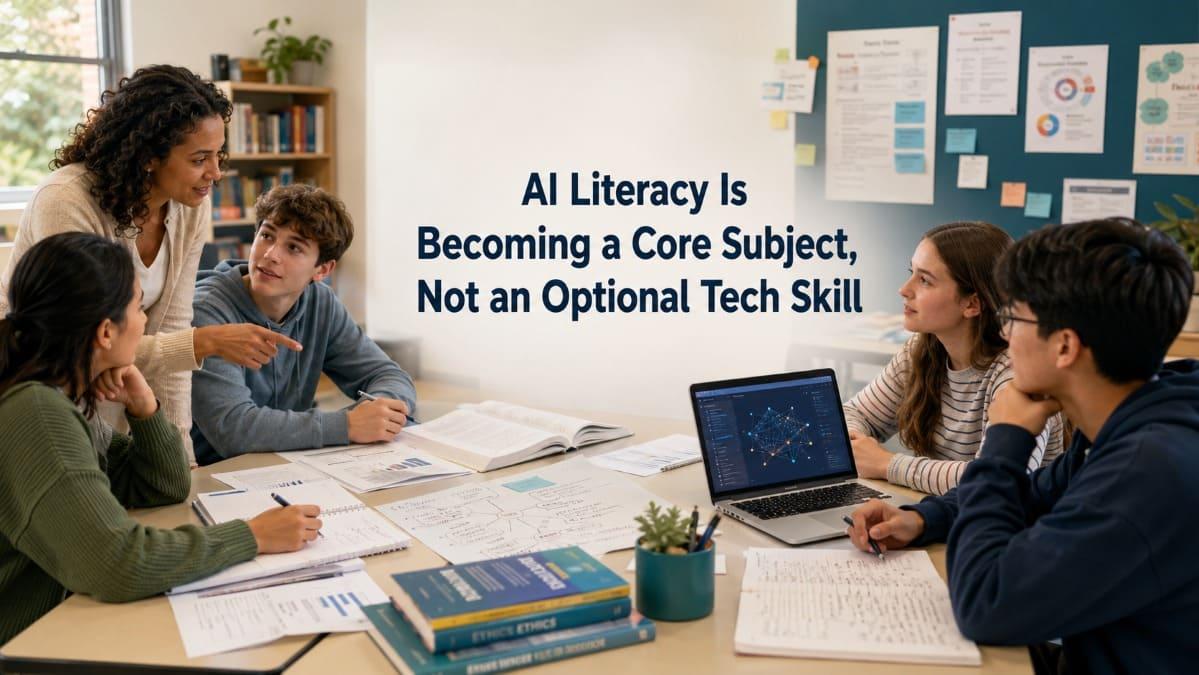
AI literacy is the ability to understand how artificial
intelligence influences information, decisions, creativity, and learning—and to
use it with critical judgment. It is becoming relevant across the curriculum
because students encounter AI not only in dedicated tools, but also in search,
recommendation systems, writing platforms, assessment products, and everyday
digital services. Teachers, academic leaders, and curriculum designers
therefore need to look beyond short lessons on prompting. This article explains
the competencies students need, why AI literacy should be treated as a shared
educational responsibility, and how schools can begin integrating it into
existing subjects, teacher development, and learning infrastructure.
- Quick
Answer
- What
Does AI Literacy Actually Mean?
- Why
Is AI Literacy Becoming Core Learning?
- What
Should Students Learn About AI?
- How
Can Schools Integrate AI Literacy Across the Curriculum?
- Common
Misconceptions That Weaken AI Education
- A
Practical Starting Point for Schools
- FAQ
- Conclusion
Quick Answer
AI literacy is the combination of knowledge, skills, and
attitudes that enables people to understand artificial intelligence, evaluate
its outputs, use it responsibly, and make informed decisions about when it
should—or should not—be used.
It is becoming a core educational requirement because AI now
affects how students find information, produce work, communicate, and encounter
automated decisions. Knowing how to operate one chatbot is not enough. Students
also need to recognize unreliable outputs, question sources, understand that AI
systems are shaped by data and design choices, protect personal information,
disclose appropriate use, and retain responsibility for their conclusions.
Calling AI literacy a core subject does not necessarily mean
every school needs a standalone AI class. In many settings, it will be more
effective as a progression of competencies taught across language, science,
mathematics, social studies, computing, arts, and media literacy.
The operational challenge is significant: schools need
shared learning outcomes, prepared teachers, age-appropriate activities,
equitable access, and assessment methods that examine student reasoning rather
than merely detecting whether a tool was used.
What Does AI Literacy Actually Mean?
AI literacy is a broad educational competency that helps
learners understand, evaluate, use, and influence AI systems while retaining
human judgment and responsibility.
The definition matters because the phrase is often reduced
to “knowing how to use generative AI.” That interpretation focuses on immediate
tool operation but overlooks how AI systems generate outputs, why those outputs
can be wrong, whose data may be involved, and how automated systems can affect
other people.
The 2026 OECD–European
Commission AI Literacy Framework for Primary and Secondary Education
describes AI literacy as knowledge, skills, and attitudes that help learners
understand how AI works, critically evaluate its outputs, and use it ethically
and creatively. Its competencies are organized around four domains: engaging
with AI, creating with AI, managing AI, and shaping AI.
This is wider than technical proficiency.
|
Dimension |
Tool-focused training |
AI literacy |
|
Main question |
How do I use this application? |
How does AI affect this task, and should I use it? |
|
Knowledge |
Interface features and commands |
Data, models, limitations, uncertainty, and social context |
|
Output evaluation |
Whether the answer looks useful |
Whether it is accurate, supported, appropriate, and
potentially harmful |
|
Responsibility |
Following the tool’s instructions |
Applying human judgment, disclosure, privacy, and
accountability |
|
Transferability |
Often tied to one product |
Applicable across changing tools and situations |
|
Learning objective |
Complete a task with AI |
Make an informed decision about AI-supported work |
Prompting can be part of AI literacy, just as searching is
part of information literacy. Neither is the whole discipline.
A student may be able to produce a polished explanation with
a chatbot while being unable to verify the explanation, identify missing
evidence, or describe what intellectual work remains their own. Operational
fluency without critical understanding can create the appearance of competence
while concealing weak learning.
AI literacy begins where tool instructions end: with judgment about evidence, purpose, consequences, and human responsibility.

Why Is AI Literacy Becoming Core Learning?
AI literacy is becoming core learning because artificial
intelligence increasingly mediates the activities schools already expect
students to perform: finding information, interpreting evidence, writing,
creating, solving problems, and making decisions.
This shift is not confined to students who intend to study
computing. A history student may encounter an AI-generated summary containing
an invented quotation. A science student may use a system that presents a
confident explanation without showing the quality of its evidence. A young
person researching health, careers, or current events may receive personalized
information without understanding how it was selected.
AI literacy therefore has at least four educational
functions.
It protects the quality of learning
Generative systems can produce answers before students have
formed their own interpretation. When learners cannot distinguish assistance
from substitution, AI may reduce productive struggle—the effort involved in
recalling, comparing, revising, and explaining ideas.
The educational question is not simply whether AI was used.
It is whether the student still performed the cognitive work connected to the
learning objective. This distinction becomes important when schools begin rethinking
homework and independent practice in the age of generative AI.
It strengthens information judgment
AI-generated language can sound coherent even when the
underlying claim is unsupported. Students need habits such as checking original
sources, separating evidence from inference, recognizing uncertainty, and
comparing an AI response with other credible material.
These are familiar educational practices, but AI changes the
scale and speed at which plausible information can be generated. Source
evaluation can no longer be reserved for an occasional research project.
It prepares students for participation, not only employment
AI literacy is sometimes justified only through future job
requirements. Workforce preparation matters, but the civic case is equally
important.
Automated systems can influence what information people see,
how services are delivered, and how individuals are categorized. Students need
sufficient understanding to ask who designed a system, what data it uses, who
benefits, who may be excluded, and how a decision can be challenged.
It creates a more equitable baseline
Students do not encounter AI under equal conditions. Some
receive adult guidance, paid access, reliable connectivity, and opportunities
to discuss limitations. Others may rely on free tools, shared devices, or
unverified advice from peers and social media.
Leaving AI literacy to informal experimentation can deepen
these differences. A school-based curriculum cannot eliminate every access gap,
but it can provide a shared foundation of concepts, vocabulary, and responsible
practices.
When schools treat AI literacy as optional enrichment,
access to informed AI use depends heavily on students’ families, devices, and
informal networks. Core provision creates a more equitable baseline.
UNESCO makes a similar curricular argument. Its AI
Competency Framework for Students outlines 12 competencies across
human-centred thinking, AI ethics, AI techniques and applications, and AI
system design. The competencies progress from understanding to applying and
creating rather than assuming that exposure to a tool automatically produces
literacy.
What Should Students Learn About AI?
Students need more than a list of AI risks or a
demonstration of popular tools. A credible curriculum should develop several
connected forms of understanding.
Recognizing where AI is present
AI is not limited to chatbots. It may appear in search
rankings, translation, image editing, recommendations, automated feedback,
accessibility services, content moderation, and adaptive learning products.
Younger learners may begin by identifying situations where a
computer sorts, recommends, predicts, or generates. Older students can examine
the distinction between rule-based software, machine learning, and generative
models without needing to become machine-learning engineers.
Understanding how outputs are produced
Students should develop an age-appropriate mental model of
data, patterns, models, prompts, probability, and output generation. The
objective is not to explain every mathematical detail. It is to prevent the
mistaken belief that an AI system knows, understands, or verifies information
in the same way a person does.
For example, students using a language model should
understand that a fluent answer is not evidence that the answer is true.
Verification remains a separate task.
Evaluating accuracy, relevance, and evidence
Output evaluation should be taught through real subject
content. Students might compare an AI-generated historical account with primary
sources, test a generated mathematics explanation for hidden errors, or
identify unsupported claims in a science summary.
This approach makes AI literacy part of disciplinary
learning rather than an isolated digital-skills exercise.
Using AI without surrendering the learning process
Responsible use depends on the purpose of an assignment.
Generating possible interview questions may support preparation. Asking a
system to complete the interview analysis may bypass the intended learning.
Translating an instruction could improve access, while submitting generated
writing as original work could misrepresent authorship.
Students need to ask:
- What
am I expected to learn?
- Which
parts of the task may AI appropriately support?
- What
must I be able to explain independently?
- How
will I verify and disclose the assistance?
- Could
I complete the essential reasoning without the tool?
Understanding rights, data, and consequences
AI literacy includes awareness that personal data,
confidential school information, copyrighted materials, or information about
other people should not be entered into a system without appropriate
authorization.
Students should also examine bias, representation,
accessibility, environmental considerations, and the distribution of benefits
and harms. The depth should vary with age, but the central principle is stable:
an AI output can affect people beyond the person operating the tool.
UNESCO’s guidance calls for human-centred, age-appropriate
use and highlights data privacy, ethical validation, and pedagogical design as
institutional concerns. These principles are set out in its Guidance
for Generative AI in Education and Research.
|
Competency area |
What a learner should be able to do |
Example learning activity |
|
Recognition |
Identify where AI may influence a digital experience |
Examine how recommendations differ across accounts or
profiles |
|
Foundations |
Explain that AI outputs depend on data, models, and human
design |
Compare rule-based classification with pattern-based
classification |
|
Evaluation |
Check accuracy, evidence, bias, and missing context |
Fact-check a generated explanation against primary or
authoritative sources |
|
Purposeful use |
Select AI only when it supports the learning objective |
Compare an unaided draft, AI-supported revision, and final
student justification |
|
Responsibility |
Protect data and disclose relevant AI assistance |
Rewrite a workflow to remove personal or confidential
information |
|
Agency |
Question, reject, or challenge an AI-supported decision |
Discuss how an automated recommendation could be appealed
or improved |
|
Creation |
Design or adapt AI-supported work with clear human intent |
Build and test a simple classification activity using a
controlled dataset |

How Can Schools Integrate AI Literacy Across the Curriculum?
Schools can integrate AI literacy by defining shared
competencies and then teaching them through relevant subjects, year levels, and
learning activities. A separate course may be useful, but it should not become
the only place where students examine AI.
Use a cross-curricular model with clear ownership
If AI literacy is declared “everyone’s responsibility”
without assigning ownership, it can easily become no one’s responsibility.
Academic leaders need to specify which competencies are introduced, practised,
and assessed at each stage.
A practical distribution might include:
- Language
and humanities: authorship, argument quality, source verification, and
representation.
- Mathematics:
probability, patterns, error rates, data quality, and statistical claims.
- Science:
model limitations, reproducibility, evidence, and uncertainty.
- Computing:
data, algorithms, model development, testing, and system design.
- Arts:
creative intent, provenance, consent, attribution, and cultural influence.
- Social
studies: power, public decisions, fairness, rights, and accountability.
The same competency can appear in several subjects, but each
appearance should deepen the learner’s understanding rather than repeat a
generic warning about AI.
Build progression instead of one-off exposure
A primary learner may identify when a digital product is
making a recommendation. A lower-secondary learner may compare outputs and
investigate the data that could influence them. An upper-secondary learner may
evaluate model performance, social effects, and possible safeguards.
Progression helps schools avoid two common extremes: content
that is too technical for younger students and content that remains superficial
for older students.
Prepare teachers before expecting classroom consistency
Teachers need their own foundation in AI concepts, pedagogy,
ethics, and professional use. This does not require every teacher to become a
computer scientist. It does require enough confidence to evaluate a tool,
explain its limitations, design an appropriate activity, and respond when
student use affects assessment.
UNESCO’s AI
Competency Framework for Teachers organizes 15 competencies across five
dimensions: a human-centred mindset, AI ethics, AI foundations and
applications, AI pedagogy, and AI for professional learning.
The framework is a useful reminder that teacher preparation
cannot stop at a webinar introducing product features. Professional learning
needs examples from actual subjects, opportunities to test activities, and time
to compare judgments with colleagues.
Assess reasoning, not only the final artifact
When AI can generate polished text, images, code, and
presentations, the final product provides less evidence of how learning
occurred.
Assessment may need process evidence such as:
- source
notes and verification records;
- oral
explanation or questioning;
- drafts
showing substantive revision;
- reflection
on where AI was used and rejected;
- comparison
of alternative outputs;
- justification
of decisions;
- supervised
performance when independent capability must be established.
This does not mean documenting every click. Evidence
requirements should be proportionate to the learning objective and the level of
risk.
Support learning through consistent infrastructure
Schools may use a mobile learning or microlearning
environment to deliver short teacher modules, student scenarios, knowledge
checks, and updated guidance. This can make foundational instruction more
consistent across departments while leaving subject teachers responsible for
contextual application.
A platform is useful only when it supports the curriculum
and governance model. It cannot decide which use is pedagogically appropriate,
verify every external tool, or replace professional judgment.
FitAcademy
Build a Shared Foundation for Responsible Digital Learning
Explore how FitAcademy can support structured microlearning, teacher development, progress tracking, and consistent delivery across a school or education network.
Learn More About FitAcademyThe most scalable model separates common foundations from
subject application: shared modules establish vocabulary and expectations,
while teachers apply them to authentic disciplinary work.

Common Misconceptions That Weaken AI Education
The largest curriculum mistakes often begin with an
incomplete definition of the problem.
“AI literacy means teaching students to prompt”
Prompting can improve the relevance or format of an output,
but it does not establish that the output is accurate or that using it supports
learning. A prompt-first curriculum can quickly become outdated as interfaces
change.
Teach durable judgment first. Product-specific techniques
can then be introduced as temporary applications of those competencies.
“Students are digital natives, so they will learn this themselves”
Frequent technology use does not guarantee understanding of
data, model limitations, privacy, or automated influence. Students may learn
shortcuts through experimentation while missing the concepts needed to judge
whether those shortcuts are appropriate.
Schools should not confuse confidence with competence.
“Giving students access is the same as teaching AI”
Access may create opportunities, but unstructured use can
reinforce misconceptions. A meaningful learning activity needs a defined
objective, teacher guidance, evidence requirements, and reflection on what the
system changed.
The same principle applies to AI
tutors in education. Availability alone does not establish instructional
quality or safety.
“A ban removes the need for AI literacy”
Restrictions may be justified for particular ages, tools,
data, or assessments. However, a restriction does not teach students how to
respond when they encounter AI elsewhere.
Even schools that limit classroom use need students and
teachers to understand what is being restricted, why the restriction exists,
and how responsible use differs across contexts.
“One annual workshop is enough”
AI literacy requires progression and repeated application. A
single awareness session may establish vocabulary, but it rarely changes how
students evaluate evidence or how teachers design assessments.
Schools need a curriculum sequence, not an event calendar.
A school does not create AI-literate learners by giving them more AI. It creates them by teaching better decisions about AI.
A Practical Starting Point for Schools
A school can begin without redesigning the entire curriculum
or purchasing a large collection of AI products. A focused one-term pilot can
reveal what teachers and learners actually need.
1. Establish a baseline
Ask teachers and students where they encounter AI, what they
believe it can do, how they verify outputs, and which uncertainties repeatedly
arise. The purpose is not to police undisclosed use. It is to identify gaps in
understanding and practice.
2. Define a small set of learner outcomes
Select four to six outcomes appropriate to one age group.
For example, students might be expected to:
- identify
when AI may be involved;
- explain
why generated outputs can be unreliable;
- verify
a claim using credible sources;
- avoid
entering personal or confidential information;
- disclose
relevant AI assistance;
- explain
which parts of a task reflect their own reasoning.
These outcomes are more useful than a list of approved
products because they remain relevant when tools change.
3. Map outcomes to authentic subjects
Choose two or three subjects where the competencies can
support existing learning objectives. Avoid adding a detached “AI activity”
that consumes lesson time without deepening subject knowledge.
A history department might test source verification. A
science department might examine uncertainty and fabricated references. A
language department could compare editing assistance with authorship
substitution.
4. Give teachers protected preparation time
Provide concise foundational learning, sample activities,
and collaborative review. Teachers should be able to test an activity as
learners before using it in class.
Updated European
Commission guidelines on ethical AI and data use in teaching include
scenarios, guiding questions, legal context, and practical support for
educators with different levels of digital experience.
5. Collect evidence from the learning process
Review student explanations, verification strategies,
misconceptions, and teacher observations. Do not judge the pilot only by
engagement or tool usage.
The stronger question is: did students become better at
deciding when to trust, question, use, modify, or reject an AI output?
6. Improve before expanding
Use pilot evidence to refine learning outcomes, assessment
instructions, teacher support, and tool access. The resulting curriculum
decisions should then inform a more detailed school
AI use policy, rather than expecting a policy document to resolve every
pedagogical question in advance.

Start with competencies and learning evidence, not a
catalogue of tools. Tools will change faster than most curriculum review
cycles; the underlying judgments should remain useful.
FAQ
Is AI literacy the same as digital literacy?
No. AI literacy overlaps with digital, media, information,
and data literacy, but it adds specific understanding of AI-generated outputs,
model limitations, training data, automation, and human responsibility. Schools
can integrate it into existing digital-literacy provision, but simply teaching
online safety or software use will not cover the full competency.
Does AI literacy need to be a standalone subject?
Not necessarily. A dedicated course can build foundations,
especially where computing provision is strong, but AI also affects
subject-specific work. A combined model is often more practical: shared
foundational instruction establishes common concepts, while individual subjects
teach how those concepts affect evidence, authorship, problem-solving, and
professional practice.
At what age should students begin learning about AI?
AI literacy can begin in primary education when instruction
is age-appropriate. Young learners can identify recommendations, distinguish
human from computer-made choices, and discuss privacy. More technical concepts,
independent tool use, and complex ethical analysis can be introduced
progressively. Access decisions should also consider platform age requirements
and applicable regulations.
Do teachers need programming skills to teach AI literacy?
Most teachers do not need programming skills to teach
foundational AI literacy. They do need an accurate mental model of AI,
subject-relevant examples, evaluation methods, and guidance on privacy and
responsible use. Computing specialists remain important for deeper instruction
on data, algorithms, model design, and technical testing.
How should schools assess AI literacy?
Assessment should examine decisions and reasoning. Useful
evidence includes fact-checking, source comparison, explanation of limitations,
disclosure of assistance, analysis of potential harms, and justification for
using or rejecting AI. A student’s ability to produce an impressive AI-assisted
artifact is not sufficient evidence of literacy.
Can AI literacy prevent students from misusing generative AI?
It can reduce some misuse by improving understanding,
judgment, and expectations, but it cannot guarantee responsible behavior. Clear
assessment design, proportionate rules, teacher supervision, access controls,
and a supportive learning culture are still needed. AI literacy should be
treated as one part of a wider educational and governance response.
Conclusion
AI literacy is becoming core learning because AI now sits
inside the information and creative environments students use—not because every
learner needs to become an AI developer.
The educational priority is durable judgment. Students
should understand enough about AI to evaluate its outputs, protect information,
recognize its effects on other people, and decide when its use supports or
undermines a learning objective. Those abilities are relevant across subjects
and beyond school.
For academic leaders, this changes the planning question.
The task is no longer whether to offer an optional workshop on a popular tool.
It is how to build a coherent progression of student competencies, teacher
capability, assessment practices, and learning support.
Schools do not need to solve every AI-related issue at once.
They do need to establish a foundation that remains useful as products,
regulations, and classroom practices continue to change.
FitAcademy
Turn AI Awareness Into Structured Learning
Learn how FitAcademy can help institutions deliver consistent, mobile-first learning for educators and learners through structured modules, progress tracking, and scalable learning operations.
Learn More