A course page is often the point where education marketing,
SEO, learning design, and business conversion meet. For education businesses,
training providers, edtech marketers, and SEO teams, a good course page must do
more than describe a program. It needs to help search engines understand the
topic, format, provider, and learning value, while helping learners decide
whether the course fits their goals. This article explains how to structure
course pages with clear learning outcomes, audience fit, curriculum
information, trust signals, internal links, structured data, and platform
continuity. It also shows why course page clarity becomes more important when
an education brand wants to scale through a branded or white-label learning
platform.
- Quick
Answer
- What
Makes a Course Page Understandable?
- Why
Course Pages Are Different From Ordinary Landing Pages
- The
Essential Information Every Course Page Should Include
- How
to Structure a Course Page for Search Engines and Learners
- Learning
Outcomes Should Be Specific, Not Decorative
- Course
Page SEO Needs Technical and Content Clarity
- Structured
Data Can Help, But It Cannot Replace a Clear Page
- How
Course Pages Connect to a Branded Learning Platform
- Common
Course Page Mistakes Education Businesses Should Avoid
- Practical
Course Page Checklist for Education Teams
- FAQ
- Conclusion
Quick Answer
A good course page helps both search engines and learners
understand what the course teaches, who it is for, how it is delivered, what
learners can expect to achieve, and why the provider is credible. It should
include a clear course title, target audience, learning outcomes, curriculum
overview, delivery format, difficulty level, instructor or organization
information, duration, certificate details, pricing or enrollment path, FAQs,
and related learning options.
For SEO, the page should use descriptive titles, helpful
headings, crawlable content, relevant internal links, optimized metadata, and
accurate structured data where appropriate. For learners, the page should
reduce uncertainty. It should answer practical questions before asking for
enrollment.
The main trade-off is that course pages should not be
over-optimized at the expense of clarity. A page filled with keywords but
lacking course substance may attract visitors who do not convert. A stronger
course page combines search visibility with learning design, trust-building,
and a clear next step into the actual learning experience.
What Makes a Course Page Understandable?
A course page is a web page that explains a specific
learning offer so learners and search systems can understand the course topic,
audience, structure, format, provider, and expected learning value.
That definition is deliberately broader than “sales page.” A
course page may support enrollment, but its first job is comprehension. If
people do not understand the course, they are unlikely to trust it. If search
engines cannot interpret the page clearly, the course may be harder to discover
for relevant queries.
Schema.org defines a course as an educational sequence that
aims to build learners’ knowledge, competence, or ability. That definition is
useful because it reminds education businesses that a course is not merely a
content collection. It should imply progression, purpose, and learning value. Schema.org Course definition
A strong course page should answer several questions
quickly:
- What
is this course about?
- Who
is it designed for?
- What
problem does it help solve?
- What
will learners be able to do after completing it?
- How
is the course delivered?
- How
long does it take?
- Who
created or teaches it?
- What
proof or credibility supports it?
- What
should the learner do next?
For education businesses, this clarity matters because
course decisions are rarely instant. Learners often compare several options,
especially when the course involves career development, professional skills,
institutional training, certification, or paid access.

A course page becomes stronger when it is written like a
learning decision guide, not only like a promotional page.
Why Course Pages Are Different From Ordinary Landing Pages
A course page is different from an ordinary landing page
because it has to explain both the offer and the learning experience.
A standard landing page may focus on a single conversion
action: sign up, download, subscribe, or request a demo. A course page has more
educational responsibility. It needs to clarify skill level, learning sequence,
course scope, workload, instructor credibility, and learner fit.
This is especially true for training providers and education
businesses that serve professional learners or institutions. A decision-maker
may not only ask whether the course looks attractive. They may ask whether the
course can support staff development, compliance needs, community learning,
customer education, or workforce upskilling.
|
Page Type |
Main Purpose |
What Readers Usually Need |
|
Blog article |
Explain a topic or problem |
Understanding, examples, context, next reading |
|
Course page |
Explain a specific learning offer |
Outcomes, audience fit, curriculum, format, credibility,
enrollment path |
|
Program page |
Explain a broader learning pathway |
Course sequence, progression, eligibility, credential,
timeline |
|
Platform page |
Explain delivery infrastructure |
Features, branding, ownership, learner management,
scalability |
|
Demo/contact page |
Move serious prospects into conversation |
Fit, pricing direction, implementation expectations, next
step |
The practical implication is that course page SEO should not
copy generic landing page templates too closely. A short page with a hero
headline, three benefits, and a button may be enough for a simple lead magnet.
It is usually too thin for a meaningful education offer.
For example, a course titled “SEO for Education Businesses”
should not stop at “Learn SEO and grow your traffic.” It should explain whether
the course is for founders, marketing teams, content writers, course creators,
or institutional training providers. It should clarify whether it covers
keyword research, course page optimization, topical authority, internal
linking, analytics, or technical SEO basics.
That level of specificity helps learners. It also gives
search engines more context.
The clearer the learning offer, the easier it is for the right learner to recognize it.
Readers who are still shaping their broader search strategy
can start with SEO
for Education Businesses: How to Make Your Courses Easier to Find.
The Essential Information Every Course Page Should Include
A useful course page should make the learning offer visible
without forcing the reader to guess.
Some education businesses hide important details because
they want visitors to contact sales first. That can work for complex enterprise
training, but for many online courses and professional programs, too little
information creates friction. Learners may leave because they cannot understand
the level, format, or expected outcome.
A practical course page should include the following
elements.
|
Course Page Element |
Why It Matters |
Example of Clear Information |
|
Course title |
Helps search engines and learners identify the topic |
SEO for Education Businesses |
|
Short course description |
Gives quick context |
Learn how education providers can improve course discovery
through SEO |
|
Target learner |
Reduces mismatch |
For training providers, edtech marketers, and content
teams |
|
Learning outcomes |
Explains expected competence |
Build a topic cluster, improve course pages, plan internal
links |
|
Curriculum overview |
Shows structure |
6 modules covering keywords, content clusters, course
pages, and analytics |
|
Delivery format |
Sets learning expectations |
Self-paced microlearning, live cohort, blended training,
or mobile-first course |
|
Difficulty level |
Helps learners self-select |
Beginner, intermediate, advanced, or role-specific |
|
Duration or workload |
Helps planning |
2 hours total, 4 weeks, or 10 short lessons |
|
Instructor/provider credibility |
Builds trust |
Instructor background, organization experience, industry
relevance |
|
Certificate details |
Clarifies credential value |
Completion certificate available after quiz and course
completion |
|
Enrollment path |
Makes next action obvious |
Join course, request access, contact provider, or explore
platform |
|
FAQ |
Removes decision friction |
Pricing, access duration, certificate, prerequisites,
support |
This information should be visible on the page, not only
hidden in images, PDFs, popups, or checkout flows. Search systems rely heavily
on accessible page content. Learners also need to scan details quickly,
especially on mobile.
For course providers using a branded learning platform,
these elements should ideally connect to the actual platform experience. If the
course page promises short lessons, certificates, mobile access, and progress
tracking, the learning environment should support those expectations.

How to Structure a Course Page for Search Engines and Learners
A course page should be structured in a way that supports
both scanning and decision-making.
The top of the page should answer the most important
questions quickly. Deeper sections can then explain curriculum, outcomes,
instructor credibility, testimonials, FAQs, and related courses. This is not
only a design issue. It affects how people understand the offer and how search
engines interpret the page.
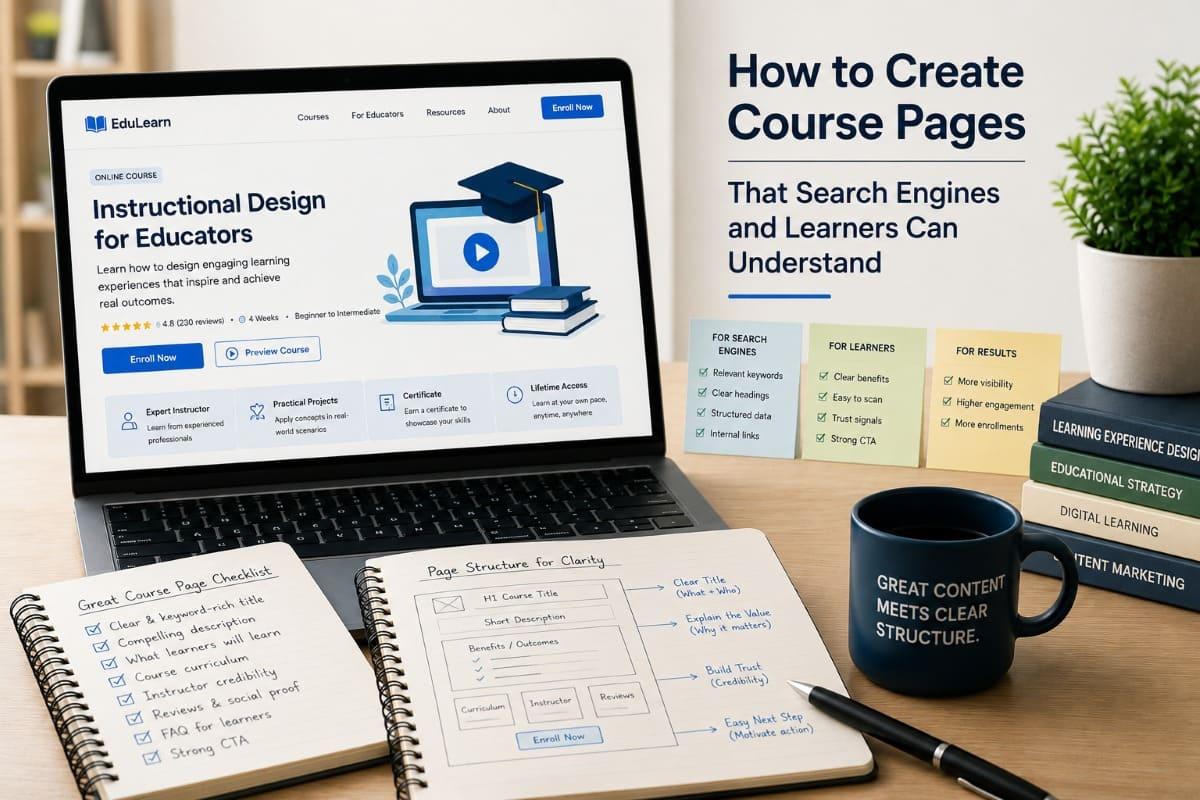
A practical course page structure may look like this:
- Hero
section with course title and concise value proposition
- Short
explanation of who the course is for
- Key
learning outcomes
- Curriculum
or module overview
- Delivery
format and learning experience
- Instructor
or provider credibility
- Certificate,
completion, or assessment information
- Pricing
or access model, where appropriate
- FAQ
section
- Related
articles, courses, or learning pathways
- Enrollment
or contact CTA
This structure should not become a rigid template for every
course. A short free introductory course may need a lighter page. A
professional certification program may need more detail, including
prerequisites, assessment requirements, cohort schedule, employer relevance, or
institutional support.
Start with a descriptive course title
The course title should be understandable without extra
context. “Growth Mastery” may sound attractive, but “SEO for Education
Businesses” is clearer. If the brand wants a creative title, pair it with a
descriptive subtitle.
Google’s documentation on title links explains that the
title link is the headline shown in search results and can influence whether
users click. Google may use the title element, headings, and other page signals
to generate that title link. Google
title link guidance
Use headings that reflect learner questions
Headings should help readers scan the page. Instead of using
vague labels such as “Overview” or “Benefits” everywhere, use headings that
clarify the decision.
Examples:
- Who
Is This Course For?
- What
Will You Learn?
- How
Is the Course Delivered?
- What
Do You Receive After Completion?
- What
Should You Know Before Joining?
This approach supports both readability and answer
extraction.
Make the CTA match the learner’s readiness
Not every course page should push immediate enrollment. Some
visitors need more information. Some institutional buyers need a discussion.
Some creators need to compare platform options.
For a white-label learning platform context, the CTA may be
“Explore White-Label Learning Platform” or “Request a Platform Consultation”
rather than “Buy Now.”
FitAcademy
Turn Course Pages Into a Branded Learning Experience
FitAcademy helps education businesses and training providers move beyond static course pages by connecting course discovery, enrollment, mobile learning, progress tracking, and branded learner engagement inside one platform.
Explore FitAcademy White LabelLearning Outcomes Should Be Specific, Not Decorative
Learning outcomes explain what learners should be able to
understand, apply, or produce after completing the course. They should be
specific enough to help learners decide whether the course is worth their time.
Many course pages use vague outcomes such as:
- Improve
your skills
- Understand
the basics
- Learn
from experts
- Grow
your business
- Become
more confident
These statements may be emotionally appealing, but they are
too broad to support a serious learning decision. A better course page explains
outcomes in observable terms.
For example:
|
Weak Outcome |
Stronger Outcome |
|
Learn SEO |
Identify relevant search intent for an education business |
|
Improve your course page |
Structure a course page with audience, outcomes,
curriculum, FAQ, and CTA |
|
Understand content strategy |
Map a topic cluster around learner problems and related
course offers |
|
Grow your visibility |
Connect blog content, internal links, and course pages
into a clearer discovery path |
Specific outcomes help several audiences at once.
For learners, they clarify value.
For employers, they clarify training relevance.
For instructors, they guide curriculum design.
For SEO teams, they provide meaningful content for the page.
For AI-assisted search systems, they make the course easier to summarize
accurately.
A vague outcome may sound attractive, but a specific outcome
helps learners decide whether the course matches the skill they actually need.
This is also where course page SEO and instructional design
overlap. A course page that cannot explain its outcomes may be exposing a
deeper curriculum problem. The issue may not be copywriting. It may be that the
course itself needs clearer structure.
Course Page SEO Needs Technical and Content Clarity
Course page SEO depends on both what the page says and how
the page is built.
A beautifully written course page can still underperform if
search engines cannot crawl it, if content is hidden behind scripts, if
metadata is duplicated, or if the page loads slowly on mobile. At the same
time, a technically clean page can still fail if it does not explain the course
clearly.
Google’s SEO Starter Guide describes SEO as helping search
engines crawl, index, and understand content. It also highlights clear titles,
useful descriptions, meaningful links, and helpful content organization. Google
SEO Starter Guide
For education businesses, practical course page SEO
includes:
- one
clear H1 that matches the course topic
- concise
and unique title tag
- useful
meta description
- descriptive
URL slug
- crawlable
course information
- clean
heading hierarchy
- internal
links to related articles and courses
- optimized
images with descriptive alt text
- fast,
mobile-friendly page experience
- FAQ
content that answers real learner questions
- structured
data where suitable
Meta descriptions are not a direct promise of ranking, but
they can influence how a page is summarized in search results. Google states
that it may use a meta description tag for snippets when it gives users a more
accurate description than page text alone. Google meta
description guidance
The practical point is simple: write metadata for humans
first. A course meta description should tell the learner what the course
covers, who it is for, and why it may be relevant.
Example:
“Learn how education businesses can improve course discovery
with SEO, stronger course pages, topical authority, and internal linking.”
That is clearer than:
“Best SEO course for online education business training
provider SEO learning marketing growth.”

Structured Data Can Help, But It Cannot Replace a Clear Page
Structured data can help search engines understand the
content of a course page or course list, but it should accurately reflect
visible page content.
Google explains that structured data helps it understand
page content and may support richer search result appearances when eligible.
Google also notes that structured data does not guarantee special search
features. Google
structured data introduction
For education businesses, structured data may be relevant
when pages describe courses, course lists, organizations, breadcrumbs, FAQs, or
articles. The exact schema choice depends on the page type.
|
Page Type |
Possible Schema Type |
Practical Use |
|
Individual course page |
Course, CourseInstance, BreadcrumbList |
Helps describe course topic, provider, delivery mode, and
page hierarchy |
|
Course category page |
ItemList, Course, BreadcrumbList |
Helps organize multiple courses in one topic or category |
|
Blog article |
Article, BlogPosting, FAQPage where appropriate |
Helps define editorial content and answer sections |
|
Education organization page |
Organization, EducationalOrganization |
Helps clarify provider identity |
|
FAQ section |
FAQPage where eligible and appropriate |
Helps structure common questions and answers |
Google’s course structured data documentation is
specifically about marking up course lists so students can find courses on
Google Search. The documentation also makes clear that Google does not
guarantee that structured data features will appear in search results. Google
Course structured data guidance
A practical caution: do not add schema that exaggerates or
misrepresents the course. If the page does not clearly show a certificate,
instructor, price, duration, or course mode, the markup should not invent those
details.
For a course page, structured data works best when it
mirrors a well-written page. It is a reinforcement layer, not a replacement for
content clarity.
Structured data helps machines understand the page; clear content helps people trust it.
How Course Pages Connect to a Branded Learning Platform
A course page creates expectation. The platform experience
either confirms or weakens that expectation.
This matters for education businesses that want to scale
beyond manual delivery. If a course page promises mobile access, structured
lessons, progress tracking, certificates, or cohort support, the learning
platform should make those features easy to experience.
A disconnected flow can hurt trust. For example:
- The
course page looks professional, but registration is manual and confusing.
- The
page promises short lessons, but videos are stored across scattered links.
- The
page mentions certificates, but completion rules are unclear.
- The
page says mobile-friendly, but the learning experience is hard to use on a
phone.
- The
page describes a branded academy, but the learner is redirected into a
generic third-party environment.
A branded or white-label learning platform can make the
course journey more coherent. The course page can introduce the learning offer,
while the platform continues the experience through enrollment, lessons,
quizzes, progress, badges, certificates, and ongoing learner communication.
For FitAcademy, this is where course page strategy connects
with platform ownership. A provider can use SEO to attract better-fit learners,
then use a branded learning environment to deliver the course in a way that
reinforces trust.
|
Course Page Promise |
Platform Capability Needed |
|
Learn in short lessons |
Microlearning structure and mobile-friendly access |
|
Track your progress |
Learner progress dashboard |
|
Complete assessments |
Quiz or assessment module |
|
Receive completion proof |
Certificate or badge system |
|
Learn under a trusted brand |
White-label branding and consistent learner interface |
|
Continue to related courses |
Course categories, pathways, and internal recommendations |
Education businesses evaluating this path can explore white-label learning platform for training
providers as the platform layer that connects course discovery with branded
learning delivery.
Common Course Page Mistakes Education Businesses Should Avoid
Course page mistakes usually happen when teams think only
from the provider’s perspective. A provider knows the course, the instructor,
the curriculum, and the intended audience. A new visitor does not.
Mistake 1: Using a clever title that hides the course topic
Creative naming can support branding, but it should not
obscure meaning. A title like “Visibility Accelerator” may need a subtitle such
as “SEO Training for Education Businesses and Training Providers.”
Mistake 2: Writing benefits without explaining outcomes
Benefits such as “grow your business” or “learn faster” can
be useful, but they need support from specific outcomes. Learners want to know
what they will actually understand, practice, or produce.
Mistake 3: Hiding important details until checkout
If duration, format, prerequisites, certificate information,
or access rules are unclear, learners may hesitate. Transparency is especially
important for paid courses and professional training.
Mistake 4: Treating all learners as the same
A course may serve beginners, intermediate learners,
managers, creators, or institutional teams. If the page does not clarify fit,
it may attract the wrong audience or discourage the right one.
Mistake 5: Adding schema without fixing the visible content
Structured data should reflect page content. If the visible
page is vague, schema alone will not solve the learner’s decision problem.
Mistake 6: Forgetting internal links
A course page should not stand alone. It should link to
relevant articles, prerequisite courses, next courses, and broader learning
pathways. For practical guidance, see How
to Structure Internal Links for Education Content Clusters.
A weak course page often creates two problems at once:
search engines receive limited context, and learners receive limited
confidence.
Practical Course Page Checklist for Education Teams
A practical course page review should combine SEO, learning
design, and conversion clarity.
Use this checklist before publishing or improving a course
page.
Course identity
- Is
the course title clear?
- Does
the URL slug reflect the course topic?
- Is
the H1 specific and understandable?
- Does
the first section explain the course in plain language?
Learner fit
- Does
the page explain who the course is for?
- Does
it mention the expected level?
- Are
prerequisites clear?
- Does
it clarify whether the course is for individuals, teams, institutions, or
creators?
Learning value
- Are
learning outcomes specific?
- Is
the curriculum visible?
- Does
the course structure show progression?
- Are
assessment, certificate, or completion rules explained?
SEO and discoverability
- Is
the title tag unique?
- Is
the meta description helpful?
- Are
headings descriptive?
- Is
the page content crawlable?
- Are
images optimized with meaningful alt text?
- Are
internal links relevant?
- Is
structured data accurate where used?
Trust and conversion
- Is
the instructor or provider credibility visible?
- Is
pricing or access explained where appropriate?
- Are
FAQs included?
- Is
the CTA aligned with learner readiness?
- Does
the next step lead to a coherent learning experience?
This checklist should not be used once and forgotten. Course
pages should be reviewed when courses change, when learner questions repeat,
when search data reveals mismatch, or when the platform experience improves.

FAQ
What should an SEO-friendly course page include?
An SEO-friendly course page should include a clear title,
target audience, course description, learning outcomes, curriculum overview,
delivery format, difficulty level, duration, instructor or provider
credibility, certificate details, FAQs, internal links, metadata, and accurate
structured data where appropriate. The page should be readable for learners and
crawlable for search engines.
How is a course page different from a landing page?
A landing page usually focuses on a single conversion
action. A course page must also explain the learning experience. It should
clarify who the course is for, what learners will gain, how the course is
structured, how it is delivered, and what happens after enrollment.
Does course schema guarantee better ranking?
No. Course schema can help search engines understand
course-related information, but it does not guarantee ranking or rich results.
The visible page still needs useful content, accurate information, technical
accessibility, and a clear learner experience. Schema should support the page,
not replace it.
Should every course have its own page?
In most cases, yes, especially when each course targets a
distinct topic, audience, or learning outcome. A dedicated page gives search
engines and learners clearer context. However, very small course catalogs may
also benefit from a strong course list page that links to individual course
detail pages.
How long should a course page be?
A course page should be long enough to answer the learner’s
key decision questions, but not padded for word count. A short introductory
course may need a concise page, while a professional program may require more
detail about curriculum, prerequisites, assessments, certificates, instructors,
and institutional use.
How does a white-label learning platform improve course pages?
A white-label learning platform improves course pages when
it connects the marketing promise to the actual learner experience. The course
page can explain the offer, while the platform supports enrollment, mobile
learning, progress tracking, quizzes, certificates, branding, and continued
learner engagement.
Conclusion
A course page is one of the most important assets in an
education business website because it sits between discovery and learning.
If the page is vague, learners may not understand the value.
If it is technically weak, search engines may struggle to interpret it. If it
promises more than the platform can deliver, trust may weaken after enrollment.
A strong course page avoids these problems by combining clear information,
specific outcomes, thoughtful structure, SEO fundamentals, accurate schema, and
a coherent next step.
For education businesses, the goal is not only to make a
course page rank. The deeper goal is to help the right learner understand the
course quickly, trust the provider, and continue into a learning experience
that matches the promise.
That is why course page optimization should involve more
than SEO teams. It should involve content strategists, curriculum teams,
product owners, instructors, designers, and platform managers. When these roles
work together, a course page becomes more than a marketing asset. It becomes
the front door to a stronger learning ecosystem.
FitAcademy
Build Course Pages Around a Real Learning Experience
FitAcademy helps education businesses and training providers launch branded learning platforms where course pages, mobile learning, learner progress, assessments, and certificates can work together more coherently.
Explore FitAcademy White Label