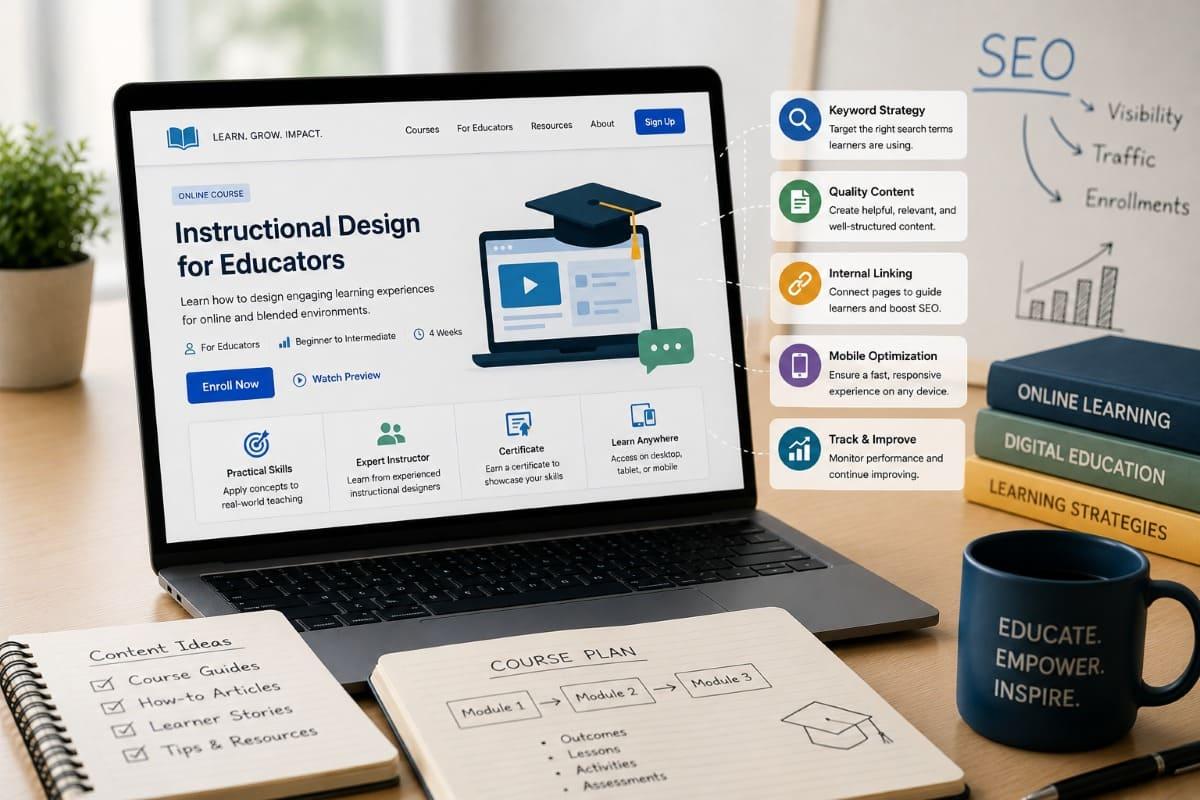
SEO for education businesses is not only about ranking a
course page for a few keywords. It is about making programs, expertise,
learning outcomes, and brand credibility easier for the right learners to
discover, understand, and trust. For training providers, academies, edtech
teams, and content strategists, search visibility affects how people find
courses before they are ready to enroll. This article explains how education
businesses can approach SEO with clearer content structure, learner-focused pages,
topical relevance, technical accessibility, and a stronger connection between
marketing content and learning platform strategy.
- Quick
Answer
- What
SEO Means for Education Businesses
- Why
Course Discovery Is Different From General Website Traffic
- The
Search Visibility Foundation Education Brands Often Miss
- How
Content Helps Learners Understand Your Expertise Before They Enroll
- Course
Pages Need Clarity Before Optimization
- SEO,
Brand Trust, and Platform Ownership Work Together
- Common
SEO Mistakes Education Businesses Should Avoid
- Practical
SEO Workflow for Education Businesses
- FAQ
- Conclusion
Quick Answer
SEO for education businesses is the process of improving how
easily learners, organizations, and decision-makers can find and understand
courses, programs, and learning expertise through search engines and
AI-assisted search experiences. It combines keyword research, helpful content,
clear course pages, internal linking, technical accessibility, structured data,
and trust-building signals.
For education providers, SEO matters because learners rarely
enroll after seeing one page. They usually compare options, check credibility,
search for learning outcomes, evaluate delivery format, and look for proof that
the provider understands their problem. Good SEO helps each stage become easier
to navigate.
The main trade-off is that education SEO cannot rely only on
traffic volume. A broad keyword may bring visitors who are not ready,
qualified, or relevant. A more useful SEO strategy connects discovery content,
course pages, learning outcomes, instructor credibility, and platform
experience into one coherent journey.
What SEO Means for Education Businesses
SEO for education businesses is a visibility strategy that
helps courses, programs, instructors, and learning resources become easier to
discover through search engines in order to attract better-fit learners and
institutional buyers.
That definition matters because education is not a simple
product category. A learner does not only ask, “What course is available?” They
may also ask:
- Is
this provider credible?
- What
will I be able to do after completing the course?
- Is
the course beginner-friendly or advanced?
- Is
it self-paced, live, blended, mobile-first, or cohort-based?
- Is
there a certificate?
- Is
the learning experience structured enough to keep me engaged?
- Can
this provider support a team, community, or institution?
A fashion business selling a shirt can optimize product
pages around size, color, fabric, price, and shipping. An education business
has to explain value in a less tangible way. It has to make knowledge,
transformation, skill development, and learning support visible.
That is why SEO for education businesses sits between
marketing, curriculum design, content strategy, and learning operations. A
course may have strong instructors and useful material, but if the website does
not explain the problem, the audience, the outcomes, and the learning path
clearly, search engines and learners both have less information to work with.
Google’s own Search Essentials emphasize helpful, reliable,
people-first content, relevant wording in prominent locations, crawlable links,
and basic accessibility for discovery. These are not education-specific rules,
but they are especially relevant for course providers because course value
often depends on clear explanation rather than impulse demand.

For education businesses, SEO is not only a traffic channel.
It is a way to organize expertise so learners can understand why a course
exists, who it is for, and what it helps them achieve.
Why Course Discovery Is Different From General Website Traffic
Course discovery is different because learners often search
with uncertainty. They may know the problem they want to solve, but not the
exact course name, provider, format, or skill pathway they need.
A training provider may want to rank for “digital marketing
course,” but the learner may actually search for:
- how
to learn SEO for small business
- beginner
digital marketing course with certificate
- online
training for marketing staff
- short
course for content marketing strategy
- how
to improve business visibility on Google
- best
way to train sales team online
These searches are not identical. Some are informational,
some are commercial, and some come from managers comparing training options for
a team. If the website only has one general course page, it may not answer
enough of those search contexts.
This is where education SEO becomes strategic. An education
brand needs different content assets for different stages of discovery. A
beginner may need a simple explainer. A manager may need a comparison page. A
professional learner may need outcome details, instructor credentials,
curriculum depth, certificate information, and examples of practical
application.
A course is easier to find when the problem, outcome, audience, and learning path are all visible.
Search visibility also depends on how well content connects.
A blog article can explain the problem. A course page can present the offer. A
resource guide can build trust. A learning platform can support onboarding,
progress, completion, and continued engagement.
For FitAcademy’s broader content cluster, this article
introduces the foundation. The next layer is how
to build topical authority for an education brand, which looks more deeply
at how multiple related articles strengthen expertise signals over time.
The Search Visibility Foundation Education Brands Often Miss
Many education businesses start SEO too late. They publish
courses first, then try to “add SEO” afterward by adjusting titles, meta
descriptions, or a few keywords. That can help, but it is rarely enough.
The stronger foundation begins earlier: with how the
education business defines its audience, learning outcomes, content categories,
and course architecture.
An education SEO foundation usually needs five connected
layers.
|
SEO Layer |
What It Means for Education Businesses |
Practical Example |
|
Audience clarity |
Define who the course is for and what problem they want
solved |
Beginner teachers, training managers, creator educators,
HR teams |
|
Keyword intent |
Map searches by learner stage, not only search volume |
“What is microlearning?” vs “white-label learning platform
for training providers” |
|
Content structure |
Organize articles, guides, and course pages around related
learning needs |
A cluster on SEO, course pages, topical authority, and
internal links |
|
Technical accessibility |
Make pages crawlable, readable, fast, and mobile-friendly |
Clean URLs, indexable content, descriptive titles,
optimized images |
|
Trust signals |
Show credibility, experience, outcomes, and transparent
details |
Instructor profile, syllabus, certificate info, learning
format, organization background |
The operational implication is simple: SEO cannot sit only
with the content writer. It often requires coordination between marketing,
curriculum, product, design, and technical teams.
For example, a course page may need information from the
instructor, pricing from the business team, schema markup from the developer,
design clarity from the UI team, and internal links from the content
strategist. When these pieces are disconnected, course visibility becomes
inconsistent.
Google’s SEO Starter Guide frames SEO as a set of
improvements that help a site’s presence in Search, while also noting that
Search Essentials are about eligibility rather than guaranteed visibility. That
distinction is important for education businesses: SEO improves
discoverability, but no legitimate SEO process can guarantee ranking or
enrollment.

How Content Helps Learners Understand Your Expertise Before They Enroll
Educational content works best when it helps people make
sense of a problem before asking them to buy a solution.
For an education business, blog content should not merely
attract visitors. It should prepare learners to understand the value of a
course, a learning path, or a platform. That means the content needs to answer
real questions with enough depth to show expertise.
A training provider offering SEO courses, for example,
should not rely only on a course sales page. It may need supporting content
that explains:
- what
SEO means for different types of businesses
- how
beginners should approach keyword research
- why
technical SEO affects visibility
- how
content clusters build authority
- how
to measure whether SEO training is working
- what
business owners often misunderstand about search traffic
These articles do more than fill a blog. They create
context. They help a learner see the provider’s thinking, teaching style, and
practical judgment.
This is especially important for education brands that sell
higher-consideration programs, institutional training, certification pathways,
or white-label learning experiences. Buyers in these categories are not only
looking for a course. They are evaluating whether the provider understands
their operational reality.
Content should not only answer “what is this topic?” It
should help learners decide whether the provider understands their context well
enough to guide them.
This is also where SEO and learning design overlap. A good
learning article often works like a preview of the provider’s instructional
quality. If the article is clear, structured, specific, and practical, the
reader may reasonably expect the course experience to follow similar standards.
FitAcademy
Learn How FitAcademy Supports Branded Learning Growth
FitAcademy helps education businesses, creators, and training providers organize learning content into a branded digital experience that supports discovery, engagement, and long-term learner relationships.
Learn More About FitAcademyCourse Pages Need Clarity Before Optimization
A course page should not be treated as a thin landing page
with a title, price, and enrollment button. It is often the most important
decision page in an education SEO journey.
Search engines need clear information to understand the
page. Learners need clear information to decide whether the course fits their
needs. The overlap between both needs is where strong course page SEO begins.
At minimum, an education course page should clarify:
- course
title
- target
learner
- learning
outcomes
- course
format
- difficulty
level
- curriculum
overview
- instructor
or provider credibility
- duration
or workload
- certificate
or completion details
- pricing
or enrollment path, where applicable
- related
courses or next learning steps
Google provides guidance for course list structured data so
course lists can be marked up in ways that help students find courses in
Search, and Schema.org defines a Course as an educational sequence intended to
build knowledge, competence, or ability. These references are useful because
they reinforce the same principle: course information should be explicit,
structured, and understandable.
That does not mean structured data alone will create
visibility. Structured data helps machines interpret content, but it does not
replace useful content, trustworthy information, or a clear learning offer.
Google also states that structured data can help Search understand page content
and may support rich results when eligible, but implementation must follow
relevant guidelines.
For a deeper practical guide, this cluster should connect
readers to how
to create course pages that search engines and learners can understand.
That sibling article can go into layout, content modules, metadata, structured
data, and conversion clarity in more detail.

SEO, Brand Trust, and Platform Ownership Work Together
SEO can bring people to your website, but the learning
experience determines whether they trust the brand enough to continue.
This is an overlooked issue for education businesses. A
provider may invest in content marketing and rank for useful queries, but then
send learners into a fragmented experience: a separate payment page, scattered
video links, manual WhatsApp groups, unbranded file folders, and inconsistent
completion tracking. That kind of workflow may work in the early stage, but it
becomes harder to scale.
A stronger education SEO strategy connects search discovery
to a reliable learning environment. When learners click from an article to a
course page, then into a branded platform, the experience should feel coherent.
The brand promise, course structure, mobile access, progress tracking,
certificate flow, and learner communication should support one another.
This is where a white-label learning platform becomes
relevant. For education businesses, platform ownership is not only a technical
decision. It affects brand trust, learner data, engagement, monetization, and
long-term content strategy.
|
Approach |
SEO Advantage |
Limitation to Consider |
|
Marketplace course listing |
May provide access to existing platform traffic |
Limited brand control and weaker direct learner
relationship |
|
Website plus manual delivery |
Flexible for early testing |
Harder to scale learner progress, completion, and
engagement |
|
Branded learning platform |
Stronger ownership of learning experience and learner
journey |
Requires clearer content operations and platform
management |
|
Custom-built platform |
High control when well executed |
Higher development cost, maintenance burden, and technical
risk |
The point is not that every education business needs the
same platform model. A small creator testing demand may begin with simple
tools. A training company serving institutions may need stronger branding,
learner management, reporting, and course organization much earlier.
SEO brings learners to the door; the learning experience determines whether they stay.
FitAcademy’s positioning as a white-label, mobile-first
learning platform is relevant here because education businesses often need more
than traffic. They need a place where discovered learners can actually learn,
progress, complete, and return.
For readers evaluating this direction, white-label learning platform strategy is a
useful next step.
Common SEO Mistakes Education Businesses Should Avoid
The most common SEO mistakes in education are not always
technical. Many are strategic.
Targeting broad keywords without learner intent
A keyword like “online course” may have high volume, but it
is too broad for most education businesses. A more useful strategy often starts
with specific problems, roles, skills, industries, or learning outcomes.
For example, “SEO course for education businesses” is
narrower than “SEO course,” but it may attract readers with clearer needs. The
trade-off is lower volume but better relevance.
Publishing isolated articles without a cluster plan
One article can rank, but a cluster builds broader
relevance. If an education brand publishes random posts across unrelated
topics, search engines and readers may struggle to understand what the brand is
truly expert in.
This is why clusters matter. A topic such as SEO for
education businesses can connect awareness, topical authority, course page
optimization, and internal linking. The structure helps readers move from
understanding the topic to applying it.
The sibling article on internal
links for education content clusters should cover this in more operational
detail.
Treating course pages like brochures
Many course pages describe what the provider wants to sell,
but not what the learner needs to understand. A stronger course page explains
the learner problem, the transformation, the structure, and the evidence of
credibility.
Overlooking mobile learners
Education discovery often happens on mobile devices,
especially when learners are browsing during breaks, commuting, or comparing
options outside formal work hours. A page that is difficult to read on mobile
can weaken both engagement and conversion.
For a mobile-first learning platform, this has a direct
operational implication: the search journey and the learning journey should
both work well on smaller screens.
Expecting SEO to fix a weak offer
SEO cannot compensate for unclear positioning, vague
learning outcomes, poor course structure, or a confusing enrollment process. It
can make a strong education offer easier to find. It cannot make an unclear
offer persuasive by itself.
When SEO fails for an education business, the problem is
often not only ranking. It may be unclear positioning, weak course information,
poor content structure, or a disconnected learning experience.
Practical SEO Workflow for Education Businesses
A practical SEO workflow should connect market demand,
educational expertise, course structure, and platform experience. It does not
need to begin with a large SEO team. It does need discipline.
Step 1: Define the education offer clearly
Before keyword research, clarify what the business teaches
and who it serves. A course for first-time entrepreneurs needs different
messaging from a professional certification program or corporate training
package.
The clearer the offer, the easier it becomes to identify
search intent.
Step 2: Map search intent to learner stages
Group keywords by stage:
- problem-aware
searches
- beginner
education searches
- comparison
searches
- course-specific
searches
- provider
evaluation searches
- enrollment
or demo-intent searches
This helps prevent every article from trying to sell too
early.
Step 3: Build a focused content cluster
Choose one macro topic and create a small set of connected
articles. A strong cluster does not need dozens of posts at the beginning. Four
well-structured articles can be more useful than twenty thin posts.
For this macro topic, the cluster works naturally:
- SEO
foundation for education businesses
- topical
authority for education brands
- course
page clarity
- internal
linking for education clusters
Each article has a distinct role. Together, they create a
more complete semantic footprint.
Step 4: Improve course pages after the content strategy
is clearCourse pages should reflect what the supporting articles
teach. If the blog explains learner problems, the course page should show how
the course solves them. If the blog explains learning outcomes, the course page
should present specific outcomes, modules, and completion paths.
Step 5: Connect SEO analytics with learning analytics
Search analytics can show which topics attract visitors.
Learning analytics can show what learners start, complete, revisit, or abandon.
When combined carefully, these signals can help education businesses improve
both acquisition and learning delivery.
For example, if many visitors arrive through a beginner
guide but few enroll in the related course, the issue may be the course page,
pricing, trust signals, or mismatch between content intent and offer.

FAQ
What is SEO for education businesses?
SEO for education businesses is the process of making
courses, programs, instructors, and learning resources easier to find and
understand through search engines. It includes content strategy, course page
optimization, technical SEO, structured information, internal linking, and
trust signals. The goal is not only traffic, but better-fit learner discovery.
Why do education businesses need SEO?
Education businesses need SEO because learners often
research before enrolling. They compare providers, formats, outcomes,
credibility, pricing, and learning support. SEO helps providers appear during
this research process and explain their value clearly before the learner
reaches a purchase or enrollment decision.
Is SEO enough to sell online courses?
SEO can support course sales, but it is not enough by
itself. The course offer, page clarity, pricing, instructor credibility,
learner journey, platform experience, and follow-up process also matter. SEO
brings visibility; conversion depends on whether the learning offer feels
relevant, credible, and easy to act on.
Should education businesses focus on blog articles or course pages first?
Most education businesses need both, but the priority
depends on the current problem. If people do not understand the topic or the
provider’s expertise, start with educational content. If traffic exists but
enrollment is weak, improve course pages. Ideally, blog content and course
pages should support the same learner journey.
How long does SEO take for an education business?
SEO timelines vary depending on competition, website
authority, content quality, technical health, and publishing consistency. New
education websites usually need time to build trust and topical depth. Rather
than expecting instant results, providers should treat SEO as a long-term
system for organizing expertise and attracting qualified learners.
Can structured data improve course visibility?
Structured data can help search engines understand
course-related information, but it does not guarantee ranking or rich results.
Education businesses should use structured data accurately, follow search
guidelines, and make sure the visible page content also clearly explains the
course, provider, format, and learning outcomes.
Conclusion
SEO for education businesses works best when it is treated
as part of the learning business system, not as a separate marketing trick.
A course becomes easier to find when the provider explains
the learner problem, builds relevant content, structures course pages clearly,
links related resources, and delivers a coherent learning experience after
discovery. Search visibility may begin with keywords, but it grows through
clarity, consistency, credibility, and operational follow-through.
For education businesses, training providers, and edtech
teams, the practical question is not simply, “How do we rank?” A better
question is: “Can the right learner find us, understand us, trust us, and
continue into a learning experience that matches the promise?”
That is where SEO connects naturally with platform strategy.
The more seriously an education brand treats learning delivery, the more
important it becomes to align discovery, content, course structure, learner
engagement, and platform ownership.
FitAcademy
Make Your Learning Business Easier to Discover and Understand
FitAcademy supports education businesses and training providers that want to build a clearer, branded learning experience around their courses, content, and learner relationships.
Learn More About FitAcademy