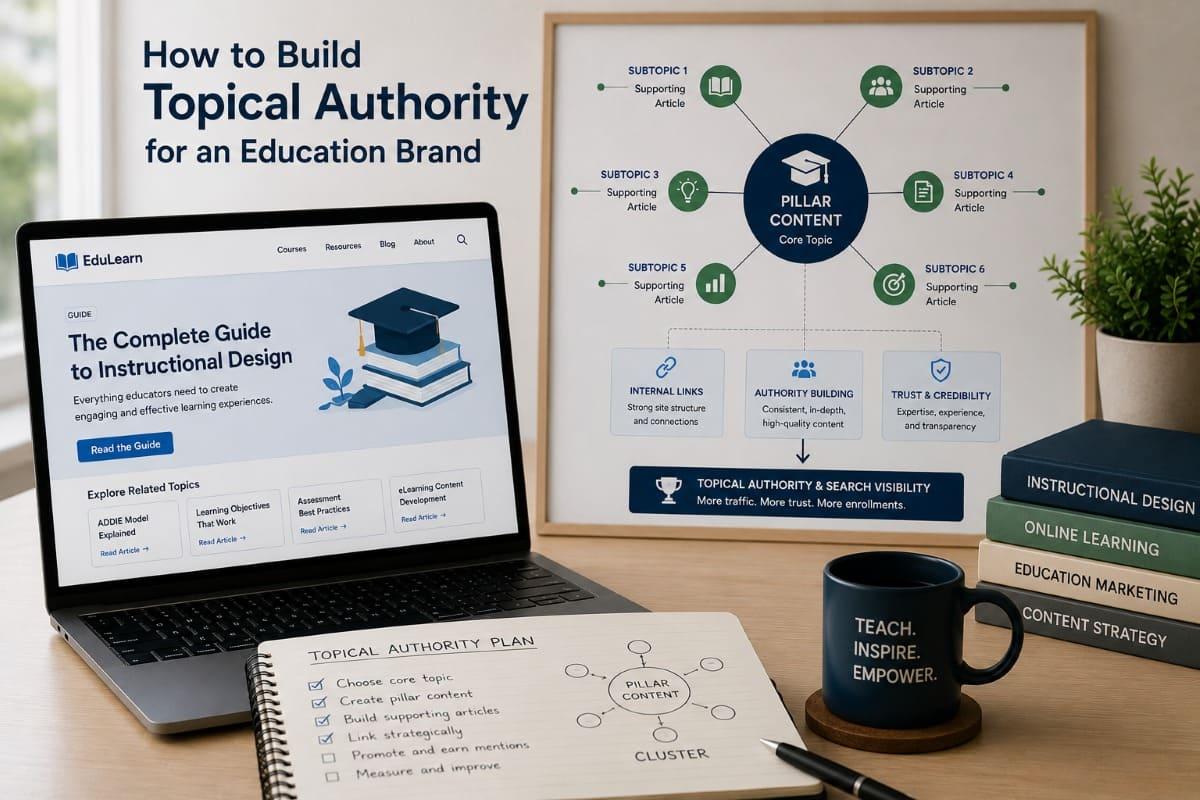
Topical authority helps an education brand become recognized
for a specific area of expertise, not only by search engines but also by
learners, institutions, and decision-makers. For education businesses, training
providers, edtech marketers, and content teams, this means creating connected,
useful, and well-structured content around the problems learners actually
search for. This article explains how education brands can build topical
authority through clear positioning, topic clusters, helpful content, internal
linking, course page alignment, and consistent learning experience design. It
also shows why topical authority is not just an SEO tactic, but part of a
broader education business strategy.
- Quick
Answer
- What
Topical Authority Means for Education Brands
- Why
Education Brands Need More Than Individual Articles
- Start
With a Clear Expertise Territory
- Build
Topic Clusters Around Learner Problems
- Connect
Blog Content, Course Pages, and Learning Pathways
- Internal
Linking Turns Content Into an Authority System
- How
Platform Experience Supports Brand Authority
- Common
Mistakes When Building Topical Authority
- Practical
Workflow for Building Education Topical Authority
- FAQ
- Conclusion
Quick Answer
Topical authority for an education brand means becoming
consistently associated with a specific field of knowledge through useful,
connected, and credible content. It is built when a brand explains a topic from
multiple angles, answers learner questions clearly, connects related articles
and course pages, and demonstrates practical expertise over time.
For education businesses, topical authority matters because
learners rarely trust a provider after reading one page. They often compare
explanations, look for learning outcomes, evaluate instructor credibility, and
check whether the provider understands their real context. A brand with
stronger topical authority can make this evaluation easier.
The operational trade-off is that topical authority requires
focus. Publishing many unrelated articles may create content volume, but it
does not necessarily build expertise signals. A stronger approach is to choose
a specific education topic, create a cluster of related content, connect it to
relevant courses or programs, and keep improving the content based on search
behavior, learner feedback, and business priorities.
What Topical Authority Means for Education Brands
Topical authority is the perceived depth, consistency, and
credibility of a brand’s content around a specific subject area. For an
education business, it means the brand is not only publishing content about a
topic, but organizing that topic in a way that helps learners understand it
progressively.
In practical terms, an education brand builds topical
authority when it can answer the surrounding questions that naturally appear
before, during, and after a learning decision.
A provider that teaches SEO, for example, should not only
publish one article titled “What Is SEO?” It may need content on keyword
research, course page optimization, technical SEO, local visibility, AI search,
content clusters, internal linking, analytics, and SEO for specific industries.
Each article should have a clear role, not merely repeat the same explanation
with different titles.
Google’s guidance on helpful, reliable, people-first content
emphasizes content created primarily to help people, rather than content
created mainly to manipulate search rankings. That matters for topical
authority because a shallow cluster built only around keyword variations is
unlikely to be as useful as one designed around real learner needs.
Topical authority is not built by saying more about
everything. It is built by saying the right things, in the right structure,
around a clearly owned area of expertise.
For education businesses, this is especially important
because trust is part of the product. A course, program, or learning platform
is not judged only by its features. It is judged by whether the provider
appears capable of guiding learners from confusion to competence.

Why Education Brands Need More Than Individual Articles
One good article can attract traffic. A connected body of
content can build authority.
This distinction matters because education buying behavior
is layered. A learner may discover a brand through a basic article, return
through a comparison guide, evaluate a course page, read an instructor profile,
and then join a program weeks later. A training manager may need even more
reassurance before choosing a provider for a team.
If the content is scattered, the brand feels scattered.
An education brand that publishes one article on SEO, one on
productivity, one on leadership, one on entrepreneurship, and one on learning
apps may generate isolated impressions. But unless those topics connect to a
clear expertise territory, the website may not communicate what the brand is
truly known for.
Topical authority helps solve this by creating a
recognizable knowledge map. It gives the website a stronger editorial
architecture. It also helps content teams avoid random publishing decisions.
|
Content Approach |
What Usually Happens |
Authority Impact |
|
Random article publishing |
Topics change based on trends, writer ideas, or short-term
keyword opportunities |
Weak topical identity |
|
Single pillar article |
One strong guide explains the main topic |
Useful, but limited coverage |
|
Topic cluster |
Several related articles cover different learner questions |
Stronger semantic depth |
|
Topic cluster linked to courses |
Content connects discovery, learning outcomes, and
enrollment paths |
Stronger business relevance |
|
Topic cluster linked to platform experience |
Content, courses, learner progress, and brand ownership
work together |
Stronger long-term education ecosystem |
Google’s SEO Starter Guide explains that SEO is about
improving a site’s presence in Search and making content easier for search
engines to crawl, index, and understand. For education brands, that principle
extends beyond technical access. The brand also needs a structure that helps
people and search systems understand the relationship between articles,
courses, and expertise areas.
A strong education brand does not publish isolated answers. It builds a map learners can follow.
For readers who are still at the earlier stage, the
foundation article SEO
for Education Businesses: How to Make Your Courses Easier to Find explains
why search visibility matters before this deeper authority-building work
begins.
Start With a Clear Expertise Territory
An expertise territory is the specific knowledge space an
education brand wants to be known for.
This is more precise than a broad category. “Education” is
too broad. “Online learning” is still broad. “Mobile-first microlearning for
training providers” is much clearer. “SEO for education businesses” is also
clearer because it connects the topic, audience, and business context.
A clear expertise territory helps content teams decide what
to publish, what to ignore, and how to connect articles into a coherent
cluster.
For example, an education brand might choose one of these
territories:
- SEO
for education businesses
- microlearning
for workforce training
- white-label
learning platforms for institutions
- course
monetization for expert creators
- mobile-first
learning for low-bandwidth audiences
- learning
content production for training providers
Each territory can produce multiple article clusters. But
the key is focus. A small education business usually gains more from owning one
narrow topic well than from lightly covering ten unrelated categories.
The narrower the first authority territory, the easier it is
to build depth, internal links, course relevance, and recognizable expertise.
This does not mean the brand can never expand. It means
expansion should follow a deliberate sequence. Once an education brand has
covered one topic deeply, it can move into adjacent topics that naturally
support the same audience.
For FitAcademy, this logic is important because the platform
serves institutions, creators, training providers, and organizations that want
branded learning experiences. The content strategy should therefore reinforce
themes such as white-label learning platforms, microlearning, mobile-first
training, creator education businesses, and scalable learning operations.

Build Topic Clusters Around Learner Problems
A topic cluster is a group of related content pieces that
collectively explain a subject from multiple useful angles. For an education
brand, the best clusters are usually built around learner problems, not only
around keywords.
This difference matters.
A keyword-led cluster might start with search volume and
produce similar articles that compete with one another. A learner-problem
cluster starts by asking what the audience needs to understand before making
progress.
For the macro topic “SEO for Education Business,” the
cluster can be structured like this:
|
Cluster Article |
Learner Problem Addressed |
Funnel Role |
|
SEO for Education Businesses: How to Make Your Courses
Easier to Find |
“Why are our courses not being discovered?” |
Awareness |
|
How to Build Topical Authority for an Education Brand |
“How do we become known for a topic?” |
Consideration |
|
How to Create Course Pages That Search Engines and
Learners Can Understand |
“Why do visitors not understand or trust our course
pages?” |
Practical Guide |
|
How to Structure Internal Links for Education Content
Clusters |
“How do we connect content so readers and search engines
understand the relationship?” |
Practical Guide |
This cluster works because each article has a different job.
The first introduces the search visibility problem. The second explains
authority building. The third improves course page clarity. The fourth turns
the content system into a connected architecture.
A weak cluster often repeats the same idea in slightly
different language. A strong cluster moves the reader forward.
What a strong education cluster should include
A useful education topic cluster should include:
- a
clear pillar or foundation article
- supporting
articles that answer related subtopics
- practical
guides for implementation
- internal
links between related pages
- course
pages connected to the content theme
- FAQ
sections that answer real decision questions
- visual
frameworks that make the topic easier to understand
- updated
content when learner needs or search behavior changes
The goal is not to create a large library immediately. It is
to create a structured body of content that feels intentional.
FitAcademy
Build Content Around a Clear Learning Strategy
FitAcademy helps education businesses and training providers connect content, courses, and learner journeys into a branded learning experience that supports long-term growth.
Learn More About FitAcademyConnect Blog Content, Course Pages, and Learning Pathways
Topical authority becomes more commercially useful when it
connects to actual learning pathways.
A blog article may attract a reader. A course page may
explain an offer. A learning pathway may show what comes next. When these three
elements work separately, the learner has to assemble the journey alone. When
they work together, the brand guides the learner with more confidence.
For example, a visitor reading about SEO for education
businesses may be ready for different next steps:
- A
beginner may need an introductory course.
- A
training provider may need a guide to course page optimization.
- A
content strategist may need internal linking workflows.
- An
edtech marketer may need a platform that supports branded learning
content.
- An
institution may need a structured training ecosystem for multiple learner
groups.
A strong education website does not force all of these
readers into the same CTA. It creates a logical path.
This is where course pages become important. A topic cluster
should eventually connect to a course page, program page, platform page, or
resource hub that helps the reader take the next step. The sibling article How
to Create Course Pages That Search Engines and Learners Can Understand
should cover this in more detail.
Google’s course structured data documentation notes that
course list markup can help students find courses through Google Search, but
structured data is only one layer. The visible page still needs clear, accurate
information about the course, provider, and learning value.

Internal Linking Turns Content Into an Authority System
Internal linking is what turns separate pages into a
connected authority system.
For education brands, internal links help readers move from
one learning question to another. They also help search engines discover
related pages and understand how content fits together. Google’s link best
practices explain that crawlable links help Google find pages and that clear
anchor text helps both people and Google understand content.
The operational lesson is straightforward: internal links
should not be added randomly after publishing. They should be planned as part
of the topic cluster.
A good internal link tells the reader what to do next. It
might move them from:
- a
beginner explanation to a practical guide
- a
blog article to a course page
- a
course page to related learning resources
- a
broad article to a more specific implementation topic
- a
content cluster to a platform or solution page
Anchor text matters. “Click here” is weak because it does
not describe the destination. “How to structure internal links for education
content clusters” is stronger because it tells readers and search engines what
the linked page is about.
For this cluster, the article How
to Structure Internal Links for Education Content Clusters should become
the practical guide that explains anchor choices, link depth, hub pages, course
links, and update routines.
Internal linking is not decoration. It is the infrastructure
that helps an education website behave like a guided learning environment.
This is one reason education SEO should borrow thinking from
instructional design. A learning experience is rarely a random pile of lessons.
It has sequence, prerequisites, reinforcement, and progression. A strong
content cluster should work in a similar way.
How Platform Experience Supports Brand Authority
A brand can build topical authority through content, but it
strengthens that authority when the learning experience matches the promise.
This matters because education brands are not only judged at
the search result level. They are judged through the full learner journey:
article, course page, registration, mobile access, learning interface, progress
tracking, certificate flow, reminders, support, and post-course engagement.
If the blog content feels professional but the learning
experience feels fragmented, trust can weaken.
For example, an education business may publish a strong
article cluster on workforce training. But if learners are then sent to
scattered video links, manual file downloads, and inconsistent communication,
the experience may not match the brand’s authority. This is not only a user
experience issue. It affects how learners remember the provider.
A branded learning platform can support topical authority in
several ways:
- It
gives learners a consistent place to continue after reading.
- It
helps organize courses around pathways or categories.
- It
reinforces the provider’s brand identity.
- It
supports mobile learning behavior.
- It
gives the business more control over learner relationships.
- It
can connect content strategy with learning analytics.
For FitAcademy, this connection is central. A white-label
learning platform allows an education business to build authority not only
through articles, but through a branded learning environment where content,
courses, and learner progress feel connected.
Authority becomes stronger when the learning experience proves the promise made by the content.
This is also why white-label
learning platform strategy is relevant for education brands that want more
control than a marketplace listing or scattered tool stack can provide.
Common Mistakes When Building Topical Authority
Topical authority is often misunderstood. Many teams treat
it as a content volume project, when it is really a structure and trust
project.
Mistake 1: Publishing many articles without a clear territory
More content does not automatically create authority. If the
website covers too many unrelated topics, each topic may remain shallow.
Education brands should start with a defined expertise territory, then expand
into adjacent topics deliberately.
Mistake 2: Creating articles that target keywords but not learners
A keyword can reveal demand, but it does not fully explain
the reader’s situation. An article that targets a phrase without answering the
underlying learner problem may attract traffic without building trust.
Mistake 3: Repeating the same article in different forms
This often happens when content teams create clusters too
mechanically. Four articles with different titles but the same explanation do
not create depth. Each article needs a distinct role.
Mistake 4: Ignoring course pages
A topic cluster should not end with content alone. If the
education brand offers courses or programs, the cluster should connect to
relevant course pages. Otherwise, the journey from discovery to learning
becomes weak.
Mistake 5: Treating internal links as an afterthought
Internal links should guide readers through related
concepts. If they are added casually or inconsistently, the cluster may feel
disconnected.
Mistake 6: Not updating old content
Authority is not static. Search behavior changes, course
offers evolve, and learner questions become more specific. Education brands
should review important articles periodically, especially pillar pages and
course-related content.
Practical Workflow for Building Education Topical Authority
A practical topical authority workflow should be simple
enough for a small content team to maintain, but structured enough to support
long-term growth.
Step 1: Choose one authority territory
Start with a topic that overlaps three things: audience
demand, business relevance, and genuine expertise.
For example, “SEO for education businesses” works if the
brand serves education providers and can offer practical guidance about
content, course pages, learner journeys, and platform visibility.
Step 2: Map learner questions
Before creating titles, list the real questions learners or
buyers ask. These questions may come from sales calls, customer support,
keyword research, course feedback, community discussions, or internal team
experience.
Examples:
- Why
are our courses not visible on Google?
- How
do we become known for a specific education topic?
- What
should a course page include?
- How
should we connect blog articles and course pages?
- How
do we know whether SEO is attracting the right learners?
Step 3: Design a small cluster
Create a focused cluster with three to five articles. Assign
each article a different intent. Avoid making every article awareness-level.
A balanced cluster might include:
- one
foundation article
- one
consideration article
- one
or two practical guides
- one
platform or decision-oriented article, if relevant
Step 4: Connect each article to the next logical action
Every article should have a role in the reader journey. A
foundation article may lead to a topical authority article. A topical authority
article may lead to internal linking or course page optimization. A practical
guide may lead to a platform page, demo page, or learning solution.
Step 5: Add authority signals
Authority signals should be real, not decorative. These may
include instructor experience, program examples, screenshots or diagrams,
transparent course details, updated publication dates, references to reliable
sources, and clear explanations of limitations.
Step 6: Review performance and learning behavior together
Search performance shows how people discover the content.
Learning behavior shows whether the content attracts the right audience.
Education brands should review both when possible.
If a cluster receives traffic but does not lead to course
engagement, the issue may be content intent, course relevance, page clarity,
pricing, trust signals, or weak CTAs. The answer is not always “publish more.”

FAQ
What is topical authority in SEO?
Topical authority in SEO is the perceived credibility and
depth a website has around a specific subject. It is built through useful
content, clear topic coverage, internal links, trustworthy information, and
consistent relevance. For education brands, it means becoming known for a
learning area rather than publishing isolated articles.
Why is topical authority important for education businesses?
Topical authority matters because education buyers need
trust before they enroll, subscribe, or choose a provider. A strong cluster of
related content helps learners see that the brand understands their problem,
can explain the topic clearly, and has a structured path toward learning or
implementation.
How many articles are needed to build topical authority?
There is no fixed number. A focused cluster of three to five
strong articles can be more useful than many shallow posts. The key is whether
the content covers meaningful learner questions, connects logically, and
supports the brand’s actual courses, programs, or learning platform.
Is topical authority the same as domain authority?
No. Topical authority refers to perceived expertise around a
subject area. Domain authority is a third-party metric used by some SEO tools
to estimate a website’s link strength or ranking potential. Education brands
should not confuse tool metrics with real topical depth, learner trust, or
content quality.
Can a new education brand build topical authority?
Yes, but it usually needs focus and consistency. A new
education brand should begin with a narrow expertise territory, publish a small
but strong cluster, link pages carefully, and connect content to clear learning
offers. Competing on broad topics too early can make progress slower.
How does a learning platform support topical authority?
A learning platform supports topical authority when it turns
content interest into a structured learning experience. Articles may attract
readers, but a branded platform can organize courses, track progress, support
mobile access, and reinforce the provider’s credibility after discovery.
Conclusion
Topical authority is one of the most useful SEO concepts for
education brands because it rewards clarity, depth, and structure. These are
the same qualities that good education businesses need anyway.
An education brand does not become credible by publishing
random articles around popular keywords. It becomes credible by choosing a
clear expertise territory, answering real learner questions, connecting related
content, aligning articles with course pages, and delivering a learning
experience that supports the promise made in search.
For training providers, edtech marketers, content teams, and
education business owners, topical authority should be seen as a long-term
asset. It can improve search visibility, but its deeper value is strategic: it
helps the market understand what the brand teaches, who it serves, and why its
learning experience deserves attention.
The best authority strategy does not end at the blog. It
continues into the course page, the platform, the learner journey, and the
relationship the brand builds after enrollment.
FitAcademy
Turn Education Content Into a Branded Learning Journey
FitAcademy helps education businesses and training providers connect expertise, courses, and learner engagement inside a branded learning platform designed for long-term growth.
Learn More About FitAcademy