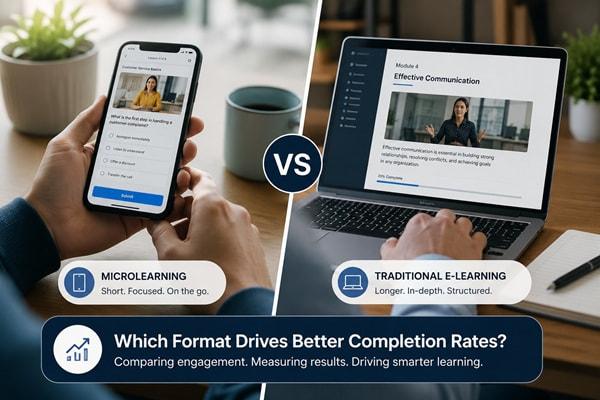
Completion rates are one of the clearest signals that a
learning format is not only accessible, but usable in real life. Traditional
e-learning can work well for structured programs, compliance training, and deep
conceptual learning. Microlearning, however, is increasingly used by
institutions and corporate learning teams because it fits shorter attention
windows, mobile behavior, and workplace learning moments. This article compares
microlearning and traditional e-learning through the lens of learner completion,
engagement, retention, and operational scalability. It explains why format
alone does not guarantee better outcomes, and why completion rates depend on
content design, learner motivation, platform experience, reminders, analytics,
and how well the learning model fits daily routines.
- Quick
Answer
- Why
Completion Rates Matter in Digital Learning
- What
Traditional E-Learning Does Well
- Why
Microlearning Often Feels Easier to Complete
- Microlearning
vs Traditional E-Learning: A Practical Comparison
- What
Actually Drives Better Completion Rates
- How
Institutions and Corporate Teams Can Apply Microlearning Strategically
- Common
Mistakes When Comparing Learning Formats
- Conclusion
- FAQ
Quick Answer
Microlearning often supports better completion rates than
traditional e-learning when learners need short, focused, mobile-friendly
lessons that fit into busy schedules. This is especially relevant for corporate
learning, professional development, onboarding, product knowledge, refresher
training, and skills reinforcement. Traditional e-learning can still be
effective when the subject requires deeper explanation, longer assessment,
certification pathways, or formal academic structure.
The better question is not simply whether microlearning is
“better” than traditional e-learning. The more useful question is: which format
matches the learner’s context, motivation, available time, and learning
objective?
For institutions and corporate learning teams, microlearning
can reduce friction because learners do not need to block a long session to
make progress. Traditional e-learning may create more depth, but it can also
increase drop-off when modules are too long, poorly structured, or disconnected
from immediate learner needs.
The strongest learning strategy often combines both formats:
microlearning for momentum and reinforcement, traditional e-learning for depth
and formal progression.

Why Completion Rates Matter in Digital Learning
Completion rate is not the only measure of learning quality,
but it is one of the most practical indicators of learner follow-through. A
course can have excellent content, strong instructional design, and high
production value, but if learners do not finish it, the organization gains
limited value from the investment.
For institutions and corporate learning teams, completion
matters because it affects:
- training
compliance
- employee
readiness
- knowledge
transfer
- certification
progress
- onboarding
efficiency
- learner
motivation
- return
on learning investment
- confidence
in the learning platform
A low completion rate does not always mean the content is
poor. It may indicate that the learning format is misaligned with the audience.
A 60-minute module may be reasonable for a formal certification program, but
unrealistic for frontline employees, busy managers, sales teams, or distributed
learners who access training between work tasks.
Research on open online courses has shown that completion
rates can vary widely depending on course design, learner intention, assessment
structure, and participation context. In one widely cited study of MOOCs,
completion rates ranged from very low levels to above 50%, with a median of
12.6% (MOOC
completion rates study)
Completion rate is rarely just a learner discipline problem.
It is often a design, delivery, timing, and platform experience problem.
For corporate learning, this is especially important.
Employees are usually not learning in isolation. They are balancing training
with meetings, tasks, performance targets, customer issues, and operational
responsibilities. The easier the learning experience fits into those realities,
the more likely learners are to complete it.
What Traditional E-Learning Does Well
Traditional e-learning usually refers to longer online
courses or modules delivered through an LMS, web portal, or structured learning
environment. It often includes videos, slides, readings, quizzes, assignments,
downloadable materials, and formal assessments.
This format remains valuable because it can support depth.
Some learning objectives cannot be reduced into very short lessons without
losing context. For example, leadership development, regulatory compliance,
technical certification, academic coursework, and professional accreditation
may require longer explanations, scenario-based exercises, and formal
assessment.
Traditional e-learning works best when learners need:
- a
structured curriculum
- sequential
learning paths
- formal
assessment
- certification
or completion records
- deeper
conceptual explanation
- guided
progression from beginner to advanced levels
- institutional
documentation
For universities, training providers, and corporate
academies, traditional e-learning also supports governance. Administrators can
define modules, track progress, manage cohorts, and align courses with internal
standards.
However, the challenge is learner commitment. Longer modules
require more time, more concentration, and stronger motivation. If learners do
not clearly understand why the course matters, or if they cannot easily fit the
session into their schedule, drop-off risk increases.
Longer learning does not automatically create deeper learning if learners never reach the end.
Traditional e-learning is not outdated. It simply needs to
be used where depth, structure, and formal progression are necessary. When
every learning need is forced into a long course format, completion can suffer.

Why Microlearning Often Feels Easier to Complete
Microlearning breaks learning into short, focused units. A
lesson may explain one concept, demonstrate one skill, answer one operational
question, or reinforce one behavior. The format is commonly associated with
mobile learning, short videos, interactive cards, quick quizzes, scenario
prompts, and just-in-time learning support.
The Association for Talent Development defines microlearning
as short learning content that can often be accessed when learners need it,
including while performing their job. ATD microlearning
definition
Microlearning can feel easier to complete because it reduces
three common barriers:
- time
friction
- cognitive
overload
- platform
resistance
Instead of asking learners to commit to a long session,
microlearning asks them to complete a smaller action. This matters in corporate
and institutional environments where learners may be willing to learn, but
unable to allocate long uninterrupted periods.
A five-minute lesson on customer handling, product features,
safety reminders, software usage, or teaching methods may be easier to complete
than a full course module. Over time, those short learning moments can create
consistent learning momentum.
A 2025 systematic review in Heliyon reported that
microlearning has been associated in reviewed studies with benefits such as
engagement, participation, and in some cases higher completion rates. However,
outcomes depend on design quality, context, learner needs, and
implementation—not the short format alone. systematic
review of microlearning
Microlearning improves completion potential by lowering the
effort required to start. But completion still depends on relevance,
sequencing, reminders, and learner motivation.
Microlearning is especially useful when the learning
objective is narrow and actionable. It works well for reinforcement, onboarding
steps, sales enablement, product education, compliance refreshers, customer
service scripts, software tips, and knowledge checks.
It is less suitable when learners need extended reasoning,
deep practice, complex debate, or formal mastery across multiple interconnected
topics. In those cases, microlearning should support the learning journey
rather than replace the full program.
Microlearning vs Traditional E-Learning: A Practical Comparison
|
Aspect |
Microlearning |
Traditional E-Learning |
|
Typical lesson length |
Short, focused, often 3–10 minutes |
Longer modules, often 20–60+ minutes |
|
Best for |
Reinforcement, onboarding, refreshers, job aids, mobile
learning |
Structured courses, certification, compliance, academic or
technical depth |
|
Completion advantage |
Lower time friction and easier session commitment |
Stronger when learners are motivated and time is protected |
|
Learner experience |
Fast, modular, often mobile-first |
More comprehensive, often desktop or LMS-oriented |
|
Content structure |
One concept or task per lesson |
Broader topic coverage per module |
|
Engagement pattern |
Frequent short interactions |
Longer, less frequent learning sessions |
|
Assessment style |
Quick checks, short quizzes, scenario prompts |
Formal quizzes, assignments, exams, completion tracking |
|
Operational challenge |
Requires strong sequencing and content governance |
Requires learner time, instructional depth, and course
maintenance |
|
Risk |
Can become fragmented if not connected to a broader
pathway |
Can feel heavy or difficult to finish if poorly designed |
|
Best strategic use |
Build momentum and reinforce behavior |
Build depth and formal capability |
The comparison shows why the answer is not binary.
Microlearning and traditional e-learning solve different problems.
Microlearning is stronger when the organization needs
learning to happen continuously, in small moments, across distributed learners.
Traditional e-learning is stronger when the organization needs structured
depth, compliance documentation, certification, or complex knowledge transfer.
For example, a company training new sales representatives
may use traditional e-learning to explain the product portfolio, pricing model,
and buyer personas. It may then use microlearning to reinforce objection
handling, feature updates, competitor comparisons, and weekly practice
scenarios.
An institution may use longer online modules for
foundational theory, then use microlearning for exam preparation, concept
review, student engagement, or post-class reinforcement.
This blended model is often more realistic than replacing
one format with the other.
FitAcademy
Learn How Microlearning Fits Into a Scalable Learning Strategy
FitAcademy helps institutions, corporate learning teams, and training providers understand how microlearning can support mobile-first learning, learner engagement, and branded digital training experiences.
Learn More About FitAcademyWhat Actually Drives Better Completion Rates
Learning format matters, but it is only one part of
completion performance. A short lesson can still fail if it is irrelevant,
confusing, poorly sequenced, or hidden inside a difficult platform. A longer
course can still perform well if learners understand its value, receive
support, and have clear progression.
Completion rates are shaped by several practical factors.
Relevance to the Learner’s Immediate Need
Learners are more likely to complete training when they
understand why it matters now. In corporate learning, this may mean connecting
lessons to a role, task, performance expectation, or upcoming responsibility.
A microlearning lesson titled “How to Handle Pricing
Objections in the First Sales Call” is likely to feel more immediately useful
than a broad module titled “Sales Communication Basics.” The first title gives
the learner a clear reason to start.
For institutions, relevance may come from linking content to
assessments, career outcomes, practical projects, or skill pathways.
Friction in the Platform Experience
Completion is affected by the platform itself. If learners
struggle to log in, find lessons, resume progress, access content on mobile, or
understand what comes next, completion can drop even when the content is
strong.
A mobile-first learning platform can help when learners are
distributed, frequently away from desks, or more comfortable learning through
smartphones. This connects closely to why mobile learning matters in global education,
especially for organizations that serve learners across different locations and
access conditions.

Lesson Design and Cognitive Load
Completion improves when lessons are easy to understand and
focused enough to finish. This does not mean content should be shallow. It
means each learning unit should have a clear objective.
A strong microlearning lesson usually answers one question,
explains one idea, or trains one action. A strong traditional e-learning module
usually organizes deeper material into logical sections with meaningful
checkpoints.
Both formats fail when they overload the learner.
Motivation, Reminders, and Learning Rhythm
Many learners intend to complete training but forget,
postpone, or lose momentum. This is where learning rhythm matters. Short
lessons, reminders, progress indicators, badges, completion milestones, and
manager visibility can support follow-through when used thoughtfully.
However, reminders alone are not enough. If learners
repeatedly receive notifications for content that feels irrelevant,
notification fatigue can reduce engagement.
Analytics and Iteration
Organizations that track learning analytics can identify
where learners drop off, which lessons are skipped, which modules take too
long, and which topics need redesign.
Completion rate should not be treated as a vanity metric. It
should trigger better questions:
- Where
are learners stopping?
- Which
lessons are too long?
- Which
topics need more context?
- Are
learners using mobile or desktop?
- Are
reminders helping or annoying?
- Do
completion patterns differ by role, region, or cohort?
The real advantage of a modern learning platform is not only
content delivery. It is the ability to observe learner behavior and improve the
learning experience over time.
This is where branded learning infrastructure becomes
strategically important. When organizations own the learning environment, they
can connect content, learner data, platform experience, and training operations
more directly.
How Institutions and Corporate Teams Can Apply Microlearning Strategically
Microlearning is most effective when it is part of a
learning system, not a collection of random short videos. Institutions and
corporate learning teams should begin by identifying where short-format
learning creates the most practical value.
A useful implementation workflow may look like this:
- Identify
high-friction learning moments
- Break
broad topics into specific learning objectives
- Decide
which objectives require microlearning and which require deeper modules
- Design
short lessons around one concept or task
- Connect
lessons into pathways, sequences, or campaigns
- Use
reminders and progress indicators carefully
- Track
completion, drop-off, engagement, and assessment results
- Improve
content based on learner behavior
For corporate learning teams, microlearning may be applied
to:
- employee
onboarding
- product
updates
- compliance
refreshers
- leadership
nudges
- safety
reminders
- customer
service scripts
- software
adoption
- sales
enablement
- field
workforce training
For institutions, microlearning may support:
- pre-class
preparation
- post-class
review
- exam
readiness
- student
engagement
- concept
reinforcement
- practical
skill reminders
- alumni
learning
- community-based
education
The key is to avoid treating microlearning as a cosmetic
change. Simply cutting a long video into shorter clips does not automatically
create an effective microlearning strategy. Each short lesson still needs
instructional purpose, sequencing, and measurable relevance.
Microlearning works best when every short lesson has a clear job to do.
FitAcademy’s broader learning strategy connects naturally to
this model because microlearning, mobile access, branded learning experience,
and learner analytics work together. Organizations exploring
microlearning apps in workforce training should think beyond content length and consider the full delivery ecosystem.

Common Mistakes When Comparing Learning Formats
One of the most common mistakes is assuming microlearning is
always better because it is shorter. Short content may be easier to start, but
it can also become shallow, fragmented, or disconnected from meaningful
learning outcomes if not designed properly.
Another mistake is defending traditional e-learning simply
because it feels more complete. A long module can look substantial, but it may
not be learner-friendly. If learners cannot finish it, the apparent depth may
not translate into actual capability.
A third mistake is comparing formats without considering the
learner’s context. A desk-based employee with scheduled training time may
complete a longer online course more easily than a field employee who relies on
mobile access. A university student may need long-form conceptual learning,
while a working professional may need short refresher lessons tied to immediate
tasks.
Organizations also sometimes focus on platform features
instead of learning operations. A platform may offer video hosting, quizzes,
certificates, and dashboards, but completion depends on how those tools are
used. Content governance, learner communication, progress tracking, and
instructional design are equally important.
Finally, many organizations underestimate the importance of
ownership. If learning happens across fragmented tools, marketplaces, messaging
apps, video links, and spreadsheets, it becomes difficult to track completion
consistently. A more structured branded learning platform can help organizations
manage the learner experience, brand identity, and analytics in one
environment.
|
Mistake |
Why It Happens |
Better Approach |
|
Assuming shorter is always better |
Microlearning is often associated with convenience |
Match lesson length to learning objective |
|
Turning long videos into random clips |
Teams want quick content repurposing |
Redesign each lesson around one clear outcome |
|
Ignoring learner context |
Organizations design from the admin perspective |
Study when, where, and how learners actually learn |
|
Measuring only completion |
Completion is easy to track |
Combine completion with engagement, assessment, and
performance indicators |
|
Using fragmented tools |
Teams prioritize speed over infrastructure |
Build a structured learning environment with clear
pathways |
|
Treating branding as cosmetic |
Branding is seen as logo placement |
Design the full learning experience around trust,
identity, and continuity |
Conclusion
Microlearning can often support better completion rates
because it reduces time friction, fits mobile behavior, and helps learners make
progress in smaller steps. For institutions and corporate learning teams, this
can be a major advantage when learners are busy, distributed, or learning
alongside daily responsibilities.
But microlearning is not a universal replacement for
traditional e-learning. Traditional formats remain important when the learning
objective requires depth, formal progression, assessment, certification, or
complex conceptual understanding.
The strongest strategy is usually not microlearning versus
traditional e-learning. It is knowing when to use each format.
Organizations that want stronger completion rates should
look beyond content length. They need to examine learner relevance, platform
usability, mobile access, learning rhythm, analytics, and operational
ownership. Better completion comes from a better learning system, not from
format selection alone.
FitAcademy
Build a More Learner-Friendly Digital Training Experience
FitAcademy supports institutions, corporate learning teams, and training providers that want to deliver branded, mobile-first microlearning experiences with a more structured learning platform strategy.
Learn More About FitAcademyFAQ
Is microlearning better than traditional e-learning?
Microlearning is not automatically better. It is often
better for short, focused, mobile-friendly learning moments such as refreshers,
onboarding steps, product updates, and reinforcement. Traditional e-learning is
still valuable for deeper courses, formal assessment, certification, and
complex topics. The best format depends on the learning objective, audience,
available time, and required level of mastery.
Can microlearning improve course completion rates?
Microlearning can improve completion potential by reducing
the time and effort required to start and finish each lesson. However, better
completion is not guaranteed. The content must be relevant, well-sequenced,
easy to access, and supported by reminders, progress tracking, and clear
learner motivation. Poorly designed microlearning can still have weak
engagement.
When should corporate learning teams use traditional e-learning?
Traditional e-learning is useful when employees need
structured, comprehensive training. This may include compliance programs,
leadership development, technical certification, safety training, or complex
product education. It works best when learners have dedicated time, clear
expectations, and a platform that makes progress easy to follow.
How long should a microlearning lesson be?
There is no universal ideal length, but microlearning
lessons are usually short enough to complete in one focused session. Many
organizations design lessons around a single concept, behavior, or task rather
than a fixed duration. A useful rule is to make the lesson only as long as
needed to achieve one clear learning outcome.
Should institutions replace full courses with microlearning?
Not necessarily. Institutions should use microlearning to
support, reinforce, or extend full courses when short lessons improve access
and retention. For academic depth, formal curriculum, and structured
assessment, longer course formats may still be necessary. A blended model often
works better than a full replacement.
What should organizations track besides completion rate?
Organizations should also track engagement, assessment
results, drop-off points, repeat access, learner feedback, time spent, mobile
usage, and performance-related indicators where relevant. Completion shows
whether learners finished, but it does not always prove understanding, behavior
change, or business impact.