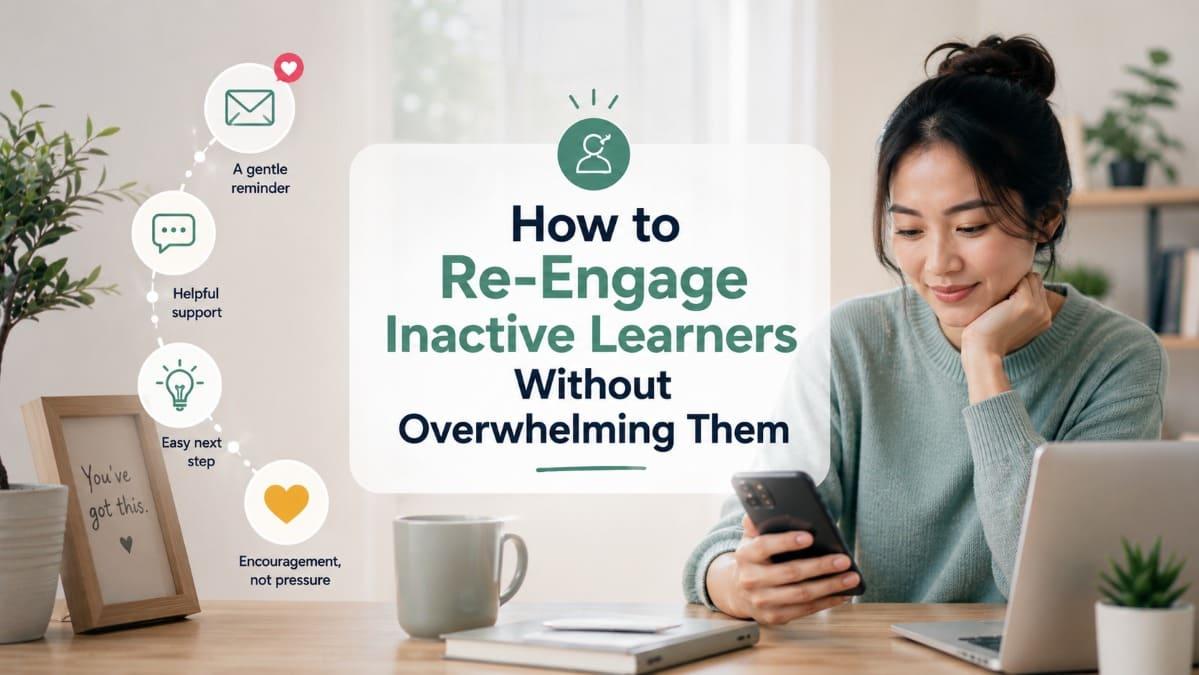
Inactive learners are not always uninterested learners. Many
stop because they lose direction, become busy, feel behind, encounter technical
friction, or do not see a clear reason to return. For teachers, trainers, and
institutions, re-engagement should not mean sending repeated reminders until
learners respond. A better approach is to understand why learners became
inactive, segment them based on behavior, send specific and respectful
messages, and make the next step feel simple. This article explains how to
re-engage inactive learners without overwhelming them, including practical
message timing, platform workflows, learner segmentation, and common mistakes
that can turn helpful reminders into notification fatigue.
- Quick
Answer
- What
Does Learner Re-Engagement Mean?
- Why
Learners Become Inactive After Starting a Course
- Why
Too Many Reminders Can Make Re-Engagement Worse
- How
to Segment Inactive Learners Before Sending Messages
- How
to Write Re-Engagement Messages That Feel Helpful
- Practical
Re-Engagement Workflow for Teachers and Institutions
- How
Learning Platforms Can Support Smarter Re-Engagement
- Common
Mistakes When Re-Engaging Inactive Learners
- Conclusion
- FAQ
Quick Answer
Learner re-engagement is the process of helping inactive
learners return to an online course with a clear, manageable next step. It
should not be treated as repeated reminder sending. Effective re-engagement
starts by identifying why learners became inactive, then matching the message,
timing, and support to their situation.
Inactive learners may stop because they are busy, confused,
overwhelmed, technically blocked, unsure about the value of the course, or
afraid they are too far behind. A useful re-engagement message should reduce
friction. It should tell the learner where they left off, what to do next, how
long it will take, and why returning is still worthwhile.
For teachers, trainers, and institutions, the goal is not to
pressure every learner into immediate completion. The goal is to make returning
feel realistic. This is especially important in mobile learning, community
training, professional development, and institutional courses where learners
may balance learning with work, family, teaching duties, or organizational
deadlines.
A good re-engagement strategy is specific, respectful, and
data-informed.
What Does Learner Re-Engagement Mean?
Learner re-engagement means reconnecting inactive learners
with a course, program, or learning path after they have stopped participating
for a period of time.
An inactive learner may still be enrolled, but they are no
longer making progress. They may not open lessons, complete quizzes, submit
assignments, join discussions, or respond to course communication.
This distinction matters because inactivity is not always
the same as dropout.
A learner who has not logged in for three days may simply be
busy. A learner who stopped after the first lesson may be confused about the
course flow. A learner who completed most modules but skipped the final
assessment may need a very different message from someone who never started.

In online learning operations, re-engagement usually
involves four actions:
- identifying
inactive learners,
- understanding
where they stopped,
- sending
a relevant message or support prompt,
- making
the next step easy to complete.
Inactive learners should not be treated as one group. A
learner who never started needs a different message from a learner who is one
quiz away from completion.
For teachers and institutions, this means learner
re-engagement should be designed as part of the learning journey, not as an
emergency activity after dropout has already happened.
Why Learners Become Inactive After Starting a Course
Learners become inactive for many reasons, and not all of
them are caused by low motivation. In many online courses, inactivity happens
when the learner’s daily reality collides with course friction.
A teacher may start a professional development course but
pause during exam week. A small business owner may stop after a module because
customer orders become urgent. A community learner may lose access to stable
internet. A corporate learner may complete lessons but skip the assessment
because the certificate rule was unclear.
The re-engagement strategy should respond to these
realities.
They feel behind
One of the most common emotional barriers is the feeling of
being behind. Once learners miss several lessons or deadlines, returning can
feel uncomfortable. They may assume they have failed, even if the course still
allows them to continue.
A helpful re-engagement message should reduce this feeling.
Instead of saying, “You have not completed the course,” it can say, “You can
continue from Module 2. The next lesson takes around five minutes.”
The second message gives the learner a path back.
They forgot the value of the course
Learners may register because the course sounded useful, but
after a few days, the reason to continue becomes less visible. This happens
often when courses are promoted with a broad promise but the learning journey
does not keep reconnecting lessons to outcomes.
Re-engagement should remind learners of the practical value,
not only the unfinished task.
For example:
“Continue your course” is generic.
“Complete the next lesson to prepare your first customer
communication checklist” is more specific.
They were confused by the platform or course structure
Some learners stop because they are not sure what to click,
where to submit a task, how to complete a quiz, or what counts toward
completion.
This is not a motivation issue. It is a navigation and
communication issue.
For these learners, a motivational message may not help.
They need clear instruction, a help link, or a simple restart path.
They did not experience an early small win
A learner who does not experience progress early may not
feel enough momentum to return. This is why early milestones matter. Completing
a first short lesson, passing a quick quiz, or finishing one practical task can
make the learner feel that continuation is possible.
For more on this part of the retention journey, see how
small wins help learners build momentum in online learning.
Learners are easier to re-engage when the course gives them a clear place to return to.
Why Too Many Reminders Can Make Re-Engagement Worse
Too many reminders can make re-engagement worse because
learners may begin to experience course communication as pressure, noise, or
guilt rather than support.
This is a common mistake in online training. When learners
become inactive, the first response is often to send more messages. The team
may use email, WhatsApp, push notifications, SMS, and group announcements at
the same time. The intention is good, but the learner experience can become
overwhelming.
A reminder should help the learner return. It should not
make the learner feel chased.
|
Message Type |
How It May Feel to the Learner |
Better Alternative |
|
“You have not completed your course.” |
Blaming or administrative |
“You can continue from Lesson 3. It takes around six
minutes.” |
|
“Please finish all modules immediately.” |
Too broad and stressful |
“Start with the next short quiz to unlock your next
milestone.” |
|
“Your course is incomplete.” |
Negative and vague |
“You are 70% complete and only need two more steps.” |
|
Repeated daily reminders |
Noisy or irritating |
Timed reminders based on learner progress and deadline |
|
Same message to all inactive learners |
Irrelevant |
Segmented messages based on where each learner stopped |

The strongest re-engagement messages usually have three
qualities:
- they
are specific,
- they
are easy to act on,
- they
respect the learner’s context.
This does not mean being too soft or vague. In formal
institutional training, deadlines may still matter. But even deadline-based
reminders should give the learner a practical next step.
A reminder becomes useful when it reduces the effort
required to restart. A reminder becomes noise when it only repeats that the
learner is inactive.
How to Segment Inactive Learners Before Sending Messages
Inactive learners should be segmented before re-engagement
messages are sent. Segmentation helps teachers and institutions avoid sending
the same message to learners with very different needs.
The simplest segmentation can be based on learner behavior
inside the platform.
|
Learner Segment |
Behavior Signal |
Likely Issue |
Best Re-Engagement Angle |
|
Registered but never started |
Enrolled but no lesson opened |
Unclear first step or low urgency |
Welcome back with one simple starting action |
|
Started but stopped early |
Completed first lesson only |
Weak onboarding or early friction |
Remind them where to continue and why it matters |
|
Mid-course inactive |
Several lessons completed, then stopped |
Busy, overwhelmed, or lost momentum |
Show progress and suggest one next step |
|
Assessment avoider |
Completed lessons but skipped quiz/task |
Assessment anxiety or unclear requirement |
Explain the assessment and reduce fear |
|
Near-completion learner |
Almost finished |
Final step unclear or delayed |
Highlight how close they are to completion |
|
Returning learner |
Previously inactive, now active again |
Needs momentum support |
Acknowledge return and guide next milestone |
Segment by progress stage
Progress stage is the most practical starting point. A
learner at 10% completion should not receive the same message as a learner at
90% completion.
The 10% learner may need motivation and clarity. The 90%
learner may need a final push, certificate reminder, or explanation of the last
requirement.
Segment by inactivity duration
A learner inactive for two days may not need a strong
reminder. A learner inactive for two weeks may need a more direct message. A
learner inactive for two months may need a reset path or an invitation to join
a new cohort.
Timing should match the course format.
For a short microlearning course, three days of inactivity
may be meaningful. For a six-week professional development course, inactivity
may need to be evaluated against the course schedule.
Segment by learner type
Institutions may need different re-engagement messages for
different learner groups. New users, returning users, facilitators, employees,
teachers, students, and community participants may respond to different support
styles.
For example, a teacher development program may use
professional language and deadline clarity. A community entrepreneurship course
may use more encouraging, action-oriented messaging. A corporate compliance
course may require firmer reminders tied to organizational requirements.
How to Write Re-Engagement Messages That Feel Helpful
A helpful re-engagement message should make returning feel
simple. It should not make the learner feel guilty, confused, or overloaded
with information.
A good message usually includes:
- learner
context,
- current
progress,
- one
next step,
- time
estimate,
- reason
to continue,
- support
option.
Use clear and respectful language
The tone should be direct but supportive. Avoid language
that sounds like blame.
Weak message:
“You have failed to complete your course. Please finish it
as soon as possible.”
Better message:
“You can continue from Module 2. The next lesson takes
around five minutes and will help you prepare for the short quiz.”
The better version is still clear, but it gives the learner
a way back.
Give only one next step
Many re-engagement messages fail because they ask learners
to do too much at once.
Instead of saying, “Please complete Modules 2, 3, 4, and the
final assessment,” start with the next action:
“Start with Lesson 2.1. It takes around six minutes.”
Once the learner returns, the platform can guide the next
step.
Mention progress when it helps
Progress can be motivating when it shows that completion is
reachable.
For example:
“You have completed 60% of the course. Continue with the
next short lesson to reach your next milestone.”
This message works because it reminds the learner that their
previous effort still counts.
Make support visible
If learners stopped because of confusion, a reminder without
support may not solve the issue.
A useful message can include:
“If you are not sure how to continue, open the course guide
or contact the facilitator from the help section.”
This is especially important for institutions serving
learners with mixed digital confidence.

Example re-engagement message templates
For a learner who never started:
“Welcome back. Your course is ready, and you can begin with
the short orientation lesson. It takes around five minutes and explains how to
complete the course step by step.”
For a learner who stopped early:
“You have completed the first lesson. Continue with Lesson 2
to apply the first concept in a simple practice task. It takes around seven
minutes.”
For a learner near completion:
“You are close to completing the course. Finish the final
quiz to unlock your completion status and certificate eligibility.”
For a learner who missed a deadline:
“You can still continue. Start from your current module
today, then check the course announcement for the updated completion schedule.”
The best re-engagement message does not ask learners to restart everything. It shows them the next manageable step.
FitAcademy
Join a Platform That Helps Learners Return With Clarity
FitAcademy helps teachers, trainers, and institutions deliver mobile-first learning with structured progress, quizzes, certificates, learner dashboards, and clearer paths for returning learners.
Join FitAcademyPractical Re-Engagement Workflow for Teachers and Institutions
A practical re-engagement workflow should be simple enough
for course teams to repeat. If the workflow is too complex, it will not be used
consistently.
The following workflow can work for many online courses,
especially microlearning, teacher training, community learning, and
institutional training programs.
Step 1: Define inactivity
Start by deciding what counts as inactivity.
For a short course, inactivity might mean no activity for
three to five days. For a longer course, it might mean missing one weekly
milestone. For formal institutional training, it may be tied to deadlines,
assessment completion, or certification requirements.
The definition should match the course design.
Step 2: Identify where learners stopped
Do not only ask, “Who is inactive?”
Ask:
- Did
they start?
- Which
lesson did they stop at?
- Did
they skip the quiz?
- Did
they complete the content but miss the final task?
- Did
many learners stop at the same module?
If many learners stop at the same place, the issue may be
course design rather than individual motivation.
Step 3: Choose the right message type
Different inactivity patterns need different messages.
|
Situation |
Recommended Message |
|
Learner never started |
Orientation reminder with one first step |
|
Learner stopped after difficult lesson |
Support message with simplified next action |
|
Learner missed quiz |
Assessment explanation and confidence-building message |
|
Learner is near completion |
Progress-based message highlighting final step |
|
Many learners stopped in same module |
Course improvement may be needed before more reminders |
Step 4: Send one clear message
Use one primary channel first. This may be email, app
notification, WhatsApp, or platform announcement, depending on the learner
context.
Avoid sending the same message through every channel at once
unless the course has a serious deadline or compliance requirement.
Step 5: Monitor response
After sending the message, check what happens.
Did learners return? Did they open the next lesson? Did they
complete the quiz? Did they contact support? Did they remain inactive?
This step matters because re-engagement is not only
communication. It is learning operations feedback.
Step 6: Improve the course where needed
If re-engagement messages repeatedly fail at the same point,
the course may need improvement.
Maybe the module is too long. Maybe the instruction is
unclear. Maybe the quiz feels disconnected. Maybe the platform navigation is
confusing. Maybe learners need a better onboarding experience.
For the earlier stage of the journey, see how
to design a better learner onboarding experience for online courses.
Re-engagement data is not only learner data. It is course
design feedback.
How Learning Platforms Can Support Smarter Re-Engagement
A learning platform can support smarter re-engagement by
showing learner progress, identifying inactivity, and helping course teams
communicate based on behavior rather than guesswork.
Without platform data, teachers and institutions often rely
on manual checking. They may look through spreadsheets, chat groups, attendance
notes, or facilitator memory. This can work for very small groups, but it
becomes difficult as programs scale.
A stronger learning platform can support re-engagement
through:
- learner
activity tracking,
- lesson
completion data,
- quiz
completion data,
- progress
dashboards,
- certificate
eligibility status,
- learner
segmentation,
- notification
or announcement tools,
- admin
reporting,
- mobile-first
access,
- cohort
management.
Progress visibility helps learners return
When learners return to a platform, they should not have to
search for their place. The platform should show what they completed, what
remains, and what they should do next.
This is especially important for mobile learning. Learners
using smartphones may have limited time and screen space. If returning requires
too many clicks, they may leave again.
Dashboards help teams intervene earlier
For institutions and training providers, dashboards can show
which learners need support before the program ends.
A teacher training team, for example, may notice that many
participants complete the first module but stop before the reflective task.
That signal allows the team to clarify instructions, send a targeted message,
or adjust the task.
Branded platforms can make re-engagement more trustworthy
Learners are more likely to trust communication when it
comes from a recognizable institution, academy, trainer, or community. A
branded learning platform can make the learning journey feel more coherent
because the course, progress, message, and certificate all sit under one
recognizable environment.
This is one reason white-label learning infrastructure can
matter for institutions. It supports not only content delivery, but also
learner relationship management.
For a broader platform perspective, see what is a white-label learning platform.

Common Mistakes When Re-Engaging Inactive Learners
Re-engagement fails when it focuses more on the
organization’s need for completion than the learner’s need for a manageable
return path.
Mistake 1: Sending the same message to everyone
A generic reminder may be easy to send, but it rarely fits
all learners. Someone who never started does not need the same message as
someone who is one quiz away from completion.
Better re-engagement begins with segmentation.
Mistake 2: Using guilt as the main motivator
Messages that make learners feel guilty may create
short-term pressure, but they can also make learners avoid returning. This is
especially risky in voluntary learning, community education, and creator-led
courses where trust matters.
A better approach is to acknowledge progress, reduce
friction, and offer a clear next step.
Mistake 3: Sending reminders too frequently
Frequent reminders can become background noise. Learners may
stop opening messages from the course provider entirely.
A better rhythm is based on course length, deadline
pressure, and learner behavior. For a short course, a reminder after a few
inactive days may make sense. For a longer course, weekly milestone reminders
may be more appropriate.
Mistake 4: Ignoring the reason learners stopped
If learners stopped because the assessment was unclear,
sending more reminders will not solve the problem. If they stopped because the
lesson was too long, a motivational message may not help. If they stopped
because they forgot the course value, a practical outcome reminder may work
better.
Re-engagement should diagnose before it communicates.
Mistake 5: Not improving the course after repeated inactivity
If many learners become inactive in the same place, the
course team should review that part of the course. The issue may be pacing,
instruction, difficulty, platform usability, or unclear relevance.
Re-engagement should not become a permanent patch for weak
course design.
For the root causes of dropout, see why
learners drop out of online courses and how to reduce it.
Conclusion
Inactive learners are not always lost learners. Many can
return when the course gives them a clear, respectful, and manageable path
back.
The most effective re-engagement strategy does not rely on
louder reminders. It relies on better understanding. Teachers, trainers, and
institutions should look at where learners stopped, why they may have stopped,
and what kind of next step would make returning easier.
A good re-engagement message is specific. It shows progress,
gives one action, reduces uncertainty, and makes support visible. A good
learning platform strengthens this process by making learner activity and
progress easier to see.
For online learning providers, re-engagement is not only a
communication tactic. It is part of learner retention, course improvement, and
long-term learning operations. When done well, it helps learners return without
feeling overwhelmed, pressured, or left behind.
FitAcademy
Help Inactive Learners Return With a Clear Next Step
FitAcademy supports mobile-first learning journeys with learner progress, quizzes, certificates, dashboards, and structured course experiences that help teachers and institutions guide learners more effectively.
Join FitAcademyFAQ
What is learner re-engagement?
Learner re-engagement is the process of helping inactive
learners return to a course or learning program. It usually involves
identifying where learners stopped, understanding possible reasons for
inactivity, and sending a helpful message or support prompt that makes the next
step clear and manageable.
Why do online learners become inactive?
Online learners become inactive for many reasons, including
lack of time, unclear course structure, weak onboarding, low motivation,
technical difficulty, missed deadlines, or uncertainty about the next step.
Inactivity does not always mean the learner has lost interest. Sometimes the
course simply needs a clearer return path.
How often should teachers remind inactive learners?
Reminder frequency should depend on course length, learner
context, and deadline pressure. A short course may need a reminder after a few
inactive days, while a longer course may use weekly milestone reminders. Too
many reminders can cause message fatigue, so each reminder should be specific
and useful.
What should a re-engagement message include?
A good re-engagement message should include where the
learner left off, one clear next step, an estimated time to complete it, a
reason to continue, and a support option. The message should feel helpful, not
blaming. It should reduce the effort needed to restart.
Can re-engagement reduce course dropout?
Re-engagement can help reduce dropout when it addresses the
real reason learners became inactive. It works best when combined with good
onboarding, visible progress, small wins, and learner support. However,
reminders alone cannot fix poor course design or unclear learning outcomes.
How can a learning platform help re-engage learners?
A learning platform can help by tracking learner activity,
showing progress, identifying inactive learners, supporting targeted messages,
and making the next lesson easy to find. For institutions, dashboards and
completion data make re-engagement more manageable across larger learner
groups.