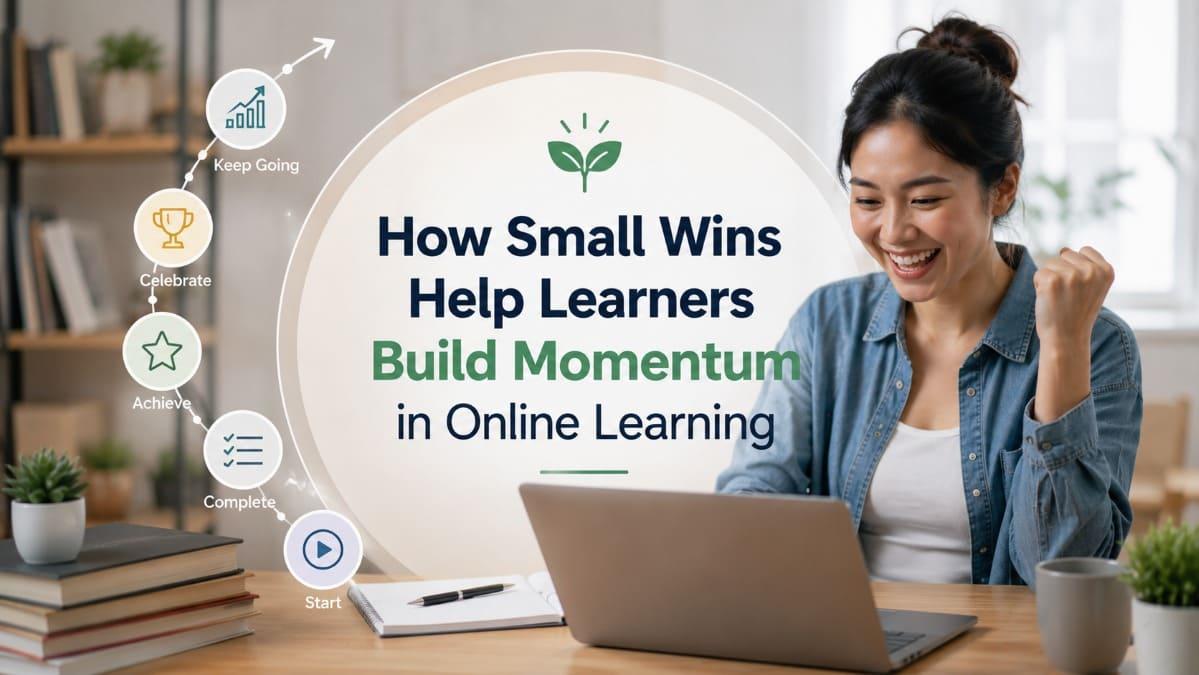
Small wins are short, visible moments of progress that help
learners feel capable enough to continue. In online learning, they can appear
as completing a first lesson, passing a short quiz, unlocking a badge,
submitting a simple task, or seeing progress move forward on a course
dashboard. For teachers, trainers, and institutions, small wins matter because
many learners do not drop out from one major failure. They slowly lose momentum
when the course feels too large, unclear, or disconnected from immediate progress.
This article explains how small wins support learner motivation, why they
matter in online course completion, and how learning platforms can make
progress more visible without turning education into shallow gamification.
- Quick
Answer
- What
Are Small Wins in Online Learning?
- Why
Small Wins Help Learners Continue
- How
Small Wins Build Momentum Across a Course
- What
Small Wins Look Like in Real Online Courses
- How
Teachers and Institutions Can Design Better Small Wins
- How
Learning Platforms Can Make Progress Visible
- Common
Mistakes When Using Small Wins
- Conclusion
- FAQ
Quick Answer
Small wins in online learning are manageable progress
moments that help learners feel they are moving forward. They may include
finishing a short lesson, answering a practice question correctly, completing a
checklist, receiving feedback, earning a badge, or reaching a visible milestone
in the course.
Small wins matter because online learners often study alone,
on mobile devices, between work or personal responsibilities. When a course
feels too large, learners may delay starting or stop halfway. A small win
reduces that pressure by turning the course into a sequence of achievable
steps.
The idea is supported by broader motivation research. Teresa
Amabile and Steven Kramer’s work on the “progress principle” found that
progress in meaningful work strongly affects motivation and positive inner work
life, based on analysis of nearly 12,000 diary entries from employees across
several companies. Although workplace research is not identical to online
learning, the core insight is useful: visible progress can strengthen people’s
willingness to continue meaningful effort. The Progress
Principle by Harvard Business School
In online courses, small wins should not make learning
superficial. They should make meaningful progress easier to see.
What Are Small Wins in Online Learning?
Small wins in online learning are small but meaningful
learning achievements that show learners they are making progress toward a
larger goal.
A small win is not simply “making the course easier.” It is
a designed moment where the learner can complete something, understand
something, apply something, or receive confirmation that they are on the right
path.
For example, in a teacher training course, a small win might
be completing a short reflection on one classroom challenge. In a digital
skills course for small business owners, it might be updating one part of a
Google Business Profile after a lesson. In a healthcare training module, it
might be correctly identifying one step in a patient communication procedure.
The small win is useful because it connects learning to
action.

Small wins can appear in several forms:
- completing
the first lesson,
- answering
a short quiz,
- submitting
a simple task,
- unlocking
the next module,
- receiving
short feedback,
- earning
a badge,
- seeing
progress increase,
- finishing
a learning streak,
- downloading
a practical template,
- completing
one real-world action.
The strongest small wins are not random rewards. They are
connected to the learner’s actual objective.
A small win works best when it confirms real progress. If
the reward is visible but the learning is meaningless, momentum becomes
fragile.
Why Small Wins Help Learners Continue
Small wins help learners continue because they reduce the
psychological distance between starting a course and completing it. A large
course goal can feel abstract. A small completed task feels immediate.
This is especially important in online learning because the
learner may not have the same external structure found in a classroom. There
may be no fixed schedule, no teacher watching the room, no peer beside them,
and no direct social pressure to continue. The platform experience must provide
more of the structure.
Academic self-efficacy is also relevant here. Self-efficacy
refers to a learner’s belief that they can perform a task or succeed in a
learning situation. Reviews of academic self-efficacy research show that it is
strongly connected to motivation, learning behavior, and academic outcomes,
including in online learning contexts. academic self-efficacy
and online learning performance
In simpler terms, learners are more likely to continue when
they believe, “I can do this.”
Small wins support that belief.
Momentum grows when learners can see that effort is producing progress.
Small wins reduce the fear of starting
Many learners do not avoid a course because they dislike
learning. They avoid it because the first step feels too large.
A busy teacher may register for a professional development
course but delay opening it because the course looks like “another big
responsibility.” A small business owner may want to improve digital marketing
skills but feel overwhelmed by long modules, unfamiliar terms, and limited
time. A staff member in mandatory training may feel the course is simply
another administrative burden.
A small first win changes the emotional entry point.
Instead of “I need to finish this entire course,” the
learner thinks, “I can complete this one short lesson.”
Small wins make progress concrete
Progress that cannot be seen is easy to underestimate. This
is why progress bars, completed lesson markers, short quizzes, and milestone
labels can be useful when they are designed carefully.
For learners, visible progress answers a simple question:
“Am I moving forward?”
For teachers and institutions, visible progress creates a
second benefit. It helps the learning team identify where learners slow down,
where they stop, and which parts of the course may need better support.
Small wins support confidence before difficulty increases
A course may need to become more difficult over time. That
is normal. Serious learning often requires practice, correction, reflection,
and application.
The mistake is making learners face complexity before they
have built enough confidence to continue.
Small wins can create early confidence before the course
introduces more demanding tasks. This does not remove difficulty. It prepares
learners to face it.
How Small Wins Build Momentum Across a Course
Small wins build momentum by turning a large learning
journey into a visible sequence of achievable steps. The learner does not
experience the course as one heavy task, but as a path with progress points.
This matters for course completion because momentum is
cumulative. One completed lesson makes the next lesson feel more reachable. One
short quiz passed makes the next assessment feel less intimidating. One visible
milestone makes the course feel less abstract.
|
Course Experience |
Without Small Wins |
With Small Wins |
|
Starting the course |
Learner sees a large course and delays |
Learner sees one clear first action |
|
First lesson |
Learner consumes content passively |
Learner completes a small task or check |
|
Mid-course progress |
Learner may feel stuck or unsure |
Learner sees milestone progress |
|
Assessments |
Quiz feels like a test of failure |
Quiz feels like feedback and confirmation |
|
Completion |
Certificate feels far away |
Completion feels like the result of steady progress |

Momentum depends on meaningful sequence
Small wins should be placed in a logical order. A badge
after a meaningless click is not the same as a small win after a useful
learning action.
For example, this sequence is weak:
- Login.
- Click
next.
- Receive
badge.
- Watch
long video.
- Take
final test.
This sequence is stronger:
- Complete
a short orientation.
- Identify
one personal learning goal.
- Watch
a focused lesson.
- Answer
three practice questions.
- Apply
one idea to a real situation.
- See
progress toward the first milestone.
The difference is not the presence of rewards. The
difference is the quality of the learning path.
Small wins are not decorations. They are instructional
design tools that help learners experience progress at the right moment.
What Small Wins Look Like in Real Online Courses
Small wins should match the course context, learner profile,
and learning outcome. A small win in a public community course will not always
look the same as a small win in institutional training.
For teacher training
In a teacher training course, a small win might be a short
classroom reflection. Instead of asking teachers to immediately complete a long
assignment, the course might begin with:
“Choose one classroom situation that you want to handle more
calmly this week.”
That small action gives the teacher a personal reason to
continue. The next lesson can then introduce a practical framework, example, or
discussion prompt.
For workforce training
In workforce training, small wins should connect to job
behavior. A learner might complete a short scenario, identify the correct
procedure, or pass a quick knowledge check.
For example, in safety training, a small win could be
correctly choosing the first action in a workplace incident scenario. This is
more useful than simply watching a long policy video without interaction.
For community learning
In community education, learners often come with different
levels of confidence and digital access. Small wins may need to be very
practical.
A course for women entrepreneurs might ask learners to take
one action after a short lesson, such as writing a one-sentence business
description, checking their business name on Google, or uploading one product
photo.
This type of small win matters because it turns online
learning into visible action outside the platform.
For creator-led courses
For creators, coaches, and independent trainers, small wins
can help learners feel that the course is immediately useful. This is important
because creator-led education often depends on trust and repeat engagement.
A fitness coach, language tutor, parenting educator, or
business mentor can design the first small win around something the learner can
practice quickly and recognize personally.

How Teachers and Institutions Can Design Better Small Wins
Teachers and institutions can design better small wins by
connecting each milestone to a real learning action, not only to content
consumption.
The question is not, “How can we reward learners more
often?” The better question is, “Where does the learner need proof that they
are making progress?”
A practical small-win design process can look like this:
|
Design Step |
Key Question |
Example |
|
Define the course outcome |
What should learners be able to do? |
Handle one classroom challenge more effectively |
|
Identify early friction |
Where might learners hesitate? |
First login, first lesson, first quiz |
|
Create one first action |
What can learners complete quickly? |
Choose one classroom situation to improve |
|
Add feedback or confirmation |
How will learners know they succeeded? |
Short response, quiz result, progress marker |
|
Connect to the next step |
What should learners do after the win? |
Continue to a lesson with practical strategies |
Start with the first five minutes
The first small win should happen early. Ideally, learners
should complete something meaningful within the first five to ten minutes.
This does not mean rushing the course. It means making the
beginning less passive.
Instead of starting with a long lecture, course designers
can begin with a simple prompt, short diagnostic, checklist, or scenario. This
gives learners a sense of participation before they encounter heavier content.
Make the small win visible
A small win loses power if the learner does not notice it.
Visibility can come from a progress bar, completed lesson
status, badge, short feedback message, certificate progress, or unlocked next
step. The platform does not need to be overly playful. It simply needs to show
progress clearly.
Keep the win aligned with the learning goal
Small wins should not distract from learning. If the course
is about practical teaching skills, the small win should involve classroom
thinking or application. If the course is about business visibility, the small
win should help learners improve one part of their visibility.
This is where many gamification systems fail. They reward
activity without strengthening capability.
Use small wins to support, not replace, deeper learning
Small wins are entry points. They are not the entire course.
A well-designed course may begin with simple wins, then move
into more complex practice, reflection, feedback, and assessment. The learner
should feel supported, not tricked into thinking serious learning requires no
effort.
FitAcademy
Join a Platform Built for Practical Learning Progress
FitAcademy helps teachers, trainers, and institutions create mobile-first learning experiences with short lessons, visible progress, quizzes, certificates, badges, and structured learner journeys.
Join FitAcademyHow Learning Platforms Can Make Progress Visible
A learning platform can make small wins easier to design and
easier to recognize. This is important because teachers and institutions should
not have to manually track every learner action through separate spreadsheets,
chat groups, and disconnected tools.
A platform can support momentum through features such as:
- lesson
completion tracking,
- progress
bars,
- short
quizzes,
- badges,
- certificates,
- course
milestones,
- leaderboard
options,
- mobile
notifications,
- learner
dashboards,
- admin
analytics.
These features are useful only when connected to good
learning design. A leaderboard, for example, may motivate some learners but
discourage others if it creates too much comparison. A badge may feel rewarding
when it marks meaningful progress, but irrelevant when it is given too often.
Progress tracking helps learners and administrators
For learners, progress tracking creates clarity. They can
see what they have completed and what remains.
For institutions, progress tracking supports learning
operations. Administrators can identify which learners are active, which groups
are falling behind, and which modules may be causing friction.
This matters for retention. Without progress data, a
training team may only notice dropout after it is too late. With visible
learner progress, support can happen earlier.
Mobile-first design makes small wins easier to complete
Many learners do not sit at a desk for long study sessions.
They may learn during breaks, after work, between teaching hours, while
commuting, or between family responsibilities.
A mobile-first learning experience can make small wins more
realistic because learners can complete short tasks when time is limited. This
is especially relevant for community learning, vocational education, teacher
training, and professional upskilling.
FitAcademy’s microlearning and mobile-first approach fits
this need because it helps learning providers break content into focused,
accessible units while still supporting quizzes, progress, and certificates.
For the broader retention issue, see why
learners drop out of online courses and how to reduce it. For the first
stage of the learner journey, see how
to design a better learner onboarding experience.
A course feels less overwhelming when learners can see the next step, not only the final destination.

Common Mistakes When Using Small Wins
Small wins are powerful when they are meaningful, but they
can become shallow when used carelessly. The goal is not to make learning feel
like a game at every moment. The goal is to help learners experience progress.
Mistake 1: Rewarding clicks instead of learning
Some platforms reward learners for clicking through content,
even if the learner has not understood or applied anything. This may increase
activity metrics, but it does not necessarily improve learning.
A better small win should involve a real action: answering,
reflecting, practicing, applying, or completing a meaningful step.
Mistake 2: Making every win feel the same
If every action receives the same reward, learners may stop
paying attention. A badge for opening the course should not feel equal to a
badge for completing a difficult assessment.
Different levels of progress should feel different. A simple
checkmark may be enough for lesson completion, while a badge or certificate
milestone may be better for more meaningful progress.
Mistake 3: Using competition without considering learner context
Leaderboards can be useful in some learning communities,
especially when learners enjoy social motivation. But they can also discourage
learners who start late, move slowly, or feel uncomfortable being compared
publicly.
For institutions, leaderboard design should be thoughtful.
It may work better at group level, cohort level, or optional challenge level
rather than as the main measure of learner value.
Mistake 4: Creating too many milestones
A course with too many small wins can feel noisy. Learners
may lose sight of the bigger goal.
The best small wins are placed at important transition
points: first start, first completion, first quiz, first application,
mid-course milestone, and final completion. The rhythm should support learning,
not interrupt it.
Mistake 5: Treating small wins as a substitute for support
Small wins can help learners continue, but they do not
replace teaching presence, feedback, facilitation, or human support. If
learners are confused, a badge will not solve the problem.
For inactive learners, small wins can be part of a
re-engagement strategy, but the message still needs to be relevant and
respectful. See how
to re-engage inactive learners without overwhelming them.
Conclusion
Small wins help learners build momentum because they make
progress visible, manageable, and emotionally easier to continue. For online
learning, this matters because many learners are not sitting in ideal learning
conditions. They are often busy, distracted, mobile-first, and balancing
learning with real responsibilities.
Teachers, trainers, and institutions can use small wins to
reduce the feeling of overwhelm without lowering learning standards. The key is
to design small wins around meaningful progress: completing a first lesson,
applying one concept, passing a short quiz, submitting a reflection, or
reaching a clear milestone.
The strongest online courses do not rely only on final
certificates. They help learners experience progress along the way. When
learners can see that each step matters, they are more likely to return,
continue, and complete the journey.
FitAcademy
Help Learners Build Momentum With FitAcademy
FitAcademy gives educators, creators, and institutions a mobile-first platform for short learning units, visible progress, quizzes, badges, certificates, and learner-friendly course experiences.
Join FitAcademyFAQ
What are small wins in online learning?
Small wins are short, meaningful progress moments that help
learners feel they are moving forward. Examples include completing a first
lesson, passing a short quiz, submitting a simple task, unlocking a milestone,
or seeing progress increase. They work best when connected to real learning
outcomes, not just platform activity.
Why do small wins improve learner motivation?
Small wins improve motivation because they make progress
visible and achievable. When learners complete a manageable task, they are more
likely to feel capable of continuing. This supports self-efficacy, which is
widely discussed in education research as an important factor in learner
motivation and performance.
Are small wins the same as gamification?
Not exactly. Gamification often uses game-like elements such
as points, badges, streaks, and leaderboards. Small wins are broader. They
focus on meaningful progress, which may or may not include gamified elements. A
short reflection, useful feedback, or completed real-world task can be a small
win even without points or badges.
Can small wins reduce dropout in online courses?
Small wins can help reduce dropout by making the course feel
more manageable and by giving learners a reason to continue after each step.
They do not guarantee completion, because dropout can also be caused by time
constraints, poor support, unclear expectations, or personal circumstances. But
they can strengthen momentum when used well.
How can teachers add small wins to an online course?
Teachers can add small wins by breaking large lessons into
focused learning units, adding short quizzes, using practical tasks, giving
quick feedback, and showing progress clearly. The first small win should appear
early, ideally before learners feel overwhelmed by the full course structure.
Should every online course use badges or leaderboards?
No. Badges and leaderboards can be useful, but they are not
suitable for every learner group or course type. Some learners enjoy visible
recognition, while others may prefer private progress tracking. The design
should match the learner context, course purpose, and institutional culture.