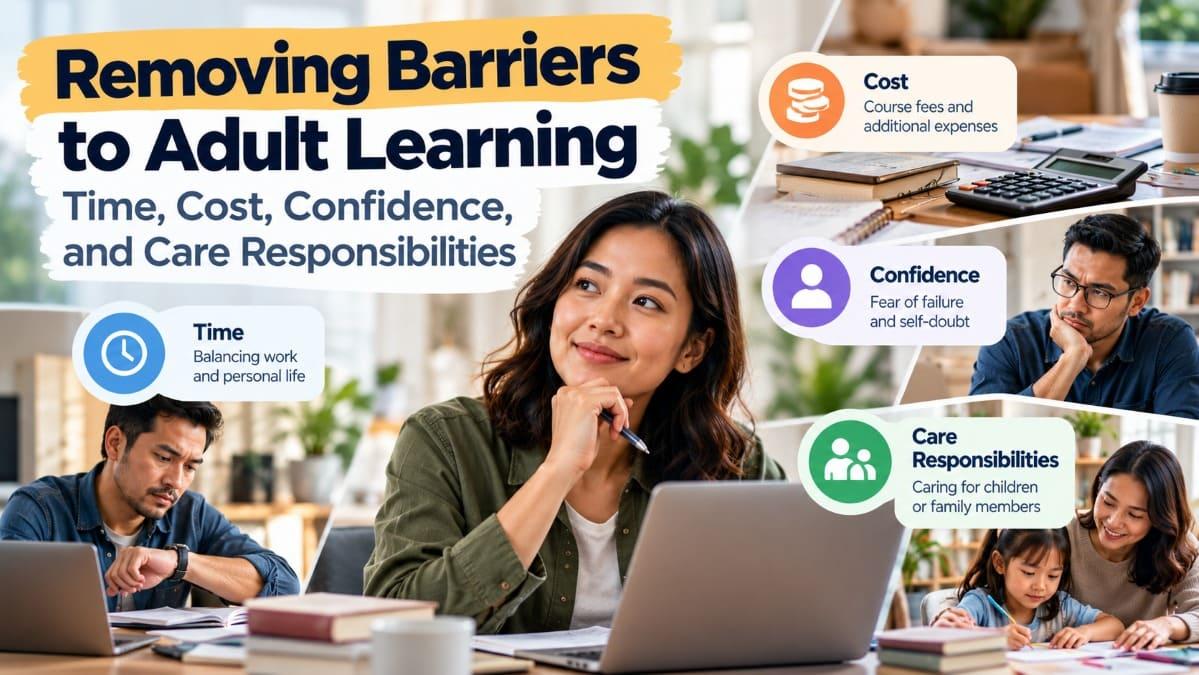
Adults do not participate in learning under the same
conditions as full-time students. Training must often compete with employment,
household budgets, childcare, eldercare, unpredictable schedules, and doubts
about returning to education. These barriers can stop participation long before
a learner reaches a course—or interrupt learning after enrollment.
OECD data show that lack of time because of work, family
responsibilities, and cost remain among the most frequently reported barriers
to adult learning. Psychological barriers matter as well: some adults lack
confidence, fear failure, or do not see themselves as capable learners.
For adult learning providers, workforce boards, community
colleges, and training organizations, improving access therefore means
designing around the realities of adult life. Flexible delivery, manageable
costs, supportive onboarding, childcare-sensitive scheduling, mobile access,
and timely intervention can all matter—but the right combination depends on the
learners being served.
- Quick
Answer
- Adult
Learning Barriers Are a System, Not a Single Problem
- Time:
When Learning Competes With Work
- Cost:
Tuition Is Only Part of the Financial Barrier
- Confidence:
Adults May Question Whether Education Is Still for Them
- Care
Responsibilities: Flexibility Must Reflect Family Life
- How
Providers Can Design Around Multiple Barriers
- What
Learning Platforms Can—and Cannot—Solve
- Common
Mistakes When Trying to Improve Adult Learning Access
- FAQ
- Conclusion
Quick Answer
The main barriers to adult learning are often not a lack of
courses but difficulty fitting learning into real life. Recent OECD analysis
identifies work-related time constraints, family responsibilities, and training
costs as the three most common barriers among adults prevented from
participating in training. Lack of confidence, fear of failure, limited
information, inconvenient delivery, and declining motivation can create
additional friction at different stages of the learning journey.
These barriers interact. A course may be free but
inaccessible because it requires attendance during working hours. An online
program may remove travel but still be difficult for a caregiver who cannot
predict when uninterrupted study time will be available. A learner may have
both time and funding yet hesitate because previous educational experiences
left them unsure whether they can succeed.
For providers, access therefore requires more than lowering
tuition or putting courses online. Programs need to be designed around actual
learner constraints through flexible scheduling, realistic workload, supportive
onboarding, modular learning, clear progression, appropriate financial support,
and mechanisms for identifying learners who are beginning to disengage.
Adult Learning Barriers Are a System, Not a Single Problem
Adult learning participation is often discussed as though
people make a simple decision: either they want to learn or they do not.
In practice, participation is a sequence of decisions.
An adult first has to recognize a reason to learn. Then they
must discover an appropriate opportunity, decide that the expected benefit
justifies the effort, find the time and money to enroll, begin the program,
manage competing responsibilities, and remain engaged long enough to complete
it.
A barrier can appear at any one of those stages.
The OECD's 2026 policy brief on barriers to adult training
explicitly frames the problem this way. Barriers can arise before adults
consider training, while they search for options, once they are deciding
whether to enroll, and after learning has begun. Governments can influence some
of these conditions through policies such as training leave, career guidance,
subsidies, Recognition of Prior Learning, or Individual Learning Accounts.
Training providers also have a role through flexible delivery, accessible
information, supportive learning environments, and completion support. OECD:
Helping adults overcome barriers to training
This lifecycle view changes how providers diagnose low
participation.
Suppose a community college launches a digital-skills
program and receives fewer enrollments than expected. The obvious conclusion
might be weak demand. Yet prospective learners might value the skills while
being unable to attend the scheduled sessions. Others might assume the course
is too advanced. Some may never have discovered the program. Still others may
understand its value but decide that childcare or lost working hours make
participation unrealistic.
Those are different problems requiring different responses.
|
Barrier |
What the Learner May Experience |
What a Provider Can Potentially Change |
|
Time |
Work schedule leaves little predictable study time |
Scheduling, pacing, asynchronous access, catch-up options |
|
Cost |
Tuition or indirect costs make participation difficult |
Scholarships, installments, employer partnerships, funding
guidance |
|
Confidence |
Fear of failure or uncertainty about returning to learning |
Low-risk entry points, orientation, mentoring, bridging
support |
|
Care responsibilities |
Childcare or eldercare conflicts with scheduled learning |
Flexible attendance, recordings, predictable schedules,
childcare support where feasible |
|
Information |
Learner cannot determine which course is appropriate |
Clear outcomes, prerequisites, guidance, course comparison |
|
Persistence |
Life changes or motivation declines after enrollment |
Progress monitoring, reminders, coaching, re-entry options |
A useful adult-learning access strategy therefore starts
with diagnosis rather than a standard list of features.
When participation is low, the first question should not be
“How do we make the course more engaging?” It should be “At what point are
learners being prevented from participating?”

Time: When Learning Competes With Work
Time is the most prominent practical barrier to adult
training.
OECD 2026 reports that among adults who wanted training but
did not participate, 29% identified lack of time because of work commitments as
their main barrier. A further 9% cited inconvenient training times or
locations.
The problem is not necessarily that adults have no hours
available anywhere in their week. It is that their available time may be
fragmented, unpredictable, or incompatible with the timetable chosen by the
provider.
Consider a retail supervisor whose shifts change weekly. A
Tuesday-evening course may be accessible one week and impossible the next. A
healthcare worker may have rotating shifts. A gig worker may technically
control their schedule but lose income every hour they spend in training. A
small-business owner may be able to study only after customer demand subsides.
This is why adult-learning flexibility must go beyond
offering one evening class.
Providers can reduce time friction in several ways:
- combine
asynchronous learning with selected live sessions;
- offer
recordings or structured catch-up alternatives;
- break
longer programs into manageable learning units;
- allow
reasonable completion windows instead of requiring identical weekly
pacing;
- schedule
synchronous sessions at predictable times;
- make
important materials accessible on mobile devices;
- communicate
expected weekly workload before enrollment.
OECD's 2026 review documents provider practices such as
after-work or weekend workshops and recorded sessions that allow participants
to catch up after missing scheduled learning.
This aligns with the logic behind the
short-course economy for adult learners. Smaller learning units can reduce
scheduling friction because adults do not need to protect large uninterrupted
blocks of time.
But there is an important caveat.
A short course can still demand too much time if its
workload is poorly communicated. A program advertised as “two hours of online
learning” may actually require several additional hours for assignments,
reading, practice, or assessment. Adult learners need an honest estimate of
total commitment, not merely video duration.
Flexibility also needs boundaries. Completely open-ended
programs can create procrastination and make completion less likely for some
learners. The stronger design often combines flexibility with structure:
manageable deadlines, visible milestones, reminders, and opportunities to
rejoin after disruption.
Adult learners rarely need learning with no structure. They need structure that can survive an unpredictable week.
Cost: Tuition Is Only Part of the Financial Barrier
Training cost remains another substantial barrier. OECD data
indicate that 13% of adults who experienced barriers to desired training
identified cost as their primary obstacle.
But the financial cost of learning is wider than tuition.
An adult may need to pay for transportation, internet
access, equipment, software, examinations, learning materials, or childcare. If
training occurs during working hours, the largest cost may be income that the
learner cannot earn while attending.
That distinction matters when providers describe a program
as affordable or free.
A subsidized course requiring three full weekdays of
attendance may be more expensive in practice for a low-wage hourly worker than
a modestly priced course that can be completed without sacrificing paid work.
Financial barriers also interact with uncertainty.
Adults are more likely to question a course purchase when
they cannot clearly understand the learning outcome, the credential they will
receive, whether employers recognize it, or how the program supports a career
objective. Reducing price does not fully solve that uncertainty.
Providers can address the cost barrier from several
directions. Depending on their funding model, they may offer installment
payments, scholarships, employer-sponsored places, public subsidies, or
partnerships with workforce agencies. They can also make total costs explicit
before enrollment so learners are not surprised by additional fees.
Governments have a larger role where the financial barrier
requires income support, paid training leave, or substantial subsidy. OECD's
2026 review points to policy instruments ranging from training leave to
subsidies and individual learning accounts, while also documenting examples
where support can cover indirect costs such as travel, accommodation, or
childcare.
This is the policy context behind Individual
Learning Accounts and Europe’s Skills Agenda. Learner-controlled funding
mechanisms can help address affordability, but they do not eliminate
scheduling, care, confidence, or course-quality barriers.

A “free course” is not necessarily free to the learner. Lost
income, childcare, transport, equipment, and time can determine whether
participation is financially realistic.
For providers, the practical implication is straightforward:
affordability should be evaluated from the learner's perspective, not only from
the tuition invoice.
Confidence: Adults May Question Whether Education Is Still for Them
Confidence is less visible than cost or scheduling, but it
can stop participation before enrollment ever occurs.
An adult who has spent ten or twenty years away from formal
education may wonder whether they can still study effectively. Someone with
poor previous school experiences may associate learning with embarrassment or
failure. A worker considering a technical field may assume that others already
know more than they do.
OECD's 2026 analysis specifically identifies lack of
confidence and motivation as barriers for some potential learners. It notes
that adults may not see themselves learning in certain fields, particularly
technical or digital areas, and that fear of failing or the belief that they
are “not good at learning” can discourage participation.
Confidence should not be mistaken for an individual
personality defect.
Program design can amplify or reduce it.
A course page filled with unfamiliar terminology,
unexplained prerequisites, complex enrollment forms, and high-stakes assessment
language can signal to hesitant learners that the program is designed for
somebody else.
The opposite experience can make entry less intimidating.
Providers can explain prerequisite knowledge clearly, offer
introductory materials, create low-risk orientation sessions, provide bridging
modules, show realistic learner pathways, and make support visible before
enrollment. OECD documents examples of “teaser” classes, discovery workshops,
introductory trials, role models, alumni visibility, and mentoring used to
reduce apprehension and help adults test whether a learning pathway feels
achievable.
This is particularly important for learners moving into
unfamiliar skill areas.
Imagine an experienced administrative worker considering
data analytics. They may have substantial workplace knowledge but interpret
“analytics” as requiring advanced mathematics or programming. A well-designed
provider can clarify what prior knowledge is actually necessary, provide a
basic digital-skills bridge if required, and show how existing experience
remains relevant.
That learner does not necessarily need easier education.
They need a clearer entry point.
Confidence also matters after enrollment. Learners who fall
behind may interpret one missed assignment as evidence that they cannot
succeed. A rigid system that immediately closes access can reinforce that
perception. A program that provides a catch-up route may prevent a temporary
disruption from becoming permanent withdrawal.

This issue connects naturally with second-chance learning for adults returning to education. Learners returning after a long educational gap often need pathways that recognize existing experience while rebuilding familiarity with structured learning.
FitAcademy
Create a More Accessible Branded Learning Experience
FitAcademy helps training organizations build mobile-first learning environments with modular content, flexible access, progress tracking, assessments, learner communication, and branded program delivery.
Explore FitAcademy White LabelCare Responsibilities: Flexibility Must Reflect Family Life
Family responsibilities account for a substantial share of
adult-learning barriers. OECD 2026 reports that lack of time because of family
responsibilities is the main barrier for 18% of adults prevented from
participating in desired training.
The impact is especially visible during stages of life when
work and caregiving overlap.
OECD Skills Outlook 2025 found that adults aged 30–49 were
more likely than older adults to report family responsibilities and training
costs as barriers. The report notes that learning for this group often has to
be organized around childcare and, in some cases, eldercare.
Care responsibilities differ from a generic lack of time
because they are often non-negotiable and difficult to predict.
A parent cannot always extend an online class because a
child needs attention. A caregiver may cancel attendance because an older
family member becomes ill. A participant may technically have two hours
available in the evening but not two uninterrupted hours.
That has several implications for program design.
Recorded sessions can help when attendance is disrupted.
Asynchronous modules allow learning to resume when the learner has time. Longer
completion windows can reduce the penalty for a difficult week. Mobile access
may allow a participant to use smaller periods of available time without
requiring a desktop computer.
Where budgets and program structures permit, providers can
go further. OECD identifies examples of training providers offering childcare
directly or subsidizing childcare costs. Public policies can also complement
provider action through childcare assistance and training leave.
Not every provider can operate childcare services, and it
would be unrealistic to suggest that they should.
The key principle is to avoid designing programs as though
adult learners have no care responsibilities.
A mandatory live session scheduled every evening for eight
consecutive weeks may exclude caregivers even when all content is available
online. Conversely, unlimited asynchronous access without deadlines may create
other participation problems.
Providers need to know their audience.
A workforce program for parents returning to employment may
need a different schedule from professional development for salaried managers.
A community education program for older adults may face different caregiving
patterns again.
This is why demographic and learner-context data can be more
useful than generic assumptions about “adult learners.”
How Providers Can Design Around Multiple Barriers
Adults rarely experience barriers in isolation.
A parent working hourly shifts may simultaneously face
work-time constraints, childcare responsibilities, financial pressure,
unreliable transportation, and uncertainty about returning to education.
Solving only one issue may leave the program inaccessible.
Providers therefore need a layered access strategy.
A practical starting point is to map the learner journey
from discovery to completion.
|
Learning Stage |
Barrier Questions to Ask |
Possible Provider Response |
|
Awareness |
Do potential learners understand why the program is
relevant? |
Clear outcomes, outreach, role models, employer or
community partnerships |
|
Exploration |
Can learners determine whether they are eligible and
prepared? |
Transparent prerequisites, guidance, bridging materials |
|
Enrollment |
Are cost, forms, schedules, or documentation preventing
entry? |
Simpler enrollment, funding information, flexible start
options |
|
Participation |
Can learning fit around work and care responsibilities? |
Modular content, mobile access, asynchronous options,
predictable schedules |
|
Persistence |
Can learners recover after missing work or falling behind? |
Catch-up routes, reminders, facilitator outreach, extended
windows |
|
Progression |
Do learners know what they can do next? |
Learning pathways, credentials, career guidance,
further-course recommendations |
The design process should then prioritize the barriers that
are actually most significant for the intended audience.
For a corporate workforce program, employer support and
protected learning time may matter more than tuition. For a community workforce
initiative, childcare, device access, or transport might be decisive. For older
adults, finding an appropriate course or feeling confident with digital
learning could be the larger obstacle.
OECD explicitly cautions that supporting every possible
barrier would be expensive and recommends that providers identify the most
prominent constraints affecting their own learners before deciding which
services to offer.
That is an important operational discipline.
Accessibility is not achieved by accumulating features. It
is achieved by reducing the friction that actually prevents the target learner
from moving to the next stage.
Providers can collect evidence through enrollment surveys,
dropout interviews, support tickets, attendance patterns, learner interviews,
abandoned application data, and facilitator feedback.
Learning analytics can add another layer. If a large share
of participants consistently stop after the same module, the problem may not be
personal motivation. The workload, content difficulty, assessment design, or
course sequence may need review.
Similarly, repeated missed live sessions may indicate a
scheduling problem rather than weak commitment.
A participation problem can look like a motivation problem when the provider cannot see the friction surrounding the learner.
What Learning Platforms Can—and Cannot—Solve
Technology can remove some adult-learning barriers, but only
when the underlying program is designed appropriately.
A mobile-first learning platform can improve access for
learners who cannot regularly use a desktop computer. Asynchronous content can
reduce scheduling friction. Downloadable materials or offline access can help
in environments with unreliable connectivity. Automated reminders and progress
indicators can support persistence.
A platform can also help administrators identify patterns
such as missed modules, stalled progress, incomplete assessments, or repeated
disengagement. That information can allow a facilitator or support team to
intervene earlier instead of discovering the problem after the course has
ended.
For organizations delivering many cohorts, a shared platform
can make flexible policies easier to administer. Different groups may receive
different deadlines, course access, learning pathways, or facilitator support
while remaining within one operational system.

But a platform cannot create hours in a learner's day.
It cannot compensate for lost wages unless financing or
employer policy addresses them. It cannot provide childcare by itself. It
cannot make poorly scoped training relevant. And it cannot restore confidence
merely by making the interface attractive.
This distinction matters when organizations evaluate white-label learning platforms.
White-label infrastructure can give providers greater
control over branding, learner communication, content structure, pathways,
administration, and support workflows. That can help organizations design an
environment suited to their audience rather than sending learners into an
unrelated marketplace experience.
The value, however, depends on what the provider does with
that control.
An inflexible program hosted on flexible technology remains
an inflexible program.
Learning technology can reduce operational friction, but
accessibility begins with program design. Platform flexibility is useful only
when policies, content, schedules, and support models use it deliberately.
Common Mistakes When Trying to Improve Adult Learning Access
Mistake 1: Assuming Online Means Accessible
Moving a course online can remove travel, but it may
introduce other barriers. Learners may lack stable internet, suitable devices,
digital confidence, quiet study space, or predictable time for synchronous
sessions.
Providers should therefore distinguish between location
flexibility and genuine accessibility. Online delivery is one tool; mobile
optimization, asynchronous options, clear instructions, accessible content
formats, and appropriate technical support may be equally important.
Mistake 2: Treating Low Enrollment as Lack of Motivation
Adults can value education while still deciding that
participation is impossible. OECD research distinguishes between
motivation-related barriers and concrete barriers such as time, cost,
inconvenient location, employer support, and family responsibilities.
Before launching another awareness campaign, providers
should determine whether prospective learners are actually being prevented from
enrolling by program design or life circumstances.
Mistake 3: Offering Flexibility Without Structure
Self-paced learning can help adults fit education around
other responsibilities, but unlimited flexibility can make it difficult to
maintain momentum. Learners may postpone study repeatedly when work and family
obligations always feel more urgent.
A better model often combines flexible access with
milestones, realistic deadlines, progress visibility, reminders, and human
support. Flexibility should make disruption survivable, not make progress
invisible.
Mistake 4: Solving Tuition While Ignoring the Cost of Participation
Subsidizing tuition is valuable, but some adults still
cannot afford the lost wages, childcare, transport, equipment, or time
associated with training.
Providers do not necessarily have the resources to pay all
of these costs, but they should understand them. Partnerships with employers,
government agencies, community organizations, or funders may sometimes address
barriers that the provider cannot solve alone.
Mistake 5: Assuming Every Learner Needs the Same Support
Some adults need childcare flexibility. Others need a basic
digital-skills bridge. Some need career guidance; others already know exactly
what training they want. A single support model can therefore spend substantial
resources without addressing the decisive barrier for each learner group.
Segmenting learners by context, not merely by age or course,
can help providers design more relevant support.
FAQ
What are the main barriers to adult learning?
Time related to work, family responsibilities, and cost are
among the most frequently reported practical barriers. OECD 2026 reports rates
of 29%, 18%, and 13% respectively among adults prevented from undertaking
desired training. Other barriers include inconvenient scheduling or location,
lack of employer support, unsuitable courses, confidence, prerequisites,
accessibility, and loss of motivation.
Why is time such a major barrier for adult learners?
Adult learning must often occur alongside employment, family
care, household responsibilities, and other commitments. The challenge is
frequently not a complete absence of free time but a lack of predictable,
uninterrupted time that matches course schedules. Flexible pacing, asynchronous
learning, recordings, weekend or evening options, and manageable workloads can
reduce this mismatch.
Can online learning remove barriers for working adults?
It can remove some barriers, especially travel and
fixed-location requirements, but it does not automatically solve scheduling,
affordability, confidence, device access, caregiving, or motivation. Online
programs can still be inaccessible when they require frequent live attendance
or assume reliable broadband, advanced digital skills, or substantial
uninterrupted study time.
How can providers support adults who lack confidence about returning to education?
Providers can clarify prerequisites, offer introductory or
trial learning, provide bridging materials, highlight realistic learner
journeys, and make mentoring or facilitator support visible. OECD also
identifies fear of failure and feeling “not good at learning” as relevant
barriers and documents providers using discovery sessions and low-risk
introductory experiences to address them.
Should training providers provide childcare?
Childcare can be highly valuable for some target groups, but
providing it directly is not realistic for every organization. Alternatives may
include childcare subsidies, funding partnerships, asynchronous delivery,
recorded sessions, flexible attendance, or schedules designed around known
caregiving constraints. The appropriate approach depends on the learners and
resources available.
What should providers measure when trying to improve adult-learning access?
Enrollment alone is insufficient. Providers can examine
application abandonment, activation, attendance, missed sessions, module
progression, completion, re-entry after interruptions, support requests, and
stated reasons for withdrawal. Combined with learner interviews or surveys,
these measures can reveal whether the main problem is awareness, scheduling,
cost, confidence, course design, or another barrier.
Conclusion
Adult-learning access is not created simply by offering more
courses.
Adults may want to learn and still be unable to participate
because work leaves no predictable time, the indirect costs are too high, care
responsibilities take priority, or previous experiences make returning to
education intimidating.
The evidence is particularly clear on practical constraints.
OECD data continue to identify work-related time, family responsibilities, and
cost among the dominant barriers to participation, while more recent analysis
also emphasizes confidence, fear of failure, information gaps, and motivation
at different stages of the learner journey.
For providers, the useful question is therefore not how to
remove every possible barrier.
It is which barriers matter most for the people the program
intends to serve.
A workforce board may need employer-supported learning time.
A community college may need evening, hybrid, and childcare-sensitive
provision. A digital-skills provider may need low-risk introductory modules
that help adults regain confidence. A large training organization may need
better progress monitoring so participants who encounter disruption can be
supported before they disappear from the program.
Technology can make these models easier to deliver at scale,
particularly through modular content, mobile access, flexible enrollment,
progress tracking, communication, and learner support workflows.
But accessibility ultimately remains a program-design
decision.
The organizations most likely to widen participation are
those that design learning not for an imaginary learner with unlimited time and
few responsibilities, but for adults whose education must coexist with work and
life.
FitAcademy
Design Flexible Learning Around Real Adult Learners
FitAcademy provides white-label, mobile-first learning infrastructure for organizations that need to deliver modular training, manage learner progress, support flexible access, and build a branded learning experience around their own programs.
Explore FitAcademy White Label