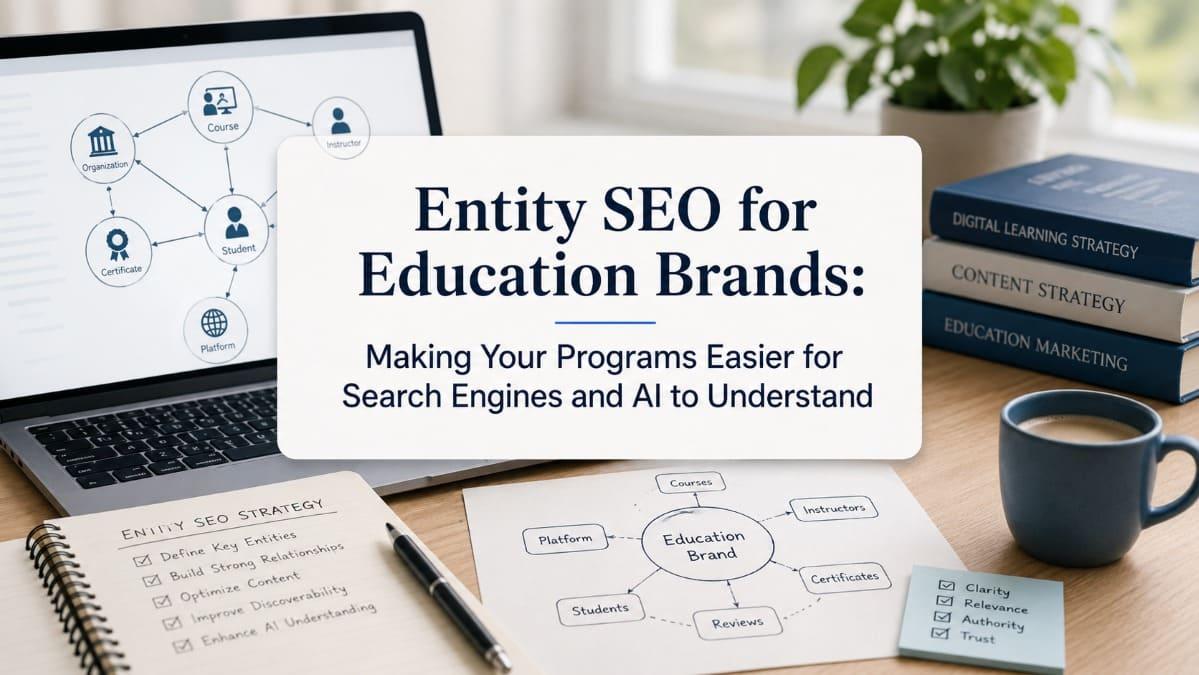
Entity SEO helps an education brand present its
organization, programs, instructors, certificates, locations, and learning
platform as clearly defined and consistently connected entities. It is not
limited to adding schema markup. Search engines and AI systems also rely on
visible page content, site structure, internal links, official profiles, and
external references to distinguish one organization or program from another.
For EdTech marketers and content teams, stronger entity clarity can reduce
conflicting information, support branded search visibility, and make education
content easier to retrieve accurately. This article explains which entities
matter, how their relationships should be documented, where structured data
fits, and how to build a practical entity-governance workflow without assuming
that entity optimization guarantees a knowledge panel, ranking, or AI citation.
- Quick
Answer
- What
Is Entity SEO for an Education Brand?
- Which
Entities Should an Education Website Define?
- Why
Education Brand Entities Become Ambiguous
- How
to Build Authoritative Entity Pages
- How
Should Structured Data Represent Education Entities?
- A
Practical Entity SEO Workflow
- Common
Entity SEO Mistakes
- How
to Measure Entity Clarity
- Conclusion
- FAQ
Quick Answer
Entity SEO for education brands is the practice of making
important organizations, people, programs, courses, credentials, products, and
relationships clearly identifiable across a website and the wider web.
An education brand should state consistently:
- Who
operates the organization
- Which
brand names it uses
- Which
programs and courses it provides
- Who
teaches or reviews the content
- Which
organization issues each certificate
- Whether
a program is accredited, recognized, or simply provides proof of
completion
- How
its learning platform relates to the organization
- Where
the organization operates
- Which
external profiles officially represent it
Visible content remains the foundation. Structured data can
reinforce those facts by describing entities such as Organization,
EducationalOrganization, Person, Course, ProfilePage, and Article, but markup
must accurately reflect information available to users.
Google states that Organization structured data on a home
page can help it understand administrative details and distinguish an
organization from others. However, structured data does not guarantee a
knowledge panel, rich result, ranking, or AI citation.
The practical objective is not to manipulate a knowledge
graph. It is to remove avoidable uncertainty about what the education brand is,
what it offers, and how its entities relate.
What Is Entity SEO for an Education Brand?
In this article, entity SEO refers to the process of
creating a clear, consistent, and verifiable representation of the important
entities associated with an education organization.
An entity is something that can be identified as distinct
from other things. On an education website, that may include:
- A
university
- A
training company
- An
academy
- A
course
- A
learning program
- An
instructor
- A
certificate
- An
accreditation body
- A
learning platform
- A
physical campus
- An
online learning channel
- A
research project
- A
partner institution
The entity itself is only one part of the problem.
Search engines and AI systems also need to interpret
relationships:
- This
company operates this education brand.
- This
education brand offers this course.
- This
instructor teaches this course.
- This
institution issues this certificate.
- This
program uses this learning platform.
- This
academy is a department of this parent organization.
- This
location belongs to this institution.
- This
article was written by this subject-matter expert.
When those relationships are visible and consistent, it
becomes easier to understand the education ecosystem represented by the
website.
Entity SEO is not another name for schema markup
Structured data is useful, but entity clarity cannot be
created through JSON-LD alone.
A website may contain technically valid Organization markup
while presenting contradictory information in visible content:
- The
home page uses one brand name.
- The
footer uses an outdated legal name.
- The
About page describes a different business model.
- Course
pages name several different providers.
- Instructor
pages do not exist.
- Social
profiles use old logos and descriptions.
- Certificates
name an issuing organization that the site never explains.
In that situation, adding more markup may simply create
another version of the same confusion.
Google requires structured data to represent the page’s
actual visible content and warns against hidden, misleading, irrelevant, or
inaccurate markup. It recommends JSON-LD as a supported format, but correct
implementation still does not guarantee that a rich result will appear.
Entity SEO therefore begins with information governance.
Entity clarity supports SEO, AEO, and GEO
Entity SEO helps conventional SEO by clarifying the subjects
and relationships represented by a site.
It supports Answer Engine Optimization because an answer is
more useful when the reader can identify:
- Which
provider the answer refers to
- Which
course or program is being discussed
- Who
issued a certificate
- Who
wrote or reviewed the information
- Which
location, country, or learner segment the statement applies to
It supports Generative Engine Optimization because
AI-generated answers may need to distinguish one education organization from
similarly named brands or connect a program with its actual provider.
Google’s current generative-search guidance states that no
special schema markup is required for generative AI visibility. Structured data
remains part of broader SEO and rich-result eligibility rather than a separate
access mechanism for AI answers.
An education brand cannot expect search systems to understand relationships that the organization itself describes inconsistently.

Which Entities Should an Education Website Define?
Not every noun mentioned on a website needs a dedicated
entity strategy.
Prioritize entities that affect discovery, trust,
enrollment, procurement, certification, authorship, or program administration.
For most education businesses, the entity model begins with
five layers.
|
Entity Layer |
Examples |
Relationship That Must Be Clear |
Typical Authoritative Page |
|
Organization |
Company, institution, foundation, academy, university |
Who legally or operationally runs the education activity |
Home page and About page |
|
Brand or platform |
Learning brand, academy brand, LMS product, mobile
application |
Whether it is a brand, product, platform, department, or
separate organization |
Product or platform page |
|
Program and course |
Degree, training program, cohort, short course,
microlearning series |
Who provides it, who it serves, and what outcome it
supports |
Program or course detail page |
|
Person |
Instructor, facilitator, author, reviewer, founder,
program lead |
Their role, expertise, affiliation, and associated content |
Instructor or author profile |
|
Credential |
Certificate, badge, qualification, academic credit |
Who issues it, what completion requires, and what
recognition it carries |
Credential or certificate information page |
|
Location |
Campus, branch, training center, service region |
Which organization operates there and which programs are
available |
Location page |
|
External organization |
Partner, accreditor, regulator, sponsor, employer |
Nature and scope of the relationship |
Partnership or accreditation explanation |
The operating organization
The website should identify the organization responsible for
the education activity.
This may be:
- A
registered company
- A
school or university
- A
foundation
- A
nonprofit organization
- A
government unit
- A
professional association
- An
individual education creator
- A
division of a larger institution
The organization name used publicly may differ from its
registered legal name.
For example:
FitAcademy is the public learning-platform brand operated by
PT Wahana Rezeki Ilmu.
This sentence clarifies two entities and one relationship:
- Brand:
FitAcademy
- Legal
organization: PT Wahana Rezeki Ilmu
- Relationship:
operated by
Without that explanation, a reader may assume that the brand
name and legal entity are interchangeable.
Google’s Organization structured data documentation
distinguishes the public name from legalName, which can be used when the
registered organization name is different.
The education brand or product
An education brand is not always an independent
organization.
It may be:
- A
commercial brand
- A
product name
- A
platform
- A
department
- A
program portfolio
- A
community initiative
- A
sub-brand
- A
mobile application
Consider the statements:
LearnPro is an education company.
LearnPro is a learning platform developed and operated by
Example Education Ltd.
Those statements describe different entity models.
The second is more precise because it explains what LearnPro
is and who operates it.
For white-label platforms, the relationships may be even
more complex:
- The
technology provider operates the infrastructure.
- The
client institution controls the learner-facing brand.
- The
client publishes its programs.
- The
technology provider maintains the application.
- Certificate
issuance may remain with the client.
- Learner
data responsibilities may be shared contractually.
A public page should not expose confidential commercial
terms, but it should avoid creating a false ownership impression.
Courses and broader learning programs
A course is not always the same as a program.
Schema.org defines a Course as a sequence of educational
events or creative works intended to build learner knowledge, competence, or
ability. It separately defines an EducationalOccupationalProgram as an
institutional program with a defined learning progression, requirements, and an
intended credential or occupational outcome.
In practice:
- A
program may contain several courses.
- A
course may have multiple cohorts.
- One
course may be offered in different delivery formats.
- A
program may lead to a certificate.
- A
learning path may combine courses without becoming a formally recognized
program.
The website should make these distinctions visible.
Example:
The Digital Facilitator Development Program consists of six
online courses, three live workshops, a field assignment, and a final
assessment.
This statement establishes that the program is broader than
one course.
Instructors, authors, and reviewers
An instructor is not automatically the author of every
article about the course.
An article author is not automatically qualified to validate
assessment or accreditation claims.
An education website may need to distinguish:
- Course
instructor
- Facilitator
- Curriculum
designer
- Content
author
- Article
author
- Technical
reviewer
- Academic
reviewer
- Program
manager
- Guest
contributor
A profile should identify the person’s relevant relationship
to the organization and subject.
Google’s ProfilePage structured data is intended for pages
focused primarily on one person or organization associated with the site. Its
valid examples include author and employee profile pages, while a generic home
page is not considered a profile page for this purpose.
Certificates, credentials, and recognition
Credential terminology requires particular precision.
A website should distinguish between:
- Certificate
of participation
- Certificate
of completion
- Certificate
based on passing an assessment
- Professional
certification
- Academic
credit
- Government-recognized
qualification
- Digital
badge
- Internal
organizational credential
A program can issue a certificate without that certificate
being accredited, professionally licensed, or accepted for academic credit.
An entity-ready credential statement could say:
Participants who complete all modules and pass the final
assessment receive a digital certificate of completion issued by Example
Academy. The certificate confirms completion of this program and is not a
government-issued professional license.
That answer identifies:
- Recipient
requirement
- Credential
type
- Issuing
organization
- Important
limitation
Credential clarity is an entity problem as much as a content
problem: the learner must be able to identify the issuer, qualification,
requirements, and recognizing authority as separate entities.
Accreditation bodies and institutional partners
Terms such as “partnered,” “supported,” “recognized,” and
“accredited” should explain the actual relationship.
A logo wall does not establish whether an organization:
- Funded
the program
- Provided
speakers
- Reviewed
the curriculum
- Accredited
the course
- Referred
participants
- Supplied
technology
- Hosted
an event
- Employed
graduates
- Merely
appeared at the same conference
Use specific language.
Instead of:
Accredited by Organization X
when no formal accreditation exists, write:
The curriculum was reviewed by representatives of
Organization X.
Only use the stronger claim when it can be verified through
the appropriate accrediting body.
Why Education Brand Entities Become Ambiguous
Entity ambiguity usually develops gradually.
The organization adds products, partners, instructors,
content channels, subdomains, and course variants without maintaining a single
source of truth.
Brand names change while old references remain online
A training business may rebrand but leave its former name
in:
- Page
titles
- Website
footer
- Structured
data
- PDF
brochures
- App-store
listings
- Social
profiles
- Author
bios
- Partner
websites
- Directory
listings
- Old
press releases
Search systems may interpret the old and new names as
separate organizations or fail to understand the relationship.
A rebrand plan should document:
- Previous
name
- Current
preferred name
- Legal
name
- Date
of change
- Old
domains
- Current
canonical domain
- Official
profile updates
- Redirect
requirements
- Public
explanation where necessary
Do not delete every historical reference if it is still
useful. Explain continuity.
The parent organization and public brand are treated as interchangeable
This is common in education startups and institutional
programs.
The brand name may appear on course pages, while contracts,
certificates, payment receipts, and privacy policies use the legal company
name.
The relationship should be stated in visible text and
maintained consistently.
For example:
CommunitySkills is a workforce-learning initiative managed
by Example Foundation.
This is clearer than alternating between CommunitySkills and
Example Foundation without explanation.
Program names are reused for different offerings
An education provider may use the same course title for:
- A
self-paced course
- A
facilitated cohort
- A
corporate version
- A
school version
- An
introductory workshop
- An
updated curriculum
If all versions share the same title, search engines and
learners may not know which duration, price, prerequisite, or certificate
applies.
Add stable differentiators:
- Level
- Delivery
format
- Target
audience
- Version
- Cohort
- Language
- Location
- Year
where appropriate
Example:
- Digital
Marketing Fundamentals — Self-Paced
- Digital
Marketing Fundamentals — Facilitated Corporate Cohort
- Digital
Marketing Fundamentals for School Entrepreneurs
Each variant should have a clear canonical page or
explicitly documented relationship.
Course pages name the brand but not the provider
A platform may host courses from multiple organizations.
The page should identify whether the visible brand is:
- Platform
operator
- Course
provider
- Instructor
organization
- Certificate
issuer
- Sponsor
These roles may belong to different entities.
A course page might state:
Hosted on FitAcademy
Course provider: Example Training Institute
Instructor: Maya Rahman
Certificate issued by: Example Training Institute
This prevents the platform from appearing to claim ownership
of every course or certificate.
Author identity is weak or generic
Articles attributed to “Admin,” “Editor,” or “Team” provide
little information about who created the content.
Generic attribution is especially weak for pages involving:
- Education
policy
- Assessment
- Child
safety
- Accreditation
- Learning
research
- Data
privacy
- Technical
platform claims
- Professional
credentials
A named author or reviewer should be connected to a profile
that explains relevant expertise.
External profiles describe different business categories
A company may describe itself as:
- An
online course marketplace on LinkedIn
- A
white-label LMS on its website
- A
mobile-learning application in an app store
- A
training agency in a business directory
- An
EdTech startup in a press article
Some variation is legitimate because each platform has
different categories.
The central description should still remain recognizable.
A stable version could be:
FitAcademy is a mobile-first microlearning and white-label
learning platform for institutions, creators, and training providers.
Supporting profiles can shorten or adapt that sentence
without changing the core entity.

How to Build Authoritative Entity Pages
An authoritative entity page is the primary public source
that explains one important entity.
It does not need to be the only page mentioning the entity.
It should be the clearest and most complete page for verifying its identity and
relationships.
Organization and About pages
The organization’s authoritative description should
generally answer:
- What
is the organization?
- What
is its preferred name?
- Does
it have a different legal name?
- What
does it provide?
- Who
does it serve?
- Where
does it operate?
- Who
leads it?
- Which
brands, programs, or platforms does it operate?
- How
can it be contacted?
- Which
profiles are official?
Google recommends adding relevant Organization information
to the home page and notes that properties such as the name, address,
telephone, URL, logo, legal name, and external profile URLs may help identify
and disambiguate the organization.
Avoid turning the About page into a long promotional history
without clear current facts.
A useful opening could be:
Example Learning Foundation is an Indonesian nonprofit
organization that develops digital learning and workforce-development programs
for community facilitators. The foundation operates CommunitySkills, its public
training initiative, and partners with local organizations to deliver
facilitated and self-paced programs.
This paragraph identifies the category, location, activity,
audience, sub-brand, and delivery model.
Course pages
Each course page should identify:
- Course
name
- Provider
- Intended
learners
- Learning
outcomes
- Prerequisites
- Delivery
mode
- Duration
- Instructor
- Assessment
- Certificate
- Language
- Availability
- Price
or access model where applicable
- Relationship
to a broader program
For example:
Introduction to Community Facilitation is the first course
in the Community Facilitator Development Program. It is provided by Example
Academy, taught by Maya Rahman, and delivered through the FitAcademy platform.
This sentence connects four entities:
- Course
- Program
- Provider
- Instructor
- Platform
Google’s Course list structured data documentation supports
details such as course name, provider, and description. Its currently
documented rich-result feature is available in English across regions where
Google Search operates, so publishers should not assume identical presentation
for every language market.
Program pages
A program page should explain how its components relate.
Include:
- Program
objective
- Provider
- Participant
group
- Courses
or modules
- Delivery
stages
- Instructors
or facilitators
- Assessment
- Credential
- Schedule
- Application
or enrollment process
- Partners
- Program
status
A program that has ended should not disappear without
explanation if it still has historical or institutional value.
Mark it clearly:
The 2025 cohort has concluded. Applications are not
currently open.
This preserves the entity while preventing outdated
enrollment expectations.
Instructor and author profiles
A useful instructor profile should contain:
- Full
public name
- Current
role
- Organizational
affiliation
- Relevant
expertise
- Courses
taught
- Articles
written or reviewed
- Professional
qualifications where relevant
- Official
profile links
- Photograph
- Disclosure
where appropriate
Do not create thin profile pages containing only a name and
photograph.
Google’s ProfilePage guidance requires the page to focus
primarily on one person or organization. It also allows profile entities to
include information such as the name, alternate name, description, identifier,
image, and external profile URLs where applicable.
Credential pages
A certificate or credential page should answer:
- What
is the credential called?
- Who
issues it?
- What
must the learner complete?
- Is
assessment required?
- Is
identity verification required?
- Does
it expire?
- Can
it be verified?
- What
recognition does it carry?
- What
does it not represent?
- Is
there an additional fee?
This page can be linked from every relevant course without
repeating the complete explanation.
Platform and product pages
For an education technology product, distinguish:
- Product
name
- Operating
company
- Product
category
- Primary
audience
- Core
use case
- Delivery
model
- Hosting
responsibility
- Branding
model
- Learner
relationship
- Data-access
model
- Support
model
Avoid describing a white-label platform only as “your own
learning platform.”
The phrase can imply source-code ownership, full technical
control, or independent hosting even when those are not included.
A clearer statement would be:
FitAcademy White Label allows an institution to operate a
branded learning website and application using FitAcademy’s managed technology
infrastructure. Branding, administration, hosting, data access, maintenance,
and commercial responsibilities depend on the selected agreement.
FitAcademy
Build a Clearer Branded Learning Ecosystem
FitAcademy helps institutions, creators, and training providers organize courses, learners, instructors, and branded learning experiences within a mobile-first platform structure.
Learn More About FitAcademyHow Should Structured Data Represent Education Entities?
Structured data should confirm the relationships described
in visible content.
It should not be the first or only place where those
relationships appear.
Use the most specific appropriate type
Google’s structured data guidelines recommend using the most
specific applicable Schema.org type while following the requirements of the
relevant Search feature.
Potential types for an education site include:
|
Page or Entity |
Potential Schema.org Type |
Practical Use |
|
Education company or institution |
Organization or an applicable subtype such as
EducationalOrganization |
Identify the organization, legal name, logo, URL, contact
details, and official profiles |
|
Instructor or author profile |
ProfilePage with Person as mainEntity |
Connect a person with a dedicated profile |
|
Organizational profile page |
ProfilePage with Organization as mainEntity where the page
genuinely functions as a profile |
Describe one affiliated organization |
|
Course page |
Course |
Describe an educational course and its provider |
|
Course listing |
ItemList containing Course items |
Represent a structured course list where Google’s
requirements are met |
|
Article |
Article or BlogPosting |
Identify headline, author, dates, and publisher |
|
Site hierarchy |
BreadcrumbList |
Clarify navigation hierarchy |
|
Video lesson or substantial public video |
VideoObject |
Describe a public video and its metadata |
|
Broader occupational program |
EducationalOccupationalProgram |
Represent a structured institutional program where
applicable |
|
Physical education location |
Applicable LocalBusiness, EducationalOrganization, or
another suitable type |
Describe location-specific organizational information |
Schema.org defines EducationalOrganization as an educational
organization and provides inherited properties for relationships such as
departments, employees, legal names, locations, brands, contact points, and
areas served.
Not every Schema.org type produces a Google rich result.
Schema vocabulary and Google-supported search appearances
are related but not identical. Check current platform documentation before
promising a visual search feature.
Maintain stable entity identifiers
Within JSON-LD, an @id can help connect references to the
same entity across structured data blocks.
For example, the organization entity might use:
https://example.com/#organization
An article publisher, course provider, and employee
affiliation can then refer to that same entity identifier rather than creating
several disconnected organization objects with different names or URLs.
The same principle can be applied to:
- Course
- Person
- Platform
- Website
- Location
- Program
Use stable canonical identifiers. Do not change them
whenever a page title or template changes.
Distinguish public name, alternate name, and legal name
A practical naming model may include:
- name:
Preferred public name
- alternateName:
Recognized abbreviation, former name, or public variation where applicable
- legalName:
Registered organization name
- url:
Canonical organizational website
- sameAs:
Relevant external pages that provide information about the same
organization
Google describes sameAs as a URL on another website
containing additional information about the organization, such as an official
profile on a social or review platform. Multiple URLs can be provided where
applicable.
Do not use sameAs for:
- Every
page that mentions the brand
- Guest-post
links
- Customer
websites
- Unrelated
directories
- A
partner organization
- A
founder’s profile when the entity being marked up is the company
- Competitor
comparison pages
The URL should refer to the same entity, not merely a
related one.
Connect courses to the correct provider
Course markup should name the organization that publishes or
provides the course.
Do not assign the technology platform as provider when a
client institution actually owns and delivers the course.
For example:
- Course
provider: Training Institute A
- Hosted
platform: FitAcademy
- Instructor:
Person B
- Certificate
issuer: Training Institute A
Those relationships may require visible page content and
several structured entities. Do not force all roles into the provider property.
Connect articles to real authors and publishers
Article markup should reflect:
- Actual
article author
- Publisher
- Headline
- Publication
date
- Substantive
modification date
- Relevant
image
- Canonical
page
An employee profile can use ProfilePage and Person, while
articles can refer to the same Person entity as author.
Google notes that structured data features such as Article
can connect to author profile pages, helping it understand creators and their
content relationships.
Keep markup synchronized with visible content
A common operational failure occurs when page content is
updated but structured data is generated from an old database field.
Examples:
- Visible
course title changes, schema title does not.
- Instructor
is replaced, schema still names the previous instructor.
- Course
price changes, markup remains old.
- Program
is closed, structured data still marks it as available.
- Logo
URL is replaced but no longer crawlable.
- Legal
name changes only in the footer.
Google requires structured data to represent the main
visible page content and to remain current. Hidden, misleading, or stale
information may make a page ineligible for rich results.
Do not treat schema validation as proof of correctness
The Rich Results Test can identify many technical errors,
but it cannot confirm every business fact.
A valid Organization object can still contain the wrong:
- Legal
name
- Logo
- Telephone
number
- Address
- Parent
company
- Official
profile
- Provider
relationship
Technical validation must be followed by editorial and
organizational review.
Schema can confirm a relationship to a machine, but only
governance can ensure that the relationship is true.

A Practical Entity SEO Workflow
Entity SEO is easier to maintain when the organization
creates a shared entity registry rather than asking writers and developers to
remember every relationship independently.
Step 1: Inventory the important entities
List entities that affect:
- Brand
identity
- Search
visibility
- Course
discovery
- Learner
trust
- Accreditation
- Authorship
- Product
consideration
- Institutional
procurement
Start with:
- Operating
organization
- Legal
organization
- Public
brands
- Products
and platforms
- Courses
- Programs
- Credentials
- Instructors
- Authors
- Locations
- Partners
- Accreditors
Do not attempt to document every minor entity during the
first audit.
Step 2: Create an entity registry
A basic registry can be maintained in a spreadsheet,
database, or content-management system.
Recommended fields include:
|
Field |
Example |
|
Entity ID |
ORG-001 |
|
Entity type |
Organization |
|
Preferred public name |
Example Academy |
|
Legal name |
PT Example Education Indonesia |
|
Alternate name |
Example Learning Academy |
|
Canonical URL |
https://example.com/about |
|
Short description |
Mobile-first training provider for community organizations |
|
Parent entity |
PT Example Education Indonesia |
|
Related brands |
Example Skills |
|
Official profiles |
LinkedIn, YouTube, app-store profile |
|
Primary logo |
Canonical image URL |
|
Content owner |
Corporate communications |
|
Last verified |
15 July 2026 |
The entity ID is an internal governance tool. It does not
need to be publicly displayed.
Step 3: Define canonical naming rules
Decide:
- Which
name appears in headings
- Which
name appears in contracts
- Which
name appears on certificates
- Which
abbreviation is acceptable
- How
the parent organization is introduced
- How
former names are handled
- How
course variants are named
- How
instructor names are formatted
- How
partner relationships are described
Document these rules in the editorial style guide.
Step 4: Assign an authoritative page
Each priority entity should have a canonical public page
where appropriate.
Examples:
- Organization
→ About page
- Product
→ Product overview page
- Course
→ Course detail page
- Program
→ Program detail page
- Person
→ Instructor or author profile
- Credential
→ Certificate information page
- Location
→ Branch page
Not every partner or certificate needs a separate page. The
objective is to provide one reliable source when the entity is important enough
to affect decisions.
Step 5: Map entity relationships
Create statements in plain language before implementing
markup.
For example:
- FitAcademy
is operated by PT Wahana Rezeki Ilmu.
- FitAcademy
provides a white-label learning platform.
- Training
Institute A publishes Course B.
- Course
B is hosted on FitAcademy.
- Instructor
C teaches Course B.
- Training
Institute A issues the course certificate.
If the organization cannot agree on these statements, it is
too early to encode them in structured data.
Step 6: Audit visible content
Search the website for every important name.
Review:
- Home
page
- About
page
- Footer
- Contact
page
- Course
pages
- Author
profiles
- Privacy
policy
- Terms
- Certificates
- PDFs
- Structured
data
- Page
titles
- Meta
descriptions
- Image
alt text
- Application
store descriptions
Record contradictions and prioritize those that affect
learner or buyer decisions.
Step 7: Implement structured data templates
Create reusable templates for:
- Organization
- Article
- Person
or ProfilePage
- Course
- Breadcrumbs
- Applicable
locations or videos
Pull data from the entity registry or a controlled CMS field
where possible.
Avoid manually rewriting organization information on every
article page.
Step 8: Align official external profiles
Update:
- Social
profiles
- App-store
listings
- Business
directories
- Partner
profiles
- Association
memberships
- Speaker
bios
- Media
kits
- Public
procurement profiles
- Government
registrations where publicly accessible
The description does not need to be identical everywhere,
but the fundamental category, name, URL, and ownership relationship should
remain consistent.
Step 9: Strengthen internal links
Connect entity pages contextually.
Examples:
- Instructor
name → instructor profile
- Course
provider → organization page
- Certificate
issuer → credential information
- Platform
name → product page
- Parent
program → program page
- Partner
name → partnership explanation where relevant
These links help readers verify relationships and help
crawlers discover the site structure.
They also strengthen the cluster established through AEO
for education businesses, GEO
for education brands, and answer-ready
education content.
Step 10: Establish a review cycle
Assign different review frequencies.
Frequent review:
- Course
availability
- Instructor
assignments
- Pricing
- Enrollment
dates
- Product
features
- Accreditation
status
Periodic review:
- Organization
description
- Official
profiles
- Leadership
- Partner
relationships
- Locations
- Structured
data templates
Event-triggered review:
- Rebrand
- Merger
- New
legal entity
- New
product
- Program
closure
- Accreditation
change
- Domain
migration
- Leadership
change
Common Entity SEO Mistakes
Creating schema for entities that do not exist visibly
Do not add:
- An
instructor who is not shown on the page
- An
accreditation relationship that is not explained
- A
partner organization that has not approved the relationship
- A
certificate that is not actually issued
- A
course rating that users did not submit
- A
location where the organization does not operate
Google’s structured data guidelines prohibit misleading or
hidden information and require markup to represent visible page content.
Using the same Organization schema for unrelated brands
A company may operate several distinct products.
They may share a legal organization while requiring separate
public descriptions.
Do not automatically present every sub-brand as an
independent legal organization. Conversely, do not erase meaningful brand
distinctions by forcing every page to use only the parent company name.
Define the relationship clearly.
Assuming a logo and sameAs links guarantee a knowledge
panelOrganization markup can help Google understand
administrative details and preferred visual elements, but it does not guarantee
a knowledge panel or any particular search presentation.
The organization still needs consistent, verifiable
information and sufficient relevance to the query.
Adding every external mention to sameAs
sameAs should point to pages representing or describing the
same entity.
A news story, partner announcement, guest article, or
conference page may mention the organization without functioning as the
organization’s identity page.
Use contextual links for mentions. Reserve sameAs for
genuine identity references.
Confusing course provider with technology provider
This is especially common on marketplaces and white-label
platforms.
The organization hosting the technology may not:
- Own
the curriculum
- Employ
the instructor
- Conduct
the assessment
- Issue
the certificate
- Set
the price
The course page and markup should assign each role
accurately.
Creating duplicate instructor profiles
The same person may appear under:
- Full
name
- Initials
- Married
or former name
- Professional
title
- Username
- Translated
spelling
Create one canonical profile and link alternate public
identifiers where necessary.
Marking every educational video as a course
Google’s current Course structured data guidance limits
Course markup to qualifying educational content with clear learning outcomes
and an instructional structure. A short standalone video or general event is
not automatically a course.
Use the content type that represents the actual resource.
Allowing marketing teams and technical teams to maintain separate facts
If marketing controls visible content while developers
hard-code structured data, contradictions are likely.
Both should draw from the same approved data source or
review process.
Creating entity pages with no reader value
A thin profile containing only a name, photo, and job title
may technically identify a person but provides little reason for a learner to
trust the instructor.
An authoritative page should answer real verification
questions.
How to Measure Entity Clarity
There is no single official “entity SEO score.”
Measurement should focus on whether important entities are
consistently represented, correctly indexed, and understood well enough to
support relevant discovery.
Conduct branded search reviews
Test searches for:
- Exact
organization name
- Brand
plus course
- Brand
plus founder
- Course
plus provider
- Instructor
plus course
- Brand
plus certificate
- Brand
plus location
- Former
brand name
- Brand
plus review
- Brand
plus login or application
Review whether results show:
- The
correct website
- Current
descriptions
- Current
logos
- Relevant
profiles
- Correct
organizational relationships
- Outdated
or conflicting pages
- Confusion
with similarly named entities
Search results vary by location, device, and
personalization, so use these reviews diagnostically rather than as fixed
rankings.
Audit entity consistency
Create a repeatable scorecard.
|
Audit Dimension |
Question |
Desired Condition |
|
Name consistency |
Does the same preferred name appear across key pages? |
One approved public name with documented variations |
|
Legal identity |
Is the legal operator stated where relevant? |
Brand and legal entity relationship is explicit |
|
Program ownership |
Is each course connected to the correct provider? |
Provider, platform, instructor, and issuer are
differentiated |
|
Author identity |
Can users verify who created or reviewed the content? |
Named profiles with relevant expertise |
|
Credential clarity |
Is the certificate type and issuer clear? |
Requirements, issuer, recognition, and limits are stated |
|
Structured data |
Does markup match visible content? |
Accurate, current, and technically valid |
|
External profiles |
Do official profiles describe the same organization? |
Category, name, URL, and description are aligned |
|
Internal linking |
Are entity relationships navigable? |
Contextual links connect authoritative pages |
|
Freshness |
Are time-sensitive entity facts reviewed? |
Named owner and update cycle |
Monitor structured data health
Use:
- Rich
Results Test
- URL
Inspection
- Search
Console enhancement reports where applicable
- Schema
validation tools
- Automated
template tests
- Source-code
review
Technical tests should be paired with factual review.
A page can pass validation while describing the wrong
provider or outdated instructor.
Review search and AI descriptions for factual accuracy
Periodically test how search engines and AI platforms
describe:
- The
organization
- Its
primary product
- Its
main audience
- Its
course portfolio
- Its
ownership
- Its
founders or leaders
- Its
location
- Its
credentials
Record recurring inaccuracies.
Then identify the likely source:
- Website
ambiguity
- Outdated
external profile
- Incorrect
third-party article
- Missing
canonical page
- Conflicting
structured data
- Similar
organization name
- Recent
rebrand
Do not assume every incorrect generated answer can be
corrected directly. Improve the underlying source ecosystem first.
Measure navigation and conversion improvements
Entity clarity may affect user behavior.
Monitor whether updates improve:
- Clicks
from instructor names to profiles
- Course-to-provider
navigation
- Visits
to certificate information
- Branded
search click-through rate
- Qualified
course inquiries
- Sales
questions about platform ownership
- Support
questions about certificate validity
- Misrouted
partnership inquiries
- Enrollment
abandonment caused by unclear prerequisites
A reduction in repetitive clarification questions may be a
meaningful operational result even when rankings do not change immediately.

Conclusion
Entity SEO for education brands is fundamentally an
information-clarity discipline.
The organization must define which entities matter, how they
are named, and how they relate.
A learner should be able to determine:
- Who
operates the brand
- Who
provides the course
- Who
teaches it
- Who
issues the certificate
- Which
program it belongs to
- Which
platform hosts it
- Which
institution recognizes it
- Where
the information can be verified
Search engines and AI systems need many of the same
relationships.
Structured data can reinforce those relationships,
particularly through Organization, EducationalOrganization, ProfilePage,
Person, Course, Article, and related types. However, markup cannot repair
contradictory visible content, weak profile pages, unclear program ownership,
or outdated external information.
The practical starting point is not a schema generator.
It is an entity registry, an approved naming system, a set
of authoritative pages, and a documented relationship map.
Once those foundations are stable, structured data, internal
links, author profiles, course pages, and external profiles can all describe
the same education ecosystem consistently.
This does not guarantee a knowledge panel, higher ranking,
or AI citation.
It does make the organization more difficult to
misidentify—and its programs easier for learners, search engines, and
AI-assisted systems to understand accurately.
FitAcademy
Create a More Coherent Learning Brand
FitAcademy supports institutions, creators, and training providers in organizing branded courses, learner journeys, instructors, and mobile-first learning delivery within one scalable platform ecosystem.
Learn More About FitAcademyFAQ
What is an entity in education SEO?
An entity is a distinct organization, person, program,
course, credential, product, location, or concept that can be identified
separately from others. Entity SEO helps make the identity and relationships of
those entities clear. For example, a course, its provider, its instructor, its
certificate issuer, and its hosting platform may be five separate but related
entities.
Is entity SEO the same as structured data?
No. Structured data is one method of describing page content
and entity relationships in a machine-readable format. Entity SEO also includes
visible content, consistent naming, canonical pages, internal links, author
profiles, course information, external corroboration, and governance. Valid
schema cannot compensate for contradictory or missing information on the
website.
Does Organization schema guarantee a Google knowledge panel?
No. Google states that Organization structured data can help
it understand and disambiguate an organization and may influence elements such
as a displayed logo. Correct markup does not guarantee a knowledge panel, rich
result, ranking improvement, or a particular presentation. Search features
remain dependent on Google’s systems and the query context.
Should an education brand use Organization or Educational Organization?
Use the most specific type that accurately represents the
entity. A school, university, academy, or other educational institution may fit
EducationalOrganization, while an EdTech software company may be better
represented as Organization or another appropriate subtype. The selected type
must match the organization’s actual role and visible page content.
Should every instructor have a separate profile page?
A separate profile is useful when the instructor, author, or
reviewer materially affects learner trust, course selection, or content
credibility. The page should contain meaningful information about expertise,
role, affiliation, and associated courses or articles. A thin page containing
only a name and photograph may provide little practical value.
How often should education entity information be reviewed?
Review frequency should reflect how quickly the information
changes. Instructor assignments, course availability, prices, program dates,
product capabilities, and accreditation status may need frequent checks.
Organization names, official profiles, leadership, and partner relationships
should also be reviewed after any rebrand, merger, launch, domain migration, or
organizational change.