Answer Engine Optimization, or AEO, helps education businesses create content that can be understood, extracted, and presented as a useful answer by search engines and AI-assisted discovery platforms.
For EdTech marketers and content teams, this means going beyond keyword targeting. Course pages, guides, program descriptions, and institutional content must answer real learner questions clearly while providing enough evidence, context, and brand information to be trusted.
This article explains how AEO relates to traditional SEO, what makes education content answer-ready, which technical foundations matter, how to build an operational AEO workflow, and how to measure visibility without assuming that rankings or AI citations can be guaranteed.
- Quick
Answer
- What
Does AEO Mean for an Education Business?
- Why
AEO Matters in Education Discovery
- How
Do Search and AI Answer Systems Find Useful Answers?
- What
Does Answer-Ready Education Content Look Like?
- A
Practical AEO Workflow for Education Content Teams
- Common
AEO Mistakes Education Brands Should Avoid
- How
Should Education Businesses Measure AEO Performance?
- Conclusion
- FAQ
Quick Answer
Answer Engine Optimization is the practice of making content
clear, reliable, and contextually complete enough for search engines and
AI-assisted answer systems to identify it as a useful response to a specific
question.
For an education business, AEO may involve directly
answering questions about course suitability, learning outcomes, prerequisites,
delivery format, duration, certification, assessment, instructor expertise,
pricing, or platform capabilities. The answer should appear in visible,
indexable text and be supported by details that help learners verify whether it
applies to their situation.
AEO does not replace search engine optimization. It depends
on the same foundations: crawlability, indexing, internal linking, page
quality, useful content, and clear site structure. Google’s current guidance
also states that no special AI schema or machine-readable file is required for
visibility in its generative search features. improve a page’s answer
readiness, but it cannot guarantee a featured snippet, AI citation, first
position, or enrollment outcome. Those decisions remain platform-dependent.
What Does AEO Mean for an Education Business?
Answer Engine Optimization, or AEO, is a content and search
visibility discipline that helps answer-based systems understand what a page
explains, which question it addresses, and why the information may be useful to
a particular user.
The “answer engine” may be a traditional search feature, a
voice interface, a question-and-answer panel, an AI-generated search
experience, or an assistant that retrieves information from indexed web pages.
The exact presentation varies, but the underlying content requirement is
similar: the system needs to locate a relevant passage and interpret it without
losing the conditions that make the answer accurate.
For education businesses, AEO is particularly relevant to
pages such as:
- Course
and program landing pages
- Admissions
and enrollment guides
- Training
methodology explanations
- Learning
platform feature pages
- Certification
and assessment information
- Tuition,
pricing, and funding pages
- Instructor
or institutional profiles
- Educational
articles and knowledge resources
- Learner
support and onboarding content
AEO should not be treated as a new label for adding more
FAQs. It requires content teams to understand what learners are trying to
decide and to provide the right answer at the right level of detail.
A learner asking, “What is microlearning?” needs a clear
definition.
A training manager asking, “Can this platform track
completion across multiple branches?” needs an operational answer.
A prospective student asking, “Will this certificate be
accepted by employers?” needs a carefully qualified explanation rather than an
unsupported promise.
Those are different answer tasks, even when they relate to
the same education brand.
AEO and SEO overlap more than they compete
Traditional SEO supports discovery across a broad range of
searches. AEO places additional attention on whether the content contains a
direct, self-contained response that can be surfaced in an answer-oriented
experience.
Google’s July 2026 guidance explicitly acknowledges AEO and
Generative Engine Optimization as terms used by the industry, while stating
that, from Google Search’s perspective, optimization for generative search
remains part of SEO. The same guidance warns against overfocusing on special
markup, artificial content chunking, or rewriting pages solely for AI systems.
|
Aspect |
Broader SEO Emphasis |
AEO Emphasis |
Shared Foundation |
|
Primary objective |
Help relevant pages become discoverable and competitive in
search |
Make a specific answer easy to identify, understand, and
reuse |
Useful content that matches real user needs |
|
Typical target |
Topic, keyword, or search intent |
Explicit learner question or decision |
Search relevance |
|
Page structure |
Titles, headings, internal links, topical depth |
Direct answers, definitions, comparison blocks, caveats |
Clear information hierarchy |
|
Technical dependency |
Crawling, indexing, canonicalization, performance |
Indexing and eligibility to appear with a usable snippet |
Technical SEO |
|
Measurement |
Impressions, rankings, clicks, conversions |
Answer-oriented impressions, citations, qualified visits,
assisted conversions |
Search Console and analytics |
|
Main risk |
Ranking-focused content with little reader value |
Oversimplified answers stripped of essential context |
Content created for systems rather than people |
An education company therefore should not build an isolated
“AEO strategy” while neglecting its foundational
SEO for education businesses. AEO works best as a refinement of an already
coherent search, content, and information architecture strategy.
The strongest answer is not merely easy to extract. It is clear enough to use and complete enough to trust.

Why AEO Matters in Education Discovery
Education decisions are rarely based on a single keyword.
A learner may begin with a broad question such as “What is
instructional design?” and later ask about course duration, portfolio
requirements, instructor credibility, available support, assessment methods,
certificate value, payment options, and career relevance.
Institutional buyers follow an equally complex path. A
corporate learning manager evaluating an online training platform may need to
understand:
- Whether
the platform supports private learning groups
- How
learner progress is recorded
- Whether
content can be accessed on mobile devices
- How
administrators manage users
- Whether
branding can be customized
- What
data the organization controls
- How
deployment and ongoing support work
- Whether
the system can operate under bandwidth limitations
A conventional article may rank for one of those topics
while leaving the actual decision unanswered. An answer-ready content system
connects early educational questions with later operational questions.
Learners increasingly search through complete questions
Search behavior has expanded beyond short keyword phrases.
People can now describe a specific situation, combine multiple requirements,
and ask for comparisons in one query.
Google explains that AI Overviews and AI Mode may use a
query fan-out process, issuing multiple related searches across subtopics and
data sources before assembling a response. This creates potential visibility
opportunities beyond exact keyword matching, but it also means a page must
establish clear relevance to the subtopic it genuinely addresses. ple, a
prospective learner might search:
What type of online course is suitable for employees who
have limited study time and unreliable internet access?
A useful answer would need more than a definition of online
learning. It might need to explain asynchronous access, mobile compatibility,
microlearning duration, offline functionality, progress synchronization, and
employer support.
A page that provides only broad promotional claims is
unlikely to resolve that question well.
Education answers carry practical consequences
Incomplete education information can lead to poor-fit
enrollments, support complaints, refund requests, low completion, or
dissatisfaction between an institution and its learners.
Consider a course page that says a program is
“beginner-friendly” but does not explain what beginner means. Does the learner
need basic spreadsheet skills? Is professional experience required? Is the
instruction delivered in technical English? Does the final assessment assume
access to particular software?
AEO encourages the content team to convert vague labels into
verifiable conditions.
Instead of:
Suitable for beginners.
A more useful answer would be:
This course is designed for learners with no previous data
analytics experience. Participants should be comfortable using a computer,
working with basic spreadsheets, and following instructional material in
English. No programming experience is required.
The second version is easier for a search system to
interpret, but its main value is operational: it helps the learner make a
better enrollment decision.
For education brands, answer quality affects more than
visibility. It influences learner expectations, enrollment fit, support demand,
and the credibility of the institution.
How Do Search and AI Answer Systems Find Useful Answers?
No content team can know every factor used by every answer
platform. Systems differ, models change, and inclusion cannot be guaranteed.
However, education businesses can improve the conditions
under which their content becomes discoverable and understandable.
The page must first be accessible and indexable
For a page to appear as a supporting link in Google’s AI
Overviews or AI Mode, Google states that the page must be indexed and eligible
to appear in Search with a snippet. There are no separate technical
requirements for these AI features. es basic technical checks essential:
- The
page returns a successful HTTP status.
- Crawlers
are not blocked unintentionally.
- The
page is not marked noindex.
- Canonical
tags identify the intended URL.
- Important
content is present in crawlable text.
- Internal
links use valid HTML links.
- Mobile
rendering does not remove essential information.
- The
page loads reliably enough for users and crawlers.
Google also recommends making content discoverable through
internal links, providing a good page experience, keeping important information
in textual form, and ensuring that structured data matches visible page
content. fully designed course page cannot answer a search query if its main
course information is hidden inside an inaccessible image, gated dashboard, or
JavaScript component that fails to render consistently.
The answer must be identifiable within the page
A page may cover the correct topic yet bury its answer
beneath a long introduction, company history, or promotional copy.
Answer-ready pages usually provide a concise response near
the relevant heading, followed by supporting explanation.
For example:
Is microlearning suitable for compliance training?
Microlearning can support compliance training when the
subject can be divided into focused concepts, procedures, or reinforcement
activities. It may be less suitable as the only format for complex judgment,
supervised practice, or high-risk competency assessment.
The opening directly answers the question. The second
sentence preserves an important limitation.
That structure is useful whether the passage appears in a
standard search snippet, a featured answer, or an AI-generated summary.
Google automatically selects standard snippets from page
content according to the query. It also states that publishers cannot manually
mark a passage as a featured snippet; Google’s systems determine whether a page
is suitable. efore improves answer clarity, not answer ownership.
The source must provide more than interchangeable information
Many education articles repeat definitions already available
across hundreds of websites. A page that says “online learning is learning
delivered through the internet” may be accurate, but it contributes little
beyond common knowledge.
A stronger education resource adds something that is
difficult to replace:
- A
decision framework
- A
carefully scoped definition
- An
implementation example
- First-hand
operational knowledge
- A
program-specific methodology
- Original
research or internal data
- An
expert interpretation
- A
practical limitation
- A
comparison based on real use conditions
- Clear
documentation of how a service works
Google’s people-first content guidance recommends
demonstrating depth, serving an intended audience, maintaining a clear site
focus, and leaving readers with enough information to achieve their goal. It
cautions against publishing large volumes of content that merely summarizes
what other sources already say. dTech brand, the competitive advantage is
rarely the generic definition. It is the explanation of how that concept
changes learning design, delivery, management, or business decisions.
What Does Answer-Ready Education Content Look Like?
Answer-ready content is not necessarily short. It is content
in which the core answer can be located quickly and the supporting context is
organized logically.
The most effective format depends on the question.
A definition may need one concise paragraph.
A platform comparison may require a table.
A course suitability question may need prerequisites and
exclusions.
A policy question may need dates, jurisdiction, and an
official reference.
A strategic question may require a framework and several
examples.
Start with a direct answer, then protect the nuance
A useful answer block generally follows this sequence:
- Direct
answer
- Scope
or condition
- Practical
implication
- Evidence
or supporting detail
- Next
logical question
For example:
A white-label learning platform is a learning system that an
organization can operate under its own brand without developing the entire
technology stack internally. The degree of control varies by provider, so
buyers should verify branding options, learner data access, hosting
arrangements, integrations, maintenance responsibilities, and commercial terms
before choosing a platform.
The first sentence defines the term. The second prevents the
reader from assuming that all white-label arrangements provide identical
ownership or control.

Match the answer format to the learner’s decision
|
Learner or Buyer Question |
Most Suitable Page |
Useful Answer Format |
Information That Builds Confidence |
|
What is this concept? |
Educational guide or glossary page |
One-sentence definition followed by context |
Examples, boundaries, related terminology |
|
Is this course suitable for me? |
Course detail page |
Eligibility statement and prerequisite checklist |
Skill level, required tools, language, workload |
|
How long will the program take? |
Course or program page |
Exact duration and schedule explanation |
Weekly commitment, cohort dates, self-paced limits |
|
What will I be able to do afterward? |
Learning outcomes section |
Observable outcome statements |
Assessment method, project, competency evidence |
|
Is the certificate formally recognized? |
Certification information page |
Directly qualified recognition statement |
Issuing body, accreditation status, applicable limits |
|
Which learning platform model should we choose? |
Comparison or consideration guide |
Decision table and implementation scenarios |
Data control, branding, cost, support, scalability |
|
How does the platform work in low-connectivity settings? |
Feature or technical page |
Operational explanation |
Offline behavior, synchronization, device requirements |
|
What happens after enrollment? |
Onboarding guide |
Sequential process |
Account setup, orientation, support, first learning task |
The answer should exist on the page where the user would
reasonably expect to find it. Publishing a separate blog article about course
duration while leaving the actual course page unclear creates unnecessary
friction.
Put essential program facts in visible text
Education businesses often place important information
inside brochures, videos, downloadable PDFs, images, or sales presentations.
Those assets may support the page, but they should not be the only location
where essential facts appear.
The visible page should clearly state applicable details
such as:
- Program
provider
- Intended
participant
- Learning
outcomes
- Prerequisites
- Course
format
- Duration
and expected study time
- Assessment
method
- Certificate
conditions
- Price
and payment terms
- Instructor
or facilitator
- Delivery
language
- Accessibility
or device requirements
- Enrollment
dates
- Support
channels
- Refund
or cancellation conditions
This information helps both retrieval systems and people. It
also reduces the risk that an answer system combines outdated information from
one page with current information from another.
Use evidence close to the claim it supports
A claim such as “our program improves employability”
requires stronger support than “the program includes three portfolio
assignments.”
The second statement can usually be verified from the course
design. The first depends on learner background, labor-market conditions,
program quality, and evidence of outcomes.
When evidence is available, identify it precisely:
- The
source of the data
- The
group measured
- The
period covered
- The
metric used
- Any
methodological limitation
- Whether
the result came from internal or external research
When evidence is unavailable, narrow the claim.
Instead of:
This course will increase your income.
Use:
The course is designed to help participants develop
practical bookkeeping skills that may support better financial management or
entry-level administrative work. Employment or income outcomes depend on
experience, local demand, and how the skills are applied.
Answer-ready does not mean overconfident. It means
understandable without becoming misleading.
An answer engine may extract a sentence without the
surrounding page. Place important qualifications close to the claim they limit.
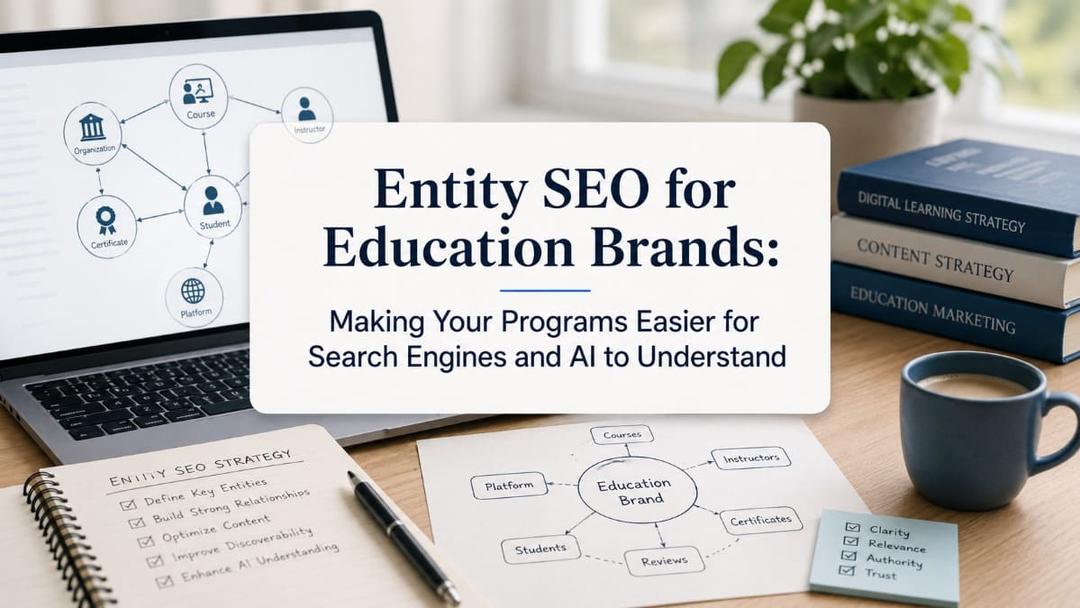
Strengthen entity clarity across the site
An education business should use consistent information when
referring to its organization, programs, instructors, credentials, products,
and delivery model.
If a program has three different names across the website,
an outdated provider name in its footer, and conflicting duration information
on multiple pages, the problem is not only technical SEO. The brand has created
an information consistency problem.
Entity clarity can be improved by maintaining:
- One
preferred organizational name
- A
clearly stated legal or operating identity
- Consistent
program names
- Dedicated
instructor profiles
- Stable
course identifiers or slugs
- Clear
relationships between provider, course, instructor, and certificate
- Updated
contact details
- Consistent
logos and brand profiles
- Accurate
external profiles and citations
Google states that Organization structured data on a home
page can help it understand administrative details and distinguish one
organization from another. Recommended properties include the organization
name, URL, logo, contact information, legal name, and relevant external
profiles through sameAs. ject deserves its own implementation plan, which is
explored further in entity
SEO for education brands.
FitAcademy
Learn How Education Content Becomes Easier to Discover
Explore how FitAcademy approaches branded learning content, microlearning delivery, and structured learner journeys for institutions, creators, and training providers.
Learn More About FitAcademyA Practical AEO Workflow for Education Content Teams
AEO becomes sustainable when it is integrated into content
research, production, review, publishing, and measurement. Treating it as a
final editing checklist usually produces cosmetic improvements rather than
stronger answers.
1. Build a learner question inventory
Start with questions that already exist inside the business.
Useful sources include:
- Google
Search Console queries
- Internal
site search
- Sales
conversations
- Demo
requests
- Enrollment
calls
- Learner
onboarding questions
- Support
tickets
- Course
feedback
- Community
discussions
- Webinar
questions
- Competitor
comparison requests
- Questions
asked by institutional procurement teams
Do not begin by asking, “Which keywords can we rank for?”
Begin with:
What does the learner or buyer need to understand, verify,
compare, or decide?
Then classify each question by purpose:
- Definition
- Suitability
- Comparison
- Process
- Cost
- Risk
- Trust
- Implementation
- Troubleshooting
- Outcome
This prevents the content calendar from becoming a long list
of awareness articles that never answers purchase or enrollment questions.
2. Assign each question to a canonical page
Every important question should have a logical primary page.
For example:
- “What
is microlearning?” → educational pillar article
- “How
long is the course?” → course detail page
- “Can
administrators export learner data?” → platform feature or documentation
page
- “Is
the certificate accredited?” → certification page
- “How
does onboarding work?” → onboarding guide
- “White-label
platform or marketplace?” → comparison article
The canonical page should provide the most current and
complete version of the answer. Supporting pages can refer to it through
descriptive internal links.
This reduces contradictory information and helps search
systems understand which page represents the main answer.
3. Write the canonical answer paragraph
Create a 40–100 word response that can stand on its own.
It should:
- Repeat
enough of the question to remain understandable
- Answer
in the first sentence
- Include
the most important condition
- Avoid
unqualified superlatives
- Use
the organization’s preferred terminology
- Leave
detailed evidence for the following paragraphs
This paragraph is not a meta description. It belongs in the
visible page and should still be useful when read in context.
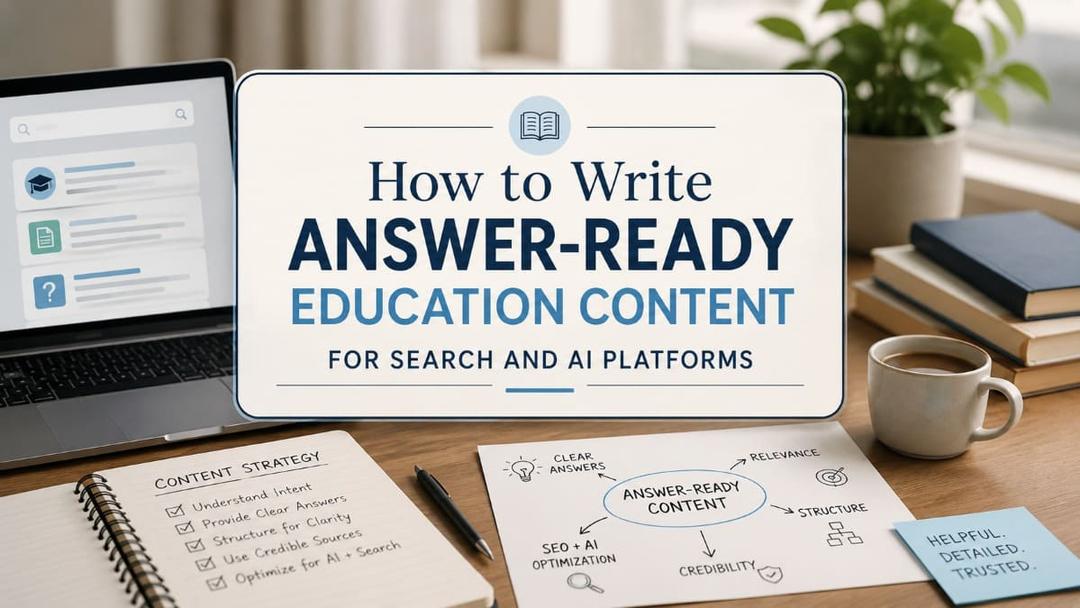
For more detailed editorial patterns, see how
to write answer-ready education content.
4. Add the information required for a real decision
The answer paragraph creates clarity. The rest of the
section creates confidence.
Ask what the reader would need to verify before acting:
- Does
the answer depend on course level?
- Does
it apply in every country?
- Is
the feature included in every pricing plan?
- Is
the certificate issued automatically or after assessment?
- Does
“mobile learning” mean responsive web access or a native application?
- Does
“offline learning” include full offline use or only cached content?
- Does
the quoted price include implementation, hosting, support, and transaction
fees?
This is where education businesses often expose the
difference between marketing language and operational reality.
AEO is stronger when the answer survives follow-up
questions.
5. Add proof and source signals
Where appropriate, strengthen the page with:
- Author
or reviewer credentials
- Publication
and update dates
- Links
to primary sources
- Methodology
notes
- Screenshots
of real workflows
- Product
documentation
- Sample
curriculum
- Assessment
examples
- Clear
provider information
- Original
observations from implementation
- Transparent
limitations
Do not add decorative citations that do not substantiate the
claim. A link should help the reader verify something meaningful.
Google encourages unique, expert-led content that provides
value beyond common knowledge. It also advises publishers to be cautious about
third-party tools that promise ranking success or claim access to internal
Google metrics. Connect the answer to the next learner question
A strong internal link anticipates what the reader needs
next.
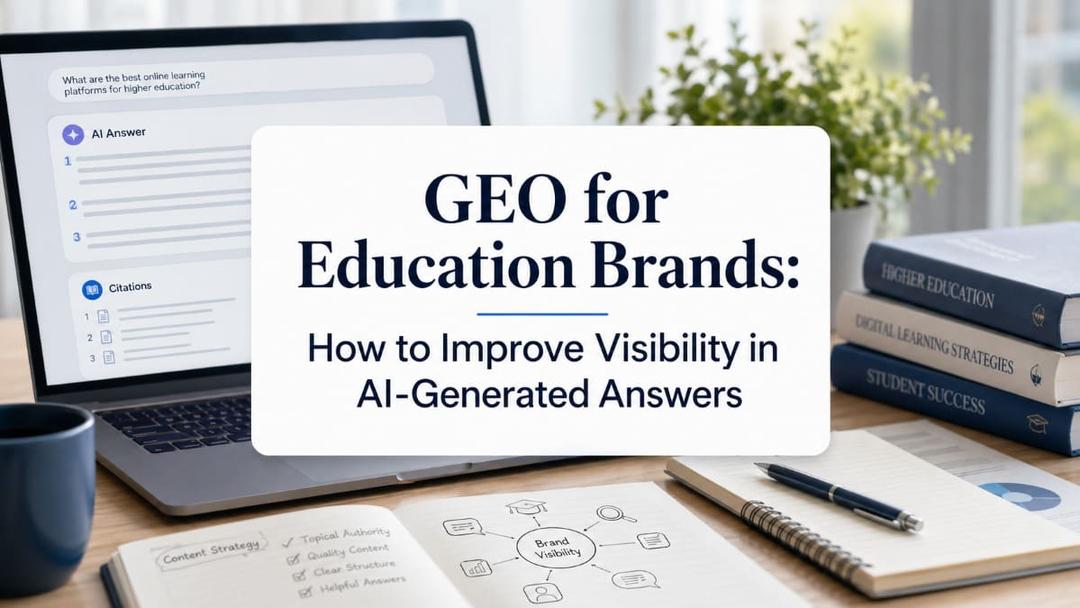
After defining AEO, the next question may be how it differs
from visibility in generative answers. That journey can continue through GEO
for education brands.
After explaining a learning format, the next link may lead
to:
- A
course using that format
- An
implementation guide
- A
comparison with another method
- A
platform feature page
- A
case example
- A
contact or demo page
Anchor text should describe the destination. “Learn how
microlearning supports workforce training” is more useful than “click here.”
7. Implement relevant structured data without treating it as a shortcut
Structured data can help search engines classify page
content and may make pages eligible for supported rich-result features. It does
not guarantee enhanced visibility, ranking, or inclusion in an AI answer. g on
the page, an education website may consider:
- Organization
for organizational identity
- Article
or BlogPosting for editorial content
- Course
for eligible course information
- ItemList
for an appropriate course list
- BreadcrumbList
for site hierarchy
- Person
or ProfilePage for instructor profiles
- VideoObject
when substantial video content is present
Google’s Course list documentation allows publishers to
describe information such as course name, provider, and description. Its
current documentation states that the Course list rich-result feature is
available in English across regions where Google Search is available. This
means an education provider should verify current language eligibility rather
than assuming identical presentation for every market. structured data can help
Google better understand details such as the article title, image, author, and
date, while Organization markup may support organizational disambiguation. up
must accurately represent what users can see on the page.
8. Test the complete experience
Before publishing, review the page from several
perspectives.
Learner check: Can a reader find the answer within a
few seconds?
Accuracy check: Are conditions and limitations stated
close to the claim?
Entity check: Are program, instructor, provider, and
credential names consistent?
Technical check: Can the page be crawled, rendered,
indexed, and shown with a snippet?
Conversion check: Is there a useful next step after
the answer?
Maintenance check: Who will update the page when
prices, dates, features, or policies change?

Common AEO Mistakes Education Brands Should Avoid
The most common AEO problems do not come from missing a
particular tool. They come from misunderstanding what answer readiness
requires.
Publishing generic answers at scale
A content team may generate hundreds of articles that define
popular education terms but provide no original framework, institutional
experience, or decision value.
This can create a large index without building meaningful
authority.
Google’s people-first guidance specifically cautions against
extensive automation across many topics and content that mainly summarizes
other sources without adding substantial value. r library of accurate,
interconnected resources is often more useful than a broad collection of
interchangeable definitions.
Breaking every topic into tiny content fragments
Short sections can help answer extraction, but content does
not need to be divided into dozens of thin pages or disconnected blocks.
Google’s current generative search guidance states that
there is no requirement to break content into tiny pieces for AI understanding
and no ideal page length. The appropriate depth depends on the audience and
subject. er question is whether the page covers one coherent user task.
A comprehensive guide to choosing a corporate learning
platform may require substantial detail. A question about course start dates
does not.
Assuming FAQ schema creates answer visibility
An FAQ section can be valuable because it answers real
questions in a concise format. That does not mean FAQ structured data will
produce a visible rich result for a commercial education website.
Google limited regular FAQ rich-result visibility primarily
to well-known government and health websites. For most education businesses,
the editorial value of FAQs is more important than the expectation of a special
search display. because learners need the answers, not because markup is
expected to create additional search real estate.
Hiding the real answer behind a sales form
A landing page may describe a program using phrases such as
“flexible,” “industry-ready,” or “designed for modern learners,” while
requiring the visitor to submit a form to learn the duration, price,
prerequisites, or delivery format.
This may increase lead volume in some campaigns, but it
weakens answer completeness and can attract poorly qualified inquiries.
Not every commercial detail must be public. However,
information withheld from the page cannot be expected to support a complete
public answer.
Removing caveats to make the answer sound stronger
Education outcomes depend on participation, prior knowledge,
teaching quality, practice, assessment, learner support, and external
conditions.
Claims such as “guaranteed employment,” “universally
accepted certificate,” or “suitable for everyone” should not be used unless
they can be substantiated under clearly defined conditions.
A qualified answer may sound less promotional, but it is
more defensible and more useful.
Publishing conflicting program information
When a course page says eight weeks, a brochure says ten
weeks, and an old article says six weeks, an answer system may encounter
multiple versions.
The organization should decide which page is authoritative,
update outdated references, and use redirects or visible revision notices when
necessary.
Content governance is part of AEO.
Answer visibility is fragile when the organization itself has not decided which version of the answer is correct.
How Should Education Businesses Measure AEO Performance?
AEO measurement should combine visibility, engagement,
conversion, and content quality signals. No single metric proves that a page
has become “the answer learners find first.”
Start with technical eligibility
Monitor whether important answer pages are:
- Indexed
- Canonicalized
correctly
- Accessible
to crawlers
- Eligible
to display snippets
- Included
in XML sitemaps
- Connected
through internal links
- Free
from critical structured data errors
- Rendering
essential content correctly
A page cannot earn sustainable answer visibility if it
repeatedly disappears from the index or exposes different information across
devices.
Track question-level search performance
Use Search Console to identify:
- Questions
generating impressions
- Pages
receiving impressions for those questions
- Changes
in click-through rate
- Query
groups that remain poorly served
- Pages
that gain visibility after answer improvements
- Countries
and devices where performance differs
Do not evaluate only exact-match keywords. A well-developed
answer page may become relevant to several semantically related queries.
Review generative search reporting where available
Google introduced a Generative AI performance report in
Search Console that can show impressions from supported generative Search
features, including AI Overviews and AI Mode. As of July 2026, the report is
being rolled out to a subset of website owners and may not appear for every
property. Available dimensions include pages, countries, and dates. ort can
help identify which pages are appearing in Google’s generative experiences, but
it should not be interpreted as a complete record of every prompt, quotation,
or AI citation across the web.
Education businesses should also monitor:
- Referral
traffic from identifiable AI platforms
- Landing
pages used by AI-referred visitors
- Demo,
contact, or enrollment conversions
- Assisted
conversions
- Brand
searches after informational exposure
- Returning
visitors
- Engagement
with linked course or product pages
- Sales
and support questions that indicate changing awareness

Evaluate answer quality manually
Metrics may show that a page is visible without showing
whether the extracted answer is complete.
Create a periodic review process:
- Select
priority learner questions.
- Review
the organization’s own answer page.
- Compare
the answer with current program facts.
- Test
several search and AI discovery interfaces.
- Record
whether the brand appears.
- Check
whether the surfaced statement is accurate.
- Identify
missing context or outdated information.
- Update
the canonical page where necessary.
Do not rewrite content every time one platform produces a
different response. Look for repeated patterns before making structural
changes.
Connect visibility to business outcomes carefully
AEO success should not be measured only by whether a brand
is mentioned in an answer.
A page may receive fewer clicks because the basic question
was answered directly in the search interface. That does not automatically mean
the content has no value. It may still increase brand familiarity or influence
later navigation.
Conversely, an AI citation with no qualified visits, brand
recall, enrollment interest, or institutional relevance may have limited
commercial impact.
Measure the full path:
Question visibility → source exposure → qualified visit →
deeper content interaction → course or platform evaluation → conversion or
assisted conversion
Attribution will remain imperfect. The objective is not to
assign exact revenue to every answer appearance, but to understand whether the
content contributes to discovery and informed decision-making.
Conclusion
AEO for education businesses is not a race to turn every
page into a short definition or an oversized FAQ.
It is a disciplined effort to make educational information
easier to find, understand, verify, and act upon.
The strongest AEO strategy begins with real learner
questions. It assigns each important question to a clear canonical page,
provides a direct answer, preserves necessary caveats, adds evidence, maintains
consistent organizational entities, and connects the reader to a useful next
step.
Technical SEO remains essential. A page still needs to be
accessible, indexable, internally connected, and eligible to appear with a
snippet. Structured data can improve machine understanding and rich-result
eligibility, but it is not a special access pass to AI answers.
For EdTech marketers and content teams, the most valuable
shift is operational: stop treating content as a collection of traffic assets
and start treating it as an organized answer system.
That system should help a learner understand a concept,
assess a course, verify a claim, compare alternatives, and decide what to do
next. When it does those jobs well, it becomes more useful to people—and better
prepared for search and AI-assisted discovery.
FitAcademy
Build a Clearer Learning and Content Experience
FitAcademy supports institutions, creators, and training providers that want to organize branded learning content, deliver mobile-first microlearning, and guide learners through a more coherent digital journey.
Learn More About FitAcademyFAQ
What is AEO in education marketing?
AEO in education marketing is the practice of creating
clear, reliable answers to the questions learners and institutional buyers ask
during discovery and decision-making. It combines answer-first writing,
technical SEO, structured information, credible evidence, and logical internal
linking. Its purpose is to help both people and answer-oriented systems
understand what an education provider offers and when the information applies.
Is AEO different from SEO?
AEO emphasizes direct answers and answer-oriented search
experiences, while SEO covers the broader process of helping pages become
crawled, indexed, understood, ranked, and selected by users. In practice, they
overlap substantially. AEO depends on SEO foundations and should normally be
integrated into the same content and technical strategy rather than managed as
an isolated channel.
Can AEO guarantee that an education brand appears in AI answers?
No. AEO cannot guarantee inclusion, ranking, citation, or a
featured snippet. Search and AI platforms decide which sources to use based on
their own systems, query context, index coverage, and quality assessments.
Education brands can improve answer readiness through accurate content, strong
technical foundations, consistent entities, and useful evidence, but visibility
remains platform-dependent.
Should every education article include an FAQ section?
No. An FAQ section is useful when readers have distinct
follow-up questions that are not answered naturally in the main article. It
should not be added merely to increase word count or deploy FAQ schema. Some
topics are better served by a comparison table, process explanation, course
checklist, or a single well-developed answer section.
Which structured data types are useful for education websites?
Relevant types may include Organization, Article,
BlogPosting, Course, ItemList, BreadcrumbList, Person, and ProfilePage,
depending on the visible page content. The markup should accurately represent
the page and follow the search platform’s current documentation. Correct
implementation may support understanding or rich-result eligibility, but it
does not guarantee special treatment.
How long does it take for AEO improvements to produce results?
There is no standard timeline. Results depend on crawling
frequency, indexing, site authority, competition, query demand, content
quality, technical condition, and platform behavior. Some updated pages may be
recrawled quickly, while others may take considerably longer. Teams should
measure changes over meaningful periods and avoid judging an AEO revision from
a small number of manual searches.