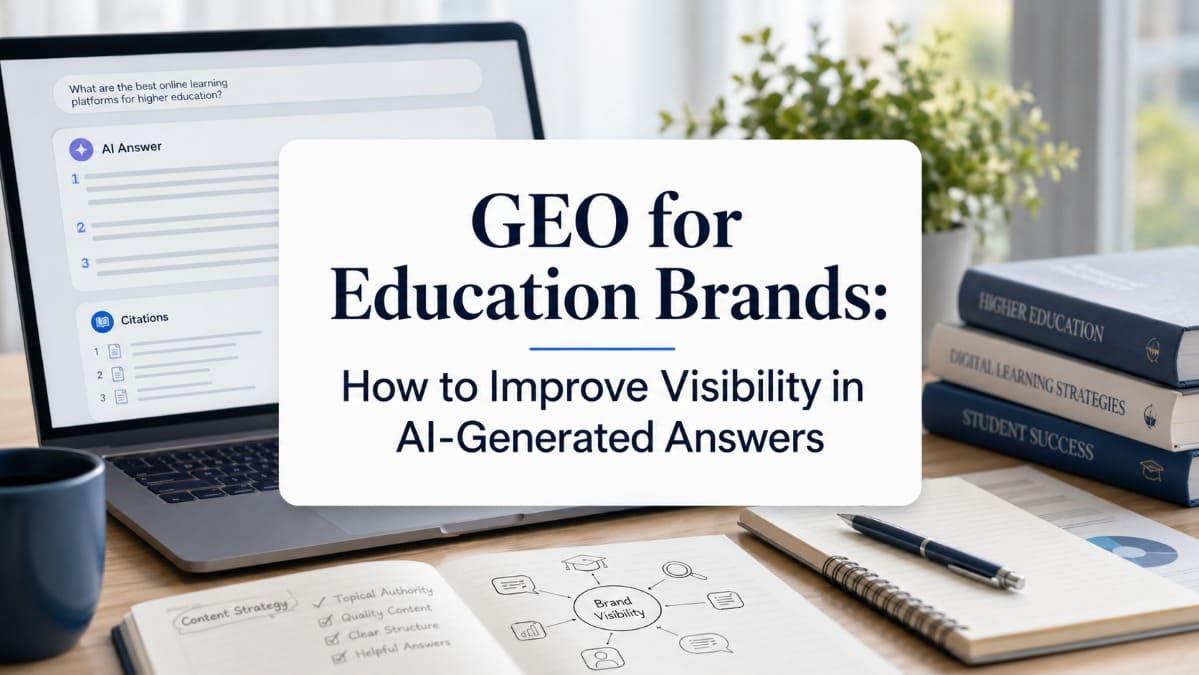
Generative Engine Optimization, or GEO, is the practice of
improving how clearly an education brand, its expertise, and its programs can
be discovered, interpreted, and referenced in AI-generated answers. It extends
beyond writing concise answers. Education brands also need technically
accessible pages, consistent entity information, original evidence,
well-defined program details, and credible references across the wider web.
This article explains how GEO differs from AEO and traditional SEO, how generative
search systems retrieve sources, what makes education content citation-worthy,
and how EdTech marketers can measure AI visibility without treating mentions as
guaranteed outcomes. It also shows how GEO can support a broader
learning-platform strategy by making an organization’s content, programs, and
expertise easier to verify.
- Quick
Answer
- What
Is GEO for an Education Brand?
- How
Do AI-Generated Answers Find and Select Sources?
- What
Makes Education Content Worth Referencing?
- Building
a Stronger Education Brand Entity
- A
Practical GEO Workflow for Education Content Teams
- Common
GEO Mistakes Education Brands Should Avoid
- How
Should Education Brands Measure AI Visibility?
- Conclusion
- FAQ
Quick Answer
Generative Engine Optimization is the process of making an
organization’s digital information easier for AI-assisted search systems to
discover, understand, verify, and potentially reference when producing
generated answers.
For an education brand, GEO involves more than placing
direct answers in articles. It also requires clear program descriptions,
consistent organizational entities, crawlable pages, credible authorship,
original evidence, structured internal links, current course information, and
external references that confirm who the organization is and what it does.
GEO overlaps substantially with search engine optimization
and Answer Engine Optimization. SEO builds the technical and topical
foundation. AEO improves the clarity of individual answers. GEO focuses more
broadly on whether the organization and its information can participate
credibly in a generated response assembled from multiple sources.
No GEO method can guarantee that a university, training
provider, EdTech company, or course will be mentioned in ChatGPT, Google AI
Overviews, Microsoft Copilot, or another AI platform. Source selection depends
on the platform, prompt, available index, location, freshness requirements, and
the evidence needed for the answer.
The practical objective is therefore not to “rank inside
AI.” It is to make the brand a clear, useful, and verifiable source when its
expertise is relevant.
What Is GEO for an Education Brand?
Generative Engine Optimization is a search and content
discipline that improves the likelihood that a brand’s information can
contribute to AI-generated answers, with the important caveat that inclusion,
citation, and presentation remain controlled by each AI platform.
An education brand may be an:
- EdTech
platform
- University
or college
- Training
provider
- Professional
academy
- Online
course business
- Corporate
learning provider
- Education
publisher
- Coaching
organization
- Workforce
development institution
- Community
learning program
Each type of organization has different visibility needs.
A university may want accurate information about admissions,
programs, research, and accreditation to appear in relevant answers.
A professional academy may need AI systems to understand
which courses it offers, who those courses are designed for, and whether its
certificates carry a specific form of recognition.
An EdTech platform may want to be considered when an
organization asks for a mobile learning platform, a microlearning system, or a
white-label alternative to a course marketplace.
GEO helps organize the information needed for those
interpretations.
GEO, AEO, and SEO solve related but different problems
The terms are frequently used interchangeably, but they
emphasize different layers of visibility.
|
Discipline |
Main Question |
Primary Focus |
Education Example |
|
SEO |
Can the page be found and compete in search? |
Crawling, indexing, relevance, authority, user experience,
and organic visibility |
Helping a course page appear for “online instructional
design course” |
|
AEO |
Can the page provide a clear answer to a specific
question? |
Direct answers, definitions, comparisons, context, and
snippet readiness |
Answering “What qualifications do I need before joining
this course?” |
|
GEO |
Can the brand and its information be understood and
potentially referenced in a generated response? |
Source usefulness, entity clarity, original evidence,
corroboration, retrieval, and citation visibility |
Being referenced in an AI comparison of mobile-first
learning platforms |
|
Conversion optimization |
Can the visitor take the appropriate next step? |
Trust, user journey, calls to action, forms, and
enrollment experience |
Moving a qualified visitor from a guide to a program
inquiry |
A useful GEO program therefore depends on AEO
for education businesses and conventional SEO rather than replacing either
one.
Google’s current guidance treats GEO and AEO as industry
terms within the broader practice of SEO. Its generative search systems
continue to depend on core search infrastructure, crawling, indexing, ranking,
and quality systems. Google also states that publishers do not need special AI
markup or an llms.txt file to appear in its generative search features.
GEO is not about writing for a machine. It is about making expertise difficult to misunderstand and easy to verify.

GEO is partly a source-selection problem
A conventional search result usually presents a set of links
that users can evaluate. A generated answer may summarize several subtopics and
cite only selected sources.
The education brand is therefore competing not only for a
position, but also for a functional role inside the answer.
A source might be used to provide:
- A
definition
- A
factual claim
- A
list of options
- An
implementation example
- A
comparison
- A
quotation
- A
current program detail
- A
local recommendation
- A
research finding
- A
limitation or counterpoint
A generic article about “the benefits of online learning”
may add little to an AI-generated response because the same information is
available from thousands of pages.
A detailed resource explaining how a mobile-first learning
system handles enrollment, offline access, progress synchronization,
facilitator management, and learner reporting has a more distinct informational
role.
That does not ensure citation. It gives the page something
specific to contribute.
The most useful GEO question is not “How can we get
mentioned?” It is “What information can our organization contribute that a
generated answer would otherwise lack?”
How Do AI-Generated Answers Find and Select Sources?
There is no single retrieval process shared by every AI
system.
Some generated answers rely on information learned during
model development. Others retrieve current web pages at the time of the
request. Some combine search indexes, partner search services, databases,
product feeds, maps, user context, and multiple follow-up searches.
Education brands should avoid assuming that one technical
tactic will produce the same result across every platform.
Generative search may decompose one prompt into several searches
A user might ask:
Which learning platform is suitable for a nonprofit that
trains community facilitators in areas with unreliable connectivity?
That question contains several separate needs:
- Learning
management capabilities
- Nonprofit
use
- Community
training
- Mobile
device compatibility
- Low-bandwidth
operation
- Offline
access
- Administrator
reporting
- Affordability
or deployment model
Google explains that AI Overviews and AI Mode may use a
query fan-out technique, conducting several related searches across subtopics
and data sources before generating a response.
This has an important content implication.
A platform page does not need to repeat the complete prompt
word for word. It does need to explain the relevant capabilities in enough
detail that the system can connect the page to one or more of those subtopics.
For example, a page could clearly document:
- What
remains available offline
- How
learner progress is stored
- When
synchronization occurs
- Which
devices are supported
- How
administrators monitor completion
- What
limitations apply without connectivity
The page becomes useful because it resolves a specific
operational question.
Public accessibility remains a fundamental requirement
Google states that pages must be indexed and eligible to
appear in Search with a snippet before they can be included as supporting links
in AI Overviews or AI Mode. It does not require a separate AI-specific
technical setup.
OpenAI similarly states that any public website can
potentially appear in ChatGPT search. Publishers that want their content to be
discoverable in ChatGPT search should allow access to OAI-SearchBot and ensure
that their hosting or content delivery network is not blocking OpenAI’s
published IP addresses.
This means GEO still begins with practical technical
questions:
- Can
the page be crawled?
- Can
the primary content be rendered?
- Is
the page indexable?
- Does
the server return a successful response?
- Is
the intended canonical URL clear?
- Are
bot requests being blocked by a firewall or CDN?
- Is
the important information publicly visible?
- Does
the page provide a usable textual representation?
- Are
updated pages being rediscovered?
A page cannot become a source for a retrieval-based system
if the system cannot reach it.
Different crawlers may serve different purposes
An organization should not assume that every AI-related
crawler has the same function.
For example, OpenAI distinguishes OAI-SearchBot, which
supports ChatGPT search visibility, from GPTBot, which relates to model
development. A publisher may make separate decisions about search
discoverability and model training access.
That distinction matters for education organizations with
intellectual property, paid research, copyrighted course materials, or
contractual content restrictions.
The goal should not be to allow every crawler automatically.
The organization should establish a documented policy covering:
- Public
marketing content
- Open
educational resources
- Paid
learning materials
- Learner-generated
content
- Research
publications
- Licensed
third-party material
- Personal
data
- Internal
documentation
GEO should operate within content governance, copyright
obligations, and data-protection requirements.
Content controls can affect what may be displayed
Google supports controls such as nosnippet, max-snippet, and
the data-nosnippet HTML attribute. These can limit whether a page or particular
passage is used in search snippets and generative search presentations.
Bing also supports data-nosnippet to give publishers
text-level control over content that can appear in search results and
AI-generated answers.
These controls create a real trade-off.
An education provider may want a public program page to
remain discoverable while preventing a sensitive pricing note, answer key,
learner testimonial detail, or licensed excerpt from being reproduced.
The technical team and content team should decide which
information is intended for public retrieval rather than applying restrictive
controls across the entire website without review.

What Makes Education Content Worth Referencing?
Citation-worthy education content gives an answer system a
reason to select that source instead of another broadly similar page.
This reason may come from originality, specificity,
authority, freshness, clarity, or direct relevance to the prompt.
It rarely comes from repeating a high-volume keyword more
frequently.
Original evidence creates informational value
Education brands often possess data that no generic
publisher has:
- Course
completion patterns
- Learner
engagement observations
- Common
onboarding barriers
- Device
usage patterns
- Assessment
difficulties
- Instructor
implementation lessons
- Program
evaluation findings
- Community
training challenges
- Content
production workflows
- Learning-support
questions
- Survey
results
- Anonymized
platform data
This evidence does not need to become a large academic
study. A carefully documented analysis of a real operational problem can be
valuable.
For example:
An analysis of 1,200 course enrollments from January to June
2026 found that learners who completed the orientation module within three days
were more likely to begin the first core lesson. The analysis shows an
association, not proof that the orientation caused later participation.
This statement is useful only when the organization can
verify:
- Where
the data came from
- Which
learners were included
- How
“orientation completion” was defined
- What
“begin the first core lesson” means
- Whether
duplicate or test accounts were removed
- Which
limitations apply
The value comes from the specificity and transparency, not
merely from adding a number.
Google’s current guidance emphasizes unique, valuable,
non-commodity content as a stronger long-term foundation for generative search
visibility than attempts to manipulate AI presentation.
First-hand expertise should be visible in the content
An article written by a training provider should contain
insights that reflect actual program operations.
For example, a guide about reducing online-course dropout
could explain:
- When
inactivity should trigger follow-up
- Which
learners require human support
- Why
reminders sometimes increase pressure
- How
prerequisite gaps appear in learner behavior
- Which
completion metrics can be misleading
- How
facilitators distinguish lack of motivation from access problems
These details make the article harder to replace with a
generic summary.
Visible expertise can also be strengthened through:
- Named
authors
- Reviewer
information
- Professional
profiles
- Relevant
qualifications
- Editorial
policies
- Methodology
notes
- Update
history
- Links
to supporting documentation
- Clear
distinction between evidence and opinion
The purpose is not to display credentials decoratively. It
is to help readers understand why the source is qualified to explain the
subject.
Clear definitions reduce semantic ambiguity
Education terminology is often used inconsistently.
“Online course,” “LMS,” “learning platform,” “virtual
classroom,” “microlearning,” and “white-label academy” may refer to different
systems depending on the provider.
A page should define its important terms before using them
in broader claims.
For example:
A white-label learning platform is a learning system that an
organization operates under its own brand while relying on a third-party
technology provider for some or all of the underlying infrastructure.
That definition is more useful than describing the platform
only as “your own branded LMS.” It establishes the relationship between
branding, operation, ownership, and infrastructure.
Where terms vary by industry or region, explain the chosen
usage.
Program facts should be precise and current
Generated answers can become misleading when source pages
contain incomplete or contradictory information.
Each program page should clearly state applicable details:
- Program
name
- Provider
- Intended
learner
- Delivery
method
- Duration
- Enrollment
period
- Study
commitment
- Prerequisites
- Learning
outcomes
- Assessment
requirements
- Certificate
conditions
- Instructor
or facilitator
- Delivery
language
- Price
- Additional
fees
- Accreditation
or recognition status
- Last
updated date
Statements such as “internationally recognized,”
“job-ready,” or “industry certified” require explanation.
Recognized by whom?
For which purpose?
In which jurisdiction?
Does the credential provide formal professional
authorization, continuing education credit, or only proof of course completion?
GEO is weakened when marketing terminology creates more
ambiguity than factual understanding.
The page should contain information that can be quoted safely
AI-generated answers often compress source material.
An education page should therefore include concise
statements that remain accurate when separated from the surrounding paragraph.
Poorly structured claim:
Our learning model is flexible, highly effective,
accessible, engaging, practical, scalable, affordable, and designed to deliver
better learning outcomes for everyone.
Safer source statement:
The program is asynchronous and mobile-accessible. Learners
can complete lessons within the enrollment period, although scheduled
assessments and facilitator sessions remain subject to published deadlines.
The second statement may sound less promotional, but it has
clear operational meaning.
Useful comparisons explain conditions, not universal winners
Comparison content is frequently relevant to generated
answers, but it must avoid artificial conclusions.
|
Education Model |
Most Suitable When |
Important Limitation to Verify |
|
Course marketplace |
The provider wants access to an existing distribution
channel |
Brand control, learner data access, fees, and direct
customer relationships may be limited |
|
Standard SaaS LMS |
The organization needs established administration and
course-management features |
Custom branding, workflows, integrations, and commercial
terms vary by provider |
|
White-label learning platform |
The organization wants a branded learning environment
without building the entire system internally |
“White-label” does not automatically mean source-code
ownership or unrestricted data control |
|
Fully custom platform |
The organization has specialized requirements and
sufficient technical capacity |
Development, security, maintenance, infrastructure, and
long-term support require substantial resources |
|
Social or messaging platform |
The program needs rapid informal communication or
community interaction |
Progress tracking, structured assessment, reporting, and
content governance may be weak |
A comparison becomes citation-worthy when it helps users
understand trade-offs rather than steering every reader toward the same option.
Generative systems need sources that can support a specific
statement. Broad claims create less citation value than precise facts,
qualified comparisons, and documented experience.
FitAcademy
Explore a More Structured Approach to Education Visibility
FitAcademy combines branded learning delivery, mobile-first microlearning, and organized content journeys that can help education providers present their programs more clearly to learners and institutional partners.
Learn More About FitAcademyBuilding a Stronger Education Brand Entity
AI visibility is not only about individual pages. It also
depends on whether the wider information ecosystem presents a coherent picture
of the organization.
An entity is a recognizable person, organization, program,
product, place, or concept that can be distinguished from other entities.
For an education brand, important entities may include:
- The
parent organization
- The
operating brand
- Individual
academies
- Courses
and programs
- Instructors
- Authors
- Certificates
- Learning
platforms
- Research
projects
- Locations
- Partner
institutions
If these entities are described inconsistently, retrieval
systems have a harder time determining which facts belong together.
Establish one authoritative organizational identity
The website should make basic organizational details
unambiguous:
- Preferred
brand name
- Legal
organization name where appropriate
- Official
website
- Logo
- Contact
information
- Operating
location
- Founding
or establishment information where relevant
- Leadership
- Primary
products or services
- Official
social profiles
- Relationship
between the company and its platforms or programs
For example, a training platform may be owned by one legal
entity, marketed under a separate brand, and operate several learning channels.
Those relationships should be explained rather than left for search systems to
infer.
Google states that Organization structured data can help it
understand administrative information and distinguish an organization from
other entities. Relevant properties may include the name, legal name, logo,
URL, contact information, and official profiles.
Structured data should reinforce visible content. It should
not introduce claims or relationships that users cannot verify on the page.
Connect people to their real expertise
Instructor and author profiles should explain:
- Current
role
- Relevant
experience
- Subject
expertise
- Courses
or articles associated with the person
- Qualifications
where relevant
- Professional
affiliations where verifiable
- Links
to appropriate external profiles
- Potential
conflicts of interest
A generic author label such as “Admin” provides little
context.
A detailed profile should still avoid exaggeration. An
instructor who has delivered workplace training is not automatically a
recognized authority on every aspect of education policy.
Google supports ProfilePage structured data for pages
primarily focused on a person or organization.
Build corroboration, not manufactured mentions
A brand’s own website is an important source, but it is also
self-published.
External sources can provide independent confirmation that
the organization, program, or expertise exists. Depending on the brand, these
may include:
- Government
or regulator directories
- Accreditation
bodies
- University
partner pages
- Professional
associations
- Conference
programs
- Research
repositories
- Reputable
media coverage
- Partner
case studies
- Industry
publications
- Verified
app listings
- Public
procurement documents
- Official
business profiles
- Expert
contributions on relevant websites
This does not mean collecting hundreds of low-quality brand
mentions.
Google’s generative optimization guidance specifically warns
that seeking inauthentic mentions is unlikely to be helpful; its systems rely
on quality and spam controls when interpreting what the wider web says about
products and services.
A practical inference is that a small number of relevant,
independently verifiable references is more useful than a large volume of
manufactured citations.
Keep entity facts consistent across the web
Review how the brand appears in:
- Website
headers and footers
- About
pages
- Course
pages
- Author
profiles
- Social
accounts
- App
stores
- Business
directories
- Partner
pages
- Press
coverage
- Speaker
profiles
- Public
documents
- Structured
data
Minor wording differences are normal. Factual conflicts are
not.
If one profile describes FitAcademy as a course marketplace,
another calls it a corporate LMS, and another presents it only as a mobile
application, an AI system may fail to understand its broader role as a branded
learning infrastructure or white-label microlearning platform.
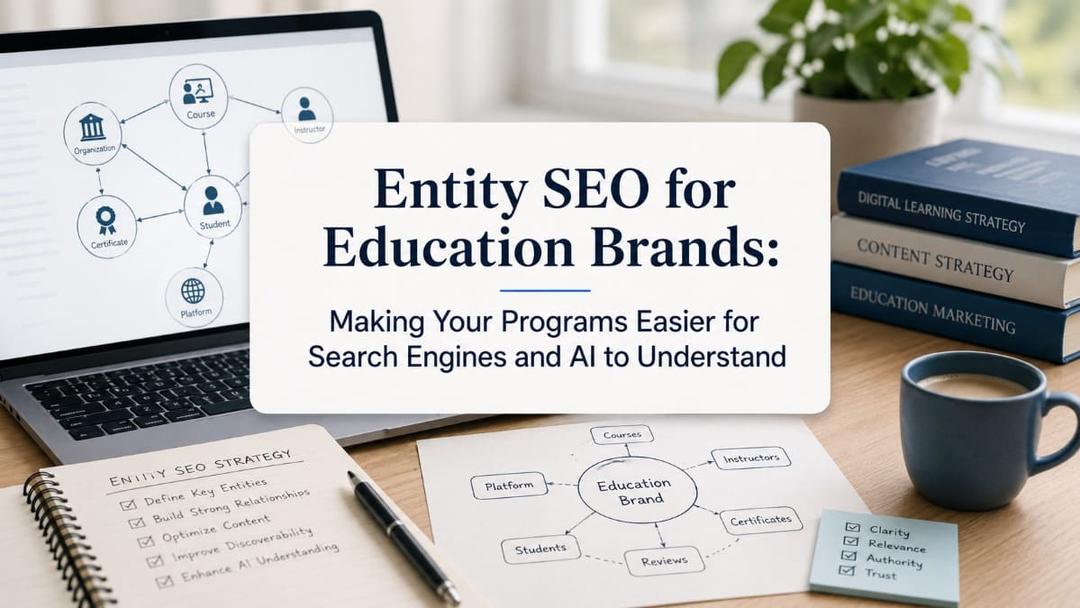
This is where entity
SEO for education brands becomes a separate operational discipline rather
than a metadata exercise.

A Practical GEO Workflow for Education Content Teams
GEO should be integrated into ordinary content and website
operations. A separate “AI content team” is not always necessary, particularly
for a smaller education organization.
The essential requirement is clear responsibility.
1. Map the decisions in which the brand should be relevant
Begin with real discovery situations, not a list of AI
platforms.
Examples:
- Choosing
an LMS for a training institution
- Comparing
microlearning and long-form courses
- Finding
a mobile learning platform for field workers
- Evaluating
white-label learning systems
- Designing
online training for low-bandwidth communities
- Improving
learner retention
- Converting
expert knowledge into teachable material
- Managing
course completion across branches
- Understanding
certificate options
- Selecting
an online training provider
For each situation, ask:
- Is
the brand genuinely qualified to contribute?
- Which
part of the question can it answer?
- What
evidence does it possess?
- Which
page should serve as the primary source?
- What
additional information is missing?
This prevents the organization from targeting broad prompts
that have little relationship to its real capabilities.
2. Create a source inventory
List the pages and external assets that explain the
organization.
Classify them as:
- Organizational
identity
- Product
or platform information
- Course
information
- Educational
expertise
- Original
research or data
- Instructor
expertise
- Case
evidence
- Partner
validation
- Policies
and terms
- Conversion
pages
Then assess each source for:
- Crawlability
- Indexing
- Accuracy
- Uniqueness
- Freshness
- Authorship
- Entity
consistency
- Evidence
quality
- Internal
linking
- Appropriate
next action
This often reveals that the brand has published many
articles while leaving its most important product, methodology, or program
facts undocumented.
3. Assign one canonical source to each important claim
An education company may repeatedly state that its platform
supports offline learning.
Which page provides the authoritative explanation?
The main product page?
A feature page?
Technical documentation?
A blog article?
A sales PDF?
One page should serve as the best public source. Supporting
pages can summarize the feature and link to that canonical explanation.
The same principle applies to:
- Pricing
- Accreditation
- Certificate
conditions
- Program
duration
- Instructor
expertise
- Hosting
model
- Learner
data access
- Platform
ownership
- Support
services
- Deployment
timeline
Canonical claim ownership reduces contradiction and makes
updates easier.
4. Improve the page’s information gain
Review what already appears in competing content.
Do not merely rewrite the same points in a different order.
Add value through:
- First-hand
examples
- Original
screenshots
- Process
diagrams
- Decision
criteria
- Implementation
limitations
- Anonymized
data
- Operational
checklists
- Regional
context
- Updated
policy details
- Clear
definitions
- Practical
scenarios
- Evidence-backed
corrections to common assumptions
An article about course completion, for instance, could
explain why a 100% completion target may be unrealistic for open-enrollment
learning, how completion should be defined, and when activation or competency
measures provide better insight.
That adds a judgment an experienced education practitioner
can use.
5. Strengthen internal relationships between sources
Internal links should make the knowledge structure visible.
A GEO cluster could connect:
- A
pillar article about SEO for education
- A
definition of AEO
- A
GEO strategy guide
- An
answer-ready writing guide
- An
entity SEO implementation guide
- Product
or platform pages
- Relevant
case evidence
Use anchors that describe the relationship rather than
mechanically repeating the same keyword.
The current article, for example, can lead content teams to how
to write answer-ready education content when they are ready to improve
individual pages.
6. Review crawl and update mechanisms
For Google visibility, maintain proper crawling, indexing,
canonicalization, XML sitemaps, and Search Console monitoring.
For Bing and Microsoft’s ecosystem, XML sitemaps remain
important for broad URL coverage. Microsoft also recommends IndexNow as a way
to notify participating search engines when URLs are created, updated, or
deleted. A notification does not guarantee indexing, but it can accelerate
discovery of changes.
For ChatGPT search, confirm that OAI-SearchBot is not
blocked where discoverability is intended.
Technical teams should document:
- Which
crawlers are allowed
- Which
directories remain private
- How
staging sites are protected
- How
paid content is handled
- How
updates are submitted
- How
server logs are reviewed
- How
CDN or firewall rules affect bots
7. Develop a legitimate external authority plan
External visibility should emerge from real contributions.
Useful activities may include:
- Publishing
original education research
- Contributing
expert articles to relevant publications
- Speaking
at professional events
- Participating
in industry associations
- Creating
public implementation resources
- Collaborating
with institutional partners
- Publishing
transparent program evaluations
- Maintaining
verified business and app profiles
- Earning
relevant media coverage
- Providing
useful data to journalists or researchers
A guest article should add expertise to the host
publication. It should not exist solely as a container for a keyword-rich link.
8. Establish a factual review cycle
Some education information changes quickly:
- Intake
dates
- Tuition
- Course
availability
- Software
features
- Instructors
- Accreditation
- Government
funding
- Policies
- Support
hours
- Technical
requirements
Assign a review frequency according to risk.
A conceptual article about instructional design may remain
stable for longer.
A page describing next month’s enrollment deadline should be
checked frequently.
Add visible update dates when they help readers, but do not
change dates without making substantive updates.
9. Test visibility without overreacting
Create a controlled prompt set based on meaningful user
scenarios.
Test periodically across selected AI and search platforms.
Record:
- Whether
the brand is mentioned
- Whether
its page is cited
- Which
competitors or institutions appear
- Which
source pages are used
- Whether
the facts are accurate
- Which
aspects of the prompt trigger inclusion
- Whether
results vary by location or account context
A single prompt result is not a stable ranking.
Generated answers can vary, and platforms may change their
retrieval or presentation. Look for repeated patterns before changing the
entire content strategy.
Common GEO Mistakes Education Brands Should Avoid
GEO is still developing, which makes it attractive to
vendors offering shortcuts. Most shortcuts fail because they optimize an
assumed mechanism rather than building a better source.
Treating llms.txt as a universal AI ranking file
An llms.txt file may be used voluntarily in particular
technical contexts, but it is not a universal protocol that guarantees
discovery or citation across generative systems.
Google explicitly states that it does not use llms.txt or
special AI text files for inclusion in Google Search or its generative search
features.
Creating such a file should never take priority over fixing
indexing, page quality, internal links, content accuracy, or entity
inconsistency.
Producing hundreds of shallow AI-targeted pages
A content team may attempt to cover every prompt variation
with a separate article.
This can produce:
- Near-duplicate
pages
- Weak
internal competition
- Maintenance
problems
- Repetitive
content
- Conflicting
answers
- Little
original information
- Reduced
reader trust
Google warns that using generative AI to produce many pages
without adding user value may violate its scaled content abuse policy.
A smaller number of authoritative pages can address multiple
related questions when they are structured coherently.
Buying irrelevant brand mentions
Mentions on unrelated websites do not automatically make a
brand authoritative.
An education platform mentioned across low-quality gambling,
coupon, general-directory, or automated article sites may create noise rather
than useful corroboration.
External visibility should be topically relevant and
editorially legitimate.
Repeating claims without publishing evidence
A brand may describe itself as:
- The
leading platform
- The
most trusted provider
- The
number-one academy
- The
best learning solution
- The
fastest-growing EdTech brand
Without a clear methodology and independently verifiable
evidence, those labels add little retrieval value.
Describe observable facts instead:
- Number
and type of institutions served
- Platform
capabilities
- Countries
or regions supported
- Documented
program outcomes
- Published
research
- Relevant
certifications
- Years
of operation
- Deployment
model
Each claim should state its period and scope where those
details matter.
Optimizing content while neglecting the brand entity
A brand can publish excellent articles and still remain
difficult to understand if its About page, product pages, structured data,
social profiles, and external listings contradict one another.
Content quality and entity clarity must develop together.
Measuring mentions without measuring business relevance
A citation for a broad educational definition may produce
visibility but no meaningful commercial result.
A single citation in a highly relevant institutional
comparison could be more valuable.
The content team should distinguish between:
- Informational
visibility
- Brand
visibility
- Product
consideration
- Qualified
referral traffic
- Enrollment
interest
- Institutional
opportunity
- Assisted
conversion
More mentions are not automatically better.
How Should Education Brands Measure AI Visibility?
GEO measurement is less standardized than conventional
search reporting. A practical measurement model should combine platform data,
referral analytics, controlled testing, and commercial outcomes.
Monitor Google’s generative search reporting where available
As of July 2026, Google is rolling out a Generative AI
performance report in Search Console to a subset of website owners.
The report includes impression data from AI Overviews and AI
Mode and can show performance by page, country, device, and date. Google notes
that the report may not appear if the property does not yet have access or has
insufficient eligible impressions.
This report can help answer:
- Which
pages appear in supported generative features?
- Is
generative visibility increasing or decreasing?
- Which
countries or devices contribute impressions?
- Which
pages have unexpectedly low visibility?
It does not provide a complete prompt-level view of every
generated answer.
Use Bing Webmaster Tools’ AI Performance data
Microsoft introduced AI Performance in Bing Webmaster Tools
as a public preview in February 2026.
The dashboard reports metrics including:
- Total
citations
- Average
cited pages
- Cited
URLs
- Grounding
queries
The data covers supported Microsoft AI experiences,
including Microsoft Copilot and AI-generated Bing experiences. Microsoft
cautions that citation totals do not indicate the placement, authority, or role
of a page within an individual answer.
This makes the report useful for identifying source
patterns, but not for declaring an “AI ranking position.”
Track ChatGPT referral traffic
OpenAI states that referral links from ChatGPT search
include the utm_source=chatgpt.com parameter, allowing publishers to identify
this traffic in analytics tools.
Education brands can monitor:
- Sessions
from ChatGPT
- Landing
pages
- Engagement
- Course-page
visits
- Contact
submissions
- Demo
requests
- Enrollment
conversions
- Assisted
conversions
Referral traffic captures clicks. It does not capture every
situation in which the brand was viewed or mentioned without a click.
Maintain a controlled citation-monitoring set
Create 20–50 representative prompts covering:
- Brand
questions
- Category
questions
- Problem
questions
- Comparisons
- Implementation
questions
- Local
or regional questions
- Course-suitability
questions
- Institutional
buying scenarios
Test them on a defined schedule.
Record the answer, source, date, location context, and
platform.
The objective is trend observation rather than daily
position tracking.

Connect source visibility to meaningful outcomes
A practical GEO measurement funnel is:
Crawlable source → indexed source → generative impression or
citation → source visit → deeper brand interaction → qualified business outcome
Potential outcome metrics include:
- Course
exploration
- Platform-feature
visits
- Branded
searches
- Newsletter
subscriptions
- Program
inquiries
- Demo
requests
- Partner
discussions
- Enrollment
- Assisted
revenue
Attribution will remain incomplete.
A user may see an education brand in an AI answer, remember
the name, and later visit directly. That influence may not appear as an AI
referral.
Use a combination of analytics, customer surveys, sales
notes, and brand-search trends rather than claiming exact attribution where it
cannot be confirmed.
Conclusion
GEO for education brands is not a technical trick for
inserting a company name into AI-generated answers.
It is the outcome of a more disciplined information system.
The organization must be crawlable. Its important pages must
be indexable. Its programs must be described accurately. Its authors and
instructors need clear identities. Its expertise should appear through original
evidence, operational insight, and useful explanations. Its external references
should confirm rather than manufacture its authority.
AEO helps individual pages answer questions clearly. GEO
expands the focus to whether the brand and its broader information ecosystem
can serve as a credible source for generated responses.
For EdTech marketers and content teams, the most valuable
work is often not creating more content. It is identifying which facts,
experiences, and frameworks the organization genuinely owns—and publishing them
in a form that learners, buyers, search engines, and AI systems can understand.
Citation visibility may follow, but it cannot be promised.
What the education brand can control is the quality,
clarity, consistency, accessibility, and usefulness of the source it puts into
the world.
FitAcademy
Make Your Education Brand Easier to Understand
FitAcademy helps institutions, creators, and training providers organize branded learning experiences through mobile-first microlearning, structured content delivery, and scalable learning infrastructure.
Learn More About FitAcademyFAQ
What is GEO in education marketing?
GEO, or Generative Engine Optimization, is the practice of
improving how an education brand and its information can be discovered,
understood, and potentially referenced in AI-generated answers. It includes
technical accessibility, content quality, entity consistency, source
credibility, original evidence, and measurement. GEO cannot guarantee that a
brand will be cited by a particular AI platform.
How is GEO different from AEO?
AEO focuses primarily on making a specific answer clear and
extractable. GEO focuses more broadly on whether a brand, source, or body of
information can contribute credibly to a generated response. The two overlap: a
GEO-ready page still needs clear answers, while strong AEO content benefits
from consistent entities, technical SEO, and external corroboration.
Does an education website need llms.txt for AI visibility?
Not as a universal requirement. Google states that it does
not use llms.txt or special AI files for inclusion in Google Search’s
generative features. Other platforms may develop different conventions, so
technical teams should follow each platform’s official documentation.
Foundational crawling, indexing, content quality, and entity clarity remain
higher priorities.
Can structured data make an education brand appear in AI answers?
Structured data can help a search engine classify page
content and understand entities, but it does not guarantee an AI citation or
generated mention. Markup such as Organization, Article, Course, Person,
ProfilePage, and BreadcrumbList should accurately reflect visible page
information and follow the relevant platform’s current technical guidelines.
Are backlinks still relevant to GEO?
Relevant links and independent references may support
discovery, authority, and corroboration, but GEO should not be reduced to
acquiring backlinks. The quality, topical relevance, context, and legitimacy of
the source matter. Manufactured mentions, paid links on unrelated sites, and
automated directories may provide little value and may create search-policy
risks.
How long does GEO take to produce measurable results?
There is no fixed timeline. Results depend on technical
accessibility, crawling frequency, existing authority, content distinctiveness,
external references, query demand, competition, and the AI platform’s retrieval
process. Education brands should evaluate trends over several months rather
than expecting stable citations immediately after publishing or updating a
page.