Answer-ready education content gives learners a clear,
accurate response before expanding into the evidence, context, and practical
details needed for a real decision. It can support traditional search
visibility, featured snippets, AI-assisted search, and generative answer
platforms without sacrificing readability or educational quality. For EdTech
marketers and content teams, the work begins with identifying the learner’s
actual question, assigning it to the right page, writing a self-contained
answer, adding necessary caveats, and connecting that answer to credible
sources and relevant next steps. This guide provides a practical workflow for
turning course information, educational expertise, and operational knowledge
into content that is easier for learners, search engines, and AI systems to
understand.
- Quick
Answer
- Start
With the Decision Behind the Search
- Build
an Answer-Ready Content Structure
- How
to Write Direct Answers Without Losing Important Nuance
- Match
the Content Format to the Education Question
- Add
Evidence, Expertise, and Entity Context
- Turn
the Draft Into a Search- and AI-Ready Web Page
- An
Editorial Workflow for Education Content Teams
- Common
Answer-Ready Writing Mistakes
- Conclusion
- FAQ
Quick Answer
To write answer-ready education content, begin by
identifying the exact question a learner or institutional buyer needs to
resolve. Provide a direct, self-contained response within the first few
sentences of the relevant section, then add the conditions, evidence, examples,
limitations, and next steps required for a responsible decision.
The answer should use clear educational terminology,
identify who or what it applies to, and avoid claims that depend on unstated
assumptions. Important facts—such as course duration, prerequisites, assessment
methods, certificate conditions, delivery format, platform capabilities, and
pricing—should be presented in visible, crawlable text rather than existing
only inside images, videos, or downloadable brochures.
Answer-ready writing supports both Answer Engine
Optimization and Generative Engine Optimization, but it remains part of a
broader search and content strategy. Google’s current guidance states that
visibility in generative Search still relies on foundational SEO, crawlable
pages, indexing, useful content, and established quality systems. It does not
require special AI markup or an llms.txt file.
The objective is not to write mechanically for AI. It is to
make accurate educational information easy to locate, understand, verify, and
apply.
Start With the Decision Behind the Search
A search query is often the visible part of a larger
decision.
Someone searching “What is microlearning?” may simply want a
definition. But they may also be deciding whether short lessons are suitable
for employees, community facilitators, students with limited study time, or
learners who use low-end mobile devices.
A training manager searching “best LMS for employee
training” may need to compare:
- User
administration
- Mobile
access
- Reporting
- Private
learning groups
- Branding
- Data
access
- Integration
options
- Content
production workflows
- Hosting
responsibilities
- Ongoing
operating costs
The writer’s first responsibility is to identify which part
of the decision the page should resolve.
Do not confuse the keyword with the question
A keyword such as “online course platform” can represent
several different intentions:
- What
is an online course platform?
- How
does an online course platform work?
- Which
platform model is suitable for a small academy?
- Can
I sell courses through my own branded platform?
- What
is the difference between a marketplace and a white-label platform?
- How
much does an online learning platform cost?
- Can
an institution manage private learners and public courses in one system?
One article cannot answer all of these questions equally
well.
A strong content team determines the page’s primary task
before writing. Supporting questions can be included where they help the
reader, but they should not turn the article into a collection of unrelated
answers.
Translate search intent into a learner task
Instead of beginning with a keyword list, complete this
sentence:
After reading this page, the reader should be able to
______.
Examples:
- Explain
what AEO means for an education business
- Determine
whether microlearning fits a particular training objective
- Compare
a course marketplace with a white-label learning platform
- Verify
whether a program’s certificate meets their needs
- Estimate
the operational requirements of launching an online academy
- Improve
the structure of an existing course page
- Decide
which learner questions should be answered publicly
This statement gives the article an editorial boundary.
If the page is intended to help a training provider compare
platform models, a long history of learning management systems may be
interesting but unnecessary. If the page explains a regulated credential,
however, background about the issuing body or governing standard may be
essential.
A page becomes answer-ready when it resolves one meaningful
learner task, not when it mentions every keyword associated with the topic.
Identify the minimum complete answer
The minimum complete answer is the shortest response that
remains accurate and useful.
It is not necessarily the shortest possible sentence.
Consider this question:
Is microlearning suitable for all types of training?
An incomplete answer would be:
Yes, microlearning is suitable for many training programs.
A better answer would be:
Microlearning is suitable for focused knowledge,
reinforcement, procedural reminders, and short practice activities. It is
usually not sufficient as the only format for complex judgment, supervised
physical skills, or competencies that require extended practice and formal
assessment.
The second answer remains concise, but it protects the
learner from a misleading generalization.
Before drafting a section, identify:
- The
direct answer
- The
most important condition
- The
strongest practical implication
- The
main limitation
- The
next question the reader is likely to ask

Build an Answer-Ready Content Structure
Answer-ready content does not require every page to follow
an identical template. It does require readers and retrieval systems to
recognize where important information begins and how the supporting ideas
relate to it.
A practical structure is:
Question or descriptive heading → direct answer →
explanation → evidence or example → limitation → next step
This sequence can be used inside an article section, course
page, product page, FAQ, or program guide.
Use headings that reveal the page’s information architecture
Headings should communicate what the following section
explains.
Weak heading: Important Information
Stronger heading: What Prerequisites Do Learners Need Before Joining the Program?
Weak heading: Platform Benefits
Stronger heading: When Does a White-Label Learning Platform Make Operational Sense?
The stronger headings reduce ambiguity for readers and make
the section easier to retrieve for a specific question.
Not every heading needs to be written as a question.
Descriptive headings can be equally effective:
- Course
Eligibility and Prerequisites
- How
Learner Progress Is Recorded
- Certificate
Requirements
- Implementation
Costs to Verify
- Limitations
of Self-Paced Training
Question headings are most useful when the section has a
direct, definable answer.
Put the answer before the extended explanation
Education writers often begin with several paragraphs of
context before stating the main point.
That approach may work in an essay, but it creates friction
on a page designed to resolve a practical question.
Instead of:
Organizations are facing many changes in the way learning is
delivered. Technology has affected workplaces, schools, communities, and
professional development. As learners become busier, different learning methods
have gained attention. One such method is microlearning.
Use:
Microlearning is a learning approach that delivers focused
content or activities in short units, usually designed around one specific
objective. It can help organizations fit learning into limited time, although
short duration alone does not guarantee that the instruction is effective.
The answer appears immediately. The writer can then explain
the context, use cases, evidence, and limitations.
Make each important answer self-contained
A self-contained answer can be understood without requiring
the reader to reconstruct information from several earlier paragraphs.
Avoid:
This model may be more suitable in those situations.
Prefer:
A white-label learning platform may be more suitable when an
organization needs stronger brand control, direct learner relationships,
configurable administration, and a dedicated learning environment.
The second version identifies both the subject and the
condition.
Self-contained does not mean repeating the complete article
title in every paragraph. It means avoiding unclear pronouns and references in
passages likely to be read independently.
Use one section for one main answer
A section about course prerequisites should not suddenly
become a detailed explanation of pricing, platform hosting, and certificate
recognition.
When a section answers several unrelated questions, its
heading no longer represents its contents accurately.
A useful editorial test is:
Could this section be summarized in one sentence without
using “and several other things”?
When the answer is no, divide or refocus the section.
Clear structure does not make education content simplistic. It makes complexity easier to navigate.
Create a logical answer hierarchy
The article’s hierarchy should move from the broadest
question to the questions that depend on it.
For example:
- What
is a white-label learning platform?
- How
does it differ from a course marketplace?
- When
is it suitable?
- What
operational responsibilities remain with the provider?
- What
should an organization verify before choosing one?
The reader needs the definition before the comparison and
the comparison before the procurement checklist.
This same logic should shape the site’s broader content
structure. A foundational guide can link to deeper comparison, implementation,
and decision pages.
Google recommends using descriptive, crawlable links so that
both users and its systems can understand the destination and discover related
pages. Standard HTML anchor elements with an href attribute remain the most
reliably crawlable link format.
For a broader explanation of this relationship, see AEO
for education businesses.
How to Write Direct Answers Without Losing Important Nuance
The main risk in answer-first writing is oversimplification.
A concise answer may be easy to extract but still be
inaccurate if it removes the conditions that determine whether the statement is
true.
Education content is especially vulnerable because
suitability, recognition, outcomes, cost, and accessibility frequently depend
on context.
Use the direct answer–condition–implication pattern
A reliable answer paragraph can often be built from three
elements.
Direct answer: State the main conclusion.
Condition: Explain when the conclusion applies.
Implication: State what the reader should understand
or verify.
Example:
A self-paced course allows learners to progress without
attending every lesson at a fixed time. However, some self-paced programs still
use enrollment deadlines, scheduled assessments, live support sessions, or
certificate-completion dates, so learners should review the actual
participation requirements before enrolling.
The first sentence answers the question. The second prevents
the phrase “self-paced” from being interpreted as unlimited access with no
deadlines.
Place caveats beside the claims they qualify
Do not save all limitations for a final disclaimer.
An AI system or search snippet may extract one passage
without the last section of the article. A human reader may also stop after
finding the immediate answer.
Compare:
Online learning is more affordable than classroom training.
With:
Online learning may reduce travel, venue, printing, and
accommodation costs, particularly when the same program serves distributed
learners. Total cost still depends on platform fees, content production,
facilitation, support, devices, connectivity, and implementation.
The second answer remains usable even when separated from
the rest of the article.
Avoid universal language when results depend on implementation
Words such as these require strong evidence:
- Always
- Never
- Guaranteed
- Best
- Most
effective
- Suitable
for everyone
- Universally
recognized
- Fully
accessible
- Completely
secure
- Proven
to increase income
Replace universal claims with observable descriptions.
Instead of:
Microlearning always increases learner engagement.
Use:
Microlearning may reduce the time required to begin a lesson
and can support repeated learning touchpoints. Engagement still depends on
relevance, instructional quality, access, reminders, facilitation, and the
learner’s reason for participating.
The revised answer is not weaker. It is more operationally
meaningful.
Define ambiguous education terms
Many education terms appear precise but are used
inconsistently.
Examples include:
- Accredited
- Certified
- Recognized
- Interactive
- Personalized
- Adaptive
- Mobile-first
- Offline
- Competency-based
- Industry-ready
- Blended
learning
- Microlearning
- Artificial
intelligence
- White-label
Whenever the interpretation affects a learner’s decision,
define the term in the context of the page.
For example:
In this program, “blended learning” means that participants
complete asynchronous digital modules and attend three scheduled
facilitator-led sessions. It does not mean that every lesson is available in
both online and classroom formats.
That explanation is more useful than relying on the label
alone.
Distinguish facts, estimates, and professional judgment
Education content often combines several types of
information.
Fact:
The program contains eight modules.
Estimate:
Most participants should allocate approximately two hours
per week.
Professional judgment:
Learners with no spreadsheet experience may need additional
practice before completing the final assignment.
Labeling these distinctions helps prevent estimates from
being repeated as guarantees.
Useful language includes:
- The
published requirement is…
- Based
on the current curriculum…
- The
expected workload is…
- In
our experience…
- This
may be suitable when…
- The
available evidence suggests…
- Results
will depend on…
- The
provider should verify…
Answer sensitive education claims with particular care
Extra scrutiny is needed for claims involving:
- Accreditation
- Professional
licensing
- Employment
- Income
- Academic
credit
- Government
recognition
- Health
or safety training
- Legal
compliance
- Child
protection
- Learner
data
- Accessibility
- Admissions
eligibility
A course-completion certificate is not automatically a
professional license.
A program created with an industry partner is not
automatically “industry accredited.”
A course that teaches employment-related skills cannot
guarantee employment.
The answer should state exactly what the credential,
partnership, or outcome represents.
Answer-ready writing is not the removal of nuance. It is the
placement of essential nuance where the answer cannot be misunderstood without
it.
Match the Content Format to the Education Question
Different questions require different answer formats.
A long paragraph is not always the clearest format. Neither
is a table, checklist, or FAQ universally appropriate.
The content format should reduce the reader’s decision
effort.
|
Education Question |
Recommended Format |
What the Format Should Clarify |
|
What is this concept? |
Definition paragraph followed by an example |
Category, function, purpose, and limitation |
|
Is this course suitable for me? |
Suitability statement and prerequisite checklist |
Intended learner, required skills, exclusions, and
workload |
|
How does the program work? |
Numbered process or learner journey |
Sequence, responsibilities, timing, and support |
|
What is the difference between two options? |
Comparison table plus interpretation |
Overlap, differences, suitability, and trade-offs |
|
What does the course include? |
Structured curriculum or module overview |
Scope, depth, activities, and assessment |
|
Is the certificate recognized? |
Qualified explanation with source |
Issuer, recognition, jurisdiction, and limitations |
|
How much will implementation cost? |
Cost-component table |
Included services, exclusions, recurring costs, and
variables |
|
Which platform should we choose? |
Decision framework |
Requirements, operational capacity, ownership, and risks |
|
What common problems occur? |
Problem–cause–response format |
Why the issue happens and how to manage it |
|
What should we do first? |
Prioritized implementation sequence |
Immediate action, dependency, owner, and expected output |
Use definition paragraphs for foundational concepts
A good definition should identify:
- The
category
- The
function
- The
practical purpose
- An
important boundary or caveat
Example:
Answer Engine Optimization is a content and search practice
that makes information easier for answer-oriented systems to identify and
present in response to specific questions, while still depending on broader
SEO, technical accessibility, and content quality.
Avoid circular definitions:
Microlearning is learning delivered through microlearning
methods.
Avoid purely promotional definitions:
Microlearning is a revolutionary way to transform modern
education.
Use comparison tables for real decision differences
A table is useful when readers need to compare the same
criteria across several options.
It is less useful when every cell contains vague words such
as “good,” “flexible,” or “high.”
A platform comparison should consider operational criteria
such as:
- Brand
control
- Learner
data access
- Content
ownership
- Hosting
- Maintenance
- User
management
- Integrations
- Payment
model
- Support
- Deployment
time
- Internal
technical capacity
The paragraph after the table should interpret the
trade-off. Never assume the table will explain itself.
Use checklists for verification, not for replacing explanation
A checklist is effective when readers already understand the
subject and need to verify whether key requirements have been met.
Example:
Before publishing a course page, verify that it states:
- Who
the program is for
- What
learners need before joining
- What
they will learn
- How
the course is delivered
- How
long it takes
- How
learning is assessed
- What
certificate is issued
- What
the price includes
- When
enrollment begins and ends
- Where
learners can ask for help
The page may still need full explanations under several of
those items.
Use process steps when sequence matters
A learner onboarding guide should show what happens first,
what depends on the previous step, and where learners can obtain support.
For example:
- Create
an account.
- Verify
the registered email address.
- Join
the assigned course or learning channel.
- Complete
the orientation lesson.
- Confirm
device and internet requirements.
- Begin
the first module.
- Contact
the facilitator when support is required.
Do not use numbered steps when the items can be completed in
any order. A false sequence can mislead readers.
Use FAQs for distinct follow-up questions
FAQs are useful when readers repeatedly ask questions that
do not fit naturally into the main narrative.
They should not become a container for every secondary
keyword.
Google currently limits regular FAQ rich-result visibility
mainly to authoritative government and health websites. Education brands should
therefore use FAQs for reader clarity and answer coverage rather than assuming
that FAQPage markup will create a prominent search feature.

Add Evidence, Expertise, and Entity Context
A direct answer helps the reader understand the conclusion.
Evidence helps the reader decide whether to trust it.
For education brands, evidence may come from official
requirements, curriculum documentation, implementation experience, learner
research, platform data, instructors, external studies, or regulatory sources.
Match the strength of the evidence to the strength of the claim
A simple product fact may require only first-party
documentation.
The platform supports private learning groups.
The page should explain how those groups are created and
managed.
A broader outcome claim requires stronger evidence.
Private learning groups improve completion rates.
This would require data showing:
- Which
groups were compared
- How
completion was defined
- The
period covered
- Whether
the groups differed in other ways
- Whether
the relationship was causal or only associated
Do not place a citation beside a claim merely because the
source discusses a similar topic. The evidence should support the actual
statement.
Prioritize primary sources for factual requirements
Use primary sources when explaining:
- Government
policies
- Accreditation
- Standards
- Professional
requirements
- Product
documentation
- Official
platform capabilities
- Research
findings
- Institutional
program details
A secondary article can help provide context, but it should
not replace the issuing body’s documentation when the learner needs to verify
an official requirement.
Show who created or reviewed the content
Readers should be able to identify the person or team
responsible for important educational content.
Useful author information includes:
- Name
- Current
role
- Relevant
expertise
- Experience
related to the topic
- Associated
programs or publications
- Profile
page
- Reviewer
where applicable
- Publication
and update dates
Google recommends evaluating content through “Who, How, and
Why”: who created it, how it was produced, and why it exists. Clear authorship
can help readers assess the experience and expertise behind a page.
For example, an article about designing workplace
assessments should ideally be written or reviewed by someone with relevant
instructional design, training, or assessment experience—not attributed only to
“Content Team.”
Add first-hand operational detail
Generic content states what should happen.
Experienced content explains what tends to make
implementation difficult.
Consider this generic recommendation:
Send reminders to inactive learners.
A more useful explanation would be:
Before sending repeated reminders, identify why the learner
became inactive. A learner who forgot a deadline may benefit from a prompt. A
learner who cannot access the platform, lacks prerequisite knowledge, or is
overwhelmed by several incomplete modules may need technical or facilitator
support instead.
The second explanation contains practical judgment.
Operational detail can come from:
- Implementation
reviews
- Support
conversations
- Learner
feedback
- Instructor
observations
- Product
documentation
- Anonymized
usage patterns
- Internal
process experience
- Program
evaluation
Do not invent an experience the organization has not had.
Give important entities enough context
When mentioning an organization, credential, technology,
course, or methodology, explain why it is relevant.
Weak:
SCORM is also supported.
Stronger:
Sharable Content Object Reference Model, commonly
abbreviated as SCORM, is a set of technical specifications used to package and
exchange certain types of e-learning content between compatible systems.
Organizations should verify which SCORM versions and tracking behaviors a
platform supports.
Important entities may include:
- Education
provider
- Parent
organization
- Instructor
- Accreditation
body
- Certificate
- Course
- Learning
platform
- Delivery
method
- Assessment
framework
- Partner
institution
- Geographic
market
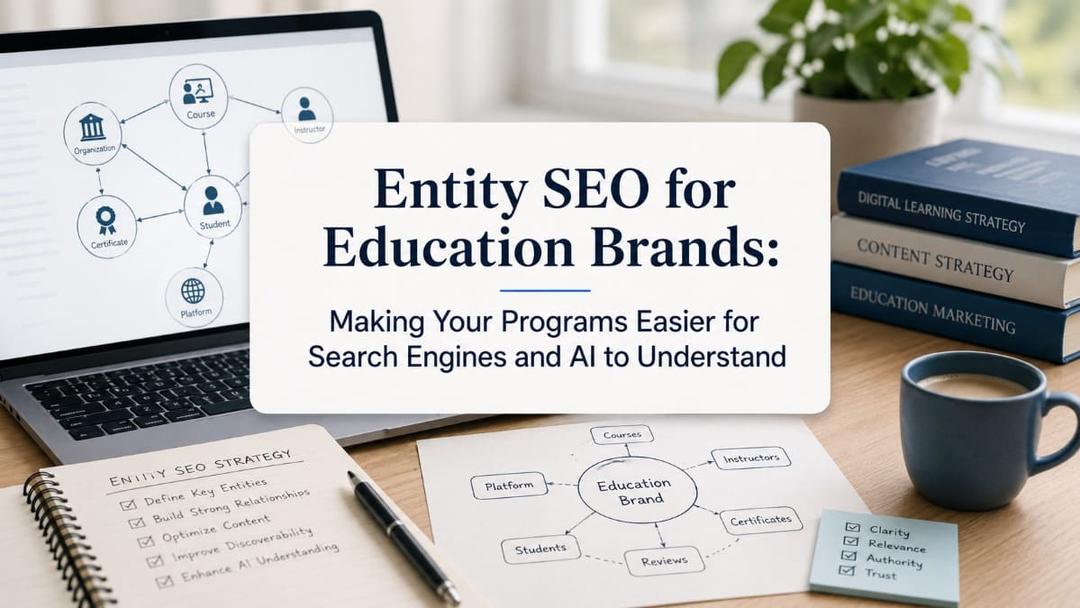
Consistent entity descriptions across the website support
the broader GEO
strategy for education brands.
Use original evidence carefully
An education business can create valuable content from its
own data, but the analysis must be transparent.
An internal data statement should identify:
- Dataset
source
- Time
period
- Sample
size
- Inclusion
criteria
- Metric
definition
- Analysis
method
- Limitations
- Whether
personal data was anonymized
- Whether
the finding shows correlation or causation
Example:
Among learners enrolled in four facilitated programs between
January and April 2026, participants who attended the orientation session
completed more initial modules on average than those who did not. The groups
were not randomly assigned, so the finding should not be interpreted as proof
that orientation attendance caused higher participation.
The caveat does not reduce the value of the observation. It
prevents an unsupported causal claim.
FitAcademy
Connect Clear Content With a Structured Learning Journey
FitAcademy helps institutions, creators, and training providers organize branded microlearning content, guide learners through focused lessons, and build a clearer digital learning experience.
Learn More About FitAcademyTurn the Draft Into a Search- and AI-Ready Web Page
Strong writing can still underperform when the page is
difficult to crawl, render, navigate, or interpret.
The content team should review the article as a web page,
not only as a document.
Keep essential answers in visible page text
Do not place the only version of an important answer inside:
- An
infographic
- A
video
- A
webinar recording
- A
PDF brochure
- An
accordion that fails to render
- An
image of a comparison table
- A
login-only dashboard
- A
downloadable curriculum
Supporting assets can enrich the page, but the central
answer should also appear in accessible text.
Google’s current guidance for generative Search recommends
keeping important content available in textual form, maintaining crawlability,
and ensuring that pages meet ordinary Search technical requirements.
Use descriptive titles and headings
The page title, H1, and main headings should describe the
subject accurately.
Avoid titles that depend entirely on curiosity:
The Strategy Every Academy Is Missing
Prefer:
How Training Providers Can Structure Course Pages for Search
and AI Platforms
The second title makes the content’s function clear before
the click.
This does not mean every heading must repeat the primary
keyword. Use natural language that reflects the questions and terminology
readers use.
Write unique, page-specific metadata
A meta description can summarize the page and encourage the
right reader to visit, but Google may create a different snippet from the page
content when another passage better matches the query. Google confirms that
snippets are primarily generated automatically from page content and may vary
for different searches.
The meta description should therefore:
- Describe
the specific page
- Identify
the intended reader where helpful
- Explain
the practical value
- Avoid
a list of keywords
- Avoid
unsupported superlatives
- Differ
from descriptions on other pages
Example:
Learn how EdTech content teams can write clear,
evidence-based education answers for traditional search, AI platforms, course
pages, and learner decisions.
Use crawlable internal links
Internal links should connect the answer to its logical
context.
For example:
- Definition
article → practical writing guide
- Practical
writing guide → entity SEO guide
- Comparison
article → platform page
- Program
page → prerequisites and certificate information
- Case
article → methodology or product documentation
Use descriptive anchor text such as:
Avoid placing several links on the same phrase or linking
every occurrence of the same keyword.
Apply structured data that matches visible content
Structured data can help search engines understand and
classify page information and may make pages eligible for supported rich
results. It should describe the content users can actually see and should not
be treated as a substitute for the visible answer.
For an education article, relevant structured data may
include:
- Article
or BlogPosting
- BreadcrumbList
- Organization
- Person
for the author where appropriate
For other education pages, relevant types may include:
- Course
- ItemList
- ProfilePage
- VideoObject
- Event
Use only markup appropriate to the page and supported by the
intended search platform.
Confirm access for intended search and AI crawlers
A public page cannot be retrieved reliably if crawlers are
blocked by robots rules, authentication, server errors, or CDN security
settings.
Google requires a page to be indexed and eligible to appear
with a snippet before it can be used as a supporting link in AI Overviews or AI
Mode. OpenAI states that publishers seeking inclusion in ChatGPT search
summaries and snippets should allow OAI-SearchBot access.
This does not mean every organization must allow all
crawlers to every directory.
Content governance should distinguish between:
- Public
editorial content
- Public
course information
- Paid
learning material
- Private
learner content
- Licensed
resources
- Internal
documentation
- Personal
data
Publish accurate update information
Add or update the dateModified value only when the page has
been substantively reviewed or changed.
For content that changes frequently—such as program pricing,
enrollment dates, instructor assignments, platform features, and accreditation
status—define a responsible owner and review cycle.
A visible “last reviewed” date can be useful when readers
need freshness, but it should not create a false impression that old
information was recently verified.

An Editorial Workflow for Education Content Teams
Answer-ready content becomes repeatable when
responsibilities are built into the editorial process.
The workflow does not need to be complicated, but each stage
should have a clear output.
Step 1: Capture the source question
Document:
- Exact
question
- Audience
- Search
or business context
- Desired
decision
- Current
page, if one exists
- Source
of the question
- Priority
Example:
Question: Can employees complete the training without
continuous internet access?
Audience: Corporate learning manager
Decision: Whether the platform is suitable for field
teams
Source: Sales demo and support questions
Step 2: Assign the canonical page
Decide which page should contain the primary answer.
Avoid publishing a new article when an existing course,
feature, or policy page is the more appropriate location.
The page should match the question’s purpose:
- Concept
→ guide
- Program
fact → program page
- Product
capability → feature or documentation page
- Policy
→ policy page
- Comparison
→ decision guide
- Repeated
support issue → help article
Step 3: Write the answer brief
Before writing the full draft, define:
- One-sentence
answer
- Important
condition
- Supporting
evidence
- Practical
example
- Main
limitation
- Related
page
- Intended
CTA
This reduces content drift.
Step 4: Draft for human understanding
Write the complete page for the learner or buyer.
Prioritize:
- Clear
terminology
- Logical
sequence
- Real
examples
- Accurate
claims
- Appropriate
depth
- Practical
decisions
Do not interrupt the first draft by mechanically adding
keywords to every section.
Step 5: Run an answer-readiness edit
Review each major question section.
Ask:
- Is
the answer visible in the first one to three sentences?
- Can
the passage stand on its own?
- Is
the subject named clearly?
- Are
essential conditions included?
- Are
claims proportional to the evidence?
- Does
the section answer the heading?
- Is
there an example or operational implication?
- Does
the next link support the reader’s journey?
Step 6: Conduct factual and subject-matter review
The reviewer should confirm:
- Program
facts
- Product
capabilities
- Terminology
- Regulatory
or accreditation statements
- Data
interpretations
- Examples
- Dates
- Pricing
or commercial details
- Limitations
A copy editor can improve language but may not be qualified
to verify instructional, technical, or regulatory claims.
Step 7: Conduct the web publishing review
Check:
- H1
and heading hierarchy
- Page
title
- Meta
description
- URL
slug
- Internal
links
- External
sources
- Author
profile
- Publication
date
- Image
alt text
- Mobile
layout
- Crawlability
- Indexability
- Canonical
URL
- Structured
data
- Page
performance
Step 8: Measure and maintain
After publishing, review:
- Search
queries
- Impressions
and clicks
- AI
referrals where identifiable
- Engagement
with the next page
- Conversion
or assisted conversion
- New
learner questions
- Outdated
information
- Incorrect
third-party summaries
- Internal
links from newer content
A published answer is not permanently complete. Education
programs, platforms, policies, and learner expectations change.
|
Workflow Stage |
Primary Owner |
Required Output |
|
Question research |
SEO, content, sales, or learner support |
Prioritized learner question |
|
Page assignment |
Content strategist or information architect |
Canonical target page |
|
Answer brief |
Writer or subject-matter lead |
Direct answer, conditions, evidence, and CTA |
|
Drafting |
Writer |
Complete reader-focused draft |
|
Subject review |
Education, product, or program specialist |
Verified facts and limitations |
|
Answer-readiness edit |
Editor or SEO specialist |
Clear self-contained answer sections |
|
Technical publishing |
Web, SEO, or development team |
Accessible, indexable, structured page |
|
Measurement |
SEO, analytics, and commercial teams |
Visibility and outcome review |
|
Maintenance |
Named content owner |
Updated canonical answer |
Common Answer-Ready Writing Mistakes
Most answer-readiness problems are editorial rather than
technical.
Starting every section with a generic introduction
Openings such as these delay the answer:
- There
are many reasons…
- This
is a complex topic…
- The
education industry continues to change…
- Technology
has become increasingly important…
- Organizations
face many challenges…
Replace them with the actual conclusion.
Writing the answer only in the conclusion
Readers should not need to consume the entire article to
learn the basic answer.
The conclusion should synthesize the implications, not
reveal the main point for the first time.
Giving one-word answers to conditional questions
Questions about suitability, recognition, effectiveness,
cost, and risk rarely deserve only “yes” or “no.”
Answer directly, then explain the condition.
Yes, the platform can support private training groups,
provided the selected configuration includes the required administration,
enrollment, and reporting capabilities.
Creating a separate article for every keyword variation
Pages targeting near-identical questions can compete with
one another and create conflicting information.
Examples:
- What
is microlearning?
- Microlearning
definition
- Meaning
of microlearning
- Microlearning
explained
- What
does microlearning mean?
These questions can usually be answered by one authoritative
page.
Treating word count as a quality target
A complete answer may require 150 words or 3,000 words
depending on the question.
Google’s current generative Search guidance states that
there is no ideal page length and no requirement to break content into
artificially small fragments for AI systems. The appropriate depth depends on
the subject and intended audience.
Do not expand a straightforward answer to satisfy an
arbitrary word count.
Using statistics without sufficient context
A percentage without a source, time period, sample, or
definition may be impossible to interpret.
Instead of:
Completion increased by 40%.
Explain:
In the organization’s April 2026 cohort, completion
increased from 50% to 70% after the onboarding process was revised. The cohort
sizes and other program changes should be reviewed before attributing the
difference solely to onboarding.
Repeating competitor content without adding value
A rewritten definition does not become original merely
because the sentences are different.
Google advises publishers to create unique, expert-led,
non-commodity content that provides value beyond commonly available
information.
Add:
- Experience
- Evidence
- Examples
- Trade-offs
- Regional
context
- Implementation
guidance
- Decision
criteria
- Limitations
- Original
frameworks
Using structured data to describe information missing from the page
Markup should not contain a course price, review,
instructor, certificate, or program detail that users cannot verify in visible
page content.
Structured data should reinforce the page, not create a
second version of it.
Writing for extraction rather than understanding
Content that repeats the same answer in several slightly
different forms may appear optimized but becomes tedious for human readers.
Use one strong direct answer, then deepen it.
The article should remain useful even if no search engine or
AI system ever extracts a sentence from it.
Conclusion
Answer-ready education content begins with a practical
question:
What does this learner or buyer need to understand before
making the next decision?
The content team then turns that question into a clear,
self-contained answer supported by the necessary conditions, examples,
evidence, and limitations.
The page should not force readers to search through several
paragraphs for basic information. It should not hide essential program facts in
brochures or videos. It should not describe credentials, outcomes, or platform
capabilities more confidently than the evidence allows.
Strong answer-ready writing is concise where the question is
simple and detailed where the decision is complex.
It uses definitions for foundational concepts, tables for
meaningful comparisons, checklists for verification, and workflows when
sequence matters. It connects each answer to a credible author, relevant
source, clear entity, and logical next page.
SEO makes the page discoverable. AEO improves the clarity of
its answers. GEO strengthens the page’s ability to contribute to generated
responses. But the central standard remains the same: the content must help a
real person understand something accurately.
For education businesses, this discipline has value beyond
search visibility. Clearer answers improve learner expectations, course fit,
sales qualification, support efficiency, institutional trust, and the overall
coherence of the learning journey.
FitAcademy
Create a Clearer Path From Education Content to Learning
FitAcademy helps education providers turn focused knowledge into branded, mobile-first learning experiences that can guide learners from initial discovery through structured participation.
Learn More About FitAcademyFAQ
What is answer-ready education content?
Answer-ready education content provides a clear,
self-contained response to a learner or buyer question before expanding into
supporting detail. It identifies the subject, states the answer, includes
essential conditions, and provides enough evidence or context to prevent
misunderstanding. It can be used in articles, course pages, platform pages,
FAQs, program guides, and support documentation.
How long should a direct answer be?
A direct answer is usually one to three sentences, but there
is no universal word limit. It should be long enough to state the conclusion
and its most important condition. A simple definition may need one sentence,
while a question about certificate recognition, pricing, or platform
suitability may need a longer qualified response.
Should every heading be written as a question?
No. Question headings are useful when the section provides a
direct answer to a real learner query. Descriptive headings may work better for
frameworks, implementation stages, limitations, or grouped information. The
priority is that the heading accurately represents the section and helps
readers predict what they will learn.
Can AI be used to draft answer-ready education content?
AI can assist with outlining, question clustering,
rewriting, summarization, and draft production. The final content still
requires factual verification, subject-matter review, original insight, and
editorial judgment. Product capabilities, course details, accreditation, legal
requirements, learner outcomes, and research claims should not be published
solely on the basis of an AI-generated draft.
Does answer-ready writing guarantee an AI citation or featured snippet?
No. Clear structure and accurate direct answers may improve
a page’s suitability, but search and AI platforms determine which sources and
passages they use. Crawling, indexing, relevance, quality, competition,
freshness, and platform-specific systems also influence visibility. No
legitimate writing method can guarantee a citation, featured snippet, or
ranking.
How often should answer-ready education content be updated?
The review frequency should match the risk of outdated
information. Course dates, prices, instructors, platform features, policies,
accreditation, and certificate conditions may require frequent review. Stable
conceptual guides can be reviewed less often. Every important page should have
an owner responsible for confirming that the canonical answer remains accurate.