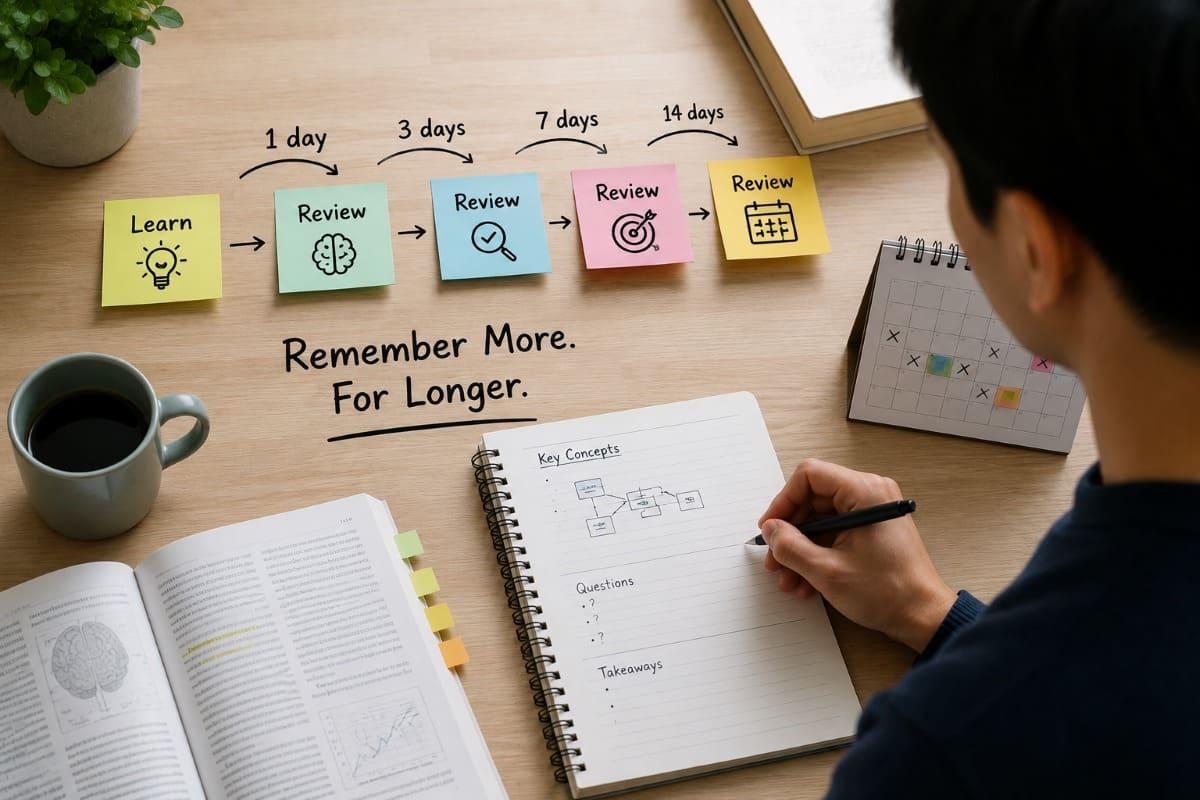
Spaced practice is a study method that spreads learning and
review across time instead of concentrating everything into one long session.
For students and adult learners, this matters because remembering more is not
only about studying harder. It is also about returning to important ideas at
the right intervals. Spaced practice helps learners revisit information before
it disappears completely, strengthen recall, and reduce dependence on
last-minute cramming. This article explains what spaced practice is, why it
works, how learners can apply it realistically, and how learning platforms can
support review schedules through microlearning, reminders, quizzes, and
progress tracking.
- Quick
Answer
- Why
Spaced Practice Matters for Long-Term Learning
- What
Spaced Practice Means in Real Study Behavior
- Spaced
Practice vs Cramming: A Practical Comparison
- How
Learners Can Build Spaced Review Into a Weekly Routine
- How
Spaced Practice Works With Active Recall
- How
Learning Platforms Can Support Spaced Practice
- Common
Mistakes When Using Spaced Practice
- A
Simple Spaced Practice Framework for Students and Adult Learners
- FAQ
- Conclusion
Quick Answer
Spaced practice helps learners remember more over time by
spreading study and review across multiple sessions instead of concentrating
learning into one long period. Rather than studying a topic once and hoping it
stays in memory, learners return to the material after short delays, then
longer delays, so recall becomes stronger and more durable.
For students, spaced practice can make exam preparation less
dependent on cramming. For adult learners, it can make professional learning
easier to maintain in short, realistic study windows. The method is especially
useful for vocabulary, concepts, procedures, formulas, definitions, technical
knowledge, and skills that need repeated practice.
Spaced practice does not mean reviewing everything every
day. It means reviewing important material at planned intervals. A learner
might study a topic on Monday, recall it on Wednesday, practice it on Friday,
and revisit it again the following week.
The operational implication is important: learning systems
should not only deliver content once. They should help learners return to key
ideas through quizzes, reminders, review prompts, and structured learning
paths.
Why Spaced Practice Matters for Long-Term Learning
Many learners study as if memory works like storage. They
read a chapter, watch a lesson, complete a module, and assume the information
has been saved.
But learning is not that simple. Information can feel clear
during the first study session and become difficult to recall several days
later. This is why learners often experience a frustrating pattern: they
understand something during class or training, but cannot remember it during an
exam, discussion, project, or work task.
Spaced practice addresses this problem by changing the
timing of study.
Instead of asking, “How many hours should I study today?”
spaced practice asks, “When should I come back to this idea so I can remember
it later?”
That shift matters. A learner who studies for three hours in
one night may feel productive, but much of that effort is concentrated in a
short window. A learner who studies the same material in shorter sessions
across several days gives memory more opportunities to reconnect with the
content.
Spaced practice turns remembering into a process, not a one-time event.
This is especially valuable for adult learners. Adults often
study while managing work, family, business, travel, and daily
responsibilities. They may not have long study blocks available. Spaced
practice allows them to use smaller sessions more strategically.
A 20-minute review today, a 10-minute quiz two days later,
and a short application task next week can be more realistic than waiting for a
large uninterrupted study session that may never happen.

What Spaced Practice Means in Real Study Behavior
Spaced practice is often misunderstood as a complicated
memory system. In practice, it can be simple.
A learner studies something, waits for a period of time,
then returns to it. The review may happen after one day, several days, one
week, or longer. The exact schedule depends on the difficulty of the material,
the learner’s goals, and how soon the knowledge needs to be used.
For example, a student learning biology might:
- read
a lesson on Monday
- answer
recall questions on Tuesday
- complete
practice diagrams on Thursday
- review
mistakes on Sunday
- revisit
the topic again before the next unit test
An adult learner studying business communication might:
- watch
one short lesson during lunch
- write
three key points later that evening
- apply
the idea in a work email the next day
- review
the principle again before a team presentation
A professional learner studying software might:
- complete
one tutorial
- redo
the task without instructions two days later
- solve
a small variation the following week
- record
common mistakes for later review
The pattern is not identical across subjects, but the logic
is the same: learning is revisited before it becomes too distant.
Spaced practice is not about adding more work. It is about
redistributing study effort so learners return to important ideas before they
disappear.
This is why spaced practice fits naturally with
microlearning. Short lessons, small quizzes, and focused review prompts can be
distributed across time without overwhelming the learner.
IES
practice guide on organizing instruction and study
Spaced Practice vs Cramming: A Practical Comparison
Cramming is the opposite of spaced practice. It concentrates
study into a short period, often right before a deadline or exam.
Cramming can feel efficient because learners cover a lot of
material quickly. It may even help in some short-term situations, especially
when a learner only needs immediate familiarity. But it is fragile when the
goal is long-term retention, deep understanding, or future application.
Spaced practice distributes learning across time. It may
feel slower at first because progress is less dramatic in a single session.
However, it gives learners repeated opportunities to recall, correct, and
reconnect ideas.
|
Aspect |
Cramming |
Spaced Practice |
|
Timing |
One long session near the deadline |
Several shorter sessions across time |
|
Learner feeling |
Intense, urgent, often stressful |
More gradual and manageable |
|
Short-term familiarity |
Can feel high |
Builds steadily |
|
Long-term recall |
Often weaker after time passes |
Usually better supported |
|
Best use |
Emergency review or short-term exposure |
Exams, professional skills, long-term learning |
|
Main risk |
Overload, fatigue, false confidence |
Requires planning and follow-through |
|
Platform support |
Content replay before deadline |
Reminders, quizzes, review paths, progress tracking |
The better strategy is not always to eliminate cramming
entirely. Learners may still need final review before a test or project. The
problem is relying on cramming as the main learning method.
A more balanced approach is:
- learn
early
- review
briefly
- recall
after delays
- practice
before the deadline
- use
final review only as reinforcement
This approach reduces the pressure on one final study
session.
How Learners Can Build Spaced Review Into a Weekly Routine
Spaced practice works best when learners make review part of
the routine, not an extra task added at the end.
A practical weekly study routine can include three types of
sessions:
- New
learning sessions
- Review
sessions
- Practice
or application sessions
New learning introduces the topic. Review brings the topic
back after a delay. Practice helps the learner use the topic in a task,
problem, scenario, or explanation.
For students, this might look like:
- Monday:
learn a new topic
- Wednesday:
recall the main ideas without notes
- Friday:
answer practice questions
- Sunday:
review mistakes and plan the next step
For adult learners, it might look like:
- Tuesday
evening: complete one short lesson
- Thursday
lunch break: answer review prompts
- Saturday
morning: apply the idea to a real work scenario
This structure respects limited time. The learner does not
need to study for hours every day. The important thing is returning to the
material more than once.
how
to build a study routine that learners can actually maintain

FitAcademy
Make Learning Easier to Continue Over Time
FitAcademy supports structured, mobile-first learning experiences that help learners move through short lessons, review prompts, quizzes, and progress checkpoints at a sustainable pace.
Learn More About FitAcademyHow Spaced Practice Works With Active Recall
Spaced practice is about when learners review. Active recall
is about how learners review.
They work best together.
A learner can space study sessions across time, but if every
review session is only rereading, the method may still be too passive. A
stronger review session asks the learner to retrieve information from memory.
For example, instead of reviewing a lesson by rereading the
same notes, the learner might:
- close
the notes and explain the concept
- answer
three questions
- draw
a process from memory
- solve
a problem without looking at the example
- teach
the idea aloud
- write
one real-life application
This combination is powerful because spacing creates the
delay, and active recall creates the retrieval effort.
A delayed recall attempt may feel harder than reviewing
immediately. That difficulty is not necessarily a bad sign. It often shows that
the learner is working to rebuild access to the information. The key is to
check answers afterward so mistakes are corrected.
A simple study cycle can look like this:
|
Stage |
Study Action |
Purpose |
|
First exposure |
Read, watch, or listen |
Understand the basic idea |
|
First recall |
Explain without notes |
Check initial understanding |
|
Delayed review |
Return after one or more days |
Strengthen memory over time |
|
Practice |
Apply or solve |
Move from recall to usable skill |
|
Correction |
Review mistakes |
Close learning gaps |
|
Later review |
Revisit after a longer delay |
Support longer-term retention |
This creates a realistic learning loop. Learners do not
simply move forward through content. They return to important ideas until those
ideas become easier to retrieve and apply.
active
recall vs rereading: which study method supports better learning?
How Learning Platforms Can Support Spaced Practice
Spaced practice is simple in theory but difficult to
maintain manually. Learners may forget what to review, when to review it, or
which topics still need attention.
A digital learning platform can reduce this friction.
A well-designed learning environment can support spaced
practice through:
- structured
learning paths
- short
lessons
- review
reminders
- delayed
quizzes
- progress
tracking
- mistake
logs
- mobile
notifications
- practice
checkpoints
- saved
notes or bookmarks
- learner
analytics
The most important design principle is that review should
not depend entirely on learner memory. The system should help learners return
to key content at useful moments.
For example, after a learner completes a lesson, the
platform might prompt a short review two days later. After a quiz, it might
recommend revisiting only the questions that were missed. After completing a
module, it might schedule a summary review before the next module begins.
This is especially relevant for mobile learning. Students
and adult learners often study in short moments: between classes, during a
commute, after work, or during a lunch break. Mobile-first review prompts make
it easier to use those moments productively.
A learning platform becomes more useful when it does not
only organize content, but also organizes return visits to the content.
For institutions, creators, and training providers, this has
operational value. Spaced practice can be built into the learning journey
rather than left as an optional habit. A branded learning platform can guide
learners through lessons, practice, review, and progress in one consistent
environment.
7
features every modern learning platform should have in 2026

Common Mistakes When Using Spaced Practice
Spaced practice is practical, but learners often apply it in
ways that reduce its value.
Mistake 1: Waiting Too Long Before the First Review
Some learners study a topic once and return weeks later. By
then, the material may feel almost new again.
A better approach is to schedule the first review fairly
soon after learning. This might be the next day or within a few days, depending
on difficulty. The first review does not need to be long. It only needs to
bring the material back into attention.
Mistake 2: Reviewing Everything Equally
Not all material deserves the same review time. Learners
should spend more time on concepts they forget, questions they miss, and skills
they struggle to apply.
This is where quiz results, practice performance, and
mistake logs become useful. They help learners decide what needs further
review.
Mistake 3: Confusing Spacing With Procrastination
Spaced practice means planned delay. Procrastination means
unplanned delay.
The difference is intention. In spaced practice, the learner
knows when they will return to the topic and what they will do. In
procrastination, the learner avoids the task until pressure becomes
unavoidable.
Mistake 4: Only Rereading During Review Sessions
Spaced rereading is still limited if learners never test
themselves. Review sessions should include active recall, practice questions,
explanation, or application.
A useful rule is: review should produce something. The
learner should answer, explain, solve, draw, compare, or apply.
Mistake 5: Making the System Too Complicated
Some learners create complex spaced repetition systems with
too many categories, intervals, and tools. This can become difficult to
maintain.
A simple system that learners actually use is better than a
perfect system they abandon.
A Simple Spaced Practice Framework for Students and Adult Learners
Learners can start with a simple 1–3–7 rhythm.
This means:
- first
review after 1 day
- second
review after 3 days
- third
review after 7 days
This is not a universal rule. Some topics need more frequent
review, while others need less. But it gives learners a practical starting
point.
Step 1: Identify What Needs Spacing
Not every task needs spaced practice. It is most useful for
material learners need to remember, explain, or use later.
Examples include:
- definitions
- formulas
- vocabulary
- processes
- frameworks
- historical
events
- technical
procedures
- professional
concepts
- exam
topics
- safety
or compliance knowledge
Step 2: Create Small Review Tasks
Review should be specific.
Instead of writing “review chapter,” learners can write:
- answer
five questions from chapter 2
- explain
the framework without notes
- redraw
the process diagram
- solve
two old problems
- summarize
the lesson in three sentences
- apply
the concept to one real situation
Step 3: Track What Was Difficult
Learners should mark topics as:
- easy
- uncertain
- difficult
- missed
- needs
practice
This helps them avoid wasting time on material they already
know well.
Step 4: Increase the Gap Gradually
If recall is strong, the learner can wait longer before the
next review. If recall is weak, the learner should review sooner.
This creates a flexible system. The schedule responds to
actual performance.
Step 5: Combine Review With Real Application
For adult learners especially, application is essential. A
learner studying leadership, teaching, marketing, finance, sewing, coding, or
communication should connect review to real use.
For example:
- explain
the concept to a colleague
- apply
a method to a work task
- solve
a realistic case
- create
a small project
- compare
the idea to a real example
This moves spaced practice beyond memorization and into
practical learning.

FAQ
What is spaced practice?
Spaced practice is a study method where learners spread
study and review sessions across time instead of studying everything in one
long session. The goal is to revisit important material after delays so
learners strengthen recall and reduce forgetting. It can be used for school
subjects, professional training, language learning, technical skills, and
online courses.
Is spaced practice better than cramming?
Spaced practice is usually better for long-term retention
because learners return to material multiple times over time. Cramming may help
with short-term familiarity before a deadline, but it often creates stress and
weaker long-term recall. A practical routine can still include final review,
but it should not depend entirely on last-minute study.
How often should learners review using spaced practice?
There is no single perfect interval for every learner or
subject. A simple starting point is to review after one day, then a few days
later, then again after about a week. Difficult material may need shorter gaps.
Easier material can be reviewed after longer gaps. Learners should adjust based
on performance.
Can spaced practice work for adult learners?
Yes. Spaced practice is especially useful for adult learners
because it can work in short sessions. A busy learner can complete a short
lesson, return to it later through a quiz or recall task, and apply it in a
real work situation. This makes the method compatible with microlearning and
mobile-first learning.
Does spaced practice only work for memorization?
No. Spaced practice is often used for memory, but it can
also support understanding and skill development when combined with
explanation, practice, feedback, and application. For example, learners can
revisit a concept, solve new problems, apply a framework, or reflect on
mistakes across multiple sessions.
How can learning platforms support spaced practice?
Learning platforms can support spaced practice through
review reminders, delayed quizzes, progress tracking, mistake logs, mobile
notifications, and structured learning paths. These features help learners know
what to review and when to review it, reducing the burden of managing the
entire schedule manually.
Conclusion
Spaced practice helps learners remember more over time by
making review part of the learning process.
Instead of treating study as a one-time event, learners
return to important ideas after planned delays. This gives memory more
opportunities to reconnect with the material and gives learners more chances to
correct gaps before they become serious problems.
For students, spaced practice can reduce the pressure of
last-minute cramming. For adult learners, it can make learning more realistic
by turning small study windows into meaningful progress. For educators,
creators, and training providers, it offers a practical design principle:
learning experiences should guide learners back to key content, not simply move
them forward through new material.
The strongest routines combine spacing with active recall,
practice, feedback, and application. This is where structured learning
platforms can help. When lessons, quizzes, review prompts, and progress
tracking work together, learners are more likely to return to what matters at
the right time.
Spaced practice does not require a perfect system. It
requires a repeatable one.
FitAcademy
Support Consistent Learning With Structured Review
FitAcademy helps organize learning experiences into mobile-friendly pathways with lessons, checkpoints, quizzes, and progress tracking that can support better study habits over time.
Learn More