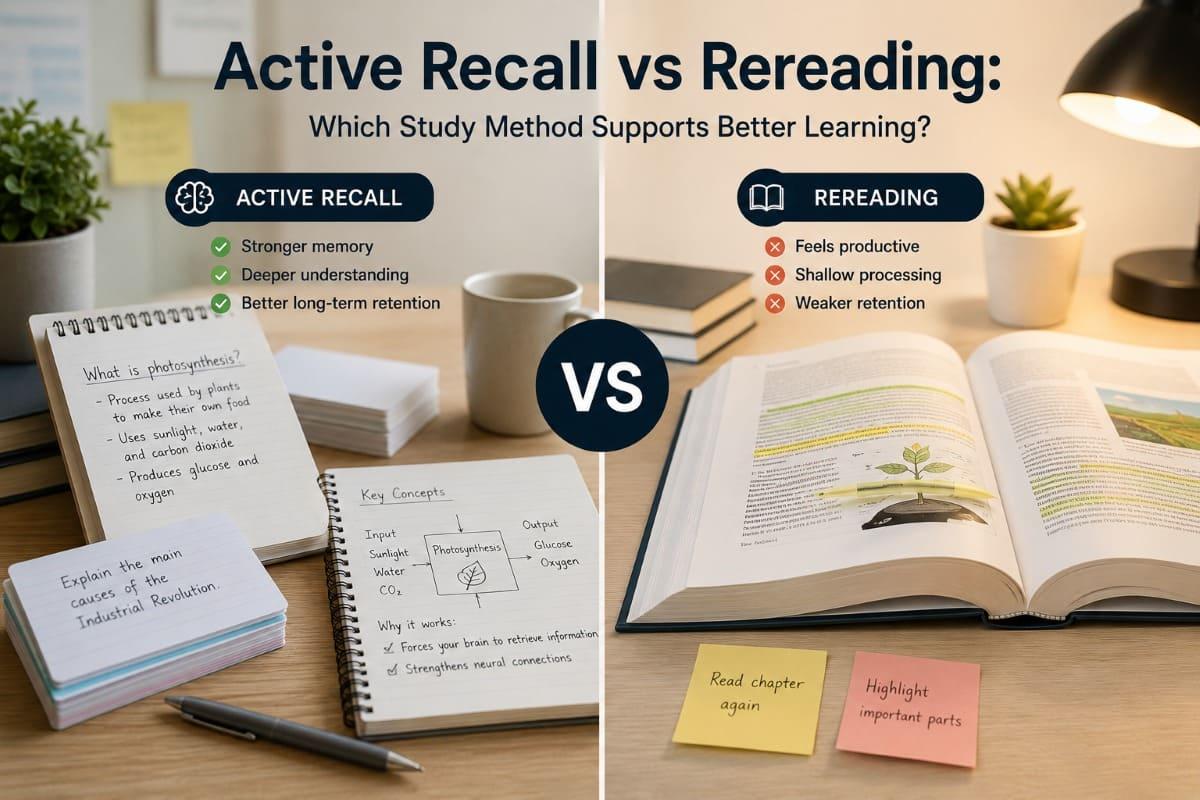
Active recall and rereading are two common study methods,
but they support learning in different ways. Rereading helps learners become
familiar with material, while active recall asks learners to retrieve
information from memory without looking at the source. This difference matters
because many students and adult learners mistake recognition for understanding.
They feel comfortable when material looks familiar, but struggle when they need
to explain, apply, or remember it later. This article explains how active
recall and rereading work, when each method is useful, and how learners can
combine them into a more effective study routine. It also connects study method
design to learning platforms, microlearning, quizzes, and structured review.
- Quick
Answer
- Why
This Comparison Matters for Learners
- What
Rereading Actually Does
- What
Active Recall Actually Does
- Active
Recall vs Rereading: A Practical Comparison
- When
Rereading Is Still Useful
- How
to Turn Passive Review Into Active Learning
- How
Learning Platforms Can Support Active Recall
- Common
Mistakes Learners Make
- FAQ
- Conclusion
Quick Answer
Active recall generally supports better long-term learning
than rereading when the goal is to remember, explain, or apply knowledge later.
Rereading exposes learners to the material again, which can increase
familiarity. Active recall requires learners to retrieve information from
memory, which makes gaps in understanding more visible and can strengthen later
recall.
This does not mean rereading is useless. Rereading can help
when learners are first encountering difficult material, checking misunderstood
details, or reviewing after a failed recall attempt. The problem happens when
rereading becomes the main study method and learners assume that familiarity
means mastery.
For students, active recall can be used through
self-quizzing, closed-book summaries, practice questions, flashcards, teaching
the concept aloud, or solving problems without looking at examples. For adult
learners, it can be built into short study sessions, mobile learning
activities, workplace practice, or course checkpoints.
The most practical approach is not “never reread.” It is:
read to understand, recall to test understanding, reread to correct gaps, then
recall again.
Why This Comparison Matters for Learners
Many learners study in ways that feel productive but do not
always reveal whether learning has happened.
Rereading is one of the most common examples. A student
opens a textbook, reads the same section again, highlights important sentences,
and feels more confident. An adult learner replays a course video, recognizes
the examples, and assumes the lesson is understood.
The problem is that recognition is easier than retrieval.
Recognition happens when learners see information and think,
“Yes, I know this.” Retrieval happens when learners must produce the
information without the source in front of them. Exams, workplace tasks,
presentations, discussions, and real-world decisions usually require retrieval,
not just recognition.
This is why the active recall vs rereading comparison
matters. It helps learners understand the difference between feeling familiar
with content and being able to use it.
Familiarity can make learning feel complete before understanding has actually been tested.
For students, this difference affects exam preparation and
assignment quality. For adult learners, it affects whether a course produces
usable skills or simply a sense of exposure. For educators and training
providers, it affects how learning experiences should be designed.
A course that only delivers content may help learners
consume information. A stronger learning experience also asks learners to
retrieve, apply, reflect, and review.

What Rereading Actually Does
Rereading means going through learning material again after
an initial exposure. This may involve rereading textbook chapters, notes,
slides, transcripts, summaries, or course materials.
Rereading can be helpful because learners often miss things
the first time. A second pass may clarify structure, vocabulary, examples, and
connections. When material is complex, rereading can help learners slow down
and notice details they did not understand earlier.
However, rereading also has a limitation: it can create a
strong feeling of fluency.
Fluency means the material feels easier to process.
Sentences look familiar. Diagrams seem clearer. Examples feel recognizable.
This can increase confidence, but confidence is not always the same as actual
recall.
For example, a learner may reread a lesson on financial
statements and feel comfortable with the terms “assets,” “liabilities,” and
“equity.” But when asked to explain how the balance sheet works without notes,
the learner may struggle.
That does not mean rereading failed completely. It means
rereading alone did not test whether the knowledge could be retrieved.
Rereading can improve familiarity, but learners still need a
way to check whether familiarity has become usable knowledge.
Rereading is most useful when it supports a larger study
cycle. It becomes weaker when it becomes the whole routine.
IES
practice guide on organizing instruction and study
What Active Recall Actually Does
Active recall is the practice of trying to retrieve
information from memory without immediately looking at the source material.
It can look simple:
- closing
the book and explaining the idea
- answering
practice questions
- using
flashcards
- writing
a summary from memory
- solving
a problem before checking the example
- teaching
the concept aloud
- creating
a blank diagram and filling it in
- listing
key points after watching a lesson
The value of active recall is that it turns studying into a
test of understanding. It shows learners what they can produce on their own.
This can feel uncomfortable. Rereading often feels smooth.
Active recall often feels effortful. Learners may pause, forget, hesitate, or
make mistakes. But that effort is part of why the method can be useful. It
exposes the gap between what feels familiar and what is actually retrievable.
Active recall also gives learners better feedback. If they
cannot answer a question, they know exactly what to review. If they can explain
a concept clearly, they have stronger evidence that learning is progressing.
For adult learners, active recall is especially practical
because it does not require long study hours. A 15-minute session can include
one short lesson, three recall questions, and one application task. This makes
the method compatible with microlearning and mobile-first learning
environments.
how
to build a study routine that learners can actually maintain

Active Recall vs Rereading: A Practical Comparison
The difference between active recall and rereading becomes
clearer when viewed through learner behavior.
|
Aspect |
Rereading |
Active Recall |
|
Main action |
Reviewing the material again |
Retrieving information from memory |
|
Learner experience |
Often feels easier and more fluent |
Often feels harder and more effortful |
|
Main benefit |
Builds familiarity and clarifies content |
Tests understanding and strengthens recall |
|
Main risk |
Can create false confidence |
Can feel uncomfortable or discouraging if poorly designed |
|
Best use |
First review, clarification, checking details |
Practice, exam preparation, skill application, long-term
memory |
|
Feedback value |
Limited unless paired with questions |
Strong because gaps become visible |
|
Platform feature fit |
Reading materials, lesson replay, summaries |
Quizzes, flashcards, practice tasks, checkpoints |
This comparison does not mean learners must choose only one
method. The better question is: what role should each method play?
A learner might begin with reading or watching a lesson to
understand the topic. Then they should close the material and attempt recall.
After that, they can reread only the parts they missed. Finally, they recall
again.
This cycle is more powerful than rereading everything
repeatedly because it uses rereading as correction, not as the entire strategy.
The best study method is not the one that feels easiest. It is the one that reveals what the learner can actually do.
When Rereading Is Still Useful
Rereading is often criticized because learners overuse it.
But used properly, it still has a place in a strong study routine.
Rereading is useful when learners are trying to understand
difficult material for the first time. Some topics require multiple exposures
before they become clear. Legal concepts, scientific processes, mathematical
explanations, technical documentation, and unfamiliar vocabulary may need
careful rereading.
Rereading is also useful after active recall. When a learner
attempts to answer a question and gets stuck, rereading the relevant section
can correct the gap. This makes rereading more targeted and efficient.
For example:
A learner reads a lesson on photosynthesis. Then they close
the material and explain the process. They forget the role of chlorophyll.
Instead of rereading the entire chapter, they return only to that section,
clarify the missing detail, and try again.
That is productive rereading.
The problem is not rereading itself. The problem is
rereading without a retrieval task, without a question, and without checking
whether the learner can use the information later.
Rereading works best as a support method, not as the main
evidence that learning has happened.
For course creators and educators, this distinction matters.
Learning materials should not simply invite learners to “review the lesson.”
They should guide learners toward specific recall prompts, practice tasks, and
reflection questions.
how
to take better notes without copying everything
How to Turn Passive Review Into Active Learning
The most practical way to improve a study routine is not to
remove reading. It is to add active steps after reading.
A simple sequence can work across many subjects:
- Read
or watch one focused lesson.
- Close
the material.
- Write
or say what you remember.
- Answer
one to five questions.
- Check
the source.
- Correct
mistakes.
- Try
again later.
This turns learning from passive review into an active loop.
Use Closed-Book Questions
After studying, learners can write questions such as:
- What
is the main idea?
- Why
does this concept matter?
- What
are the steps in the process?
- What
example can I create?
- How
is this different from another concept?
- Where
would I use this in real life?
Closed-book questions prevent learners from depending too
much on the source material.
Use Blank-Page Recall
A blank-page recall method is simple. The learner takes a
blank page and writes everything they remember about a topic. Then they check
the source and add corrections.
This works well for conceptual topics, exam review, and
adult learning because it quickly reveals gaps.
Use Practice Before Looking at the Answer
For problem-solving subjects, learners should try a problem
before studying the solution. Looking at worked examples is useful, but
learners also need opportunities to solve without the answer visible.
Use Small Recall Tasks in Microlearning
Active recall does not need to be long. A microlearning
lesson can end with one question, one scenario, one flashcard, or one short
application task.
This is especially useful for adult learners who study in
short time windows.

FitAcademy
Design Learning That Goes Beyond Content Consumption
FitAcademy helps creators, educators, and training providers organize lessons, quizzes, review prompts, and mobile-friendly learning paths so learners can practice what they study.
Learn More About FitAcademyHow Learning Platforms Can Support Active Recall
A learning platform can make active recall easier by
embedding it into the learner journey.
Without structure, learners may watch videos, read
materials, and move on too quickly. With better design, the platform can pause
learners at key moments and ask them to retrieve, apply, or reflect.
Useful platform features may include:
- short
quizzes after lessons
- flashcard-style
review
- scenario-based
questions
- practice
tasks
- progress
checkpoints
- delayed
review reminders
- mobile
learning prompts
- learning
analytics
- completion
tracking
- feedback
from instructors or mentors
The goal is not to turn every lesson into an exam. The goal
is to make retrieval a normal part of learning.
For example, a course on entrepreneurship might include a
short lesson about customer problems. Instead of asking learners to only watch
the video, the platform can ask:
“What problem does your target customer experience most
often? Write one sentence without looking back at the lesson.”
This is active recall plus application.
For institutional learning, active recall can also support
training quality. A workforce development program, online academy, or
professional community can use quizzes and practice checkpoints to see whether
learners are progressing. This does not guarantee mastery, but it gives better
signals than video completion alone.
7
features every modern learning platform should have in 2026

Common Mistakes Learners Make
Mistake 1: Thinking Active Recall Means Only Flashcards
Flashcards are one form of active recall, but they are not
the only one. Active recall can include explaining a concept aloud, answering
essay prompts, solving problems, completing diagrams, or applying knowledge to
a case.
For deeper learning, learners should use recall methods that
match the final task. If the exam requires essays, practice explaining. If the
job requires application, practice scenarios.
Mistake 2: Making Recall Questions Too Easy
Recognition-based questions can be useful, but they may not
always create enough retrieval effort. If every question simply asks learners
to pick from obvious options, they may still rely on recognition.
Better recall questions ask learners to produce, explain,
compare, sequence, diagnose, or apply.
Mistake 3: Skipping Feedback
Active recall without feedback can reinforce mistakes.
Learners should check answers, correct misunderstandings, and revisit difficult
points.
Feedback does not always need to come from a teacher. It can
come from answer keys, worked examples, rubrics, peer discussion, learning
analytics, or self-checking against the source.
Mistake 4: Using Active Recall Too Late
Many learners wait until exam week to test themselves. This
creates stress and reveals gaps too late.
A better routine uses small recall tasks immediately after
learning and again later. This connects active recall to spaced practice, which
is covered in the next article in this cluster.
how
spaced practice helps learners remember more over time
Mistake 5: Treating Struggle as Failure
Active recall often feels harder than rereading. That does
not mean it is failing. The difficulty is part of the learning signal.
Learners should treat forgotten answers as useful
information. A missed question shows what needs attention. It is better to
discover that gap during study than during an exam, presentation, or workplace
task.
FAQ
Is active recall always better than rereading?
Active recall is usually better when the goal is long-term
recall, exam preparation, or application. However, rereading can still help
when learners are first trying to understand difficult content or correct
mistakes after a recall attempt. The most practical approach is to combine
both: use reading for understanding, active recall for testing, and targeted
rereading for correction.
Why does rereading feel easier than active recall?
Rereading feels easier because the material is visible.
Learners can recognize ideas without having to produce them from memory. Active
recall feels harder because it removes the source and forces the learner to
retrieve, explain, or apply information. That extra effort can feel
uncomfortable, but it often gives a clearer picture of real understanding.
What are simple examples of active recall?
Simple examples include closing the book and explaining the
topic, answering practice questions, using flashcards, writing a blank-page
summary, creating a diagram from memory, solving a problem without looking at
the solution, or teaching the concept aloud. The key is that the learner
retrieves information before checking the source.
Can adult learners use active recall with limited time?
Yes. Active recall is useful for adult learners because it
can be done in short sessions. A learner can watch a 10-minute lesson, answer
three recall questions, and write one workplace application example. This makes
active recall compatible with microlearning, mobile learning, and professional
development routines.
How often should learners use active recall?
Learners can use active recall during every study session in
a small way. It does not need to dominate the whole session. Even five minutes
of closed-book recall after reading or watching a lesson can help learners
check what they understood and identify what to review next.
Conclusion
Active recall and rereading are not equal study methods, but
they do not need to be enemies.
Rereading helps learners revisit material, clarify details,
and rebuild understanding. Active recall helps learners test whether that
understanding can be retrieved without support. The key difference is that
rereading often feels fluent, while active recall exposes what the learner can
actually remember, explain, and apply.
For students, this can improve exam preparation and reduce
false confidence. For adult learners, it can make limited study time more
productive. For educators, creators, and training providers, it shows why
learning design should go beyond content delivery.
A strong learning experience should not only ask learners to
consume lessons. It should help them retrieve ideas, practice skills, correct
misunderstandings, and review over time.
That is where structured digital learning environments can
play a meaningful role. With quizzes, prompts, checkpoints, mobile access, and
progress tracking, a learning platform can make active recall easier to repeat.
The method still requires learner effort, but the system can make the right
effort more visible, guided, and sustainable.
FitAcademy
Help Learners Practice, Not Just Consume Content
FitAcademy supports structured digital learning experiences where lessons, quizzes, practice tasks, and progress checkpoints can work together inside a mobile-first learning environment.
Learn More