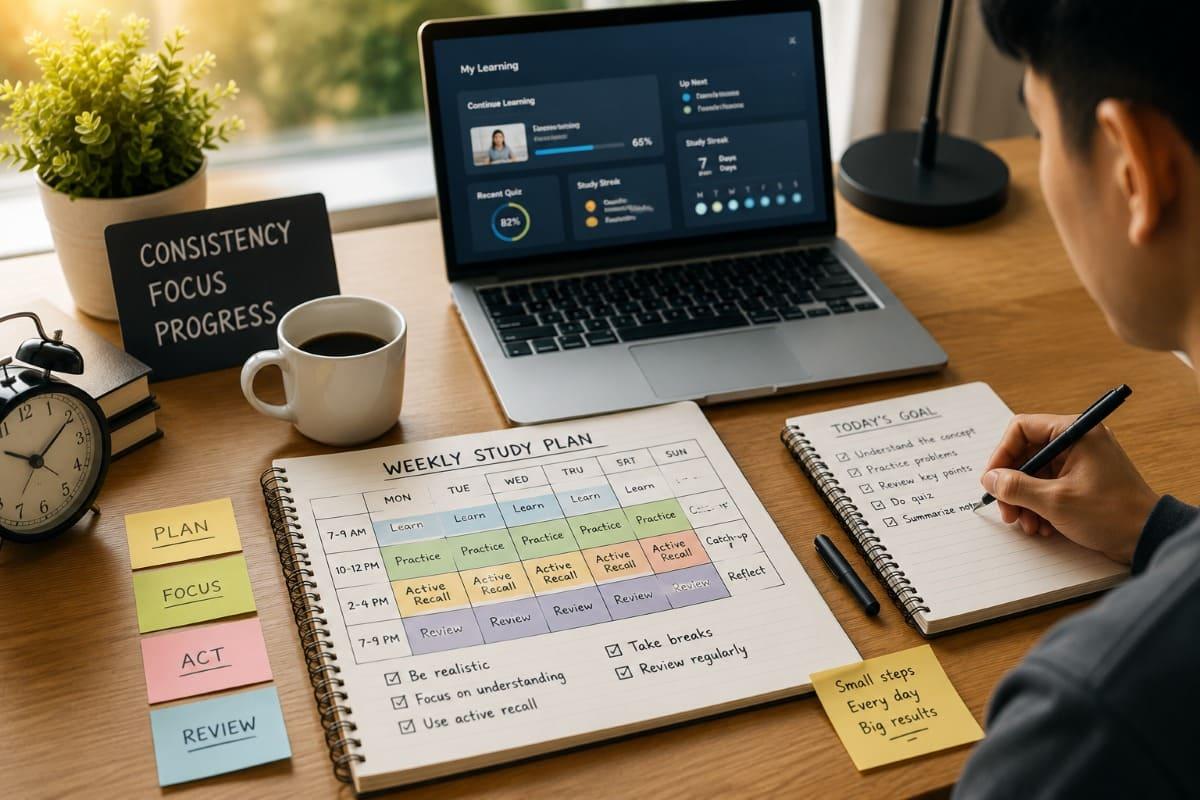
A study routine is not simply a timetable. It is a
repeatable learning system that helps students and adult learners study
consistently without relying on last-minute pressure, motivation spikes, or
unrealistic discipline. A maintainable routine considers time, energy,
attention, learning goals, and recovery. It also uses study methods that
support long-term understanding, such as retrieval practice, spaced review,
short learning blocks, and reflection. For learners, a better routine reduces
overwhelm and improves follow-through. For educators, creators, and learning
platforms, it creates a clearer structure for guiding learners through content,
practice, feedback, and progress over time.
- Quick
Answer
- Why
Most Study Routines Are Difficult to Maintain
- What
Makes a Study Routine Sustainable
- Start
With Real Life, Not an Ideal Schedule
- Use
Study Blocks That Actually Support Learning
- Make
the Routine Easy to Start, Pause, and Restart
- How
Digital Learning Platforms Can Support Better Study Habits
- Common
Mistakes When Building a Study Routine
- A
Practical Weekly Routine Learners Can Adapt
- FAQ
Quick Answer
A maintainable study routine is a simple, repeatable plan
that helps learners study regularly without depending on perfect motivation or
long uninterrupted hours. The best routines usually combine short focused
sessions, clear learning goals, active review, spaced practice, and realistic
recovery time.
For students and adult learners, the goal is not to study
more every day. The goal is to make study behavior easier to repeat. A strong
routine answers four practical questions: what should I study, when will I
study, how will I study, and how will I know whether I am improving?
A routine becomes easier to maintain when it matches the
learner’s actual life. A university student may need a weekly subject rotation.
A working adult may need 20-minute evening sessions. A professional learner may
need mobile-first lessons during commute breaks or lunch hours.
The operational implication is clear: study routines work
best when learning content, practice tasks, reminders, and progress tracking
are connected. This is why modern learning platforms increasingly support
microlearning, mobile learning, and structured learning paths.
Why Most Study Routines Are Difficult to Maintain
Many learners do not fail because they are lazy. They fail
because the routine they design does not match their daily reality.
A common routine looks good on paper: two hours of reading
every night, full revision every weekend, complete focus after school or work,
and no missed sessions. The problem is that this routine assumes a stable life,
high energy, and unlimited attention. Most learners do not have that.
Students may deal with classes, assignments, exams, family
responsibilities, social commitments, and fatigue. Adult learners often balance
work, parenting, commuting, financial pressure, and career development. In both
cases, a study routine that requires perfect conditions is fragile.
The routine collapses as soon as something interrupts it.
A maintainable routine works differently. It assumes
interruptions will happen. It gives learners a way to continue without feeling
that they have failed completely.
A good study routine is not strict because life is predictable. It is flexible because life is not.
The deeper issue is that many learners confuse planning with
learning. They spend time creating beautiful schedules, color-coded calendars,
or long to-do lists, but the actual study method remains weak. Rereading,
highlighting, and copying notes may feel productive, but they do not always
help learners check whether they can retrieve, explain, or apply what they
studied.
Research-informed learning guidance often emphasizes methods
such as retrieval practice, spaced learning, and self-testing because they
require learners to bring knowledge back from memory instead of only exposing
themselves to the same material repeatedly. For example, the American
Psychological Association describes repeated retrieval practice as a useful way
to support learning, while the Institute of Education Sciences includes spacing
learning over time as an evidence-based recommendation in its study guidance.
American
Psychological Association study strategies
IES
practice guide on organizing instruction and study

What Makes a Study Routine Sustainable
A sustainable study routine has three qualities: it is
realistic, repeatable, and connected to learning outcomes.
Realistic means the routine fits the learner’s actual
schedule and energy level. A student who is exhausted after a full school day
may not benefit from a two-hour session every evening. A working adult who can
only study after dinner may need shorter lessons, not an ambitious plan that
ignores fatigue.
Repeatable means the routine can survive imperfect weeks. A
learner should know what to do when they miss a session, fall behind, or need
to restart. The best routines avoid “all-or-nothing” thinking.
Connected to learning outcomes means the routine is not only
about time spent. It should help learners answer questions such as:
- Can
I explain this concept without looking?
- Can
I solve a problem using this method?
- Can
I remember the key idea after several days?
- Can
I apply this lesson in a realistic situation?
- Do I
know what to review next?
A routine that only tracks study hours may encourage effort,
but it does not necessarily reveal understanding. A better routine includes
small checks for comprehension, recall, and application.
A study routine becomes more useful when it shifts from “how
long did I study?” to “what can I now recall, explain, or do?”
For learning platforms, this matters because platform design
can shape learner behavior. A platform that only hosts long videos may leave
learners alone after watching. A platform that provides short lessons, practice
prompts, quizzes, progress checkpoints, and reminders can help learners convert
intention into action.
This is where microlearning becomes relevant. Short, focused
learning units can make it easier for learners to study consistently,
especially when they are busy. However, microlearning should not mean
fragmented learning. It works best when each small lesson connects to a larger
learning path.
why
mobile learning matters more than ever in global education
Start With Real Life, Not an Ideal Schedule
The first step in building a study routine is not choosing a
study method. It is understanding the learner’s real constraints.
A maintainable routine should begin with a simple audit:
- When
is the learner usually alert?
- When
is the learner usually tired?
- Which
days are already overloaded?
- How
much uninterrupted time is realistically available?
- What
topics require deep focus?
- What
tasks can be done in shorter sessions?
- What
device will the learner usually use?
This matters because not all study tasks require the same
level of attention. Reading a difficult chapter, solving a complex problem,
practicing a skill, reviewing flashcards, and watching a short lesson are
different types of learning activity.
For example, a college student may reserve morning sessions
for difficult subjects and use evening sessions for light review. A working
adult may use weekends for deeper learning and weekdays for short mobile
lessons. A professional learner may schedule practice tasks immediately after
learning a new concept so the knowledge is applied before it fades.
|
Routine Element |
Unrealistic Approach |
Maintainable Approach |
|
Study time |
“Study two hours every night” |
“Study 25 minutes on four realistic days” |
|
Missed session |
“Start over next week” |
“Use a restart block the next day” |
|
Review method |
“Reread everything before the test” |
“Use short recall checks across the week” |
|
Learning goal |
“Finish the chapter” |
“Explain the concept and answer practice questions” |
|
Platform use |
“Watch all lessons in one sitting” |
“Complete short lessons with checkpoints” |
A good study routine should also separate planning from
execution. Planning once per week is usually enough. Daily study time should be
used for learning, not constantly redesigning the schedule.
Use Study Blocks That Actually Support Learning
A study block is a focused unit of learning time. It does
not need to be long. What matters is that each block has a clear purpose.
A simple study block may include:
- 3
minutes to identify the task
- 15–25
minutes of focused learning
- 5
minutes of active recall or practice
- 2
minutes to record what to review later
This structure is useful because it prevents passive study
from filling the entire session. A learner may still read, watch, or listen,
but the block ends with action: recall, explain, solve, summarize, compare, or
apply.
For example, instead of writing “study biology,” a stronger
block would be:
“Review cell respiration, close the notes, explain the
process from memory, then answer five practice questions.”
Instead of writing “watch course video,” a better block
would be:
“Watch one lesson on customer segmentation, write three key
ideas, then apply the concept to one business example.”
This is also where learners should understand the difference
between exposure and retrieval. Exposure means seeing the material again.
Retrieval means trying to bring the material back from memory. Both can have a
place in learning, but retrieval gives learners a clearer signal of what they
actually know.
active
recall vs rereading: which study method supports better learning?

FitAcademy
Learn Better With Structured Digital Learning
FitAcademy supports structured, mobile-first learning experiences that help learners move from lessons to practice, review, and progress tracking in a more consistent way.
Learn More About FitAcademyMake the Routine Easy to Start, Pause, and Restart
The hardest part of studying is often not the middle of the
session. It is starting.
A maintainable study routine should reduce the number of
decisions a learner must make before beginning. The learner should not need to
ask, “What should I do today?” every time. The routine should already provide
the next step.
This can be done with a simple “next action” system. At the
end of every study session, the learner writes one clear next action:
- “Review
formulas 1–5.”
- “Redo
the three questions I missed.”
- “Explain
lesson 2 without notes.”
- “Watch
the next 10-minute lesson.”
- “Create
three examples for this concept.”
This small habit makes restarting easier. The next session
begins with clarity instead of friction.
A strong routine should also include a recovery rule.
Learners often abandon routines because they miss one or two days and feel
behind. A recovery rule prevents this.
Examples:
- If
one session is missed, do a 15-minute restart session.
- If a
full week is missed, review the last completed lesson before moving
forward.
- If
energy is low, complete the smallest useful version of the task.
- If
the learner is confused, switch from content consumption to question
writing.
The ability to restart is not a backup plan. It is part of
the routine itself.
This is especially important for adult learners. Many adults
study in unstable time windows: after work, between responsibilities, during
travel, or late at night. A flexible routine helps them continue even when life
changes.
How Digital Learning Platforms Can Support Better Study Habits
A learner can build a study routine with a notebook,
calendar, and discipline. But a well-designed learning platform can make the
routine easier to maintain.
Modern digital learning environments can support study
habits by giving learners:
- clear
learning paths
- short
lessons
- progress
visibility
- mobile
access
- reminders
- quizzes
and practice tasks
- completion
checkpoints
- feedback
loops
- review
prompts
- downloadable
or reusable materials
For students, this can reduce confusion about what to do
next. For adult learners, it can make learning more compatible with busy
schedules. For educators and training providers, it can create a more
structured learner journey instead of leaving learners to manage everything
alone.
A branded learning platform can also support consistency.
When learners return to the same learning environment, with familiar navigation
and a clear content sequence, the routine becomes easier to repeat. This does
not guarantee better learning outcomes by itself, but it can reduce operational
friction.
The most useful platforms do not only deliver content. They
help learners move through a cycle:
learn → practice → retrieve → review → apply → reflect →
continue
That cycle is what turns a routine from a schedule into a
learning system.
7
features every modern learning platform should have in 2026

Common Mistakes When Building a Study Routine
Many study routines fail because they are designed around
ambition instead of behavior. The intention is good, but the system is too
difficult to repeat.
Mistake 1: Planning Too Much Study Time Too Soon
A learner who has not studied consistently for months may
suddenly plan two or three hours per day. This usually creates early motivation
followed by quick exhaustion.
A better approach is to start smaller and build consistency
first. A 20-minute session repeated four times per week is often more useful
than an unrealistic plan that disappears after two days.
Mistake 2: Treating Rereading as the Main Routine
Rereading can help learners become familiar with material,
but familiarity is not the same as mastery. Learners may recognize information
while reading but struggle to recall it later.
A better routine includes recall checks, practice questions,
short explanations, and spaced review. The related article on active recall
explains this difference in more detail.
Mistake 3: Ignoring Spacing
Cramming may feel efficient before an exam or deadline, but
it often overloads attention and gives learners limited opportunities to
revisit material over time.
A more maintainable routine spreads review across multiple
days or weeks. This does not require complex scheduling. Even a simple “review
after one day, three days, and one week” pattern can help learners revisit
important material more deliberately.
how
spaced practice helps learners remember more over time
Mistake 4: Building a Routine Without Feedback
A learner may follow a schedule but never check whether it
is working. This creates a false sense of progress.
Feedback can be simple: quiz results, practice performance,
confidence ratings, error logs, tutor comments, peer discussion, or
self-explanation. Without feedback, the routine becomes activity tracking
rather than learning improvement.
Mistake 5: Making the Routine Too Dependent on
MotivationMotivation changes. A routine that only works when the
learner feels inspired is not stable.
A stronger routine uses triggers and defaults. For example:
after dinner, open the next lesson; after class, write three recall questions;
before sleeping, review one small concept. The habit becomes attached to an
existing moment.
A Practical Weekly Routine Learners Can Adapt
A maintainable study routine does not need to be complex.
The following model can be adapted by students, adult learners, and
professional learners.
Step 1: Choose One Main Learning Goal for the Week
Avoid planning everything at once. Choose one priority.
Examples:
- understand
one chapter
- complete
one course module
- prepare
for one test topic
- practice
one skill
- finish
one project milestone
The goal should be specific enough to guide action.
Step 2: Create Three to Five Study Blocks
A realistic weekly routine may include:
- two
learning blocks
- one
practice block
- one
review block
- one
flexible catch-up block
This structure gives the learner both direction and
breathing room.
Step 3: Match Task Type to Energy Level
High-energy time is better for difficult reading,
problem-solving, writing, analysis, or new concepts.
Lower-energy time can be used for review, flashcards, short
videos, organizing notes, or checking progress.
This makes the routine more humane and more likely to
continue.
Step 4: Add Active Recall to Every Session
At the end of each session, the learner should close the
material and answer:
- What
are the three most important ideas?
- What
can I explain without notes?
- What
question would test this concept?
- Where
am I still confused?
- What
should I review next?
This turns every session into a learning checkpoint.
Step 5: Schedule Review Before Forgetting Becomes a Problem
Review should not only happen before exams. A simple review
rhythm can be built into the week:
|
Day |
Study Focus |
Example Activity |
|
Monday |
Learn |
Complete one lesson or topic |
|
Tuesday |
Recall |
Explain Monday’s topic without notes |
|
Wednesday |
Practice |
Answer questions or apply the concept |
|
Thursday |
Learn |
Continue to the next topic |
|
Friday |
Review |
Revisit difficult points and errors |
|
Weekend |
Catch up or reflect |
Complete missed work and plan next week |
This is only a template. The best routine is the one a
learner can repeat and adjust.

FAQ
How long should a study session be?
A useful study session can be short. Many learners benefit
from focused blocks of 20 to 45 minutes, depending on the subject, energy
level, and task difficulty. The key is not only duration but quality. A short
session with a clear goal, active recall, and practice may be more valuable
than a long session spent passively rereading.
Is it better to study every day or several times per week?
Both can work, depending on the learner’s schedule. Daily
study can build rhythm, but it may become unrealistic for busy adult learners.
Several focused sessions per week can also be effective when they include
review and practice. The best routine is consistent enough to maintain and
flexible enough to survive real-life interruptions.
Why do study routines fail after a few days?
Study routines often fail because they are too ambitious,
too vague, or too dependent on motivation. A learner may plan long sessions
without deciding what to do inside each session. A better routine starts small,
defines specific tasks, includes review, and provides a restart rule for missed
days.
What should I do if I miss a study session?
Do not restart the entire plan. Use a recovery block. A
15-minute restart session can help you review the last topic, identify the next
action, and continue. Missing one session should not become a reason to abandon
the routine. A maintainable routine expects interruptions.
How can online learning platforms help with study routines?
Online learning platforms can support routines by organizing
lessons into clear paths, providing short modules, tracking progress, offering
quizzes, and reminding learners what to do next. The platform does not replace
learner effort, but it can reduce confusion and make consistent study behavior
easier to repeat.
Conclusion
A maintainable study routine is not built from pressure. It
is built from clarity, repetition, feedback, and flexibility.
For students, this means replacing vague intentions with
specific study blocks. For adult learners, it means designing a routine that
respects limited time and changing energy. For educators and learning
providers, it means creating learning experiences that guide learners through
content, practice, review, and application instead of simply giving them access
to information.
The strongest routines are not the most intense. They are
the ones learners can return to after a busy day, a missed session, or a
difficult topic. They help learners know what to study, how to study, when to
review, and how to continue.
In a digital learning environment, this is where thoughtful
platform design matters. Clear learning paths, microlearning units, mobile
access, progress tracking, and practice activities can make study routines
easier to maintain. The routine still belongs to the learner, but the learning
system can make consistency more achievable.
FitAcademy
Support Better Learning Habits With FitAcademy
FitAcademy helps organize digital learning experiences into structured, mobile-friendly pathways that support consistent learning, practice, and progress over time.
Learn More