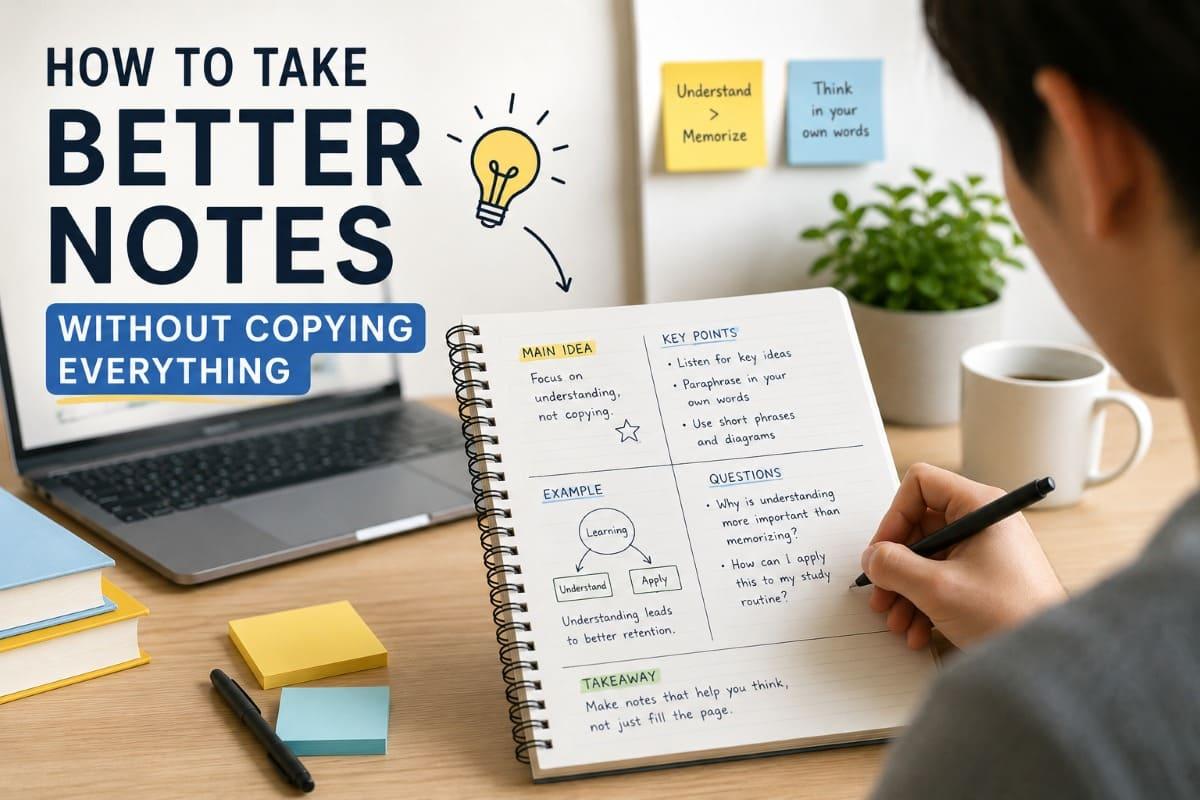
Better note-taking is not about writing down everything a
teacher, trainer, book, or course video says. It is about turning information
into a clearer structure that learners can understand, review, remember, and
use later. Many students and adult learners copy too much because it feels
safe, but copied notes often become long, passive, and difficult to review.
This article explains how to take better notes by identifying key ideas,
organizing concepts, writing in your own words, adding questions, and connecting
notes to active recall and spaced practice. It also shows how digital learning
platforms can support better note-taking through structured lessons, summaries,
quizzes, review prompts, and learning paths.
- Quick
Answer
- Why
Copying Everything Feels Productive but Often Fails
- What
Better Notes Are Supposed to Do
- The
Simple Framework: Capture, Clarify, Connect, Review
- How
to Take Notes From Lessons, Videos, and Reading Materials
- How
Notes Should Support Active Recall and Spaced Review
- How
Learning Platforms Can Help Learners Take Better Notes
- Common
Mistakes When Taking Notes
- A
Practical Note-Taking Template Learners Can Use
- FAQ
- Conclusion
Quick Answer
To take better notes without copying everything, learners
should focus on meaning, structure, and review value. Good notes capture the
main idea, explain it in the learner’s own words, show how concepts connect,
and include questions or prompts that can be used for later recall.
Copying everything may feel productive because the learner
is busy writing. However, it often leads to long notes that are hard to scan,
hard to remember, and hard to use before exams, assignments, projects, or
workplace tasks. Better notes are selective. They help learners identify what
matters most.
A practical note-taking routine can use four steps: capture
key ideas, clarify confusing points, connect ideas to examples, and review
using questions. For students, this can improve class revision and exam
preparation. For adult learners, it can make online courses, professional
training, and self-paced learning easier to apply.
The operational implication is important: learning materials
should be structured in a way that helps learners notice key points, not simply
consume information. A good learning platform can support this through clear
lesson design, summaries, quizzes, bookmarks, downloadable materials, and
review prompts.
Why Copying Everything Feels Productive but Often Fails
Many learners copy too much because it feels responsible.
In a classroom, they may try to write every sentence from
the slide. In an online course, they may pause the video repeatedly to copy the
transcript. In a training session, they may capture every definition, example,
and explanation because they are afraid of missing something important.
This approach feels active because the learner is doing
something. But the activity is often transcription, not thinking.
The problem appears later. When learners return to their
notes, they may find pages of copied material with no clear hierarchy.
Everything looks important. Nothing stands out. The learner still has to decide
what the lesson meant, what should be remembered, what needs practice, and what
remains confusing.
That means the real learning work has been delayed.
Notes are useful when they reduce confusion later, not when they preserve every word from the lesson.
Copy-heavy notes can also create a false sense of progress.
A learner may feel that they studied because they produced many pages of notes.
But if those notes cannot be used to answer questions, explain ideas, solve
problems, or guide review, they may not support learning very well.
This does not mean learners should never copy exact wording.
Some information should be recorded precisely, such as formulas, technical
terms, legal definitions, safety instructions, important quotations, or steps
in a procedure. The issue is copying everything without deciding what deserves
exact wording and what should be summarized.

What Better Notes Are Supposed to Do
Better notes are not a record of everything that happened in
a lesson. They are a learning tool.
Good notes should help learners do four things:
- understand
the main idea
- remember
important details
- review
efficiently later
- apply
the knowledge in a real task
This changes the purpose of note-taking. Instead of asking,
“Did I write everything down?” the learner asks, “Will this help me think,
recall, and use the material later?”
A useful note usually includes:
- the
main concept
- a
short explanation in the learner’s own words
- important
terms or definitions
- examples
- connections
to previous knowledge
- questions
for later review
- unclear
points that need follow-up
- practice
tasks or next actions
For example, weak notes might say:
“Spaced practice means studying over time instead of all at
once.”
Better notes might say:
“Spaced practice = review after delays. Purpose: remember
more over time. Example: study Monday, recall Wednesday, practice Friday.
Question: Why is this different from cramming?”
The second version is more useful because it includes
meaning, example, contrast, and a review question.
Better notes are not shorter because they remove value. They
are shorter because they separate key ideas from supporting noise.
For students, this makes exam preparation easier. For adult
learners, it makes online learning more practical because notes can become
action guides, not just archives. For educators and course creators, it
suggests an important design principle: content should help learners identify
structure.
The Simple Framework: Capture, Clarify, Connect, Review
A practical note-taking system does not need to be
complicated. One useful framework is:
Capture → Clarify → Connect → Review
This keeps note-taking focused on learning instead of
copying.
Capture the Main Idea
The first step is to capture the key point, not every
sentence.
Learners can ask:
- What
is the main idea of this section?
- What
problem does this concept solve?
- What
term or process must I remember?
- What
would I need to explain to someone else?
- What
is likely to be tested, used, or applied?
This helps learners listen, read, or watch with purpose.
Clarify in Your Own Words
After capturing the idea, the learner should rewrite it in
simpler language. This step is important because copying can hide confusion.
If a learner cannot explain the concept in their own words,
the note should include a question or warning:
“Need to review this again.”
“Confusing difference between X and Y.”
“Ask teacher for another example.”
“Look for practice problem.”
This makes confusion visible and easier to address.
Connect the Idea to Examples
Learning becomes stronger when ideas are connected to
examples.
A note can include:
- a
real-life example
- a
class example
- a
workplace example
- a
comparison with another concept
- a
diagram or simple flow
- a
mistake to avoid
For adult learners, this is especially important. A training
concept becomes more valuable when connected to a work task, business decision,
client problem, teaching activity, or personal project.
Review With Questions
The final step is to turn notes into review prompts.
Instead of only writing statements, learners should add
questions such as:
- What
does this concept mean?
- Why
does it matter?
- How
does it work?
- What
is an example?
- How
is it different from another idea?
- When
would I use this?
- What
mistake should I avoid?
These questions make notes easier to use for active recall
later.
|
Note-Taking Step |
Main Purpose |
Example Learner Action |
|
Capture |
Identify what matters |
Write the main concept, not every sentence |
|
Clarify |
Check understanding |
Rewrite the idea in your own words |
|
Connect |
Build meaning |
Add examples, comparisons, or diagrams |
|
Review |
Support memory |
Create questions for later recall |

How to Take Notes From Lessons, Videos, and Reading Materials
Different learning formats need slightly different
note-taking strategies. A live class, a recorded video, and a textbook chapter
do not create the same learning situation.
Taking Notes During Live Lessons
In a live lesson, learners must listen and write at the same
time. This can be difficult, so the goal should be selective capture.
Learners should focus on:
- definitions
the instructor emphasizes
- examples
used to explain difficult ideas
- steps
in a process
- comparisons
between concepts
- questions
raised during discussion
- mistakes
the instructor warns about
- summary
points at the end of the lesson
The learner should avoid trying to write every sentence. If
they write too much, they may stop listening carefully.
A useful approach is to leave space in the notes. After
class, the learner can fill gaps, rewrite unclear points, and add questions.
Taking Notes From Course Videos
Video lessons give learners more control because they can
pause, rewind, or replay. But this can also create a bad habit: copying the
video almost word for word.
A better method is to watch a short segment first, pause,
then write the main idea from memory.
For example:
- Watch
3–5 minutes.
- Pause
the video.
- Write
the main idea without replaying.
- Add
one example or question.
- Continue
to the next segment.
This keeps the learner mentally active.
Taking Notes From Reading Materials
When reading, learners should avoid highlighting large
sections without processing them. Highlighting can be useful, but only when it
supports later review.
A better reading note includes:
- the
main claim
- important
terms
- supporting
evidence or example
- a
short summary
- questions
- connections
to previous lessons
For difficult reading, learners can use margin prompts:
“What does this mean?”
“Why is this important?”
“How does this connect to the previous section?”
“What is the author trying to prove?”
“What should I remember?”
This makes reading more interactive.
IES
practice guide on organizing instruction and study
FitAcademy
Help Learners Move From Content to Understanding
FitAcademy supports structured digital learning experiences where lessons, summaries, quizzes, and review prompts can help learners study more actively and consistently.
Learn More About FitAcademyHow Notes Should Support Active Recall and Spaced Review
Good notes should not only help learners understand today.
They should help learners review later.
This is where note-taking connects directly to active recall
and spaced practice.
Active recall asks learners to retrieve information from
memory. Spaced practice asks learners to return to information after time has
passed. Notes can support both methods when they include questions, examples,
and review prompts.
For example, instead of writing notes only as statements:
“Active recall is the process of retrieving information from
memory.”
The learner can add a recall question:
“What is active recall, and why is it different from
rereading?”
Instead of writing:
“Spaced practice means reviewing over time.”
The learner can add:
“Create a 1-day, 3-day, and 7-day review plan for this
topic.”
Now the notes are not just content. They are a review
system.
active
recall vs rereading: which study method supports better learning?
how
spaced practice helps learners remember more over time
|
Note Type |
Passive Version |
Active Review Version |
|
Definition |
“Microlearning uses short lessons.” |
“What is microlearning, and when is it useful?” |
|
Process |
“Step 1, Step 2, Step 3.” |
“Can I explain the process without notes?” |
|
Example |
“Example from lesson.” |
“Can I create a new example?” |
|
Mistake |
“Common mistake: copying too much.” |
“Why does copying too much weaken review?” |
|
Application |
“Use in workplace.” |
“How would I apply this in my own task?” |
The best notes do not only store information. They prepare the learner to retrieve it.
This is why note-taking should be connected to routine. At
the end of each study session, learners can mark:
- what
to review tomorrow
- what
to review next week
- what
still feels unclear
- what
needs practice
- what
can be applied immediately
For adult learners, this is especially useful because they
may not return to the course every day. Notes help them restart quickly.
How Learning Platforms Can Help Learners Take Better Notes
A learning platform cannot take meaningful notes for the
learner. But it can create an environment that makes better note-taking easier.
A well-structured digital learning platform can support
note-taking through:
- clear
lesson titles
- short
learning modules
- key
concept summaries
- downloadable
worksheets
- bookmarks
- lesson
checkpoints
- quizzes
- reflection
prompts
- progress
tracking
- mobile
access
- discussion
spaces
- feedback
from instructors or mentors
The design of the learning experience matters. If a course
presents long, unstructured videos without summaries or checkpoints, learners
may struggle to identify what is important. If lessons are organized into
smaller units with clear objectives and review prompts, note-taking becomes
more focused.
For example, a mobile-first lesson might end with:
- one
key idea
- one
example
- one
recall question
- one
action task
This gives learners a natural note-taking structure.
For institutions, creators, and training providers, this has
operational value. Better note-taking support can improve learner experience,
reduce confusion, and make self-paced learning easier to continue. It can also
help learners return to previous lessons when preparing for assessments,
projects, or real-world application.
Learning platforms support better notes when they make
lesson structure visible: what matters, what to practice, what to review, and
what to do next.
A branded learning platform can reinforce this consistency
across courses. When learners repeatedly encounter clear lesson structures,
summaries, practice tasks, and review prompts, note-taking becomes less random
and more strategic.
7
features every modern learning platform should have in 2026

Common Mistakes When Taking Notes
Mistake 1: Copying Slides Word for Word
Slides are often designed as teaching aids, not complete
learning notes. Copying them exactly may preserve information, but it does not
guarantee understanding.
A better approach is to write what the slide means, why it
matters, and what question it answers.
Mistake 2: Highlighting Too Much
Highlighting can help when used selectively. But if most of
the page is highlighted, the learner has not made a decision about importance.
A useful rule is to highlight after reading a section, not
during the first sentence-by-sentence pass. This helps learners understand the
whole idea before marking key points.
Mistake 3: Writing Notes That Cannot Be Reviewed
Some notes are detailed but difficult to use later. They may
be messy, unstructured, or too long.
Better notes should be scannable. Learners should be able to
find main ideas, questions, examples, and unclear points quickly.
Mistake 4: Never Revisiting Notes
Notes that are never reviewed become storage, not learning
tools.
Learners should schedule short review sessions. Even five
minutes of recall using notes can be useful when repeated over time.
Mistake 5: Keeping Questions Separate From Notes
Questions are part of learning. If a learner is confused,
the question should be written directly into the notes.
This helps the learner return to the gap later, ask for
help, or search for a clearer explanation.
Mistake 6: Treating Digital Notes as a Dumping Ground
Digital tools make it easy to save too much. Learners may
collect screenshots, transcripts, PDFs, links, and copied text without
processing them.
A better digital note should still include structure: key
idea, explanation, example, question, and next action.
A Practical Note-Taking Template Learners Can Use
Learners can use a simple five-part note structure.
1. Topic
Write the topic clearly.
Example:
“Spaced Practice”
2. Main Idea
Write the central idea in one or two sentences.
Example:
“Spaced practice means reviewing material across time
instead of studying everything in one session. It helps learners return to
important ideas before they forget too much.”
3. Key Points
Write only the most important supporting points.
Example:
- review
after delay
- use
active recall
- focus
more on difficult topics
- avoid
relying only on cramming
4. Example or Application
Add one example.
Example:
“Study vocabulary on Monday, test myself on Wednesday, use
the words in sentences on Friday, review mistakes on Sunday.”
5. Review Questions
Turn the note into recall prompts.
Example:
- What
is spaced practice?
- How
is it different from cramming?
- How
can I use it this week?
- What
topic should I review again?
This template works because it keeps notes short but useful.
It also works across many learning formats: classroom learning, online courses,
professional training, reading, video lessons, and self-paced study.
 For students, this template can make exam review easier
because every note already contains questions. For adult learners, it can make
learning more applicable because every note includes an example or action.
For students, this template can make exam review easier
because every note already contains questions. For adult learners, it can make
learning more applicable because every note includes an example or action.
The template can also be adapted into a digital learning
platform worksheet, course handout, lesson reflection, or mobile learning
prompt.
how
to build a study routine that learners can actually maintain
FAQ
What is the best way to take notes without copying everything?
The best way is to focus on key ideas, write in your own
words, add examples, and create review questions. Instead of copying every
sentence, learners should ask what the lesson means, why it matters, and how it
can be used later. Good notes should help with understanding, recall, and
application.
Is copying notes always bad?
No. Some information should be copied exactly, such as
formulas, technical definitions, legal wording, procedures, or important
quotations. The problem is copying everything without processing it. Learners
should copy exact wording only when precision matters, then add their own
explanation and example.
How can students take notes faster in class?
Students can take notes faster by listening for structure
rather than writing every word. They should capture main ideas, examples,
steps, comparisons, and questions. It also helps to use abbreviations, leave
space for later clarification, and review notes soon after class while the
lesson is still fresh.
How should adult learners take notes from online courses?
Adult learners should focus on practical use. After each
short lesson, they can write the main idea, one useful example, one question,
and one action they can apply. This keeps notes connected to real life instead
of becoming a transcript of the course.
Should notes be handwritten or digital?
Both can work. Handwritten notes may encourage selectivity
because writing is slower. Digital notes are easier to search, edit, and
organize. The better choice depends on the learner’s context. The most
important factor is not the tool but whether the notes support understanding,
recall, review, and application.
How often should learners review their notes?
Learners should review notes soon after the lesson and again
after a delay. A simple approach is to review the next day, a few days later,
and again before an assessment or application task. Review should include
active recall, not only rereading.
Conclusion
Better note-taking begins with a simple shift: notes are not
meant to capture everything. They are meant to make learning easier to
understand, remember, and use.
Copying everything may feel safe, but it often creates long
notes that are difficult to review. Stronger notes are selective, structured,
and active. They identify the main idea, clarify meaning, connect concepts to
examples, and create questions for later review.
For students, this can make class notes more useful before
exams and assignments. For adult learners, it can turn online courses and
professional training into practical action. For educators, creators, and
training providers, it shows why lesson structure matters. Learners take better
notes when the learning experience clearly signals what matters, what to
practice, and what to review.
In a digital learning environment, note-taking can be
supported by short lessons, summaries, quizzes, reflection prompts, worksheets,
and progress tracking. The platform does not replace the learner’s thinking,
but it can guide that thinking in a more consistent way.
Good notes are not the longest notes. They are the notes
learners can return to, understand quickly, and use with confidence.
FitAcademy
Create Learning Experiences That Are Easier to Understand and Review
FitAcademy helps organize digital learning into structured, mobile-friendly lessons with summaries, checkpoints, and review activities that support better learner habits.
Learn More