Free educational content can attract attention, but
attention alone does not create a reliable enrollment pipeline. Course
providers and creators need a deliberate journey that moves readers, viewers,
or followers from general interest toward a relevant next step. That journey
usually combines useful content, a clearly defined audience, an appropriate
conversion asset, lightweight qualification, and timely follow-up.
This article explains how to design that system without
turning educational content into aggressive promotion. It covers lead
qualification, conversion paths, landing pages, email nurturing,
content-to-course alignment, common mistakes, and the operational role of a
branded learning platform. The goal is not to collect the largest possible
contact list, but to identify people whose needs, goals, readiness, and
expectations are reasonably aligned with the learning offer.
- Quick
Answer
- Why
Free Educational Content Often Fails to Generate Qualified Leads
- What
Makes a Lead Qualified in an Education Business?
- How
to Build a Content-to-Lead Journey
- Choosing
the Right Conversion Assets
- How
to Qualify Leads Without Adding Too Much Friction
- Common
Mistakes That Reduce Lead Quality
- A
Practical Implementation Framework
- Conclusion
- FAQ
Quick Answer
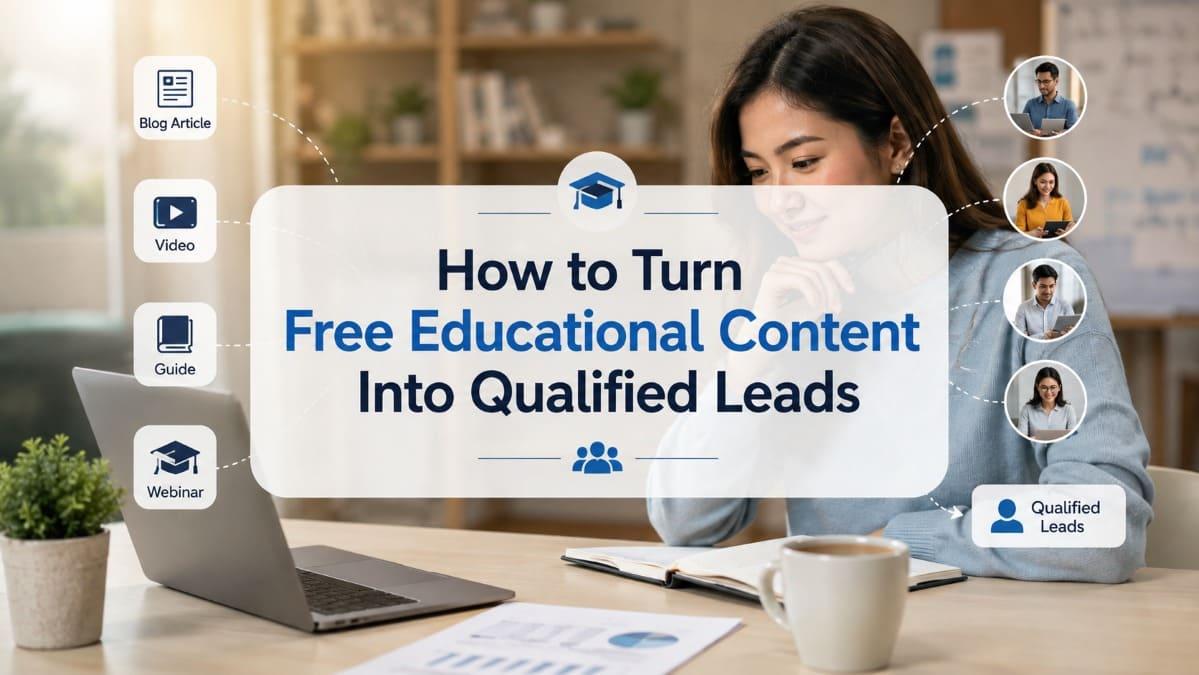
Turning free educational content into qualified leads means
creating a structured path from useful information to a relevant next action.
Free content may include blog articles, short videos,
webinars, templates, checklists, sample lessons, email courses, or community
discussions. A qualified lead is not simply someone who submits an email
address. It is someone whose problem, objective, audience profile, level of
readiness, and expected outcome are reasonably aligned with the course or
learning service being offered.
The process usually works in five stages:
- Attract
a specific audience with content connected to a real learning need.
- Offer
a logical next step that provides additional value.
- Collect
enough information to understand relevance and intent.
- Nurture
the lead with educational follow-up rather than immediate sales pressure.
- direct
the right people toward a course, consultation, trial, or branded learning
experience.
The main trade-off is between volume and relevance. A
low-friction form may generate more contacts, but many may have little
enrollment potential. A more selective conversion path may produce fewer leads
while giving the provider stronger signals about who should receive further
attention.

Why Free Educational Content Often Fails to Generate Qualified Leads
Free content frequently performs one job well: attracting
attention.
The difficulty begins after that attention arrives.
A creator may publish useful tutorials, answer detailed
questions on social media, or build a blog that receives steady search traffic.
Yet those visitors may leave without subscribing, exploring a course, or
revealing what they need. The content creates value, but the business has no
structured way to continue the relationship.
This usually happens for one of four reasons.
The content is useful but disconnected from the offer
A course provider may attract readers with a broad topic
while selling a highly specialized program.
For example, a provider offering an advanced instructional
design course might publish general productivity articles because those topics
attract more traffic. The audience may be larger, but the connection to the
paid program is weak. Most readers are unlikely to need instructional design
training.
Traffic relevance matters more than raw traffic volume when
the objective is lead generation.
Free content should not reproduce an entire paid course, but
it should address problems close enough to the course outcome that the reader
can recognize a logical progression.
A strong progression might look like this:
- Free
article: how to structure a short online lesson
- Downloadable
template: lesson planning worksheet
- Email
sequence: examples of effective learning activities
- Paid
offer: comprehensive course on designing online learning programs
Each step deepens the same underlying need.
There is no meaningful next step
A generic “subscribe to our newsletter” box gives visitors
little reason to act.
The offer does not explain what they will receive, how it
relates to the content, or why providing contact information is worthwhile.
A stronger next step extends the value of the current page.
Someone reading about course pricing may be offered a pricing calculator.
Someone watching a tutorial on curriculum planning may be offered a curriculum
template. Someone attending an introductory webinar may be offered a sample
module or diagnostic assessment.
The transition should feel like part of the learning
experience rather than an interruption.
The conversion request appears before sufficient trust has formed
Visitors arriving from search, social media, or a referral
may know very little about the educator.
Immediately asking them to book a call or purchase a course
can be premature, particularly for high-consideration programs. Before
committing, people may need to evaluate the provider’s expertise, teaching
style, curriculum depth, practical relevance, support model, and credibility.
Free educational content can support this evaluation. It
gives potential learners a low-risk way to judge whether the provider
understands their problem and can explain it clearly.
Every contact is treated as equally valuable
A list containing thousands of email addresses may look
promising, but it is not necessarily a pipeline of potential learners.
Some subscribers may be students looking for free resources.
Others may be professionals researching on behalf of an employer. Some may want
a beginner course, while the provider only offers advanced training. Others may
be interested in the topic but have no intention of enrolling.
A useful lead system does not only capture contacts. It
gradually identifies who the person is, what they are trying to accomplish, and
whether the offer is appropriate.
Free content becomes commercially useful when it reveals
learner intent, not merely when it increases page views or follower counts.
What Makes a Lead Qualified in an Education Business?
A qualified education lead is a prospective learner or buyer
whose needs, profile, timing, and expectations show a plausible fit with a
specific learning offer.
Qualification does not mean certainty. A qualified lead may
still decide not to enroll. The purpose is to distinguish meaningful interest
from casual attention so that communication, support, and sales effort can be
prioritized appropriately.
For course providers and creators, qualification usually
involves several dimensions.
|
Qualification dimension |
Question to assess |
Example signal |
|
Problem fit |
Does the person face a problem the course addresses? |
They need to improve course design, learner engagement, or
training delivery |
|
Audience fit |
Is the offer designed for someone in their role or
experience level? |
They identify as a trainer, creator, team lead, or
learning administrator |
|
Outcome fit |
Does the desired result match the course promise? |
They want to launch a course, improve completion, or build
a learning system |
|
Readiness |
Are they actively exploring a solution? |
They download a planning guide, join a webinar, or review
program details |
|
Timing |
Is the need immediate, planned, or exploratory? |
They intend to launch within three months rather than
“someday” |
|
Delivery fit |
Can they use the format offered? |
They are comfortable with mobile learning, cohort
learning, or self-paced study |
|
Commercial fit |
Is the pricing model plausible for them? |
They understand whether the offer is free,
subscription-based, or premium |
|
Authority |
Are they the learner, buyer, recommender, or
decision-maker? |
A training manager may influence a larger institutional
purchase |
Not every education business needs to evaluate every
dimension at the first interaction.
A low-cost self-paced course may require minimal
qualification. A creator might only need to know the learner’s topic interest
and experience level.
A premium cohort program, institutional academy, or
white-label platform requires more context. The provider may need to understand
participant volume, content readiness, branding requirements, internal
stakeholders, reporting needs, and launch timing.
The qualification model should match the complexity of the
decision.
A qualified lead is not the person who downloaded the most resources. It is the person whose needs increasingly align with the learning offer.
How to Build a Content-to-Lead Journey
A content-to-lead journey is a sequence that helps an
anonymous visitor become an identifiable and increasingly understood
prospective learner.
The journey should be designed around the learner’s decision
process, not merely around the provider’s desire to collect contact
information.
Start with one specific learner problem
Broad content can attract a broad audience, but conversion
paths work better when each piece addresses a recognizable situation.
Compare these two topics:
- How
to grow your knowledge
- How
to structure a 30-minute employee onboarding module
The first topic may generate interest from many types of
readers. The second reveals more about the audience, context, and potential
solution.
Specificity makes it easier to connect content with an
appropriate next step.
For course providers, useful problem categories may include:
- choosing
a course topic
- structuring
a curriculum
- producing
learning materials
- improving
learner engagement
- managing
cohort communication
- issuing
certificates
- tracking
progress
- monetizing
expertise
- launching
a branded academy
- moving
offline training into an online or blended format
Each problem can become an entry point into a different
conversion path.
Match the next step to the reader’s current intent
Not every reader is ready for the same action.
Someone asking “What is microlearning?” is probably at an
earlier stage than someone asking “How much does a white-label learning
platform cost?”
The first reader may benefit from an explanatory guide or
example learning pathway. The second may be ready for a platform comparison,
implementation checklist, or consultation.
A practical intent sequence is:
- Awareness:
“Help me understand the problem.”
- Consideration:
“Help me compare possible approaches.”
- Evaluation:
“Help me determine whether this solution fits.”
- Decision:
“Help me understand implementation, cost, and risk.”
The conversion asset should correspond to the stage.
Sending an early-stage reader directly to a sales call can
create resistance. Offering another introductory checklist to a decision-stage
buyer can delay progress unnecessarily.
Make the value exchange explicit
A visitor should understand what they will receive and why
it is useful.
Instead of:
“Join our mailing list.”
Use a specific value proposition:
“Download the course planning worksheet used to organize
objectives, lesson sequence, practice activities, and assessment.”
The second version communicates scope, relevance, and
practical benefit.
It also gives the provider a clearer signal. Someone who
requests a course planning worksheet is more likely to be working on a course
than someone who subscribes to a general newsletter.
Continue the same topic after conversion
The experience should remain coherent after the visitor
submits a form.
If a person downloads a learner onboarding checklist, the
follow-up should not immediately shift to unrelated promotions. A stronger
sequence might include:
- The
requested checklist.
- A
short explanation of the most commonly overlooked onboarding step.
- An
example onboarding flow.
- A
self-assessment about the provider’s current learning system.
- A
relevant invitation to explore a course or platform.
The sequence progressively develops the original topic.
This matters because educational buyers often assess the
quality of the free follow-up as evidence of the quality of the paid learning
experience.

Choosing the Right Conversion Assets
A conversion asset is the resource, experience, or tool
offered in exchange for a visitor’s information, participation, or next action.
The strongest asset is not necessarily the largest or most
expensive to produce. It is the one that helps the user make progress while
revealing meaningful information about their needs.
Checklists and templates
Checklists and templates are effective when the audience has
already decided to complete a task but needs help organizing it.
Examples include:
- course
launch checklist
- curriculum
planning template
- learner
onboarding worksheet
- webinar
preparation guide
- training
evaluation form
- content
production calendar
- learning
platform requirements checklist
These assets can produce useful intent signals because they
are connected to an operational activity.
Their limitation is that they often attract people who
prefer to solve the problem independently. The follow-up therefore needs to
show when a template is sufficient and when a more structured course, service,
or platform may be necessary.
Diagnostic assessments
A diagnostic assessment helps prospective learners evaluate
their current situation.
For example, a course creator readiness assessment might ask
about:
- target
audience clarity
- learning
outcomes
- curriculum
structure
- content
availability
- delivery
format
- learner
support
- pricing
- platform
readiness
The result can direct the person toward an appropriate
resource, course level, or service.
Diagnostics are especially useful when the provider serves
several audience segments. They can prevent beginners from entering an advanced
program and help experienced providers bypass introductory material.
The assessment should remain credible. It should not be
designed so that every result concludes that the user must buy the most
expensive solution.
Webinars and live sessions
A webinar can reveal stronger intent because participation
requires time and scheduling.
It also allows potential learners to evaluate the educator’s
teaching style, depth of knowledge, and ability to answer practical questions.
However, registration alone is not sufficient qualification.
Some attendees join primarily for free information, while others may be
researching a future project.
Useful post-webinar signals include:
- attendance
- duration
of participation
- questions
asked
- poll
responses
- resource
downloads
- replay
viewing
- visits
to curriculum or pricing pages
- requests
for implementation information
The provider should use these signals as context, not as
proof that the person is ready to buy.
Sample lessons and learning experiences
A sample lesson can be particularly valuable for education
businesses because it demonstrates the product directly.
The sample may include:
- one
microlearning module
- a
short video lesson
- an
interactive exercise
- a
quiz
- a
downloadable worksheet
- a
mobile learning experience
- part
of a cohort orientation
A sample lesson helps potential learners evaluate
instructional quality rather than relying only on marketing descriptions.
For creators considering their own branded learning
environment, a sample experience can also demonstrate how content, learner
progress, quizzes, certificates, and communication might work inside a white-label learning platform.
Email courses and learning challenges
A short email course can move a reader through a defined
sequence over several days.
For example:
- Day
1: define the learner problem
- Day
2: write the learning outcome
- Day
3: outline the course structure
- Day
4: select content formats
- Day
5: plan delivery and support
This format is useful when the topic cannot be understood
through a single PDF. It also gives the provider an opportunity to observe
engagement across multiple interactions.
The risk is overproduction. A five-day email course should
not require the operational effort of a paid cohort unless it plays a strategic
role in the broader funnel.
|
Conversion asset |
Best suited to |
Qualification strength |
Main limitation |
|
Checklist |
Task-oriented visitors |
Low to moderate |
May attract users seeking only a quick free resource |
|
Template |
People actively building something |
Moderate |
Does not always reveal urgency or purchasing ability |
|
Diagnostic assessment |
Audiences with different needs or maturity levels |
Moderate to strong |
Poorly designed scoring can feel manipulative |
|
Webinar |
Prospects evaluating expertise or approach |
Moderate to strong |
Registration does not guarantee attendance or intent |
|
Sample lesson |
Prospects comparing teaching quality and delivery |
Strong |
Must represent the actual paid experience honestly |
|
Email course |
Prospects needing progressive education |
Moderate |
Requires consistent content and follow-up operations |
|
Consultation |
High-value or complex offers |
Strong |
Resource-intensive and unsuitable for early-stage traffic |
FitAcademy
Turn Educational Interest Into a Branded Learning Journey
Free content can attract potential learners, but a structured platform helps you continue the relationship through sample modules, learner registration, progress tracking, quizzes, communication, and relevant course pathways. FitAcademy supports creators and training providers that want to build a branded learning experience rather than depend only on disconnected pages and forms.
Explore FitAcademy White LabelHow to Qualify Leads Without Adding Too Much Friction
Lead qualification should improve relevance without making
the visitor feel as though they are completing a procurement questionnaire.
The key is progressive qualification: collecting information
over time rather than requesting everything during the first interaction.
Ask only what is necessary at the first step
For a basic download, a name and email address may be
enough.
Additional fields should be included only when they
influence the immediate experience. A course provider might ask one relevant
question such as:
- What
best describes your role?
- What
are you currently trying to build?
- What
is your experience level?
- When
do you plan to launch?
- Are
you learning for yourself or for an organization?
One well-chosen question can be more useful than five
generic fields.
A creator selling an introductory online course may ask
about experience level. A white-label platform provider may need to know
whether the visitor represents an institution, creator business, or training
organization.
Use behavior as part of qualification
Forms are not the only source of information.
Visitor behavior can indicate which topics and offers are
most relevant. Useful signals may include:
- which
article generated the conversion
- which
resource was requested
- whether
the person viewed a course page
- whether
they completed a sample module
- whether
they returned to the website
- whether
they attended a webinar
- whether
they opened follow-up material
- whether
they explored implementation or pricing information
Behavior should be interpreted carefully. Opening an email
does not automatically indicate purchase intent, and privacy practices should
remain appropriate to the tools, market, and consent model being used.
The objective is to understand patterns, not to assign
excessive meaning to a single action.
Let learners identify their own path
Self-selection can simplify qualification.
A landing page might allow visitors to choose among:
- I
want to create my first course.
- I
already sell courses and want to scale.
- I
manage training for an organization.
- I
need a branded learning platform.
- I
want to improve an existing learning program.
Each selection can lead to a different resource or sequence.
This is often more useful than sending everyone into the
same generic funnel.
Separate learning interest from buying readiness
A person can be highly interested in a subject without being
ready to enroll.
Education businesses should distinguish between:
- topic
interest
- active
problem
- solution
exploration
- program
comparison
- implementation
planning
- purchase
readiness
A subscriber who reads several foundational articles may
remain in an educational sequence. Someone who completes a platform
requirements checklist and reviews implementation options may be ready for a
more direct conversation.
Qualification works best when it improves the learner’s path
as well as the provider’s pipeline. Data collection that benefits only the
seller usually creates unnecessary friction.

Common Mistakes That Reduce Lead Quality
Generating leads is not difficult if the only requirement is
collecting email addresses. Generating leads that are relevant, informed, and
appropriately prepared requires more discipline.
Creating a lead magnet before defining the course audience
Many providers begin by asking, “What free PDF should we
create?”
A better question is, “What does our ideal learner need to
understand or accomplish before this program becomes relevant?”
Without that connection, the lead magnet may attract an
audience that enjoys the topic but has little fit with the offer.
A general social media checklist, for example, may attract
freelancers, students, small businesses, agencies, and hobbyists. If the paid
program is specifically designed for experienced education creators building
cohort-based courses, most of those contacts may be unsuitable.
Giving away content without creating progression
Free content should deliver real value. Artificially
withholding basic information can damage trust.
However, providing a large collection of disconnected tips
does not necessarily help readers understand what comes next.
The distinction is between information and progression.
A free article can explain what a course structure should
contain. A template can help the reader draft it. A paid program may provide
guided implementation, feedback, examples, peer learning, accountability,
assessment, and access to a platform.
The paid value should come from deeper support and
execution, not from hiding foundational knowledge.
Sending the same sequence to every lead
A first-time creator, an established academy, and a
corporate learning manager may all download a guide about online training.
Their needs are still different.
A generic follow-up sequence may become too broad to feel
useful to any of them.
Basic segmentation by role, objective, experience, or
organizational context can improve relevance without requiring a complex
marketing automation system.
Moving to sales language too quickly
A person who requested a free template has not necessarily
requested a sales conversation.
An immediate sequence of promotional emails can make the
original resource feel like a pretext rather than a genuine educational offer.
A stronger approach is to provide the promised asset, add
practical context, demonstrate expertise, and then introduce a relevant next
step.
This does not mean avoiding commercial communication
entirely. It means earning the transition.
Measuring lead volume without examining lead quality
A campaign may appear successful because it generated many
registrations.
The more useful questions are:
- Did
the leads match the intended audience?
- Did
they engage with the next learning step?
- Did
they explore the relevant course or platform?
- Did
they complete the sample experience?
- Did
they ask questions that indicated a genuine problem?
- Did
the campaign attract people whose expectations matched the offer?
Detailed measurement belongs within a broader performance
framework. Providers developing that framework can continue with how
to measure content, visibility, and enrollment performance.
Using disconnected tools without a clear data flow
A provider might publish content on a website, collect
contacts through one form tool, send emails through another system, host
courses on a marketplace, and track sales manually in a spreadsheet.
This can work at a small scale. Over time, however, the
provider may struggle to understand the full learner journey.
The issue is not simply the number of tools. It is whether
information can move clearly between them.
The business should know:
- where
a lead originated
- what
topic attracted them
- which
resource they requested
- which
course or experience they entered
- what
progress they made
- whether
they converted
- what
support they needed
A branded learning infrastructure can make this journey
easier to coordinate, particularly when free sample content, registration,
course delivery, progress data, and learner communication need to operate as
one system.
The strongest lead funnel does not push every visitor toward enrollment. It helps each visitor reach the next appropriate decision.
A Practical Implementation Framework
Course providers and creators do not need to build a
complicated funnel from the beginning.
A focused system around one course, one audience, and one
conversion journey is usually easier to operate and evaluate.
Step 1: Define the paid learning outcome
Start with the result the paid offer is designed to support.
For example:
“Help independent trainers turn workshop material into a
structured mobile learning program.”
This outcome is more useful than a broad statement such as
“help people learn online.”
It clarifies who the program serves, what transformation it
supports, and which free content topics are relevant.
Step 2: Identify the questions that appear before enrollment
List the questions potential learners ask before they are
ready to consider the program.
These may include:
- Can
my topic work as an online course?
- How
much content do I need?
- Should
I use video, text, quizzes, or live sessions?
- How
do I keep learners engaged?
- Do
I need my own learning platform?
- How
will I track progress?
- Can
learners access the material on mobile devices?
- What
support should I provide?
These questions become the foundation for free educational
content.
An educational blog can play an important awareness role by
answering these early questions before the reader is ready to enroll. That
broader acquisition function is explored in how
educational blogs attract learners before enrollment.
Step 3: Select one high-intent content entry point
Choose a topic that is sufficiently useful and closely
connected to the paid outcome.
For example:
“How to Convert a Two-Day Workshop Into a Mobile
Microlearning Program”
This article is likely to attract readers who already have
training material and are considering digital delivery.
Step 4: Create one relevant conversion asset
The next step might be:
“Workshop-to-Microlearning Conversion Worksheet”
The asset could help the reader list learning objectives,
divide content into short modules, identify practice activities, and choose
assessment points.
The resource should be useful independently while naturally
exposing areas where the reader may need more guidance or infrastructure.
Step 5: Add lightweight qualification
The form might request:
- name
- email
- role
- approximate
number of learners
- intended
launch period
Not every field needs to be mandatory. The provider should
request only information that will change the follow-up path.
Step 6: Build a short nurturing sequence
A practical five-message sequence might be:
- Deliver
the worksheet and explain how to use it.
- Show
an example of converting one long topic into five short modules.
- Explain
the difference between content production and learning delivery.
- Share
a checklist for evaluating platform readiness.
- Invite
relevant readers to explore a branded learning platform or implementation
discussion.
The messages should remain focused on the original problem.
Step 7: Connect the lead to an actual learning experience
Whenever possible, the next step should demonstrate the
learning offer rather than only describe it.
This might include:
- a
sample microlearning module
- a
course preview
- an
onboarding experience
- a
short quiz
- a
guided learning pathway
- a
live orientation
- a
limited trial environment
A creator using a branded platform can present the sample
inside the same environment that will later host the full course. This reduces
the gap between marketing, evaluation, and learning delivery.
Step 8: Define simple qualification thresholds
The provider may categorize leads as:
- Early
interest: consumed one resource.
- Engaged:
consumed several related resources.
- Relevant:
matches the target audience and problem.
- Evaluation-stage:
explored the course, sample lesson, platform, or implementation details.
- Conversation-ready:
requested pricing, consultation, or launch information.
These categories should guide communication, not become
rigid labels.
Step 9: Review what the journey teaches you
The system should reveal more than how many forms were
submitted.
It should help answer:
- Which
problems attract the most relevant learners?
- Which
resources produce meaningful follow-up engagement?
- Which
audience segments progress toward the offer?
- Where
do potential learners stop?
- Which
expectations need clarification?
- Does
the free content represent the paid experience accurately?
- Are
leads looking for a course, service, community, or technology platform?
The answers can improve both the funnel and the learning
product.

Conclusion
Free educational content becomes a lead-generation system
only when it is connected to a deliberate learner journey.
The content attracts a relevant audience. The conversion
asset helps the visitor make further progress. Qualification reveals whether
the person’s needs align with the offer. Educational follow-up builds
understanding and trust. A sample course, consultation, or platform experience
then gives the prospective learner a practical way to evaluate the next step.
The objective is not to force every reader toward
enrollment.
Some visitors need basic education. Others are comparing
approaches. A smaller group may already be preparing to choose a course, launch
an academy, or implement a branded learning environment. The role of the system
is to recognize these differences and respond appropriately.
For creators and course providers, this approach can also
clarify the relationship between content marketing and learning operations. The
website, forms, email sequence, course environment, learner data, and follow-up
process should not operate as unrelated activities.
As the education business grows, owning more of that journey
may become strategically important. A white-label learning platform can help
connect branded content, learner registration, sample modules, structured
courses, progress tracking, assessments, and long-term learner relationships
within a more coherent infrastructure.
FitAcademy
Build a Learning Journey You Can Own
FitAcademy helps course providers, creators, and training organizations develop branded mobile-first learning experiences for free sample content, structured courses, learner progress, quizzes, certificates, and ongoing engagement. Explore how a white-label platform can support the journey from audience interest to active learning.
Explore White-Label LearningFAQ
What is the difference between a website visitor and a qualified lead?
A website visitor is anyone who accesses the content. A
qualified lead has also shown a plausible fit with the learning offer through
their problem, role, objective, behavior, timing, or stated interest.
Qualification does not guarantee enrollment, but it gives the provider a
stronger basis for relevant follow-up.
Should all free educational content require an email address?
No. Requiring registration for every resource can reduce
reach and trust. Public articles, short videos, and introductory explanations
can support discovery. Registration is more appropriate when the visitor
receives additional value, such as a template, assessment, sample lesson,
structured email course, webinar, or personalized result.
How much free content should a course provider give away?
Free content should provide a complete and useful answer to
the problem it addresses. The paid offer can provide deeper structure, guided
implementation, feedback, accountability, assessment, community, support, or
platform access. Providers should not deliberately make free content incomplete
merely to create pressure to buy.
Which lead magnet works best for an online course?
The best lead magnet depends on the course and the learner’s
stage. Templates work well for task-oriented audiences, diagnostics for people
comparing options, webinars for evaluating expertise, and sample lessons for
assessing teaching quality. The most important criterion is alignment with the
paid learning outcome.
How can creators identify whether a lead is ready to enroll?
Useful signals include audience fit, repeated engagement
with related topics, completion of a sample lesson, visits to curriculum or
implementation pages, stated launch timing, questions about support or pricing,
and explicit requests for more information. No single signal should be treated
as definitive.
Does a creator need a learning platform to generate qualified leads?
Not necessarily. A simple website, form, email system, and
course platform may be sufficient at an early stage. A dedicated or white-label
platform becomes more relevant when the creator needs a branded learner
experience, integrated registration, sample modules, progress tracking,
assessments, certificates, data continuity, or support for multiple courses and
learner groups.