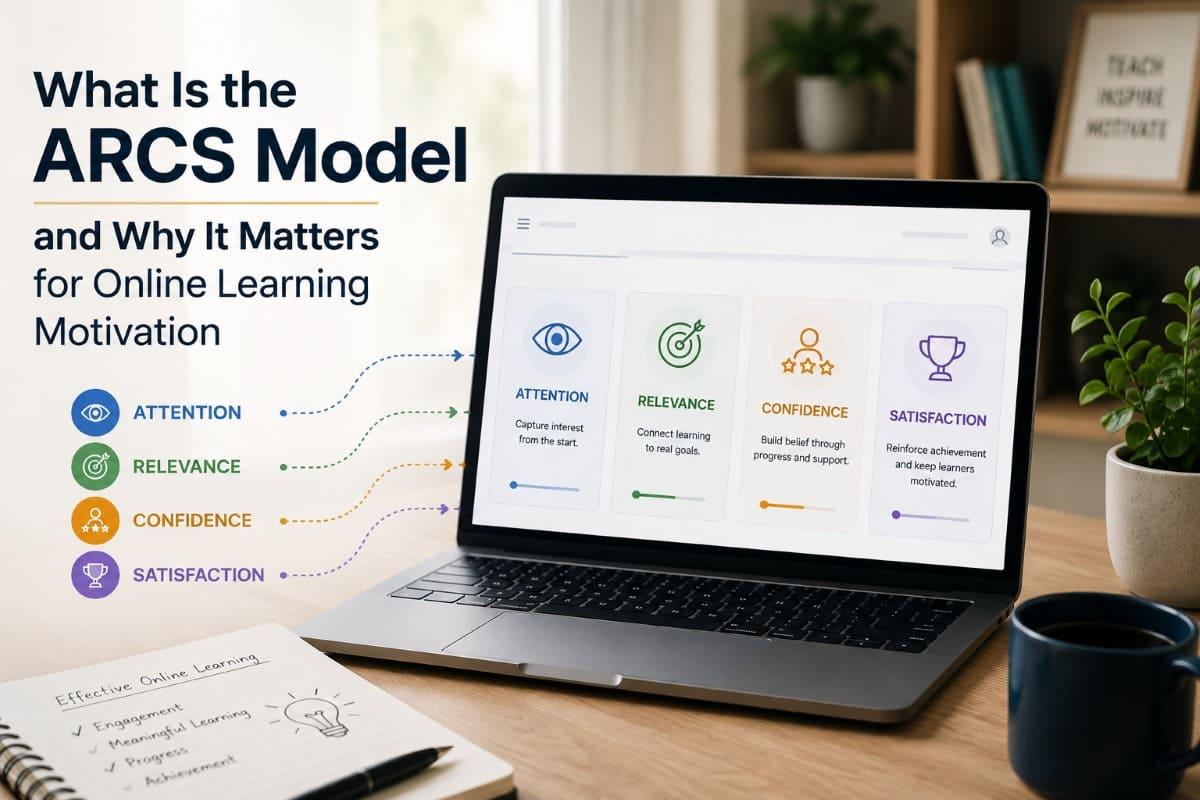
The ARCS Model is a practical framework for designing
learning experiences that support learner motivation through four conditions:
Attention, Relevance, Confidence, and Satisfaction. For online learning teams,
the model is useful because motivation is not only a learner attitude problem.
It is often shaped by course structure, content flow, platform experience,
feedback design, and whether learners can connect lessons to real goals. This
article explains what the ARCS Model is, why it matters for online learning
motivation, and how EdTech teams, program managers, teachers, and trainers can
use it as a strategic lens when designing digital courses, microlearning
programs, and branded learning platforms.
- Quick
Answer
- What
Is the ARCS Model?
- Why
Motivation Often Breaks Down in Online Learning
- The
Four ARCS Elements and What They Mean in Practice
- Why
the ARCS Model Matters for EdTech Teams and Program Managers
- How
ARCS Connects to Microlearning and Learning Platform Strategy
- How
Organizations Can Apply ARCS Without Overcomplicating Course Design
- Common
Misconceptions About ARCS in Online Learning
- FAQ
- Conclusion
Quick Answer
The ARCS Model is a motivational design framework developed
by John M. Keller to help educators and instructional designers create learning
experiences that stimulate and sustain motivation. ARCS stands for Attention,
Relevance, Confidence, and Satisfaction. Each element addresses a different
motivational condition: learners need to notice and stay engaged with the
material, see why it matters, believe they can succeed, and feel that the
learning experience is worthwhile.
For online learning, ARCS matters because digital courses
often fail not only because the content is weak, but because the experience
does not support learner motivation over time. A well-designed online course
should not rely only on attractive videos, badges, or reminders. It needs a
structure that helps learners understand the value of the lesson, build
momentum, receive useful feedback, and connect learning to real outcomes.
For EdTech teams, teachers, trainers, and program managers,
ARCS offers a practical way to evaluate motivation across content design,
learner onboarding, platform features, microlearning flow, assessments, and
completion experience.

What Is the ARCS Model?
The ARCS Model is a motivational design framework that helps
educators, trainers, and instructional designers improve the motivational
quality of learning experiences by addressing Attention, Relevance, Confidence,
and Satisfaction. It is not a content outline, a gamification system, or a
platform feature checklist. It is a way to ask whether the learning experience
gives learners enough reason, clarity, and emotional momentum to continue.
John M. Keller’s official ARCS explanation describes the
model as a problem-solving approach for designing the motivational aspects of
learning environments so they can stimulate and sustain learners’ motivation to
learn. The model has two major parts: a set of motivational categories and a
systematic design process for creating appropriate motivational enhancements. ARCS Model official explanation
That distinction matters. ARCS is not simply a four-word
acronym to decorate an instructional design slide. It asks learning teams to
diagnose where motivation is weak.
A learner may lose motivation because:
- the
lesson does not capture attention;
- the
topic feels disconnected from personal or professional goals;
- the
task feels too difficult or unclear;
- the
learner completes the activity but gains little satisfaction from the
result.
Each of these problems requires a different design response.
For example, adding a badge may not solve a relevance
problem. A learner who does not understand why a compliance module matters to
their job may not become more motivated just because the platform awards
points. Similarly, adding a dramatic opening video may not solve a confidence
problem if the learner still does not know what is expected or how to succeed.
Motivation is not fixed by making lessons louder. It is improved by making the learning experience more meaningful, achievable, and rewarding.
For online learning teams, this is where ARCS becomes
useful. It gives a practical language for reviewing whether a course is merely
available online or genuinely designed for learner engagement.
Why Motivation Often Breaks Down in Online Learning
Online learning motivation often breaks down because
learners have more control over when, where, and whether they continue. In a
classroom, a teacher can notice confusion, adjust the pace, read body language,
or invite participation. In a digital course, many of those signals disappear
unless the learning experience is intentionally designed to support them.
This does not mean online learning is weaker. It means
online learning requires different design discipline.
A learner using a mobile-first course during a lunch break,
after work, or between field assignments has limited attention. They may be
motivated at the beginning but lose momentum if the course feels too abstract,
too long, too repetitive, or too disconnected from the reason they joined.
For program managers, this is a familiar operational
problem. Completion rates, quiz performance, learner feedback, and support
questions often reveal symptoms, but not always the cause. Learners may say a
course is “boring,” but the real issue may be unclear relevance. They may say a
module is “too hard,” but the issue may be weak confidence design. They may
finish the course but never apply the skill because satisfaction was treated as
a certificate download rather than meaningful reinforcement.
In online learning, motivation is partly a content issue,
partly a platform issue, and partly an operational design issue. ARCS helps
teams examine all three together.
This is especially relevant for organizations running online
training at scale. A teacher can personally encourage 20 learners in a live
session. A training provider serving hundreds or thousands of learners needs a
more repeatable system. The platform, content structure, reminders,
assessments, progress indicators, and feedback loops all become part of the
motivational environment.
This is why ARCS is useful for EdTech teams and program
managers. It moves the conversation beyond “How do we make the course more
engaging?” toward a more precise question: “Which motivational condition is
currently missing?”
The Four ARCS Elements and What They Mean in Practice
The four ARCS elements are Attention, Relevance, Confidence,
and Satisfaction. Together, they help learning teams evaluate whether learners
are likely to notice the learning opportunity, care about it, believe they can
complete it, and feel rewarded by the outcome.
|
ARCS Element |
Core Question |
What It Means in Online Learning |
Common Design Risk |
|
Attention |
Does the learner notice and stay mentally engaged? |
Lessons need a clear opening, varied delivery, useful
examples, and manageable pacing. |
Overusing novelty, animation, or dramatic hooks that
distract from learning. |
|
Relevance |
Does the learner understand why this matters? |
Content should connect to real learner goals, roles,
problems, or decisions. |
Assuming the topic is obviously useful without explaining
its practical value. |
|
Confidence |
Does the learner believe success is possible? |
Instructions, progression, feedback, and assessments
should feel clear and achievable. |
Making the course feel difficult without giving enough
scaffolding. |
|
Satisfaction |
Does the learner feel the effort was worthwhile? |
Learners need feedback, visible progress, recognition,
application, or useful next steps. |
Treating completion certificates as the only form of
satisfaction. |
Attention: more than grabbing interest
Attention is the first condition, but it is often
misunderstood. Capturing attention does not mean overwhelming learners with
motion graphics, loud visuals, or constant surprises. In online learning,
attention is usually strongest when the course quickly signals what the learner
is about to solve, why the lesson deserves focus, and how the experience will
stay manageable.
For a microlearning platform, attention may come from a
short scenario, a practical question, a real mistake to avoid, or a clear
problem statement. A three-minute video can still feel long if it opens slowly.
A ten-minute lesson can feel focused if the learner immediately understands the
purpose.
This article will not go deeply into attention tactics
because the cluster includes a dedicated article: How
to Capture Learner Attention Without Making Lessons Feel Distracting.
Relevance: the bridge between content and learner goals
Relevance is the learner’s answer to the question, “Why
should I care?” In professional learning, relevance may come from job
performance, certification needs, business goals, career growth, community
responsibility, or immediate problem-solving.
For teachers and trainers, relevance requires more than
saying, “This is important.” It means using examples, cases, tasks, and
language that reflect the learner’s situation. A course for new business owners
should not explain financial planning in the same way as a course for corporate
finance staff. The concept may be similar, but the relevance pathway is
different.
A separate article in this cluster can explore this more
deeply: How
to Make Learning Feel Relevant to Real Learner Goals.
Confidence: clarity, structure, and achievable progress
Confidence in ARCS is not about giving learners empty
encouragement. It is about designing the learning experience so learners can
understand the requirements, see a path forward, and experience progress.
In online learning, confidence is affected by practical
details:
- whether
the course explains what learners will do;
- whether
modules are sequenced logically;
- whether
quizzes feel aligned with the lesson;
- whether
feedback helps learners correct mistakes;
- whether
the platform makes progress visible;
- whether
learners can return to materials when needed.
For program managers, confidence design matters because
uncertainty can quietly reduce completion. Learners may not drop out because
they dislike the topic. They may leave because they feel lost, behind, or
unsure whether they are doing well.
Satisfaction: making learning feel worth the effort
Satisfaction is the learner’s sense that the effort produced
value. It may come from applying a skill, receiving meaningful feedback,
completing a challenge, earning recognition, unlocking a next step, or seeing
evidence of improvement.
Certificates, badges, and completion screens can support
satisfaction, but they should not replace substance. A learner who completes a
teacher training module should ideally leave with a better lesson plan, clearer
classroom strategy, or improved ability to explain a concept. A creator who
completes a course on digital marketing should leave with a practical asset,
not only a score.

Why the ARCS Model Matters for EdTech Teams and Program Managers
The ARCS Model matters for EdTech teams and program managers
because motivation is often treated too late in the learning design process.
Many teams focus first on content production, platform setup, instructor
recruitment, and launch deadlines. Motivation is addressed only after the
course is already live and the data shows weak completion or low engagement.
That sequence is expensive.
Once a course has been recorded, uploaded, promoted, and
distributed, fixing motivation problems may require changes to scripts, lesson
order, assessments, onboarding, notifications, learning paths, or even the way
the program is positioned. ARCS helps teams ask better questions earlier.
For an EdTech product team, ARCS can inform platform
features. For example, progress tracking supports confidence when it helps
learners see where they are and what remains. Reminders support attention when
they are timely and relevant, but they can become noise if they are too
frequent or generic. Discussion features may support relevance and satisfaction
when learners can exchange real problems, but they may fail if the community
has no facilitation.
For a program manager, ARCS can guide course review. Instead
of only asking whether the content is accurate, the team can ask:
- Does
the course open with a learner-centered reason to continue?
- Do
examples reflect the audience’s real context?
- Does
the course structure help learners believe they can finish?
- Does
the final activity give learners something useful to apply?
- Does
the platform make progress and next steps clear?
For teachers and trainers, ARCS can improve lesson planning
without forcing every lesson into a rigid template. A teacher can use ARCS as a
diagnostic lens: “My learners are present, but are they attentive? They
understand the topic, but do they see its relevance? They completed the task,
but did they feel capable and satisfied?”
ARCS is most useful when teams use it before launch, not
only after engagement problems appear in the dashboard.
This is also why ARCS fits well with structured learning
operations. Motivation is not only created by an inspiring instructor. It is
reinforced by the system around the learner.
FitAcademy
Learn How FitAcademy Supports Better Online Learning Experiences
FitAcademy helps institutions, creators, and training providers deliver branded, mobile-first learning experiences with structured content, progress tracking, learner access, and practical digital learning operations.
Learn More About FitAcademyHow ARCS Connects to Microlearning and Learning Platform Strategy
ARCS connects strongly to microlearning because short
lessons still need motivational structure. A common mistake is assuming that
short content is automatically engaging. It is not. A short video can be
forgettable if it has no clear purpose, weak relevance, confusing instruction,
or no satisfying application.
Microlearning works best when each unit has a focused role
in the learner journey. The lesson should answer a specific need, reduce
cognitive friction, and help learners make visible progress. ARCS gives teams a
way to evaluate whether each microlearning unit is motivationally complete,
even when the content is brief.
For example, a microlearning lesson for new trainers might
be designed like this:
|
Microlearning Design Point |
ARCS Connection |
Practical Example |
|
Opening question |
Attention |
“Why do learners forget your explanation even when they
seem to understand it?” |
|
Real learner scenario |
Relevance |
A trainer struggles to explain a complex topic to
beginners. |
|
Simple step-by-step method |
Confidence |
The lesson gives a three-step explanation structure. |
|
Practice prompt |
Satisfaction |
The learner rewrites one explanation and can use it
immediately. |
This type of structure is more useful than simply cutting a
long lesson into shorter clips. Shorter content reduces time demand, but ARCS
improves the motivational logic inside the learning experience.
For platform strategy, ARCS also helps clarify what a
learning platform should support. A branded learning platform is not only a
place to host videos. It should help organizations create a coherent learning
journey, communicate value, structure progress, support feedback, and maintain
the learner relationship.
This matters for institutions, training providers, and
creator-led education businesses. If they rely only on third-party content
marketplaces or fragmented tools, they may have less control over onboarding,
learner data, engagement patterns, branding, and follow-up learning pathways.
A white-label learning platform can support ARCS more
effectively when the organization wants to design the full learner experience
around its own audience, brand, learning goals, and operational workflow. That
does not mean every organization needs a white-label system immediately.
Smaller teams may start with simpler tools. But when the learning program
becomes strategic, platform ownership becomes more relevant.
Short lessons reduce friction. Motivational design gives those short lessons a reason to matter.

How Organizations Can Apply ARCS Without Overcomplicating Course Design
Organizations can apply ARCS by using it as a review lens
during course planning, not as a complicated theory document for every lesson.
The goal is not to force teachers or trainers to fill out lengthy forms. The
goal is to help learning teams make better design decisions before learners
experience the course.
A practical ARCS workflow can be simple.
1. Define the learner’s real context
Before writing scripts or recording videos, identify who the
learners are and what situation they bring into the course. Are they beginners,
professionals, volunteers, teachers, field workers, entrepreneurs, or members
of a community program? What pressure, goal, or problem makes the learning
relevant?
Without this, teams often create content that is technically
correct but emotionally distant.
2. Identify the likely motivation barrier
Not every course has the same motivation problem. A
mandatory compliance course may struggle with relevance. A technical skills
course may struggle with confidence. A broad awareness course may struggle with
attention. A course that ends without application may struggle with
satisfaction.
The better question is not “How do we make this more
engaging?” but “Which ARCS condition is most at risk?”
3. Design one or two targeted improvements
Motivational design does not need to be excessive. A short
course may only need a stronger opening scenario, clearer learner benefit,
better progress structure, or more useful closing activity.
For example:
- If
attention is weak, start with a real problem or decision.
- If
relevance is weak, connect the lesson to the learner’s role or goal.
- If
confidence is weak, clarify steps, criteria, and examples.
- If
satisfaction is weak, end with application, feedback, or recognition.
4. Connect motivation to platform features
This is where EdTech teams need to be careful. Platform
features should support learning motivation, not distract from it.
Progress tracking can support confidence. Certificates can
support satisfaction. Push notifications can support attention. Personalized
pathways can support relevance. Learning analytics can help program managers
identify where motivation drops.
But none of these features work automatically. A progress
bar attached to a poorly structured course does not fix the course. A
certificate attached to shallow learning may give short-term satisfaction but
weak long-term value.
The strongest platform features are not the most decorative
ones. They are the ones that support the learner’s next meaningful action.
Common Misconceptions About ARCS in Online Learning
The ARCS Model is simple to understand, but it is easy to
apply superficially. For online learning teams, the risk is not
misunderstanding the acronym. The risk is treating each element as a checklist
item rather than a design condition.
Misconception 1: Attention means entertainment
Attention is not the same as entertainment. A lesson can be
visually active but mentally shallow. Learners may watch but not process. Good
attention design helps learners focus on what matters.
In an online course, this might mean opening with a strong
practical question, showing a realistic mistake, or presenting a clear learning
challenge. It does not always mean adding more animation, music, or dramatic
editing.
Misconception 2: Relevance is obvious if the topic is useful
Many education teams assume learners will automatically
understand why a topic matters. This is rarely safe. A topic may be important
from the organization’s perspective but unclear from the learner’s perspective.
For example, a training provider may know that reflective
practice is important for teachers. But a busy teacher may care more about
tomorrow’s classroom problem: explaining a difficult concept, managing mixed
learner abilities, or designing a better activity. Relevance improves when the
course connects the concept to that practical reality.
Misconception 3: Confidence means making lessons easy
Confidence does not mean lowering standards. It means making
success understandable and achievable. Learners can handle challenge when
expectations are clear, support is available, and progress feels possible.
In fact, making lessons too easy can reduce satisfaction. A
course that feels too basic may not respect the learner’s capability. Good
confidence design balances challenge with clarity.
Misconception 4: Satisfaction is only about rewards
Rewards can support satisfaction, but satisfaction is
broader than rewards. Learners may feel satisfied because they solved a
problem, produced useful work, received meaningful feedback, or recognized
their own improvement.
For professional learning, practical application is often
more powerful than a decorative reward. A certificate may matter, but the
learner should also feel that the course helped them do something better.
Misconception 5: ARCS replaces instructional design
ARCS does not replace learning objectives, content
sequencing, assessment design, or instructional strategy. It complements them.
A course can be motivationally appealing but educationally weak if it lacks
sound learning design. Conversely, a course can be instructionally accurate but
motivationally weak if learners do not see value or progress.
For teams building scalable online programs, both are
needed: instructional quality and motivational design.

FAQ
What does ARCS stand for in learning design?
ARCS stands for Attention, Relevance, Confidence, and
Satisfaction. These four elements describe motivational conditions that
influence whether learners notice the lesson, understand its value, believe
they can succeed, and feel the learning experience was worthwhile. In online
learning, ARCS is useful because it helps teams diagnose why learners may
disengage even when the course content is accurate.
Is the ARCS Model only for online learning?
No. The ARCS Model can be applied to classroom learning,
corporate training, adult education, and online learning. It is especially
useful in digital learning because online learners often need more intentional
support to stay focused, see relevance, understand progress, and complete the
learning journey without continuous instructor presence.
How is ARCS different from gamification?
ARCS is a motivational design framework, while gamification
uses game-like elements such as points, badges, levels, and leaderboards. They
can overlap, but they are not the same. Gamification may support motivation
when used well, but ARCS helps teams understand the deeper motivational
condition that needs support. This difference is explored further in ARCS
vs Gamification: Which Better Supports Learner Motivation?
Can ARCS improve course completion rates?
ARCS can help improve the motivational quality of a course,
which may support completion when implemented well. However, it should not be
treated as a guaranteed completion-rate solution. Completion also depends on
learner context, course difficulty, time availability, platform usability,
program requirements, support systems, and whether the learning goal is
meaningful to the audience.
Who should use the ARCS Model?
The ARCS Model is useful for instructional designers, EdTech
teams, teachers, trainers, corporate learning teams, program managers, and
training providers. It is especially helpful for teams that need to design
repeatable online learning experiences where motivation cannot depend only on
live instructor energy or one-to-one encouragement.
Does ARCS work with microlearning?
Yes, ARCS can work well with microlearning because short
lessons still need motivational quality. A microlearning unit should capture
attention quickly, connect to a real need, feel achievable, and end with a
useful sense of progress or application. Without those conditions, short
content may be easy to consume but easy to forget.
Conclusion
The ARCS Model matters because it gives online learning
teams a practical way to think about motivation before learners disengage. It
reminds educators, trainers, and program managers that motivation is not only a
personality trait or a learner responsibility. It is shaped by how the learning
experience is designed.
For online learning, this is especially important. Learners
may be studying on mobile devices, outside formal classrooms, across different
schedules, and with varying levels of confidence. A course that captures
attention but lacks relevance may still fail. A course that feels relevant but
too difficult may lose learners halfway. A course that is completed without
satisfaction may produce weak long-term engagement.
ARCS helps teams examine these issues with more precision.
For organizations building digital courses, microlearning
programs, or branded learning platforms, the model offers a useful strategic
lens. It does not replace instructional design, learning objectives, or
platform operations. But it helps connect them to the motivational experience
of the learner.
A stronger online learning ecosystem is not built only by
uploading more content. It is built by designing learning experiences that
learners can notice, value, complete, and use.
FitAcademy
Build Learning Experiences That Learners Can Actually Follow
FitAcademy supports institutions, creators, and training providers with a branded, mobile-first learning platform for structured online courses, microlearning delivery, learner progress, and scalable education programs.
Learn More About FitAcademy