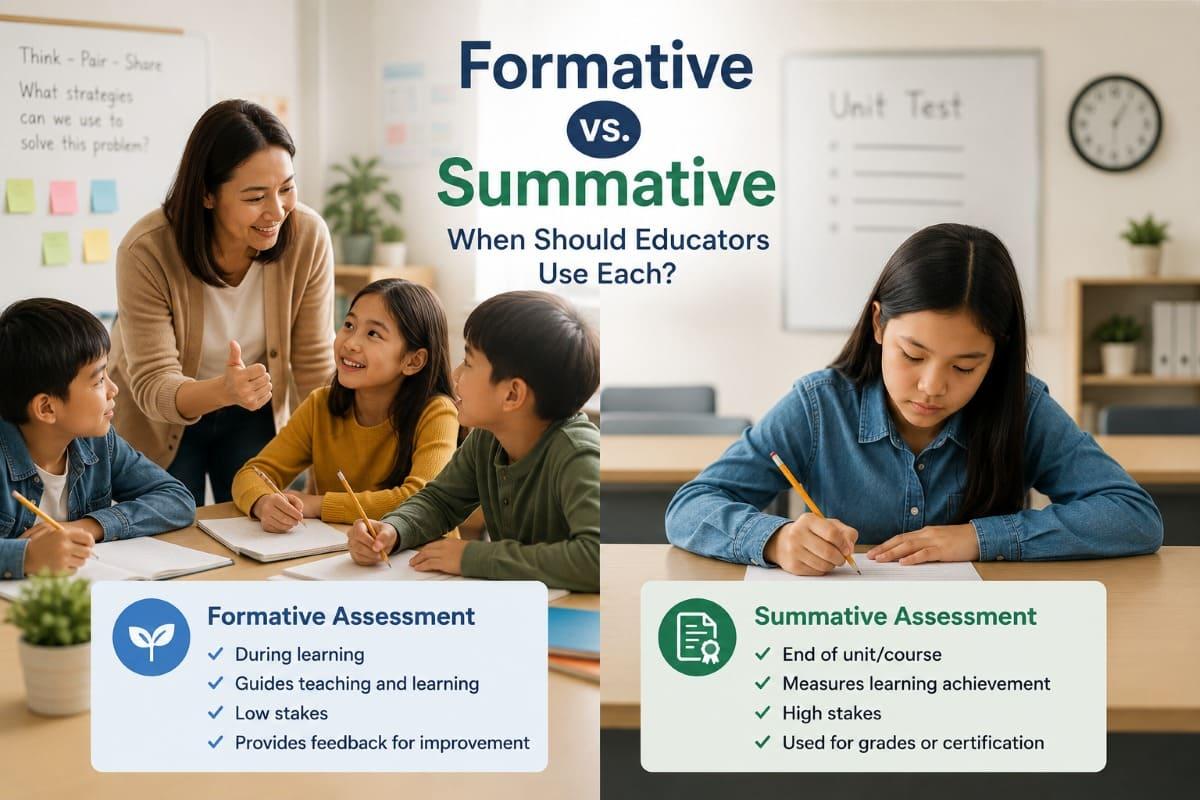
Formative and summative assessment serve different purposes
in learning design. Formative assessment helps educators understand learner
progress during instruction, while summative assessment evaluates achievement
after a learning unit, course, or program. For teachers, trainers, and
institutions, the distinction matters because assessment decisions affect
feedback, pacing, certification, reporting, and learning program quality. This
article explains the difference between formative and summative assessment,
when each should be used, how they work in online and blended learning
environments, and how institutions can combine both without turning assessment
into a burden for learners or educators.
- Quick
Answer
- What
Is Formative Assessment?
- What
Is Summative Assessment?
- Formative
vs Summative Assessment: The Practical Difference
- When
Should Educators Use Formative Assessment?
- When
Should Educators Use Summative Assessment?
- How
Online Learning Platforms Support Both Assessment Types
- Common
Mistakes When Using Formative and Summative Assessment
- Practical
Framework: How to Combine Both in One Learning Program
- FAQ
- Conclusion
Quick Answer
Formative assessment is used during learning to identify
what learners understand, where they are struggling, and what support they need
next. Summative assessment is used after a lesson, module, course, or program
to evaluate what learners have achieved against a standard, objective, or
expected outcome.
Educators should use formative assessment when the goal is
to guide learning while there is still time to improve. This may include short
quizzes, practice tasks, discussion prompts, polls, self-checks, draft
submissions, peer review, or teacher observations. They should use summative
assessment when the goal is to make a final judgment, such as assigning a
grade, awarding a certificate, confirming competency, or reporting program
results.
The two are not competitors. A strong learning program
usually needs both. Formative assessment improves learning while it is
happening. Summative assessment confirms what has been learned at the end. For
institutions and training providers, the key is to design assessment
intentionally, so each activity has a clear purpose and does not become
unnecessary testing.
Formative assessment guides the journey. Summative assessment confirms the destination.
What Is Formative Assessment?
Formative assessment is assessment used during the learning
process to help educators and learners understand progress and decide what
should happen next.
OECD describes formative assessment as frequent assessment
of learner progress used to identify learning needs and shape teaching. OECD
formative assessment
In practical terms, formative assessment is not mainly about
grading. It is about adjustment. A teacher may use a short quiz to see whether
students are ready for the next topic. A trainer may review practice responses
before moving into a more advanced scenario. An online course creator may add a
reflective question after a microlearning lesson to check whether learners
understand the key idea.
The assessment can be simple. It may be a question at the
end of a video, a quick poll, a short written response, a discussion reply, or
a practice task. What makes it formative is not the format. It is how the
result is used.
If the result helps the educator change explanation, pacing,
feedback, grouping, or next activity, the assessment is functioning
formatively.

Formative assessment is valuable because it protects
educators from teaching blindly. It shows what learners need before the course
has already moved on.
For institutions, formative assessment is especially useful
in programs where learners come from different backgrounds. In teacher
training, workforce development, community education, or professional
upskilling, learners may not start at the same level. A formative check helps
identify gaps early.
In mobile-first or microlearning environments, formative
assessment can be built into the learning flow. A short lesson may be followed
by one scenario question, a self-check, or a simple reflection prompt. The goal
is not to interrupt learning. The goal is to keep learning responsive.
What Is Summative Assessment?
Summative assessment is assessment used at the end of an
instructional unit, course, module, or program to evaluate learner achievement
against a standard, benchmark, or expected outcome.
Carnegie Mellon University’s Eberly Center explains that
summative assessment evaluates student learning at the end of an instructional
unit by comparing it against a standard or benchmark. Carnegie
Mellon University Eberly Center on formative and summative assessment
In practice, summative assessment may include:
- final
exams
- end-of-module
tests
- final
projects
- competency
demonstrations
- certification
assessments
- performance
portfolios
- graded
presentations
- capstone
assignments
Summative assessment usually carries more consequence than
formative assessment. It may affect grades, completion status, certification,
promotion, program reporting, or institutional evaluation.
This does not mean summative assessment must always be
stressful or rigid. A well-designed final project, for example, may be more
meaningful than a long multiple-choice test if the learning goal requires
performance, judgment, or creation.
The key question is: what evidence is needed to confirm that
the learner has achieved the intended outcome?
For a compliance course, that evidence may be a scored test.
For a teacher training program, it may be a lesson plan and teaching
demonstration. For a creator education program, it may be a published learning
module. For a workplace training program, it may be a supervisor-reviewed task.
The format matters less than the evidence it produces.
Formative vs Summative Assessment: The Practical Difference
The practical difference is timing, purpose, stakes, and how
the result is used.
Formative assessment happens while learning is still in
progress. It helps educators and learners make improvements. Summative
assessment happens after a defined learning period. It evaluates whether the
intended learning outcome has been achieved.
|
Aspect |
Formative Assessment |
Summative Assessment |
|
Main purpose |
Improve learning during the process |
Evaluate learning after instruction |
|
Timing |
Before or during a lesson, module, or course |
At the end of a unit, course, or program |
|
Stakes |
Usually low or no stakes |
Often medium or high stakes |
|
Examples |
Short quiz, draft, poll, discussion, practice task,
self-check |
Final exam, graded project, certificate test, competency
assessment |
|
Main user of results |
Learners and educators |
Learners, educators, institutions, employers, certifiers |
|
Best question to ask |
What support is needed next? |
What has the learner achieved? |
|
Risk if misused |
Too many checks can interrupt learning |
High-stakes judgment may miss learning process details |
The same activity can sometimes be used in both ways,
depending on how the result is interpreted.
A quiz after a lesson can be formative if the educator uses
the results to reteach a concept, adjust the next activity, or give targeted
feedback. The same quiz can become summative if it is used as a final score for
completion or certification.
This is why educators should not define assessment only by
format. A quiz is not automatically formative. A project is not automatically
summative. The purpose and use of evidence determine the role.

When Should Educators Use Formative Assessment?
Educators should use formative assessment when they need
evidence that can still improve learning.
This is most useful before learners reach a final evaluation
point. If learners are struggling, formative assessment gives educators time to
respond. If learners are progressing well, it confirms that the course can move
forward.
Formative assessment works especially well in these
situations:
- before
introducing a difficult topic
- after
a short lesson or microlearning video
- during
practice activities
- before
a graded assessment
- when
learners show different levels of readiness
- when
instructors need to identify misconceptions
- when
course creators want to improve content clarity
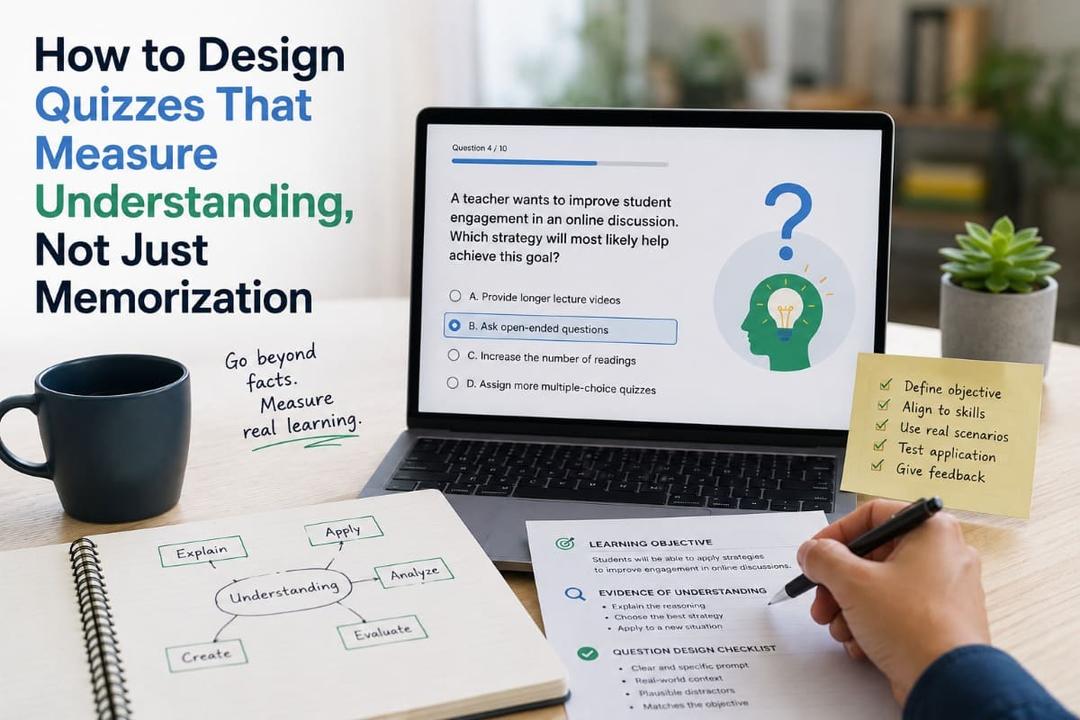
For example, in an online teacher training program, learners
may watch a short lesson about designing better quiz questions. A formative
assessment might ask them to identify which question measures understanding
rather than memorization. This connects naturally to how
to design quizzes that measure understanding, not just memorization.
The educator can then review responses. If many learners
choose the wrong option, the platform or instructor can provide a short
explanation, recommend a supporting lesson, or revise the original content.
That is formative assessment at work.
Formative assessment should be frequent, but not excessive
Frequent checks can help, but too many checks can make
learning feel fragmented. This is a common problem in online courses where
every short video is followed by several repetitive questions.
A better approach is to use light but purposeful checks. One
strong question may be more useful than five shallow ones.
For mobile-first learning, the assessment should respect
learner attention. A quick scenario question, a confidence check, or a
practical reflection may work better than a long test after every lesson.
Good formative assessment feels like part of learning, not
an interruption from learning.
Formative assessment should lead to action
A formative check without follow-up has limited value.
If a teacher asks learners to complete a practice task but
never reviews the patterns, learners may not benefit. If a training platform
collects quiz data but the institution never uses it to improve content, the
data becomes decorative.
Useful follow-up may include:
- clarifying
a concept
- giving
immediate feedback
- adjusting
the next lesson
- recommending
additional practice
- opening
a discussion
- revising
a weak learning material
- identifying
learners who need support
This is where formative assessment connects closely with
feedback. The next article in this cluster, how
to give feedback that helps learners improve, explores that connection in
more detail.
FitAcademy
Learn How Assessment Can Improve the Learning Experience
FitAcademy helps teachers, trainers, and institutions create structured online learning experiences with quizzes, learner progress tracking, and feedback-friendly workflows.
Learn More About FitAcademyWhen Should Educators Use Summative Assessment?
Educators should use summative assessment when they need to
evaluate achievement at the end of a defined learning experience.
This is appropriate when a course, module, training cycle,
or learning pathway has reached a conclusion and the organization needs
evidence of completion, readiness, mastery, or performance.
Summative assessment is especially useful when:
- learners
need a final grade
- a
certificate depends on achievement
- an
institution must report program outcomes
- a
trainer needs to confirm workplace readiness
- a
course has required learning standards
- learners
must demonstrate final performance
- stakeholders
need evidence that the program worked
For example, a workforce training program may use formative
assessments during the course to support learners. At the end, it may use a
final scenario-based test or workplace task to confirm whether learners can
apply the required procedure.
In a creator-led course, the summative assessment might be a
final project. In a teacher training program, it might be a lesson plan,
recorded teaching practice, or final reflection supported by a rubric.
Summative assessment is not only about exams. It is about
final evidence.
Summative assessment should match the real outcome
A common mistake is using a written test to assess a
performance-based skill. If the outcome requires learners to teach,
communicate, solve, design, operate, facilitate, or create, then the final
assessment should capture that performance as closely as possible.
A multiple-choice test may confirm some knowledge, but it
may not prove that learners can perform a task.
For example:
- A
facilitation course may need a recorded facilitation task.
- A
course design program may need a completed course outline.
- A
customer service training may need scenario responses.
- A
digital skills course may need a completed practical assignment.
- A
leadership program may need a decision-making case.
This does not mean every summative assessment must be
complex. It means the evidence should fit the claim being made.
If the certificate says learners can do something, the
assessment should show that they can.

Summative assessment should be fair and transparent
Because summative assessment often carries consequences,
learners should understand what is expected before the final evaluation.
This means educators should provide:
- clear
criteria
- aligned
practice activities
- examples
when appropriate
- rubrics
for performance tasks
- reasonable
time and access conditions
- feedback
opportunities before final submission
A final assessment should not test something learners never
had the opportunity to practice.
For institutions, this is both a learning quality issue and
a trust issue. Learners are more likely to accept assessment results when
expectations are clear and the assessment feels aligned with the course.
How Online Learning Platforms Support Both Assessment Types
Online learning platforms support formative and summative
assessment when they make assessment easier to design, deliver, review, and
improve.
In a traditional classroom or offline training environment,
many assessment decisions happen informally. A teacher sees confused faces,
hears questions, checks notebooks, or observes practice. In online learning,
those signals are less visible unless the platform is designed to capture them.
A well-structured learning platform can support formative
assessment through:
- short
quizzes after lessons
- instant
feedback
- discussion
prompts
- progress
checks
- learner
reflection questions
- instructor
review tools
- analytics
on incorrect answers
- reminders
for incomplete learning activities
It can support summative assessment through:
- final
tests
- project
submission
- rubric-based
evaluation
- completion
tracking
- certificate
logic
- cohort
reporting
- learner
performance records
UNESCO describes learning assessment as a way to understand,
measure, and improve education quality and equity at a system level. UNESCO learning
assessment. In institutional online learning, the same principle applies
operationally: assessment data should help teams understand what is happening
and improve the learning experience.
For FitAcademy’s mobile-first and microlearning context,
this distinction is important. A short lesson may use a formative check to
guide the learner immediately. A full course or pathway may use a summative
assessment to confirm completion or readiness.
A learning platform becomes more valuable when assessment
data is connected to action: feedback, revision, learner support, and program
improvement.
This is also why assessment should not be separated from
learning operations. Institutions need to know who has completed learning, who
is struggling, what content needs improvement, and whether the final outcomes
are credible.
A branded learning platform gives organizations more control
over this process than a scattered mix of videos, forms, spreadsheets, and chat
messages.
Common Mistakes When Using Formative and Summative Assessment
Most assessment mistakes happen when educators use the right
tool for the wrong purpose.
A formative quiz can become unhelpful when it is treated
like a final judgment. A summative test can become unfair when learners were
never given formative opportunities to practice and improve.
Mistake 1: Treating every quiz as a grade
When every quiz affects the final score, learners may focus
on avoiding mistakes instead of learning from them. This can reduce
experimentation, honest self-assessment, and willingness to engage with
difficult material.
Some quizzes should be low-stakes. They should help learners
see where they are, not punish them for still learning.
Mistake 2: Using summative assessment too early
A final judgment should come after instruction, practice,
and feedback. If learners are assessed summatively before they have had enough
support, the result may reflect poor learning design rather than learner
ability.
This is especially risky in short training programs where
institutions want quick completion. Speed should not remove the learner’s
opportunity to practice.
Mistake 3: Collecting formative data but not using it
A platform may show that many learners failed a question,
but the educator or institution must still act. Data alone does not improve
learning.
If assessment data is ignored, learners may repeat the same
misunderstanding. Course creators may continue using unclear explanations.
Institutions may miss early warning signs.
This topic connects with how
to improve a learning program using learner feedback and performance data.
Mistake 4: Choosing assessment formats based only on convenience
Automated quizzes are efficient, but not every learning
outcome can be measured well with automated questions. Open responses,
projects, peer review, instructor feedback, or performance tasks may be needed
when the outcome involves judgment, creation, or behavior.
The practical solution is not to reject automation. It is to
use automation where it fits and add human review where it matters most.
Practical Framework: How to Combine Both in One Learning Program
A strong learning program usually combines formative and
summative assessment across the learner journey.
The simplest framework is:
|
Learning Stage |
Assessment Type |
Purpose |
Example |
|
Before learning |
Diagnostic or light formative check |
Understand readiness |
Short pre-question or self-assessment |
|
During lesson |
Formative assessment |
Check understanding |
Poll, quiz, scenario question |
|
During practice |
Formative assessment |
Guide improvement |
Draft task, peer review, instructor note |
|
Before completion |
Formative review |
Prepare for final assessment |
Practice test or rubric self-check |
|
End of module/course |
Summative assessment |
Evaluate achievement |
Final test, project, case response, performance task |
|
After completion |
Program review |
Improve future learning design |
Analyze results and learner feedback |

For a teacher training program, the structure might look
like this:
A short pre-check identifies whether participants understand
basic assessment terms. After each microlearning lesson, learners answer a
scenario-based question. During practice, they revise weak quiz questions.
Before the final task, they review a rubric. At the end, they submit a short
assessment plan for a real lesson.
The formative assessments help them improve. The summative
assessment confirms what they can produce.
For a workplace training program, the structure may be
different. Learners may complete short knowledge checks during modules,
practice through workplace scenarios, and finish with a final competency task.
The institution may use the final score for reporting, while using formative
data to improve future training.
For an online creator education business, formative
assessment can keep learners engaged and supported throughout the course.
Summative assessment can give the course stronger credibility, especially if
the creator offers completion certificates or advanced learning pathways.
The main principle stays the same: formative assessment
should improve the path; summative assessment should verify the outcome.
FAQ
What is the simplest difference between formative and summative assessment?
Formative assessment happens during learning and is used to
improve learning. Summative assessment happens after instruction and is used to
evaluate achievement. A short quiz can be formative if the results guide
feedback or reteaching. A final test, project, or certificate assessment is
summative when it confirms what learners have achieved.
Can the same quiz be both formative and summative?
Yes, the same quiz can function differently depending on how
the results are used. If the quiz helps learners identify gaps and improve
before the final evaluation, it is formative. If the quiz determines a final
score, completion status, or certificate eligibility, it is summative. Purpose
matters more than format.
Should online courses include both formative and summative assessment?
Most structured online courses benefit from both. Formative
assessment helps learners stay on track during the course, while summative
assessment confirms achievement at the end. The balance depends on course
length, learning goals, stakes, learner profile, and whether the program offers
certificates, grades, or professional outcomes.
Is formative assessment always ungraded?
Formative assessment is often low-stakes or ungraded, but it
can still carry small participation marks or completion credit. The important
point is that learners should be able to use the result to improve. If the
result only judges final performance, the assessment is no longer functioning
primarily as formative.
Why is summative assessment important for institutions?
Summative assessment helps institutions confirm whether
learners met expected outcomes. It supports grading, certification, reporting,
accountability, and program evaluation. However, summative assessment should be
aligned with learning objectives and supported by formative opportunities, so
the final result reflects learning rather than surprise or poor preparation.
What happens when a course uses only summative assessment?
When a course uses only summative assessment, learners may
not discover misunderstandings until it is too late to improve. Educators also
lose opportunities to adjust instruction during the course. This can make final
results less useful because they show who passed or failed, but not where the
learning process broke down.
Conclusion
Formative and summative assessment answer different
questions.
Formative assessment asks: what do learners need now?
Summative assessment asks: what have learners achieved?
Both questions matter. A learning program that only uses
formative assessment may support improvement but lack final evidence. A program
that only uses summative assessment may produce scores but miss the learning
needs that appeared along the way.
For teachers, trainers, and institutions, the practical goal
is not to choose one assessment type over the other. It is to use each at the
right moment.
In online and mobile-first learning environments, this
requires intentional design. Short checks, scenario questions, practice tasks,
feedback moments, final projects, and completion assessments should work
together. When assessment is connected to learning objectives, platform data,
feedback, and program improvement, it becomes more than a reporting tool.
It becomes part of the learning system itself.
FitAcademy
Build Better Learning Journeys With Meaningful Assessment
FitAcademy helps institutions, trainers, and education creators deliver mobile-first learning programs with structured lessons, quizzes, learner progress, and assessment workflows that support better learning decisions.
Learn More About FitAcademy