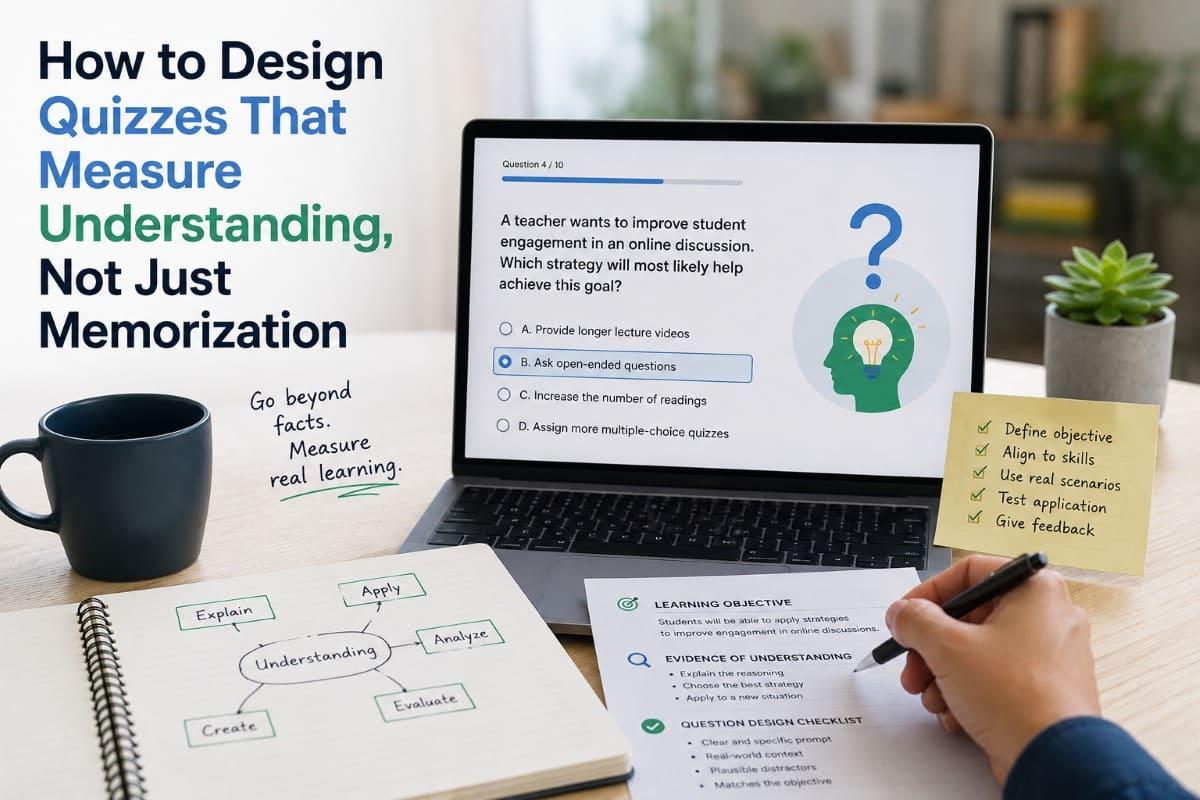
A good quiz should do more than check whether learners can
remember words, facts, or definitions. It should reveal whether they can
explain ideas, apply concepts, recognize errors, make decisions, and connect
learning to realistic situations. For teachers, trainers, and institutions,
this matters because quiz design affects the quality of learning evidence. A
high score may look encouraging, but it can be misleading if the questions only
test surface recall. This article explains how to design quizzes that measure
understanding, how to align questions with learning objectives, how to choose
better question formats, and how digital learning platforms can support more
meaningful assessment at scale.
- Quick
Answer
- Why
Understanding Should Be the Real Target of a Quiz
- What
Makes a Quiz Measure Understanding?
- How
to Design Quiz Questions That Reveal Thinking
- Choosing
the Right Quiz Format for the Learning Goal
- How
Digital Learning Platforms Can Make Quizzes More Useful
- Common
Quiz Design Mistakes That Weaken Learning Evidence
- Practical
Workflow: Building a Quiz From Learning Objectives
- FAQ
- Conclusion
Quick Answer
A quiz measures understanding when it asks learners to use
knowledge, not only repeat it. Instead of asking learners to recall isolated
facts, a well-designed quiz asks them to explain meaning, choose the best
action in a scenario, interpret an example, identify a misconception, compare
options, or apply a concept to a realistic problem.
This matters for teachers, trainers, and institutions
because quiz results often influence instructional decisions. If a quiz only
measures memorization, educators may assume learners are ready to move forward
when they still cannot use the material in practice. In online training, this
risk is even greater because quiz scores may become one of the few visible
signals of learner progress.
A better quiz starts with clear learning objectives, then
matches each question to the type of thinking the learner should demonstrate.
Multiple-choice questions can measure understanding when they include plausible
distractors and scenario-based reasoning. Short-answer, matching, sequencing,
and case-based questions can also be useful when they are designed with a clear
purpose.
A quiz is only useful when the answer tells educators something worth acting on.
Why Understanding Should Be the Real Target of a Quiz
Quizzes are often treated as small checkpoints: learners
watch a lesson, answer several questions, and receive a score. That structure
is familiar, but it does not automatically produce meaningful evidence of
learning.
A quiz can be easy to administer but weak as an assessment
tool. For example, a learner may remember that “formative assessment is used
during learning” without understanding how a teacher should respond when many
learners answer incorrectly. Another learner may memorize the definition of
active learning but still fail to identify what active learning looks like in a
real classroom or training session.
Understanding is different from recognition. Recognition
asks, “Have you seen this before?” Understanding asks, “Can you use this idea
correctly when the situation changes?”
Educational organizations such as the OECD describe
formative assessment as frequent assessment of learner progress used to
identify learning needs and shape teaching. That framing is useful because it
reminds educators that assessment should inform action, not simply produce
scores. OECD
formative assessment
For institutions and training providers, this has
operational consequences. If quizzes are poorly designed, learner dashboards
may look more positive than the actual learning outcomes. Completion rates may
rise, certificates may be issued, and reports may appear clean, while learners
still struggle to apply the material.

The most important quiz design question is not “How many
questions should we ask?” but “What kind of learner thinking should the answer
reveal?”
In a branded learning platform or microlearning environment,
quizzes often appear after short lessons. This can be powerful, but only when
the quiz is aligned with the lesson’s purpose. A three-minute lesson does not
need a long test. It does need a precise check that shows whether the learner
has grasped the key idea well enough to continue.
That is where many online learning programs fall short. They
create quizzes as a content requirement rather than as a learning decision
tool.
What Makes a Quiz Measure Understanding?
A quiz measures understanding when the learner must process
meaning, not simply retrieve a phrase from memory.
A simple definition can help: an understanding-based quiz is
an assessment activity that asks learners to interpret, apply, explain,
compare, diagnose, or transfer knowledge in order to show whether they can use
what they learned in a meaningful context.
This does not mean every quiz question must be difficult. It
means every question should have a clear cognitive purpose.
Carnegie Mellon University’s Eberly Center explains Bloom’s
Taxonomy as a way to distinguish levels of cognitive complexity, moving from
simpler forms of knowledge toward more complex intellectual activity. Carnegie
Mellon University Eberly Center on Bloom’s Taxonomy
For quiz design, that distinction is practical. A question
that asks learners to define a concept may be appropriate at the beginning of a
course. But if the learning objective says learners should be able to apply,
evaluate, or troubleshoot, the quiz must ask for more than recall.
|
Quiz Design Element |
Memorization-Based Quiz |
Understanding-Based Quiz |
|
Main purpose |
Check whether learners remember information |
Check whether learners can use information correctly |
|
Typical question style |
Definition, label, fact, date, term |
Scenario, comparison, explanation, application,
misconception |
|
Learner thinking required |
Recall or recognition |
Interpretation, reasoning, decision-making, transfer |
|
Risk |
High scores may hide shallow learning |
Takes more planning but gives better evidence |
|
Best use |
Early exposure, vocabulary, basic facts |
Skill development, concept mastery, workplace readiness |
A memorization-based question is not always bad. Some
knowledge must be remembered. A language learner needs vocabulary. A health
worker may need to remember safety steps. A new employee may need to know
company procedures.
The issue is balance.
If the entire quiz only checks recall, it cannot tell
whether learners can make sense of the material. A stronger quiz may begin with
one recall question, then move into application or interpretation. This mirrors
how learners often build competence: first they recognize the concept, then
they use it.
How to Design Quiz Questions That Reveal Thinking
A quiz question reveals thinking when the wrong answers are
informative.
In a weak multiple-choice question, the incorrect options
are obviously wrong. Learners can often guess the answer by eliminating silly
choices. In a stronger question, each distractor represents a realistic
misconception, incomplete understanding, or common decision error.
Consider this basic question:
“What is feedback?”
A learner may select the correct definition without knowing
how to give useful feedback. A more meaningful version would be:
“A learner submits a practice task with several errors.
Which response would most help the learner improve?”
This second question requires judgment. The learner must
understand that feedback should be specific, actionable, and connected to
improvement. It also prepares the learner for the next article in the cluster, how
to give feedback that helps learners improve.
Use scenarios to test application
Scenario-based questions are especially useful in teacher
training, corporate learning, professional development, compliance training,
and creator-led education. They place the learner inside a realistic situation.
For example:
- A
trainer must choose the best follow-up after learners fail a quiz.
- A
teacher must identify why students misunderstand a concept.
- A
course creator must decide whether a question measures recall or
application.
- A
manager must interpret performance data from an online training dashboard.
These scenarios do not need to be long. In microlearning, a
scenario may be only two or three sentences. The point is to make the learner
use the idea, not search memory for a phrase.
Ask learners to choose the best answer, not just the correct answer
In real learning situations, especially professional and
institutional training, the challenge is often not identifying one obvious
answer. It is choosing the most appropriate response under specific conditions.
A question that asks for the “best next step” can reveal
whether the learner understands priority, context, and consequence.
For example:
A trainer notices that 70% of learners answered the same
question incorrectly. What should the trainer do first?
A. Ignore the result because most learners passed the course
B. Repeat the same quiz until the score improves
C. Review the lesson explanation and clarify the concept before moving on
D. Remove the question from the quiz permanently
The correct answer is not just a fact. It reflects an
assessment decision.
Good distractors are not random wrong answers. They are small windows into learner misunderstanding.
Include questions that diagnose misconceptions
Misconception-based questions are valuable because they help
educators see what learners are getting wrong and why.
For example, in a course about assessment, learners may
believe that a quiz is formative simply because it is short. A diagnostic
question can test that misunderstanding:
“Which situation best represents formative assessment?”
The answer choices can include:
- a
final exam used for certification
- a
short quiz used to adjust the next lesson
- a
survey asking whether learners liked the course
- a
certificate issued after course completion
This helps separate learners who remember the term from
learners who understand its purpose. The distinction also connects naturally to
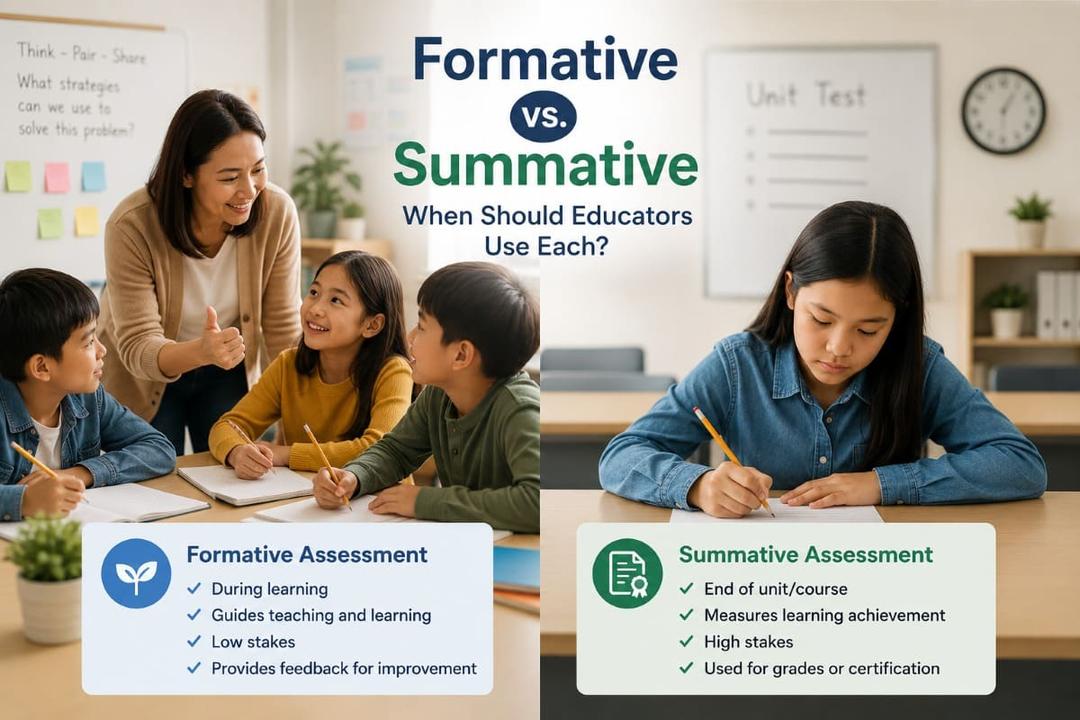
the broader cluster article Formative
vs Summative Assessment: When Should Educators Use Each?.
Choosing the Right Quiz Format for the Learning Goal
The best quiz format depends on what the learner is expected
to demonstrate.
Multiple-choice questions are efficient, scalable, and easy
to grade automatically. They work well for online courses, mobile learning,
institutional training, and large cohorts. But they must be designed carefully.
A multiple-choice question can measure understanding only when it asks learners
to interpret, apply, compare, or diagnose.
Short-answer questions can reveal reasoning more directly,
but they require clearer rubrics and more effort to review. Matching questions
may work well for relationships between terms and examples. Sequencing
questions are useful when learners must understand process order, such as
safety procedures, instructional design steps, or customer service workflows.
Carnegie Mellon’s guidance on creating exams emphasizes that
effective exams should align with course objectives and accurately gauge
student learning. Carnegie
Mellon University Eberly Center on creating exams
|
Learning Goal |
Useful Quiz Format |
Why It Works |
Design Caution |
|
Remember key terms |
Multiple choice, matching |
Efficient for basic recognition |
Do not overuse if the course goal is application |
|
Explain a concept |
Short answer, selected response with explanation |
Shows whether learners understand meaning |
Provide a clear scoring guide |
|
Apply a concept |
Scenario-based multiple choice |
Scalable and practical for online learning |
Distractors must reflect realistic mistakes |
|
Follow a process |
Sequencing question |
Tests order and dependency |
Avoid making the sequence too obvious |
|
Diagnose a problem |
Case-based question |
Reveals reasoning and judgment |
Keep the case focused, not overloaded |
|
Reflect on performance |
Open response, self-check question |
Supports metacognition |
Not ideal as the only graded evidence |

The practical takeaway is simple: do not choose a quiz
format because it is familiar. Choose it because it matches the evidence you
need.
A training provider that teaches workplace communication may
need scenario-based questions. A language course may need a mix of vocabulary
recall and contextual usage. A teacher development program may need case-based
questions that ask participants to choose the best instructional response.
Scalable assessment does not mean shallow assessment. Even
automated quizzes can measure deeper understanding when the question design is
intentional.
How Digital Learning Platforms Can Make Quizzes More Useful
Digital learning platforms can make quizzes more useful when
they connect quiz design, learner progress, feedback, and instructional
decisions into one workflow.
For teachers and trainers, this matters because assessment
is not finished when learners submit answers. The real value appears when
educators can see patterns: which question confused many learners, which lesson
may need revision, which cohort is ready to move forward, and which learners
need support.
UNESCO describes learning assessment at system level as a
way to understand, measure, and improve education quality and equity. UNESCO learning
assessment. In institutional and online training contexts, the same logic
applies at a smaller scale: assessment data should help improve learning
delivery.
A mobile-first learning platform can support better quiz use
in several ways:
- showing
learner progress across lessons
- identifying
questions with high incorrect response rates
- giving
immediate feedback after answers
- allowing
teachers or creators to revise weak questions
- connecting
quiz results with certificates or completion pathways
- helping
institutions monitor learning across departments, cohorts, or programs
For FitAcademy’s context, this is especially relevant to
microlearning. Short lessons need short but meaningful checks. A learner using
a mobile device may not complete a long written assessment, but they can answer
a well-designed scenario question, receive feedback, and continue to the next
lesson.
FitAcademy
Create Quizzes Inside a Branded Learning Experience
FitAcademy helps teachers, trainers, and institutions deliver mobile-first learning experiences with structured lessons, quizzes, learner progress, and branded course environments designed for scalable education programs.
Join FitAcademy
The platform does not replace instructional judgment. It
supports it. A dashboard may show that learners struggled with a question, but
the educator still needs to decide whether the issue is the lesson, the
question, the wording, the topic difficulty, or the learners’ prior knowledge.
That distinction is important. Learning analytics can show
patterns. Educators interpret those patterns.
Common Quiz Design Mistakes That Weaken Learning Evidence
Many quiz problems are not technical. They come from unclear
instructional decisions.
The most common mistake is writing quiz questions after the
content is finished, as if assessment were an administrative add-on. This
usually produces questions that copy phrases from the lesson rather than test
whether learners can use the idea.
Another mistake is treating difficulty as the same thing as
quality. A confusing question is not a deeper question. If learners get it
wrong because the wording is ambiguous, the quiz is not measuring
understanding. It is measuring tolerance for poor wording.
Mistake 1: Asking only definition questions
Definition questions are useful for checking basic
familiarity, but they should not dominate the quiz when the learning objective
involves application.
A better approach is to pair a definition question with a
practical question.
For example:
- Definition:
What is learner feedback?
- Application:
Which feedback response would most help the learner improve this task?
This sequence gives educators more useful evidence.
Mistake 2: Making the correct answer too obvious
When the wrong answers are unrealistic, learners can pass
through test-taking strategy rather than understanding.
Weak distractor:
A. Give specific feedback
B. Give helpful guidance
C. Ignore the learner completely
D. Support improvement
The incorrect option is too obvious. A stronger distractor
would reflect a common but flawed approach, such as “tell the learner to try
harder without explaining what to improve.”
Mistake 3: Testing content that was never taught
A quiz should challenge learners, but it should not surprise
them with content that was not introduced or practiced. This is especially
important in short online lessons where learners may have limited context.
If the quiz introduces a new concept, it becomes part
assessment, part instruction. That can be acceptable in some formative
situations, but it should be intentional.
Mistake 4: Ignoring quiz data after learners finish
A quiz result is not only a learner score. It is also
feedback for the educator and the learning program.
If many learners miss the same question, the institution
should ask:
- Was
the concept explained clearly?
- Was
the question wording fair?
- Was
the distractor too attractive because of a common misconception?
- Did
learners need a prerequisite lesson?
- Should
the content be revised?
This connects to the later cluster topic how
to improve a learning program using learner feedback and performance data.
A weak quiz tells learners whether they passed. A strong
quiz tells educators what needs to happen next.
Practical Workflow: Building a Quiz From Learning Objectives
The most reliable way to design a good quiz is to start from
the learning objective, not from the lesson text.
A learning objective describes what learners should be able
to do after instruction. If the objective is clear, the quiz can be designed to
capture evidence of that ability. If the objective is vague, the quiz usually
becomes vague too.
Step 1: Identify the exact learning outcome
Start with one specific outcome.
Weak outcome:
Learners understand assessment.
Stronger outcome:
Learners can distinguish between quiz questions that measure recall and quiz
questions that measure understanding.
The stronger version gives the quiz designer a target. The
question should ask learners to classify, compare, or revise examples of quiz
questions.
Step 2: Decide what evidence would prove understanding
Ask: “What would a learner do if they truly understood
this?”
They might:
- choose
the best response in a realistic scenario
- explain
why one option is better than another
- identify
a misconception
- apply
a concept to a new example
- revise
a weak question into a stronger one
This step prevents the quiz from becoming a memory check by
default.
Step 3: Select the question format
Choose the format that captures the evidence efficiently.
For a large online course, scenario-based multiple choice
may be more practical than open essays. For a small teacher training cohort,
short-answer responses may provide richer insight. For a certification-oriented
program, a mix of objective and performance-based assessment may be needed.
The right format depends on scale, review capacity, stakes,
learner profile, and platform capability.
Step 4: Write plausible distractors
Distractors should represent common misunderstandings. This
is where experienced teachers and trainers add real value because they know how
learners typically get confused.
For example, in assessment training, common misconceptions
may include:
- thinking
all quizzes are formative
- assuming
higher scores always mean deeper understanding
- believing
longer tests are automatically better
- confusing
learner satisfaction with learning evidence
These can become useful distractors.
Step 5: Add feedback that teaches
Feedback should explain why an answer is correct or
incorrect. In online learning, this is especially important because learners
may not have immediate access to a teacher.
Good feedback is specific:
“You selected an option that checks recall. To measure
understanding, the question should ask the learner to apply the concept to a
new example.”
This kind of feedback turns the quiz into a learning moment.

Step 6: Review item performance after use
After learners complete the quiz, review the data. A
question that nearly everyone gets right may be too easy, or it may confirm
that the lesson worked. A question that many learners get wrong may reveal a
misconception, a weak explanation, or a poorly written item.
The interpretation matters.
This is where a branded learning infrastructure becomes
useful for institutions and training providers. When quizzes, content, learner
progress, and feedback are managed in one environment, teams can improve the
learning program over time rather than treating every course as a one-time
content upload.
FAQ
What is the main difference between a memorization quiz and an understanding quiz?
A memorization quiz asks learners to recall information they
have seen before. An understanding quiz asks learners to use information
correctly. For example, asking for a definition checks recall. Asking learners
to choose the best response in a realistic teaching, training, or workplace
scenario checks whether they understand how the idea works in practice.
Can multiple-choice questions measure deeper understanding?
Yes, multiple-choice questions can measure deeper
understanding when they are scenario-based, aligned with learning objectives,
and supported by realistic distractors. The weakness is not the format itself.
The weakness appears when the question only asks for obvious recall or includes
incorrect options that no informed learner would seriously choose.
How many quiz questions should an online lesson include?
There is no universal number. A short microlearning lesson
may only need two or three well-designed questions if they capture the most
important evidence of understanding. A longer module may require more items
across different learning objectives. The better question is whether each item
provides useful evidence, not whether the quiz reaches a fixed length.
Should quizzes always be graded?
No. Some quizzes are best used as formative checks, where
the purpose is to guide learning rather than judge final performance. Graded
quizzes may be appropriate for certification, compliance, or progression
requirements. For many learning programs, a mix of low-stakes practice quizzes
and higher-stakes assessments creates a healthier assessment structure.
How can institutions use quiz data to improve learning programs?
Institutions can use quiz data to identify difficult
concepts, weak lesson explanations, confusing questions, learner support needs,
and content revision priorities. The data should not be viewed only as
individual learner scores. When analyzed across groups, quiz results can reveal
whether the learning program itself is working as intended.
What is the biggest mistake educators make when designing quizzes?
The biggest mistake is writing questions that copy the
lesson wording instead of testing the learning objective. This creates the
appearance of learning without strong evidence. A better approach is to ask
what learners should be able to do with the knowledge, then design questions
that reveal that ability.
Conclusion
A quiz is not automatically meaningful because it produces a
score. It becomes meaningful when the questions reveal whether learners can use
what they have learned.
For teachers, trainers, and institutions, this shift changes
the role of quiz design. The task is not simply to write questions after a
lesson. It is to decide what kind of thinking should be visible, what evidence
is needed, and how the result will guide the next learning decision.
In online learning, this matters even more. When learners
study through mobile-first courses, microlearning modules, or branded learning
platforms, quizzes often become one of the clearest signals of progress. If
those quizzes only measure memorization, the learning program may look
successful without producing real understanding.
Better quiz design does not require making every assessment
long or complicated. It requires alignment: clear objectives, purposeful
question formats, realistic scenarios, useful distractors, and feedback that
helps learners improve.
For organizations building scalable education programs, this
is also a platform strategy issue. The right learning infrastructure should
help educators create quizzes, deliver them smoothly, review learner
performance, and improve content over time.
FitAcademy
Build Learning Experiences That Measure Real Progress
FitAcademy supports teachers, trainers, and institutions in delivering branded, mobile-first learning programs with structured courses, quizzes, learner progress tracking, and scalable learning workflows.
Join FitAcademy