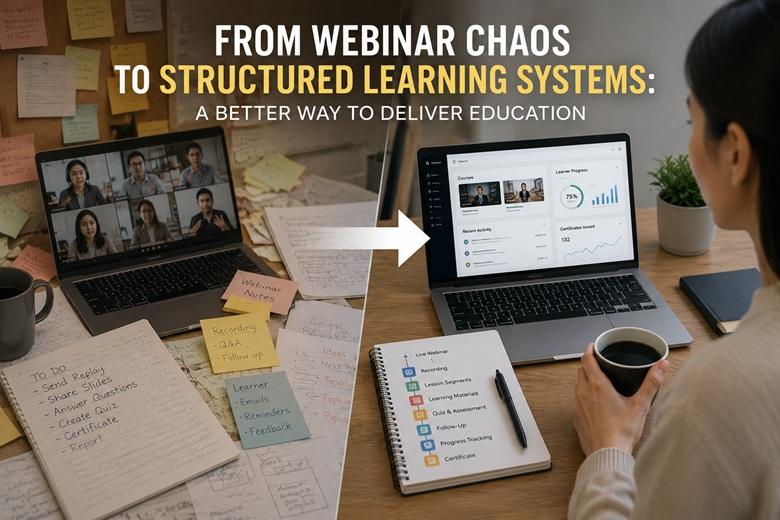
Webinars are often the easiest way for organizations to
start delivering education online. They are fast to organize, familiar to
participants, and useful for live interaction. But when webinars become the
main delivery model for training, member education, customer education, or
professional development, many organizations begin to face operational chaos:
scattered recordings, repeated questions, weak follow-up, unclear completion
tracking, and limited learner data. This article explains how organizations can
move from one-off webinar delivery to structured learning systems that support
repeatable programs, better learner journeys, stronger engagement, and more
scalable online education operations.
- Quick
Answer
- Why
Webinars Became the Default Online Education Format
- Where
Webinar Chaos Begins
- What
a Structured Learning System Actually Changes
- How
to Turn Live Sessions Into Repeatable Learning Assets
- The
Role of Mobile Learning, Microlearning, and Learner Follow-Up
- When
Organizations Should Move Beyond Webinar-Only Delivery
- Practical
Steps to Build a More Structured Learning System
- Common
Mistakes Organizations Make
- Conclusion
- FAQ
Quick Answer
Webinars are useful for live teaching, expert discussion,
and community engagement, but they are not always enough to operate online
education at scale. Webinar chaos happens when organizations rely on live
sessions without a structured system for content access, learner onboarding,
recordings, assignments, progress tracking, certificates, follow-up, and
reporting.
This affects associations, communities, institutions,
corporate learning teams, training providers, and professional organizations
that deliver education repeatedly. A webinar may create attention for one
moment, but a structured learning system turns that moment into a reusable
learning journey.
The better approach is not to abandon webinars. It is to
place webinars inside a broader learning system. Live sessions can become part
of a course, cohort program, microlearning pathway, member education track, or
professional development experience. With the right structure, organizations
can reuse content, track learner progress, improve completion visibility,
support mobile learners, and create a more professional branded education
experience.

Why Webinars Became the Default Online Education Format
Webinars became popular because they solve an immediate
problem: they let organizations deliver knowledge online without building a
full learning infrastructure.
For many organizations, this is attractive. A webinar can be
planned quickly, promoted through email or social media, delivered through a
familiar video platform, and attended by participants from different locations.
It feels practical, accessible, and low-risk.
This is especially true for organizations that are not
traditional education companies. Associations, communities, nonprofits,
professional networks, corporate teams, and public institutions often begin
with webinars because they already have experts, topics, and audiences. What
they may not have is a structured online learning operation.
A webinar allows them to start.
It can support:
- expert
talks
- member
education sessions
- public
awareness programs
- internal
training
- onboarding
briefings
- professional
development workshops
- product
education
- community
learning events
The challenge appears when webinars move from occasional
activity to ongoing education strategy.
A single webinar can be managed manually. A recurring
webinar series requires more coordination. A full learning program built only
from webinars can quickly become difficult to manage. The organization has to
handle registrations, attendance, reminders, materials, recordings, feedback,
follow-up, certificates, and reporting.
At this point, the webinar is no longer just an event. It
becomes part of learning operations.
A webinar delivers a moment of attention. A learning system turns that moment into a structured journey.
This distinction matters because many organizations mistake
activity for infrastructure. Hosting many webinars can create the appearance of
an active education program, but activity alone does not guarantee a clear
learner experience, measurable progress, or long-term educational value.
Webinars are effective as learning moments, but they become
operationally fragile when they are expected to function as the entire
education system.
The best use of webinars is not as a replacement for
learning systems. It is as one component within a broader online learning
model.
Where Webinar Chaos Begins
Webinar chaos usually begins quietly. At first, the system
appears to work because the organization can still deliver sessions.
Participants attend. Speakers present. Recordings are saved. Feedback forms are
sent. The program continues.
But behind the scenes, the workflow becomes increasingly
fragmented.
Recordings may be stored in different folders. Presentation
files may be shared manually. Participant questions may remain inside chat
history. Attendance may be tracked in spreadsheets. Certificates may be created
one by one. Follow-up emails may depend on one staff member. Learner progress
may be difficult to verify.
The problem is not the webinar itself. The problem is the
lack of structure around the webinar.
|
Webinar-Only Problem |
What Happens Operationally |
Impact on Learners and Teams |
|
Scattered recordings |
Recordings are saved in folders, drives, or video links
without a clear learning path |
Learners struggle to revisit content systematically |
|
Manual attendance tracking |
Staff download attendance reports and update spreadsheets |
Reporting becomes slow and error-prone |
|
Weak learner follow-up |
Reminders, materials, and next steps are sent manually |
Learners may miss important actions |
|
No progress visibility |
Attendance does not show whether learners understood or
completed the program |
The organization lacks useful learning analytics |
|
Limited content reuse |
Each webinar is treated as a one-time event |
Valuable expert content loses long-term value |
|
Inconsistent branding |
Learners interact with multiple platforms and
communication formats |
The education experience feels less professional |
|
Certificate complexity |
Completion proof is handled separately from learning
activity |
Administrative workload increases |
For small programs, these issues may feel manageable. For
organizations delivering education regularly, they become serious operational
friction.
The hidden cost is not only staff time. It is also lost
learning value.
A strong webinar may contain useful expert insight,
practical frameworks, and valuable discussion. If the recording is simply
stored somewhere and forgotten, the organization loses the opportunity to turn
that content into a reusable learning asset.

This is why webinar chaos is often a content operations
problem as much as a delivery problem. Organizations may already have valuable
educational content, but they do not yet have the system to organize,
distribute, measure, and improve it.
For readers who are already experiencing tool fragmentation,
this connects closely with the
hidden cost of using multiple tools for online education, especially when
webinar delivery depends on separate tools for registration, communication,
materials, feedback, and reporting.
What a Structured Learning System Actually Changes
A structured learning system changes the role of webinars
from isolated events into organized learning components.
Instead of asking, “How do we host the next webinar?” the
organization begins asking, “How does this session fit into the learner
journey?”
That shift changes everything.
A structured learning system helps define:
- what
learners should do before the live session
- how
they access learning materials
- what
happens during the session
- where
recordings are stored
- how
learners continue after the session
- how
progress or completion is tracked
- how
the organization measures participation and engagement
- how
content can be reused for future cohorts
- how
the program supports the organization’s brand
This is not only a technical improvement. It is an
operational improvement.
A structured system gives teams a repeatable way to deliver
education. It reduces dependency on memory, manual coordination, and scattered
files. It also helps learners understand where they are in the program and what
they need to do next.
|
Education Element |
Webinar-Only Delivery |
Structured Learning System |
|
Live teaching |
Main learning experience |
One part of a broader learning journey |
|
Recordings |
Stored after the event |
Organized into reusable learning content |
|
Materials |
Sent manually or stored separately |
Attached to lessons or modules |
|
Learner journey |
Often unclear after the session ends |
Guided before, during, and after learning |
|
Completion tracking |
Based mainly on attendance |
Can include progress, activity, assessment, or certificate
logic |
|
Program reporting |
Manual and fragmented |
Easier to consolidate |
|
Brand experience |
Dependent on external tools |
More coherent and organization-owned |
|
Scalability |
Each event requires repeated setup |
Programs can be reused and improved |
The most important change is continuity. Learners no longer
experience education as a series of disconnected events. They experience it as
a pathway.
For organizations, this supports better program design. A
webinar can become the live discussion layer of a larger course. A recording
can become an on-demand lesson. A Q&A session can become a resource
library. A recurring event can become a cohort-based program. A speaker series
can become a member learning track.
The goal is not to run more webinars. The goal is to create learning that continues after the live session ends.
This is where a white-label learning platform can become
relevant. It allows organizations to deliver structured education under their
own brand, rather than relying only on external webinar tools and scattered
content repositories.
How to Turn Live Sessions Into Repeatable Learning Assets
Many organizations already have more learning content than
they realize. The problem is that much of it is trapped inside live webinar
formats.
A one-hour expert session may include several useful
learning assets:
- the
full recording
- short
lesson clips
- presentation
slides
- discussion
questions
- participant
questions
- practical
examples
- downloadable
resources
- follow-up
assignments
- assessment
questions
- certificate
requirements
- summary
notes
Without a system, these assets remain scattered. With a
structured workflow, they can become part of a reusable learning library.
The process does not need to be complicated. A practical
approach is to design every webinar with post-session learning value in mind.
Before the webinar, the organization can define the learning
objective, target audience, expected outcome, and supporting materials. During
the webinar, the team can capture key explanations, examples, and questions.
After the webinar, the content can be edited, segmented, organized, and placed
into a course or learning pathway.

This approach supports a stronger return on effort. Instead
of spending time preparing one webinar that disappears after the event, the
organization builds a growing library of learning assets.
A live session on leadership, for example, can become:
- a
recorded lesson
- a
five-part microlearning sequence
- a
quiz-based completion module
- a
resource for new members
- part
of a certification pathway
- a
reusable onboarding asset
- an
internal training module
This matters because organizations often underestimate the
value of structured content reuse. When expert knowledge is captured and
organized properly, it can serve more learners over time.
The more reusable a learning asset becomes, the less
dependent the organization is on repeatedly delivering the same knowledge live.
This does not remove the value of live interaction. It makes
live interaction more strategic. Instead of using webinars only to deliver
basic information, organizations can use live sessions for discussion,
mentoring, reflection, case analysis, peer learning, and expert Q&A.
That is a better use of human presence.
FitAcademy
Turn Webinar Delivery Into a Branded Learning System
FitAcademy helps organizations structure live sessions, recordings, learning materials, progress tracking, and mobile access inside a branded white-label learning environment.
Explore White-LabelThe Role of Mobile Learning, Microlearning, and Learner Follow-Up
Webinar-based education often assumes that learners will
attend at the scheduled time, stay focused for the full session, remember the
key points, and apply the lesson afterward. In reality, many learners are busy,
mobile, and distracted.
This is especially true for professionals, entrepreneurs,
community members, field teams, and adult learners. They may value the content
but struggle to attend every live session or revisit long recordings.
A structured learning system can support more flexible
behavior.
Instead of relying only on one long live session,
organizations can break learning into smaller components:
- pre-session
preparation
- short
concept lessons
- live
webinar discussion
- post-session
recap
- quick
quizzes
- reflection
prompts
- downloadable
materials
- mobile-friendly
review content
- reminder-based
follow-up
This is where microlearning becomes useful. Microlearning
does not mean oversimplifying the topic. It means organizing learning into
focused, manageable units that fit better into real learner behavior.
For example, a 90-minute webinar on digital marketing for
small businesses can become:
- a
short introduction lesson
- three
focused concept videos
- one
live discussion session
- a
practical checklist
- a
quiz
- a
follow-up task
- a
certificate of completion
This structure helps learners engage before and after the live session, not only during it.
Mobile learning also matters because many learners access
education from smartphones. If the learning experience depends on long
recordings, scattered links, and desktop-heavy workflows, mobile learners may
struggle. A mobile-first learning platform can make lessons, materials,
progress, and notifications easier to access in one place.

Follow-up is another critical part of structured education. Many webinars lose value because the organization does not guide learners after the session. Learners attend, receive a recording link, and then move on.
A structured learning system can make follow-up more
intentional. It can guide learners to review content, complete a quiz, download
resources, submit a task, join the next module, or receive a certificate.
This creates a stronger bridge between attendance and actual
learning progress.
When Organizations Should Move Beyond Webinar-Only Delivery
Not every webinar program needs a full platform immediately.
But organizations should pay attention to signs that webinar-only delivery is
no longer enough.
The clearest signal is repetition. If the organization
delivers the same topic repeatedly, the content should probably become a
reusable learning asset. Repeating the same live explanation every month may be
inefficient when some parts can be turned into structured on-demand lessons.
Another signal is learner volume. As more learners join,
manual coordination becomes harder. Staff may spend more time answering access
questions, sending materials, tracking attendance, and managing certificates.
A third signal is the need for accountability. If
stakeholders want to know who completed the program, which topics performed
well, or how learners progressed, webinar attendance alone is usually
insufficient.
Organizations should also move beyond webinar-only delivery
when education becomes part of their strategic value proposition. This
includes:
- associations
offering member education
- communities
building professional development programs
- corporate
teams managing recurring training
- institutions
offering public learning programs
- training
providers selling paid courses
- nonprofits
delivering capacity-building education
- creators
turning expertise into structured learning products
At this stage, the learning platform model becomes an
important strategic decision.
Some organizations may choose a standard LMS. Others may use
a course marketplace. Some may invest in custom development. Others may prefer
a white-label learning platform that gives them branded control without
building the entire system from scratch.
For associations, communities, and membership organizations,
this question becomes especially important because education is closely tied to
trust, retention, and member value. A deeper comparison is available in the
best learning platform model for associations, communities, and membership
organizations.
Practical Steps to Build a More Structured Learning System
Moving from webinar chaos to a structured learning system
does not need to happen all at once. The transition can be staged.
The first step is to define the learning journey.
Organizations should identify what happens before, during, and after each
learning experience. This helps shift the mindset from event management to
learning design.
A basic journey may look like this:
|
Stage |
Webinar-Only Approach |
Structured Learning Approach |
|
Before learning |
Send registration link and reminder |
Provide onboarding, objectives, preparation materials, and
clear access |
|
During learning |
Host live session |
Combine live teaching with guided interaction and learning
activities |
|
After learning |
Send recording link |
Offer recap lessons, assignments, quiz, resources, and
next steps |
|
Completion |
Track attendance manually |
Define completion rules and certificate logic |
|
Reporting |
Compile spreadsheet data |
Review participation, progress, engagement, and outcomes
more systematically |
|
Reuse |
Store recording |
Convert content into reusable modules or learning paths |
The second step is to standardize content structure. Each
program should have consistent components: title, objective, module outline,
lesson materials, completion criteria, and follow-up actions. This makes
programs easier to repeat and improve.
The third step is to centralize learner access. Learners
should not have to search through emails, chat groups, and folders to find the
next step. A structured platform can help organize everything in one branded
learning environment.
The fourth step is to define data needs. Not every
organization needs advanced analytics immediately, but most need basic
visibility into registration, attendance, progress, completion, engagement, and
feedback.
The fifth step is to decide which parts should remain live
and which parts should become on-demand. Live sessions are valuable for
interaction. On-demand content is valuable for scale, flexibility, and reuse. A
strong learning system uses both intentionally.
The sixth step is to plan ownership. The organization should
understand who owns the learner relationship, learning data, content library,
and brand experience. This becomes increasingly important as education grows.
For organizations comparing broader platform strategy, why
more organizations are moving from LMS platforms to white-label learning
ecosystems provides a useful next step.
Common Mistakes Organizations Make
The first mistake is treating webinars as complete learning
products. A webinar can be part of a learning product, but it rarely provides
the full structure learners need. Without preparation, follow-up, assessment,
or progress tracking, the session may create awareness but limited continuity.
The second mistake is saving recordings without organizing
them. A folder full of recordings is not a learning library. Learners need
context, sequence, descriptions, supporting materials, and clear learning
objectives.
The third mistake is measuring success only by attendance.
Attendance shows who joined, but it does not always show who understood,
completed, applied, or benefited from the learning experience. Organizations
need to be careful not to confuse participation with progress.
The fourth mistake is relying too heavily on one staff
member to manage the entire workflow. When registration, reminders, recordings,
certificates, and reports depend on manual knowledge, the system becomes
fragile.
The fifth mistake is choosing tools only for the next event
rather than the long-term education model. This often leads to tool sprawl,
where every new problem creates another separate tool.
The better approach is to define the learning operation
first, then choose tools or platforms that support it.
The strongest online education systems are not built around
events. They are built around repeatable learner journeys.
For organizations that want to grow education beyond
occasional webinars, a white-label learning
platform can help centralize the learner journey, improve brand
consistency, and reduce manual operational friction.
Conclusion
Webinars are valuable. They create live interaction, bring
experts closer to learners, and help organizations start online education
quickly. But webinars alone are not always enough to support scalable learning
operations.
When education becomes recurring, strategic, or
revenue-generating, organizations need more than live sessions. They need
structure. They need a way to organize content, guide learners, reuse
recordings, track progress, manage completion, and understand what is working.
The shift from webinar chaos to structured learning systems
is not about making education more complicated. It is about making it more
reliable.
A structured learning system helps organizations turn
scattered learning activity into a coherent education experience. It gives
learners a clearer path and gives teams a better operational foundation. It
also helps organizations build long-term educational assets instead of
repeatedly starting from zero.
For associations, communities, institutions, training
providers, and corporate learning teams, this shift can become an important
step toward stronger learning delivery, better learner engagement, and more
sustainable education operations.
FitAcademy
Move Beyond Webinar Chaos
FitAcademy helps organizations create branded learning systems where live sessions, recordings, microlearning content, learner progress, and mobile access can work together more coherently.
Explore White-LabelFAQ
Are webinars still useful for online education?
Yes. Webinars are useful for live teaching, expert
interaction, Q&A, community engagement, and timely discussions. The issue
is not the webinar format itself. The problem appears when webinars become the
entire education system without structured content access, progress tracking,
learner follow-up, and reusable learning assets.
What is webinar chaos?
Webinar chaos refers to the operational disorder that
happens when online education depends on scattered live sessions, separate
registration tools, manual attendance tracking, unorganized recordings,
disconnected materials, and weak follow-up. It often becomes visible when the
organization runs recurring programs or serves larger learner groups.
How can organizations turn webinars into structured learning programs?
Organizations can define learning objectives before the
session, record and segment useful content, organize materials into modules,
add recap lessons or quizzes, guide learners through follow-up activities, and
track completion. The goal is to turn a one-time live event into a reusable
learning journey.
What is the difference between a webinar and a learning system?
A webinar is a delivery format for live online sessions. A
learning system is a broader operational structure that manages content,
learner access, progress, communication, completion, analytics, and sometimes
monetization. A webinar can be part of a learning system, but it is not the
whole system.
When should an organization move beyond webinar-only delivery?
An organization should consider moving beyond webinar-only
delivery when programs become recurring, learner numbers grow, certificates are
needed, reporting becomes important, recordings need to be reused, or education
becomes part of member value, workforce training, customer education, or
revenue generation.
Can a white-label learning platform still include webinars?
Yes. A white-label learning platform can still include
webinars as part of the learning journey. The difference is that live sessions
can be connected to structured modules, recordings, resources, progress
tracking, mobile access, and branded learner experiences instead of remaining
isolated events.