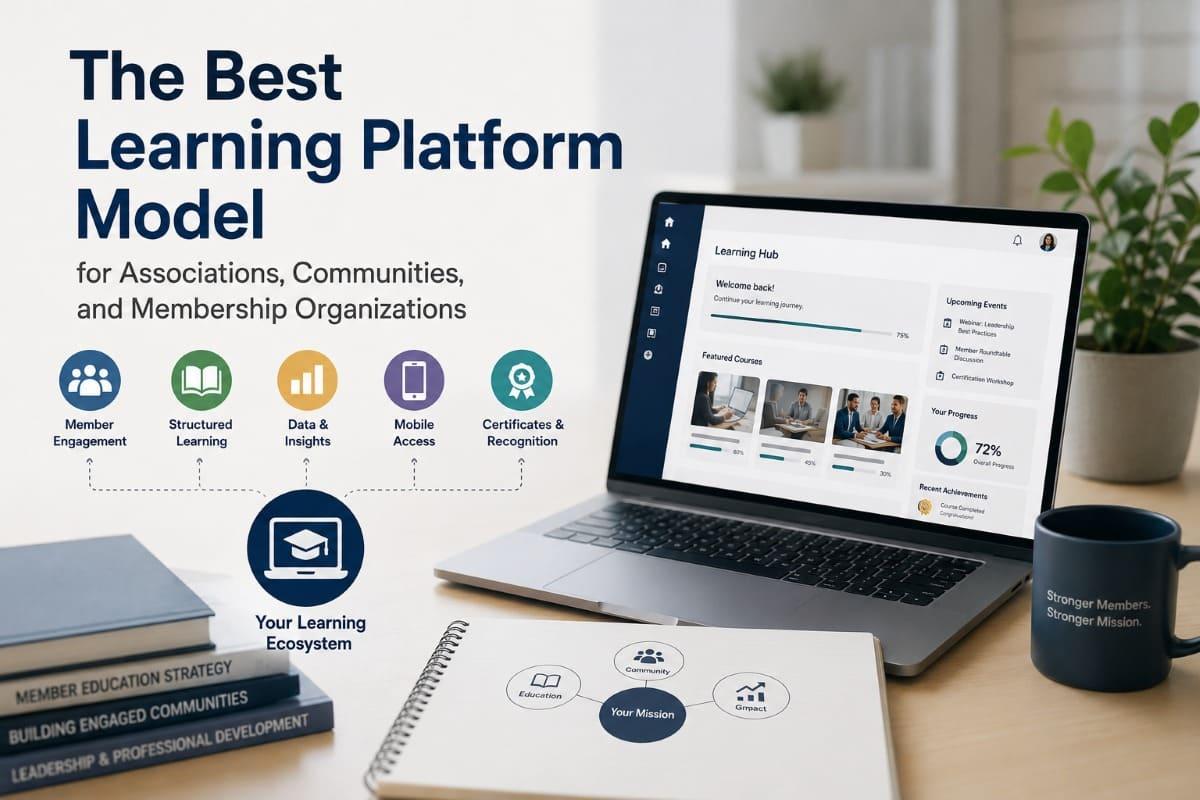
Associations, communities, and membership organizations
often need more than a basic online course tool. Their education model usually
combines member engagement, professional development, expert knowledge, events,
certification, content libraries, and long-term relationship building. Choosing
the right learning platform model is therefore not only a technology decision.
It affects how the organization delivers value, manages members, owns learner
data, strengthens its brand, and scales education programs over time. This
article compares common platform models—webinars, community tools,
marketplaces, LMS platforms, custom builds, and white-label learning
ecosystems—to help membership-based organizations choose a model that fits
their operational needs and strategic goals.
- Quick
Answer
- Why
Membership-Based Organizations Need a Different Platform Strategy
- The
Main Learning Platform Models to Consider
- How
to Compare Platform Models Beyond Features
- Why
Associations and Communities Often Outgrow Simple Delivery Tools
- When
a White-Label Learning Ecosystem Becomes the Stronger Fit
- Practical
Decision Framework for Choosing the Right Model
- Common
Mistakes to Avoid
- Conclusion
- FAQ
Quick Answer
The best learning platform model for associations,
communities, and membership organizations depends on how central education is
to the organization’s value proposition. If education is occasional, simple
webinar tools or community platforms may be enough. If education is recurring,
member-facing, branded, data-driven, or connected to certification and revenue,
a more structured learning platform becomes important.
Membership organizations usually need a model that supports
more than content hosting. They need learner access control, member
segmentation, progress tracking, mobile learning, branded experience, content
reuse, analytics, and sometimes monetization. A generic LMS can work for
structured courses, but it may feel limited if the organization needs stronger
branding, mobile-first delivery, community-led education, or flexible learning
operations.
For many associations and communities, a white-label
learning ecosystem offers a practical middle path. It provides more ownership
and brand control than marketplaces or scattered tools, while avoiding the cost
and complexity of building a custom platform from scratch.

Why Membership-Based Organizations Need a Different Platform Strategy
Associations, communities, and membership organizations do
not usually operate education in the same way as traditional schools or pure
online course businesses.
Their learning programs are often connected to a wider
mission. Education may support member retention, professional development,
public awareness, advocacy, workforce readiness, certification, leadership
development, or community engagement. In many cases, learning is not a separate
product. It is part of the organization’s reason to exist.
This creates a different platform requirement.
A membership organization may need to serve different groups
at once:
- new
members who need onboarding
- active
members who need continuing education
- senior
members who contribute expertise
- external
learners who may become future members
- sponsors
or partners who support programs
- trainers,
mentors, or subject-matter experts
- administrators
who need reporting and coordination
A basic content delivery tool may support one course, but it
may not support the full relationship between the organization and its members.
For example, an association may want to offer:
- member-only
learning tracks
- paid
public courses
- recorded
event libraries
- professional
certificates
- leadership
development programs
- mobile
microlearning lessons
- partner-supported
training
- regional
chapter education
- expert-led
discussion sessions
- recurring
learning cohorts
This is why the learning platform model matters. The
platform is not only where content is placed. It becomes part of the member
experience.
For membership organizations, learning is not only content delivery. It is a relationship-building system.
When a member logs into a learning environment, the
experience should reinforce trust in the organization. It should feel coherent,
credible, and aligned with the organization’s brand. If the experience is
scattered across webinar links, cloud folders, chat groups, and external tools,
the educational value may still exist, but the organizational value becomes
weaker.
A learning platform for associations must support both
education delivery and member relationship strategy. Treating it only as a
course repository usually leads to an incomplete decision.
This is where many organizations begin to reconsider their
existing setup. They may have started with webinars and simple tools, but as
learning becomes more strategic, they need a model that supports continuity,
ownership, and scale.
The Main Learning Platform Models to Consider
There is no single best platform model for every
organization. The right choice depends on budget, technical capacity, brand
expectations, member needs, learning complexity, data requirements, and
long-term ambition.
Most associations, communities, and membership organizations
compare six common models.
|
Platform Model |
Best For |
Main Limitation |
|
Webinar-based delivery |
Occasional live sessions, expert talks, basic member
events |
Weak structure for progress tracking, content reuse, and
learner data |
|
Community platform |
Member discussion, peer interaction, informal learning |
Often limited for structured courses, certificates, and
analytics |
|
Course marketplace |
Public reach and simple course distribution |
Limited brand ownership and learner relationship control |
|
Standard LMS |
Structured courses, assessments, compliance-style learning |
May feel rigid or less suitable for branded member
engagement |
|
Custom-built platform |
Organizations needing full technical control |
Higher cost, longer development, and ongoing maintenance
responsibility |
|
White-label learning ecosystem |
Branded, scalable, organization-owned learning experience |
Requires strategic planning and platform governance to use
effectively |
Each model can be useful. The mistake is choosing based only
on familiarity or price.
A webinar-based model may be enough when education is mostly
live and occasional. A community platform may work when discussion matters more
than structured completion. A standard LMS may fit when the organization needs
course modules, assessments, and certificates. A marketplace can help if public
discovery is more important than owning the learner relationship. A custom
build can be suitable when the organization has unique workflows, budget, and
long-term technical capacity.
A white-label learning ecosystem becomes attractive when the
organization wants a branded platform experience without building the entire
technology stack from zero.

The best decision usually comes from understanding the
organization’s learning maturity.
If learning is still experimental, a lightweight setup may
be appropriate. If learning is becoming a strategic member service, the
organization should think more carefully about platform ownership, learner
experience, content governance, and reporting.
This decision also connects to the broader issue of
fragmented tools. Organizations that are still relying on separate webinar,
folder, form, payment, and communication tools may want to first understand the
hidden cost of using multiple tools for online
education|hidden-cost-multiple-tools-online-education before choosing a
long-term platform model.
How to Compare Platform Models Beyond Features
Many organizations compare learning platforms by looking at
feature lists. This is understandable, but it often leads to the wrong
decision.
A feature list can show whether a platform has courses,
videos, quizzes, certificates, payments, mobile access, or analytics. But it
does not always show whether the platform fits the organization’s operating
model.
For associations and communities, the better comparison
starts with strategic questions.
Does the platform support the organization’s member journey?
A platform should help members move from awareness to participation, learning,
completion, and continued engagement.
Does the platform strengthen the organization’s brand?
A learning experience should feel like part of the organization, not a
disconnected third-party destination.
Does the platform give the organization useful learner data?
The organization should be able to understand participation, progress,
engagement, and program performance.
Does the platform support different learner groups?
Members, non-members, trainers, partners, and internal teams may need different
access levels.
Does the platform support mobile behavior?
Many learners expect flexible access from smartphones, especially for short
lessons, reminders, and on-demand review.
Does the platform help education become repeatable?
The organization should be able to reuse learning assets across cohorts,
chapters, programs, or member segments.
|
Decision Criteria |
Why It Matters for Associations and Communities |
|
Brand ownership |
Reinforces trust, authority, and professional identity |
|
Learner data visibility |
Helps improve programs and report value to stakeholders |
|
Access control |
Supports member-only, public, paid, and partner-based
learning |
|
Content reuse |
Turns events and expert sessions into long-term learning
assets |
|
Mobile learning |
Makes education easier for busy professionals and
distributed members |
|
Monetization flexibility |
Supports paid courses, member benefits, certificates, or
sponsored education |
|
Administrative workflow |
Reduces manual coordination and repeated setup |
|
Scalability |
Allows the organization to grow from events to structured
learning programs |
Feature comparison is still useful, but it should come after
operational fit.
For example, two platforms may both offer certificates. But
one may require manual certificate handling, while another connects
certificates to completion logic. Two platforms may both support video lessons,
but one may make content difficult to organize for mobile learners. Two
platforms may both provide analytics, but one may only show basic attendance
while another supports deeper learning performance review.
The better platform decision is not “Which tool has more
features?” It is “Which model supports our learning operation and member
relationship over time?”
This is why the best learning platform model must be
evaluated as infrastructure, not only software.
Why Associations and Communities Often Outgrow Simple Delivery Tools
Simple delivery tools are useful in the beginning because
they remove friction. A webinar platform lets the organization host sessions. A
chat group lets members communicate. A cloud folder stores materials. A form
collects feedback. A payment link collects fees.
This works until the organization needs structure.
Many associations and communities outgrow simple tools when
education becomes more frequent or more valuable to members. The signs are
usually practical:
- members
ask where recordings are stored
- new
members want access to previous learning materials
- staff
manually send the same links repeatedly
- certificates
take too much time to prepare
- attendance
data does not show real progress
- content
is duplicated across folders
- the
organization cannot easily report learning impact
- paid
programs require manual access management
- regional
chapters run inconsistent education programs
- mobile
learners struggle to access long recordings or scattered files
This is the transition point from event management to
learning operations.
A community can host events without a learning platform. But
if the organization wants to build a member education library, offer structured
development pathways, sell courses, issue certificates, or track learning
engagement, the platform model becomes more important.

This does not mean simple tools should be abandoned
immediately. They can still support live events, communication, marketing, and
collaboration. But they should not carry the entire education system once the
program becomes strategic.
This is especially important for organizations that have
already experienced [internal- webinar
chaos and need structured learning systems. Once webinars become recurring
programs, a stronger learning model can help turn live knowledge into reusable
learning assets.
FitAcademy
Learn How FitAcademy Supports Structured Learning Programs
FitAcademy helps organizations create branded learning environments for member education, training programs, microlearning content, learner access, and scalable online learning operations.
Learn MoreWhen a White-Label Learning Ecosystem Becomes the Stronger Fit
A white-label learning ecosystem becomes a stronger fit when
the organization wants education to feel like part of its own brand, not an
external add-on.
This matters for associations and communities because trust
is central to membership value. Members join because they believe the
organization represents knowledge, access, credibility, and professional
belonging. The learning experience should reinforce that trust.
A white-label model can help the organization offer a
branded learning platform with its own identity, content structure, learner
journey, and operational logic. Depending on the platform implementation, this
may include courses, microlearning, mobile access, certificates, analytics,
payments, and learner management.
The strongest fit usually appears when the organization
needs several of these conditions:
- branded
member education
- recurring
programs or cohorts
- mobile-first
learning access
- structured
content libraries
- paid
or member-only courses
- certificates
or completion records
- learner
progress tracking
- partner
or sponsor-supported education
- internal
and external learner segments
- long-term
ownership of learning data and content
A white-label learning ecosystem is not always the cheapest
option. It is also not the same as building fully custom software. Its value
sits between flexibility, ownership, and implementation practicality.
Compared with a marketplace, it gives the organization
stronger brand presence and learner relationship control. Compared with a
generic LMS, it may offer a more branded and ecosystem-oriented experience.
Compared with custom development, it can reduce technical burden while still
giving the organization a platform that feels more like its own.
|
Organization Need |
Marketplace |
Standard LMS |
Custom Build |
White-Label Learning Ecosystem |
|
Strong brand ownership |
Low |
Medium |
High |
High |
|
Learner data control |
Limited |
Medium |
High |
Stronger, depending on setup |
|
Fast implementation |
Medium |
Medium |
Low |
Medium to high |
|
Technical responsibility |
Low |
Medium |
High |
Lower than custom build |
|
Member education fit |
Limited |
Medium |
High if designed well |
Strong when configured well |
|
Mobile-first experience |
Platform-dependent |
Platform-dependent |
Customizable |
Often stronger if included |
|
Monetization flexibility |
Platform-dependent |
Medium |
High |
Strong when supported |
|
Long-term learning ecosystem |
Limited |
Medium |
High |
Strong |
The caveat is that a white-label platform still requires
strategy. The organization must define its learning model, audience segments,
content structure, access rules, and program governance. A platform can support
the system, but it cannot replace strategic clarity.
A white-label platform is most valuable when the organization already understands that education is part of its long-term member strategy.
For organizations already comparing LMS limitations with
broader platform ownership, why
more organizations are moving from LMS platforms to white-label learning
ecosystems provides a deeper continuation of this decision.
Practical Decision Framework for Choosing the Right Model
Choosing the best learning platform model becomes easier
when the organization starts from use case, not technology.
A practical decision framework can begin with five
questions.
1. How strategic is education to the organization?
If education is occasional, simple tools may be enough. If
education is central to member value, revenue, certification, or organizational
authority, the platform should be treated as infrastructure.
2. Who needs access to learning?
Membership organizations often serve different learner
groups. Members, non-members, trainers, partners, employees, sponsors, and
chapter leaders may each need different access levels. The platform model
should support that complexity without creating excessive manual work.
3. What kind of learning experience does the
organization want to deliver?A live event series needs one model. A mobile microlearning
pathway needs another. A certification program needs a more structured
approach. A public course business may require monetization, landing pages, and
learner communication features.
4. What data does the organization need?
If the organization only needs attendance, a webinar tool
may be enough. If it needs completion, engagement, progress, program
performance, revenue visibility, or member learning history, a more integrated
platform becomes more important.
5. How much ownership does the organization want?
Ownership affects branding, learner relationship, content
library, data access, integration possibilities, and long-term scalability. The
more strategic education becomes, the more important ownership usually becomes.
A simplified recommendation may look like this:
|
Situation |
Recommended Model |
|
Occasional expert talks or public awareness events |
Webinar-based delivery |
|
Informal peer learning and discussion |
Community platform |
|
Simple public course distribution with low brand-control
needs |
Course marketplace |
|
Structured internal training or course administration |
Standard LMS |
|
Unique technical workflows and large budget |
Custom-built platform |
|
Branded member education, microlearning, monetization, and
scalable learning operations |
White-label learning ecosystem |
This framework does not remove the need for platform
evaluation, but it helps the organization avoid choosing based on trend, price,
or familiarity alone.
For many membership organizations, the best model is not
necessarily the most advanced one. It is the model that matches their current
maturity while giving them room to grow.

Common Mistakes to Avoid
The first mistake is choosing a platform only because it is
familiar. Many organizations use webinar tools, community platforms, or shared
drives because they already know them. Familiarity reduces friction in the
short term, but it may create operational limitations later.
The second mistake is choosing the platform only by price.
Lower subscription cost does not always mean lower total cost. Staff time,
manual coordination, member support, reporting gaps, and poor learner
experience can become expensive in less visible ways.
The third mistake is treating member education as a side
activity. If education supports retention, authority, certification, or
revenue, it deserves a stronger platform strategy.
The fourth mistake is assuming that any LMS can support
membership-based learning. Some LMS platforms are strong for formal courses but
less flexible for communities, associations, chapter-based learning, public
programs, or mobile microlearning.
The fifth mistake is ignoring long-term data ownership. If
the organization cannot easily access learner history, completion data,
engagement trends, or program performance, it may struggle to improve its
learning strategy.
The sixth mistake is overbuilding too early. A custom
platform may sound attractive, but it can require significant budget, technical
management, product development, maintenance, security oversight, and
continuous improvement. Unless the organization has a clear reason to build
from scratch, a white-label model may be more practical.
The right platform model should reduce operational burden
while increasing the organization’s ability to deliver, measure, and scale
learning value.
The best choice is usually the one that balances ambition
with operational capacity.
Conclusion
Associations, communities, and membership organizations need
to choose learning platforms differently from organizations that only want to
host courses. Their education programs are closely tied to trust, member value,
professional identity, and long-term engagement.
This makes the platform model a strategic decision.
Webinars can support live interaction. Community platforms
can support discussion. Marketplaces can support distribution. Standard LMS
platforms can support structured course administration. Custom platforms can
support highly specific requirements. White-label learning ecosystems can
support branded ownership, scalable learning delivery, mobile access, and more
coherent education operations.
The best model depends on the organization’s maturity,
goals, audience, budget, and internal capacity. A small community running
occasional sessions may not need a sophisticated platform. A growing
association building member education, certificates, paid programs, and
reusable learning assets likely needs a more structured approach.
The key is to choose a model that fits both today’s learning
operation and tomorrow’s member strategy. For many organizations, the strongest
path is not to jump directly into custom development or remain stuck with
scattered tools. It is to adopt a platform model that supports ownership,
structure, and scale without unnecessary technical burden.
FitAcademy
Learn More About Branded Learning Infrastructure for Organizations
FitAcademy supports associations, communities, institutions, and training providers that want to deliver structured learning programs through a branded, mobile-first platform environment.
Learn MoreFAQ
What is the best learning platform for associations?
The best learning platform for an association depends on the
role of education in its member strategy. If education is occasional, webinar
tools may be enough. If the association offers recurring programs, member-only
content, certificates, paid courses, or professional development pathways, a
structured LMS or white-label learning platform is usually more suitable.
Do communities need an LMS?
Not always. A community may only need a discussion platform
if learning is informal and peer-led. However, if the community wants to
organize lessons, track progress, manage access, issue certificates, or build a
structured learning library, an LMS or white-label learning ecosystem can
provide stronger operational support.
What is the difference between a community platform and a learning platform?
A community platform is usually designed for interaction,
discussion, networking, and member engagement. A learning platform is designed
to organize educational content, manage learner access, track progress, support
assessments, and sometimes issue certificates. Some organizations need both
community interaction and structured learning delivery.
Is a white-label learning platform better than a marketplace?
A white-label learning platform is better when the
organization wants brand ownership, learner relationship control, and a more
customized learning experience. A marketplace may be useful for public
discovery, but it usually gives the organization less control over branding,
data, pricing, and the long-term learner relationship.
When should a membership organization avoid building a custom platform?
A membership organization should be cautious about custom
development if it lacks the budget, technical team, product roadmap,
maintenance capacity, or long-term platform management capability. Custom
builds can be powerful, but they carry significant operational responsibility.
A white-label model may be more practical when the organization wants ownership
without starting from zero.
How should associations compare learning platform options?
Associations should compare platforms based on member
journey, brand control, learner data, access management, mobile experience,
content reuse, monetization, reporting, and scalability. Feature lists are
useful, but operational fit is more important than simply choosing the platform
with the most features.