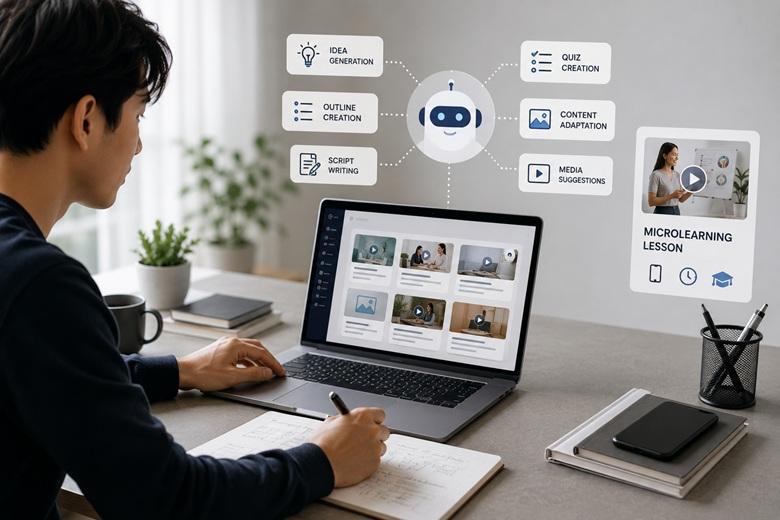
AI is changing microlearning content production by helping
educators, creators, coaches, and training providers move faster from raw
expertise to structured learning materials. Instead of starting every lesson
from a blank page, teams can use AI to support topic research, outline
development, script drafting, quiz generation, content repurposing,
translation, summarization, and learner support assets. This does not mean AI
replaces instructional judgment. Microlearning still needs clear learning
objectives, accurate content, learner context, human review, and practical
application. For creators and education businesses, the opportunity is to use
AI as a production accelerator while keeping strategy, pedagogy, and quality
control in human hands. This article explains how AI is reshaping microlearning
workflows, where it adds value, what risks to manage, and how creators can use
it to build learning products more efficiently.
- Quick
Answer
- Why
AI Matters for Microlearning Production
- From
Raw Expertise to Structured Lesson Assets
- Where
AI Adds the Most Value in the Production Workflow
- AI-Assisted
Microlearning vs Traditional Content Production
- What
AI Cannot Replace in Learning Design
- A
Practical Workflow for AI-Assisted Microlearning Production
- Common
Mistakes When Using AI for Learning Content
- Conclusion
- FAQ
Quick Answer
AI is changing microlearning content production by reducing
the time and effort needed to plan, draft, adapt, and organize short learning
materials. Creators, coaches, institutions, and training providers can use AI
to turn expertise into lesson outlines, video scripts, summaries, quizzes,
reflection prompts, captions, translations, and repurposed content for multiple
formats.
This matters because microlearning depends on focused,
modular content. ATD describes microlearning as short learning content that
supports learning and performance, often accessible on demand when learners
need it. AI can help create these small learning assets faster, especially when
teams need many lessons across different topics, audiences, or languages.
The trade-off is quality control. AI can assist production,
but it should not define the learning strategy alone. UNESCO’s guidance on
generative AI in education emphasizes a human-centred approach, which is
especially important when learning content affects skills, decisions,
professional development, or public knowledge.
For creators and education businesses, the best use of AI is
not “automatic course creation.” It is a supervised workflow where AI
accelerates drafting while humans validate accuracy, learning objectives,
examples, tone, and learner relevance.

Why AI Matters for Microlearning Production
Microlearning looks simple from the learner’s perspective. A
lesson may be only a few minutes long. It may include one video, one short
explanation, one quiz, one worksheet, or one action prompt. But behind that
simplicity is a production challenge.
Someone still has to define the learning objective, choose
the right concept, simplify the explanation, write the script, prepare
examples, design assessment questions, create supporting materials, review
accuracy, publish the content, and update it later.
For creators and small education teams, this workload can
become a bottleneck.
A coach may have valuable expertise but limited time to turn
it into structured lessons. A training provider may need to produce many short
modules for different clients. A professional community may want to launch
learning content but lack a full instructional design team. A creator may
already publish educational content on social media but struggle to convert
that content into organized learning products.
AI matters because it can reduce friction at several points
in this workflow. It can help organize scattered ideas, generate first drafts,
suggest lesson sequences, simplify explanations, create quiz variations,
convert long content into shorter learning units, and adapt material for
different learner levels.
AI does not make microlearning valuable by itself. It makes the production process easier to start, scale, and refine.
This is especially relevant because microlearning is
modular. A full training program may require dozens or even hundreds of small
learning assets. Without a production system, teams can spend too much time on
repetitive drafting and formatting tasks.
AI can help teams move faster, but speed is not the only
benefit. It can also support consistency. For example, a creator can use AI to
apply a consistent lesson structure across multiple modules: opening problem,
concept explanation, example, learner task, quick quiz, and next step. A
training provider can use AI to convert workshop materials into shorter
learning units. A subject-matter expert can use AI to turn bullet-point
knowledge into learner-friendly explanations.
This is why AI is becoming relevant not only for large
organizations, but also for creator-led education businesses. It lowers the
barrier between expertise and publishable learning content.
However, the value of AI depends on how it is used. If teams
use AI only to generate more content, they may create clutter. If they use AI
to support better instructional workflow, they can create more focused and
useful learning experiences.
AI is most useful in microlearning when it helps educators
reduce production friction without weakening learning structure, accuracy, or
learner relevance.

From Raw Expertise to Structured Lesson Assets
One of the biggest challenges in education businesses is
that expertise often starts in messy formats. It may exist as workshop
recordings, coaching notes, slide decks, client conversations, internal
documents, webinar transcripts, social media posts, podcast episodes, or
personal experience.
This is not yet a learning product.
A learning product needs structure. It needs a clear
learner, a defined problem, a sequence of ideas, examples, practice, and a path
toward application. Microlearning requires even tighter discipline because each
lesson must stay focused.
AI can help convert raw expertise into structured lesson
assets.
For example, a coach may begin with a one-hour webinar
transcript. AI can help identify key themes, separate them into smaller topics,
suggest lesson titles, generate short summaries, create draft scripts, and
propose quiz questions. A creator may begin with ten social media posts about
pricing. AI can help group those posts into a short micro-course about service
pricing. A training provider may begin with a long PDF manual. AI can help
break it into short modules and suggest learner checkpoints.
This does not mean the AI output is ready to publish. It
means the blank-page problem becomes less severe.
The human expert still needs to decide what is accurate,
what is essential, what should be removed, and what sequence will actually help
learners. AI may suggest a structure, but it does not truly know the learner’s
business context, emotional barriers, market reality, or prior knowledge unless
those are clearly provided and reviewed.
A practical AI-assisted conversion process might look like
this:
- collect
raw expertise from notes, recordings, slides, or articles
- identify
the target learner and learning outcome
- ask
AI to summarize key concepts and possible lesson topics
- select
only the topics that support the outcome
- generate
draft lesson scripts or outlines
- add
examples from real experience
- create
quizzes, reflection prompts, or exercises
- review
accuracy, tone, and learner fit
- publish
as structured microlearning modules
- improve
based on learner data and feedback
This workflow is particularly useful for creators who
already have content but have not yet built a learning product. Instead of
asking, “What should I teach from zero?” they can ask, “Which parts of my
existing expertise can become a focused learning pathway?”
Where AI Adds the Most Value in the Production Workflow
AI can support many parts of the microlearning production
workflow, but not all tasks have equal value. The strongest use cases are
usually repetitive, text-heavy, structure-heavy, or adaptation-heavy tasks.
Lesson Ideation and Topic Breakdown
Creators often know their subject deeply but may struggle to
break it into small learning units. AI can help identify subtopics, sequence
ideas, and suggest lesson titles based on audience needs.
For example, a broad topic like “personal branding for
coaches” can become micro-lessons on positioning, profile messaging, content
pillars, social proof, offer clarity, and audience trust.
This is useful because microlearning works best when each
lesson has one job.
Script Drafting and Explanation Simplification
AI can help transform rough notes into short lesson scripts.
It can also simplify technical explanations for beginner learners or adjust
tone for professional, academic, or creator-led audiences.
This can save time, especially for experts who think clearly
but do not enjoy writing. However, human review remains essential because AI
may produce generic explanations or miss important nuance.
Quiz, Reflection, and Practice Prompt Generation
Microlearning should not be only passive consumption.
Learners need small moments of application. AI can help draft multiple-choice
questions, reflection prompts, checklists, scenario questions, and practical
tasks.
The educator still needs to check whether the assessment
truly measures the intended learning outcome. A quiz that is easy to generate
is not always useful.
Repurposing Existing Content
AI can help convert long-form content into shorter formats.
A webinar can become a lesson sequence. A podcast can become a summary module.
A workshop can become a micro-course. A guidebook can become a checklist and
quiz.
This is highly relevant for creators because many already
have large content archives. The challenge is not lack of content; it is lack
of structure.
Localization and Translation Support
For global education businesses, AI can help draft
translations, adapt examples, and localize terminology. This can make learning
content more accessible across markets.
However, translation should be reviewed by humans,
especially when the content includes cultural references, legal language,
technical terminology, or sensitive topics. AI-assisted localization can
accelerate the process, but it should not remove quality assurance.
Content Maintenance and Updating
Microlearning assets may need regular updates. AI can help
compare old and new versions of a policy, summarize changes, or suggest updates
to lesson content. This is useful for fast-changing topics such as technology,
compliance, marketing platforms, or business tools.
The final decision still belongs to the educator or
subject-matter expert.
|
Production Task |
How AI Can Help |
Human Review Needed |
|
Topic breakdown |
Suggest lesson structure and sequence |
Confirm learner relevance and scope |
|
Script drafting |
Turn rough notes into short lesson drafts |
Check accuracy, tone, and examples |
|
Quiz creation |
Generate question variations and answer options |
Validate assessment quality |
|
Content repurposing |
Convert webinars, posts, or documents into modules |
Remove repetition and refine learning flow |
|
Translation |
Draft multilingual versions |
Review cultural and technical accuracy |
|
Updates |
Identify changes and suggest revisions |
Approve final content and compliance |
This workflow aligns with broader discussions about AI in
education. OECD notes that as AI advances, education systems need to understand
how AI will affect learning and skills, including the way people teach, learn,
and prepare for changing work. For microlearning production, this means AI
should be viewed as part of a changing learning infrastructure, not merely as a
writing shortcut.
FitAcademy
Create Microlearning Content Faster With FitAcademy
FitAcademy helps creators, coaches, and education businesses turn expertise into structured microlearning experiences. With the Join Platform option, you can start publishing focused lessons and testing learning products without building a full platform first.
Join the PlatformAI-Assisted Microlearning vs Traditional Content Production
Traditional content production usually follows a linear
process. A subject-matter expert provides material. An instructional designer
develops the structure. A writer prepares scripts. A designer creates assets. A
reviewer checks quality. A platform manager uploads the content. The process
can be effective, but it can also be slow and resource-heavy.
AI-assisted production changes this rhythm. It allows
smaller teams to draft, test, and revise learning assets faster. It also makes
it easier for creators to experiment with different lesson formats before
committing to full production.
This does not eliminate the need for roles such as
instructional design, editing, review, or platform management. Instead, it
changes where human effort is concentrated. More time can be spent on strategy,
learner fit, examples, quality review, and improvement rather than repetitive
first drafts.
|
Aspect |
Traditional Production |
AI-Assisted Production |
|
Starting point |
Manual outline and script development |
AI-supported ideation and drafting |
|
Production speed |
Often slower, especially for large content libraries |
Faster first drafts and repurposing |
|
Best suited for |
Formal programs, high-stakes training, complex curriculum |
Modular content, creator-led learning, rapid updates |
|
Main strength |
Strong control when well-resourced |
Faster iteration and lower blank-page friction |
|
Main risk |
Slow production and high operational cost |
Generic content, factual errors, weak instructional design |
|
Human role |
Create, review, publish |
Direct, validate, refine, contextualize |
The important point is not that AI-assisted production is
always better. It is better for certain workflows.
For example, a creator launching a short course on client
onboarding can use AI to draft lesson scripts and checklists quickly. A
training provider updating internal sales enablement modules can use AI to
adapt material for different roles. A professional community can turn live
event recordings into short recap lessons.
However, high-stakes learning content still needs careful
review. Topics involving health, law, finance, safety, compliance,
certification, or professional licensing require stronger governance. AI may
help draft supporting materials, but expert validation is non-negotiable.
AI-assisted production works best when speed is paired with
governance. Faster drafts are valuable only if the final learning experience
remains accurate, useful, and trustworthy.

What AI Cannot Replace in Learning Design
AI can accelerate production, but it cannot fully replace
learning design judgment. This is especially important for creators and
education businesses that want to build long-term trust.
AI does not automatically understand learner motivation. It
may generate a lesson that is logically organized but emotionally disconnected
from the learner’s real barriers. A small business owner may not need more
theory; they may need confidence, examples, and a simple first action. A new
manager may not need a perfect definition; they may need a scenario that feels
close to their daily work.
AI also cannot verify all factual claims reliably without
human checking. It can produce confident wording even when details are
incomplete or wrong. This is why expert review matters.
AI cannot decide strategic positioning by itself. A creator
must still choose the audience, learning promise, product model, pricing logic,
and platform path. AI can suggest options, but it cannot own the business
decision.
AI also cannot replace original experience. The most
valuable creator-led education often comes from lived practice: client stories,
field observations, mistakes, frameworks, examples, and judgment developed over
time. AI can help express that knowledge, but it cannot authentically originate
the creator’s professional experience.
Finally, AI cannot take responsibility for learner outcomes.
The creator, institution, or training provider remains responsible for what is
published.
UNESCO’s guidance on generative AI in education emphasizes
the need for human-centred implementation and long-term capacity building,
which reinforces the idea that AI should be governed rather than adopted
casually. The World Economic Forum has also discussed AI’s role in personalized
learning and augmented teaching, while still framing technology as a support
for educators rather than a replacement for human care and mentorship.
AI can draft the lesson, but humans must decide whether the lesson deserves to be taught.
This is the line creators should remember. AI is useful for
production. Humans remain responsible for purpose, accuracy, ethics, pedagogy,
and trust.
A Practical Workflow for AI-Assisted Microlearning Production
For creators, coaches, and education businesses, the best
approach is not to ask AI to “create a course” from a vague topic. That usually
produces generic output. A better workflow gives AI a clear role inside a
human-led process.
Start with the learning objective. Define what the learner
should be able to understand, decide, or do after completing the lesson. The
more specific the outcome, the better the AI support.
Next, provide source material. This may include notes,
transcripts, frameworks, examples, slides, articles, or internal documents. AI
performs better when it works from real expertise rather than guessing from a
broad topic.
Then ask AI to propose a microlearning structure. This could
include lesson title, learner problem, core explanation, example, practice
prompt, quiz, and summary.
After that, review the structure manually. Remove anything
that does not support the learning objective. Add context that only the
educator or creator knows.
Then draft the lesson assets. AI can help create scripts,
summaries, quiz questions, captions, worksheets, and email reminders. Each
asset should be reviewed for accuracy and consistency.
Next, publish the content on a learning platform. A proper
platform helps manage learner access, payment, progress, mobile delivery, and
learning analytics.
Finally, improve the lesson based on data. If learners drop
off, ask many similar questions, fail the quiz, or do not complete the task,
the lesson may need revision.
|
Workflow Stage |
Human Role |
AI Role |
Output |
|
Define objective |
Choose learner outcome |
Suggest wording variations |
Clear learning objective |
|
Provide source material |
Supply expertise and examples |
Summarize and organize inputs |
Topic map |
|
Build lesson structure |
Approve sequence |
Draft module outline |
Microlearning lesson plan |
|
Create assets |
Add judgment and context |
Draft scripts, quizzes, prompts |
Lesson content |
|
Review quality |
Validate accuracy and relevance |
Suggest edits and alternatives |
Publish-ready material |
|
Publish and measure |
Monitor learner behavior |
Help analyze feedback themes |
Improvement plan |
This workflow is especially useful for creators who are
moving from content publishing into paid learning products. The related article
how
coaches and creators can monetize knowledge with microlearning explains how
creators can turn expertise into learning offers, while why
creator-led education is growing faster than traditional online courses
explains the wider shift behind this opportunity.

For creators who do not want to build a full technical
stack, a Join Platform model can reduce operational complexity. Instead of
spending time on platform development, they can focus on expertise, lesson
quality, learner communication, and business validation. For readers comparing
platform paths, how
to build a learning business without hiring a full development team
provides a broader platform strategy discussion.
Common Mistakes When Using AI for Learning Content
AI can make production faster, but it can also make bad
content easier to produce at scale. This is the main risk.
One common mistake is asking AI to generate a full course
from a broad topic without source material. The result may look polished but
lack originality, depth, and audience fit. A creator’s strongest asset is not
generic information. It is their perspective, examples, and understanding of
the learner.
Another mistake is publishing AI drafts without expert
review. This can create factual errors, weak explanations, unclear examples, or
misleading simplifications. In education, accuracy is part of trust.
A third mistake is producing too much content too quickly.
Microlearning is not about flooding learners with small lessons. It is about
delivering the right lesson at the right point in the learning journey. Too
many modules can overwhelm learners and reduce completion.
Some creators also use AI to imitate expertise they do not
have. This is risky. AI may help explain a topic, but it does not give the
creator professional authority. Creators should stay within their credible
domain or involve qualified reviewers.
Another mistake is ignoring assessment. AI-generated lessons
may sound clear, but learners still need opportunities to apply knowledge.
Quizzes, scenarios, tasks, reflection prompts, and feedback loops help turn
content into learning.
Finally, creators may forget data privacy and intellectual
property concerns. Uploading client materials, private transcripts, or
proprietary documents into AI tools should be handled carefully. Teams should
understand the tools they use, their data policies, and the sensitivity of the
material.
|
Mistake |
Consequence |
Better Approach |
|
Generating from vague prompts |
Generic lessons with weak differentiation |
Start from real expertise and clear learner outcomes |
|
Publishing without review |
Accuracy and trust risks |
Use human expert validation |
|
Creating too many modules |
Learner overload and lower completion |
Build a focused sequence |
|
Teaching outside credible expertise |
Reputation and quality problems |
Stay within validated knowledge areas |
|
Skipping application |
Passive content, weak learning impact |
Add quizzes, tasks, scenarios, or reflection prompts |
|
Ignoring data sensitivity |
Privacy or IP risk |
Review tool policies and avoid sensitive uploads |
The better approach is to treat AI as a production assistant
inside a responsible learning workflow. It should help creators move faster,
not lower the standard of what gets published.
Conclusion
AI is changing microlearning content production by making it
easier to turn expertise into structured learning assets. It can help creators,
coaches, institutions, and training providers draft outlines, scripts, quizzes,
summaries, translations, and repurposed content faster than traditional manual
workflows.
But AI does not remove the need for educational judgment.
Microlearning still depends on clear objectives, learner relevance, practical
application, credible expertise, accurate content, and thoughtful sequencing.
The most effective teams will use AI to reduce production friction while
keeping humans responsible for strategy, quality, and trust.
For creator-led education and microlearning businesses, this
shift is significant. AI can help more experts move from scattered content to
structured learning products. It can lower production barriers and make
experimentation easier. But sustainable learning businesses will not be built
by automation alone. They will be built by combining AI-assisted workflows with
strong platform infrastructure, human expertise, and a clear understanding of
learner needs.
FitAcademy
Build AI-Assisted Microlearning on FitAcademy
FitAcademy helps creators, coaches, and education businesses turn expertise into structured microlearning experiences. With the Join Platform option, you can focus on producing useful lessons and validating your offer without building a full learning platform from scratch.
Join the PlatformFAQ
How is AI used in microlearning content production?
AI can support microlearning production by helping with
topic breakdown, lesson outlines, script drafts, quizzes, summaries, captions,
translations, worksheets, and content repurposing. It is especially useful for
turning raw expertise such as notes, transcripts, webinars, or articles into
smaller learning assets. Human review is still needed to ensure accuracy,
structure, and learner relevance.
Can AI create a complete microlearning course?
AI can draft many parts of a microlearning course, but it
should not be treated as a complete replacement for instructional design. A
useful course still needs clear objectives, credible source material, practical
examples, assessment, and human validation. AI can accelerate production, but
the educator or creator remains responsible for quality.
Is AI-generated learning content reliable?
AI-generated content can be useful, but it is not
automatically reliable. It may include generic explanations, missing context,
or factual errors. Reliability improves when AI works from trusted source
material and when subject-matter experts review the output before publication.
High-stakes topics require especially careful verification.
Does AI replace instructional designers?
AI may change the work of instructional designers, but it
does not fully replace their judgment. Instructional designers define learning
outcomes, structure learner progression, design assessment, and align content
with context. AI can help with drafting and adaptation, but human expertise
remains important for learning quality.
Why is AI useful for creators and coaches?
AI is useful for creators and coaches because many already
have expertise but lack time to turn it into structured learning products. AI
can help convert notes, videos, posts, or workshop material into lesson drafts,
quizzes, and summaries. This helps creators move faster from audience trust to
paid learning experiences.
What is the biggest risk of using AI for microlearning?
The biggest risk is producing polished but shallow or
inaccurate content at scale. Microlearning should not become a collection of
generic AI-generated lessons. It should remain focused on learner outcomes,
practical application, and credible expertise. Human review, source validation,
and learner feedback are essential.