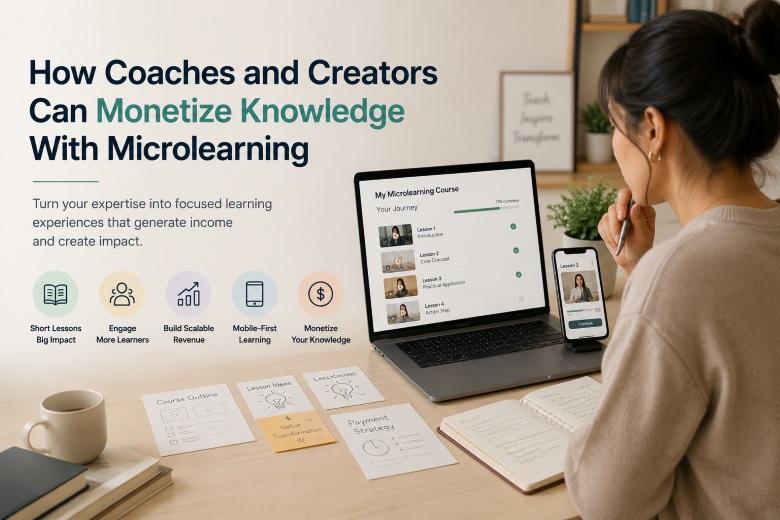
Coaches, educators, consultants, and creators are
increasingly looking for ways to turn their expertise into scalable learning
products without building a traditional course business from scratch.
Microlearning offers a practical path because it breaks knowledge into short,
focused, mobile-friendly lessons that are easier to produce, easier to update,
and easier for learners to consume. For creators and education entrepreneurs,
this makes knowledge monetization more operationally realistic: instead of selling
only long courses, coaching hours, or downloadable materials, they can build
structured learning experiences around specific skills, outcomes, and
communities. This article explains how microlearning supports creator
monetization, what business models work, what platform decisions matter, and
how creators can use a learning platform to move from content publishing to a
sustainable education business.
- Quick
Answer
- Why
Microlearning Fits the Creator Economy
- From
Free Content to Paid Learning Products
- Monetization
Models Coaches and Creators Can Use
- What
Makes Knowledge Worth Paying For
- Choosing
the Right Platform Model for Creator Monetization
- How
to Launch a Microlearning Offer Without Overbuilding
- Common
Mistakes Creators Make When Monetizing Knowledge
- Conclusion
- FAQ
Quick Answer
Coaches and creators can monetize knowledge with
microlearning by turning their expertise into short, structured,
outcome-focused lessons that learners can buy, complete, and apply quickly.
Unlike traditional online courses, microlearning does not require every topic
to become a long curriculum. A creator can package one specific skill, problem,
or transformation into a compact learning product supported by videos, quizzes,
worksheets, community prompts, certificates, or follow-up sessions.
This matters because many creators already have audience
trust, but not always a scalable education system. Social content builds
visibility; microlearning turns that visibility into a paid learning
experience. For coaches, consultants, trainers, and niche experts,
microlearning can support lower-ticket offers, lead-nurturing products,
membership content, certification pathways, or paid learning communities.
The main trade-off is that microlearning still needs
structure. Short lessons are not automatically valuable. Each module must solve
a clear problem, fit into a learning journey, and connect to a realistic
business model. The right platform should support content delivery, payments,
learner access, analytics, mobile use, and branded learning experiences.

Why Microlearning Fits the Creator Economy
The creator economy has changed how people discover
expertise. Audiences now learn from independent coaches, consultants,
educators, founders, professionals, and niche specialists across social
platforms, newsletters, communities, webinars, and short-form video. Many
creators are no longer only entertainers or influencers. They are also
educators, advisors, and trusted interpreters of complex topics.
But attention is not the same as monetization.
A creator may have thousands of followers, consistent
engagement, and strong credibility, yet still struggle to convert that
attention into recurring revenue. Sponsored posts, affiliate links, and
one-to-one coaching can generate income, but each model has limitations.
Sponsorship depends on brand budgets. Affiliate income depends on third-party
products. Coaching depends heavily on personal time.
Microlearning offers a different route: productizing
knowledge.
Instead of repeating the same explanation in private
sessions or giving away all expertise through free content, creators can
organize their knowledge into small, paid learning units. Each unit teaches one
clear thing: how to write a better sales page, how to price a service, how to
prepare for a job interview, how to improve public speaking, how to use AI for
lesson planning, or how to create a capsule wardrobe.
Audience trust becomes more valuable when it is connected to a structured learning experience.
This is why microlearning fits creators particularly well.
It works with how many creators already produce content: short explanations,
frameworks, examples, checklists, demonstrations, and practical advice. The
difference is that microlearning adds structure, progression, and measurable
learner value.
A social media post may create awareness. A microlearning
module can guide action.
A free video may explain a concept. A paid learning
experience can help the learner practice, complete tasks, and track progress.
A creator’s expertise becomes more commercially valuable
when it is packaged around outcomes, not just content volume.
For creators, the real business shift is not from free
content to paid content. It is from scattered expertise to structured learning
products that help learners achieve a specific result.
Microlearning is also operationally realistic for creators
with limited teams. A full online academy with dozens of long courses may feel
overwhelming. A short learning product with five to ten focused lessons is more
manageable. It can be launched, tested, improved, and expanded based on learner
response.
This makes microlearning especially useful for:
- independent
coaches who want scalable products beyond one-to-one sessions
- creators
with niche audiences who need affordable entry-level offers
- consultants
who want to turn methods into repeatable training assets
- professional
communities that want member learning programs
- educators
who want to deliver practical skills in mobile-friendly formats
- small
academies that want to validate demand before building large programs
The creator economy rewards visibility, but education
businesses reward trust, structure, and repeatable outcomes. Microlearning sits
between those two worlds.
From Free Content to Paid Learning Products
Many coaches and creators begin with free educational
content. They publish tips, explain frameworks, answer audience questions, host
live sessions, or share behind-the-scenes expertise. This is often a strong
starting point because it builds authority and helps the audience understand
the creator’s perspective.
However, free content has a structural limitation: it is
usually fragmented.
A follower may watch one video today, save a carousel next
week, and read a newsletter later, but the learning path is rarely organized.
The audience receives insight, but not always sequence. They get inspiration,
but not always implementation.
Paid microlearning solves this gap by creating a guided
path.
For example, a career coach might already publish free
advice about CV writing, interview preparation, salary negotiation, and
LinkedIn visibility. Instead of turning all of that into one long “career
mastery” course, the coach could create several microlearning products:
- “Rewrite
Your CV in 60 Minutes”
- “Interview
Answers for Career Switchers”
- “LinkedIn
Profile Basics for Job Seekers”
- “Salary
Negotiation Scripts for First-Time Managers”
Each product is specific, practical, and easier to buy
because the learner understands the immediate value.
The same logic works across many creator categories. A
fitness coach can create short programs for posture correction, beginner
strength training, or healthy meal planning. A business consultant can create
modules on pricing, sales calls, or customer retention. A fashion educator can
create mini-lessons on body proportions, fabric selection, or styling
principles. A public speaking coach can create bite-sized exercises for vocal
clarity, presentation structure, or confidence building.
The strongest microlearning products usually start from
audience pain points, not from the creator’s complete knowledge archive.
|
Free Creator Content |
Paid Microlearning Product |
|
Designed for reach and engagement |
Designed for learning progress and action |
|
Often consumed casually |
Usually purchased with a clear goal |
|
Scattered across platforms |
Organized into a structured path |
|
Hard to track completion |
Can include progress, quizzes, or certificates |
|
Builds trust |
Converts trust into learner value |
|
Monetized indirectly through ads, sponsors, or leads |
Monetized directly through course sales, subscriptions, or
paid access |
The practical question is not, “What can I teach?” Most
creators can teach many things. The better question is, “What problem does my
audience already want to solve badly enough to pay for?”
That question changes the product strategy.
A broad topic such as “personal branding” may be too
abstract for a first microlearning offer. A sharper topic such as “Build a
LinkedIn headline and profile summary for freelance consultants” is easier to
understand, easier to market, and easier to complete.
A broad topic such as “digital marketing” may feel
overwhelming. A focused module such as “Create your first landing page offer
for a coaching service” gives the learner a concrete outcome.
This is where microlearning becomes powerful for
monetization. It allows creators to sell small, clear transformations before
asking learners to commit to a large course or long-term program.

Monetization Models Coaches and Creators Can Use
Microlearning does not require one fixed business model.
Coaches and creators can monetize short learning products in several ways
depending on their audience size, level of trust, topic depth, and operational
capacity.
The right model depends on whether microlearning is the main
product, an entry-level offer, a community benefit, or a stepping stone toward
higher-value services.
One-Time Paid Micro-Courses
This is the simplest model. The creator sells a short course
focused on one problem or outcome. The course may include short videos,
downloadable templates, quizzes, and practical assignments.
This model works well when the topic has clear immediate
value. Examples include:
- a
sales coach teaching discovery call scripts
- a
writing coach teaching newsletter structure
- a
finance educator teaching budgeting basics
- a
design mentor teaching portfolio review preparation
- a
leadership coach teaching first-time manager communication
One-time micro-courses are useful because they are easy for
learners to understand and relatively easy for creators to launch. The price
can remain accessible while still creating a paid relationship.
The limitation is that revenue may be inconsistent unless
the creator has ongoing traffic, email marketing, community distribution, or
multiple products.
Subscription or Membership Learning
In a subscription model, learners pay for ongoing access to
a library of microlearning content. This can work well for creators who teach
topics that require continuous improvement, regular updates, or repeated
practice.
For example, a language coach might publish weekly speaking
drills. A business coach might release monthly sales templates. A marketing
educator might provide short lessons on campaign planning, analytics, and
content strategy. A fashion educator might publish seasonal styling lessons.
The advantage is recurring revenue. The challenge is content
operations. A membership needs a consistent publishing rhythm, clear content
organization, and enough perceived value to reduce churn.
Creators should avoid launching a subscription simply
because recurring revenue sounds attractive. The model works best when learners
have recurring needs.
Cohort-Based Microlearning
A cohort-based model combines short lessons with scheduled
participation. Learners move through microlearning modules together, often
supported by live sessions, community discussions, assignments, or peer
feedback.
This can be effective for coaches because it preserves some
human interaction while reducing the need for fully individualized delivery.
Instead of repeating the same foundational teaching in every live session, the
coach can assign micro-lessons before the session and use live time for
discussion, review, and application.
This model is especially relevant for topics such as
business building, career development, leadership, communication, creative
skills, and professional certification.
Microlearning as a Lead-In to Premium Coaching
Some creators use microlearning as a lower-ticket entry
product that prepares learners for higher-value offers. A learner may first buy
a short course, then join a group program, book a consultation, or enroll in a
more advanced academy.
This model works because microlearning reduces buyer
hesitation. The learner can experience the creator’s teaching style, platform
experience, and practical value before making a larger commitment.
For example, a coach might sell a $29 micro-course before
offering a $500 group program. A consultant might offer a short diagnostic
learning module before inviting business owners to a paid strategy workshop.
The key is to avoid making the microlearning product feel
like a thin advertisement. It must deliver real value on its own.
Paid Certificates or Completion-Based Access
Some creators and education businesses may add paid
certificates, completion badges, or assessment-based recognition. This can be
useful when learners want proof of completion for professional development,
community programs, or internal training.
However, certificates should be handled carefully. A
certificate has more perceived value when the learning objectives, assessment
criteria, and completion requirements are clear. Without that structure,
certificates can feel decorative rather than meaningful.
Monetization works best when the business model matches
learner behavior. A one-time problem often fits a micro-course. Continuous
improvement may fit a membership. Transformation with accountability may fit a
cohort.
FitAcademy
Start Monetizing Your Expertise With Microlearning
FitAcademy’s Join Platform option helps coaches, creators, and education entrepreneurs launch structured microlearning products without building their own learning platform first. It is a practical way to test paid learning offers, organize learner access, and start building an education business around your expertise.
Join the PlatformWhat Makes Knowledge Worth Paying For
Creators sometimes assume that if their free content
performs well, paid learning products will automatically sell. That is not
always true. Free content and paid education solve different problems.
Free content often wins attention by being interesting,
useful, entertaining, or relatable. Paid learning must go further. It must
create enough perceived value that the learner believes paying will help them
reach an outcome faster, more clearly, or with less uncertainty.
In microlearning, knowledge becomes more monetizable when it
has five qualities.
First, it must be specific. “Improve your business” is
vague. “Create your first paid workshop offer” is specific. “Become more
confident” is broad. “Prepare a three-minute self-introduction for networking
events” is actionable.
Second, it must be structured. Learners pay not only for
information but for sequence. They want to know what to do first, what to do
next, and how to avoid common mistakes.
Third, it must be practical. A strong microlearning product
helps learners apply the lesson. This may happen through templates, checklists,
examples, reflection prompts, quizzes, assignments, or short exercises.
Fourth, it must be credible. Creators do not need formal
institutional status to teach, but they do need trust signals. These may
include professional experience, audience proof, past client outcomes, clear
methodology, transparent limitations, or strong educational design.
Fifth, it must be packaged around a meaningful outcome.
Learners are more likely to pay when they can imagine the result: a better
profile, a clearer offer, a finished plan, a stronger skill, a completed
checklist, or a more confident decision.
People rarely pay for information alone. They pay for clarity, sequence, confidence, and a path toward action.
For coaches, this distinction matters. A coach may have deep
expertise, but expertise alone can be difficult to sell if it is not packaged
clearly. Microlearning forces the creator to define the learner’s starting
point, the desired outcome, and the steps between them.
For example, instead of selling “financial literacy
lessons,” a creator might sell “Build your first monthly budget system in five
short lessons.” Instead of selling “content strategy,” a creator might sell
“Plan 30 days of expert content from one core topic.” Instead of selling
“public speaking,” a creator might sell “Create and practice your first
two-minute pitch.”
This outcome-based packaging also improves marketing. The
landing page becomes clearer. The social posts become sharper. The email
campaign becomes easier to write. The learner understands what they are buying.

Choosing the Right Platform Model for Creator Monetization
The platform decision shapes how creators monetize
knowledge. It affects payments, learner access, branding, data ownership, user
experience, analytics, and long-term scalability.
Many creators start with the tools they already know: social
media, video hosting, messaging apps, shared folders, payment links, or webinar
platforms. These tools can work for early validation, but they may become
limiting once the creator wants to deliver structured learning at scale.
A creator education business usually needs more than a place
to upload videos. It needs a system for managing learners, organizing content,
controlling access, tracking progress, collecting payments, communicating
updates, and improving the learning experience over time.
There are several common platform paths.
|
Platform Path |
Best For |
Strengths |
Limitations |
|
Social media only |
Audience building and free content |
High reach, familiar format, easy publishing |
Weak learning structure, limited ownership, algorithm
dependency |
|
Marketplace course platform |
Early course sales and discovery |
Built-in infrastructure, easier setup |
Limited brand control, platform competition, restricted
learner relationship |
|
Generic course SaaS |
Independent creators with simple needs |
More control than marketplaces, faster launch |
Branding, mobile experience, analytics, or customization
may vary |
|
Join platform model |
Creators testing paid learning without full platform
ownership |
Lower operational burden, structured learning delivery,
faster validation |
Less control than full white-label ownership |
|
White-label platform |
Established creators, academies, institutions, and
training providers |
Strong brand ownership, learner data control, scalable
ecosystem |
Higher strategic commitment and operational planning |
|
Custom-built platform |
Large organizations with unique technical requirements |
Maximum customization |
High cost, longer development timeline, ongoing technical
responsibility |
For many coaches and creators, a Join Platform model can be
a practical first step. It allows them to launch and validate learning products
without immediately investing in a full branded platform. This is useful when
the creator is still testing pricing, demand, audience segments, course
formats, or content workflows.
A white-label platform becomes more relevant when the
creator has stronger traction, a larger audience, multiple programs,
institutional partners, or a need for deeper brand ownership. At that stage,
the learning experience itself becomes part of the creator’s business identity.
This distinction matters because platform ownership should
follow business maturity. A new creator does not always need a full platform
from day one. But a growing education business should not remain forever
dependent on fragmented tools.
A creator’s platform decision should match the maturity of
the learning business: validate first, systemize next, and deepen ownership
when the audience and offer are ready.
This is also where internal linking strategy becomes useful
for readers exploring the broader decision. Creators who want to understand the
wider shift toward expert-led learning can continue with why
creator-led education is growing faster than traditional online courses.
Those considering a more independent platform path may also find how
to build a learning business without hiring a full development team useful.
How to Launch a Microlearning Offer Without Overbuilding
A common mistake in creator monetization is trying to build
the “complete academy” before proving that people want the first offer. This
creates unnecessary complexity. The creator spends months planning a large
curriculum, designing too many modules, recording too much content, and
configuring too many features before testing real buyer behavior.
A better approach is to launch a focused microlearning offer
first.
The process can be simple but disciplined.
Start with one audience segment. A coach should avoid trying
to serve beginners, intermediate learners, professionals, business owners, and
teams all at once. The clearer the audience, the easier it is to design the
learning outcome.
Next, identify one painful problem. Good microlearning
products usually solve a narrow problem that learners already recognize. If the
creator has to spend too much time convincing people that the problem exists,
the offer may be too abstract.
Then define the learning outcome. The outcome should
describe what the learner will understand, complete, decide, or improve after
finishing the module.
After that, outline the shortest useful sequence. A
microlearning product might include five to ten lessons, each focused on one
step. The goal is not to make the course feel small. The goal is to remove
unnecessary friction.
A practical sequence might look like this:
- Lesson
1: Identify the problem or goal
- Lesson
2: Understand the core framework
- Lesson
3: Apply the framework to the learner’s situation
- Lesson
4: Complete a guided task
- Lesson
5: Review common mistakes
- Lesson
6: Submit, reflect, or plan the next action
The creator can then add support assets only where they
improve learning. A worksheet, checklist, example library, short quiz, or
certificate may help. But not every product needs every asset.
Finally, launch to a small audience before scaling. This
could be an email list, community group, webinar audience, existing clients, or
social followers who have already shown interest in the topic.

A practical launch should measure more than sales. Creators
should also review completion rates, drop-off points, learner questions, refund
reasons, quiz performance, and qualitative feedback. These signals help improve
the product before expanding marketing.
This connects naturally with the role of learning analytics.
A creator does not need enterprise-level reporting in the beginning, but they
do need enough visibility to understand whether learners are actually
progressing. Sales show demand. Completion and feedback show learning quality.
Creators who plan to produce learning content faster may
also explore how
AI is changing microlearning content production, especially when they need
help turning raw expertise into lesson outlines, scripts, quizzes, or
summaries. AI can support production, but the creator still needs judgment,
accuracy, and a strong understanding of the learner’s problem.
Common Mistakes Creators Make When Monetizing Knowledge
Microlearning can make knowledge monetization more
accessible, but it does not remove the need for strategic thinking. Many
creators struggle not because their expertise is weak, but because the learning
product is poorly positioned or operationally underdeveloped.
One common mistake is turning content into a course without
redesigning it for learning. A playlist of videos is not automatically a
microlearning product. Learners need sequence, context, and a clear reason why
each lesson exists.
Another mistake is choosing a platform only by price.
Low-cost tools can be useful at the beginning, but creators should also
consider payment flow, learner experience, mobile usability, access control,
analytics, support, and future scalability. A platform that feels cheap at
launch may become expensive later if it creates manual work or limits growth.
Creators also often underestimate content operations. A
course is not finished when the videos are uploaded. Learner questions,
updates, broken links, outdated examples, completion issues, and support
requests all become part of the business. Even a small microlearning product
needs basic governance.
Some creators price too low because the content is short.
This is understandable but not always strategic. Microlearning should not be
priced only by duration. A short product that solves a painful problem can be
more valuable than a long course filled with unnecessary explanation. Pricing
should reflect outcome, audience, trust, support level, and market context.
Another mistake is relying entirely on social media
algorithms for sales. Social platforms are useful for discovery, but creator
education businesses usually become stronger when they build direct channels
such as email lists, communities, owned learning environments, and structured
learner relationships.
Finally, some creators try to scale before validating
learning quality. They invest in ads, affiliates, or partnerships before
knowing whether learners complete the product and find it useful. This can
damage trust. A stronger approach is to improve the first learning experience
before increasing distribution.
|
Mistake |
Why It Happens |
Better Approach |
|
Uploading content without structure |
The creator assumes content equals learning |
Design a sequence with clear outcomes and application |
|
Choosing tools only by price |
Early-stage budget pressure |
Evaluate workflow, learner experience, payments, and
analytics |
|
Pricing based only on lesson length |
Short content feels less valuable |
Price based on outcome, trust, and support level |
|
Depending only on social platforms |
Social media feels like the main audience asset |
Build direct learner relationships through email,
community, and platform access |
|
Scaling before validation |
The creator wants faster revenue growth |
Test completion, feedback, and learner results before
expanding |
The better strategic approach is to treat microlearning as a
business system, not just a content format. The creator needs a clear offer, a
reliable delivery experience, a practical platform setup, a feedback loop, and
a plan for future products.
Conclusion
Microlearning gives coaches and creators a practical way to
turn expertise into paid learning products without immediately building a large
online academy. It fits the way modern audiences consume content, but it also
adds something that social media alone rarely provides: structure, progression,
completion, and a clearer path from attention to learner value.
For creator monetization, the opportunity is not simply to
make shorter courses. The opportunity is to package knowledge around specific
outcomes that people understand and are willing to pay for. A strong
microlearning product helps learners solve a defined problem, apply the lesson,
and decide whether they want to continue deeper into the creator’s ecosystem.
The platform decision matters because monetization depends
on more than content quality. Coaches and creators need a way to manage access,
payments, learning flow, learner progress, mobile experience, and long-term
relationships. A Join Platform model can be a practical starting point for
creators who want to validate paid learning products without the complexity of
building their own platform. As the business matures, deeper platform ownership
may become more important.
The creators who succeed with microlearning will likely be
those who combine audience trust with educational structure. They will not only
publish knowledge. They will design learning experiences that help people move
from interest to action.
FitAcademy
Turn Your Expertise Into a Microlearning Business
FitAcademy helps creators, coaches, and education entrepreneurs launch structured learning products through a platform designed for microlearning, mobile access, and scalable knowledge monetization. Start with the Join Platform option and test your offer without building a full learning system from scratch.
Join FitAcademy PlatformFAQ
What is microlearning for creators?
Microlearning for creators is the process of turning
expertise into short, focused learning modules that help an audience solve a
specific problem or develop a practical skill. Instead of creating one long
course, the creator designs compact lessons around clear outcomes. This format
works well for coaches, consultants, educators, and niche experts who want to
monetize knowledge while keeping production manageable.
Can coaches make money from microlearning?
Yes, coaches can monetize microlearning through paid
mini-courses, subscriptions, cohort programs, certificates, or entry-level
products that lead to higher-value coaching. The strongest offers usually solve
a specific problem rather than trying to teach everything the coach knows.
Revenue depends on audience trust, offer clarity, pricing, distribution, and
the quality of the learning experience.
Is microlearning better than a traditional online course?
Microlearning is not always better; it is better suited for
certain use cases. It works well for focused skills, quick application,
onboarding, repeated practice, and mobile learning. Traditional online courses
may be more appropriate for deep theory, comprehensive certification, or
complex subjects that require extended study. Many creators can use both
formats at different stages of the learner journey.
How long should a microlearning course be?
There is no universal length, but a microlearning course
should be as short as possible while still helping the learner achieve the
intended outcome. Many microlearning products use short lessons, focused
exercises, and practical assets rather than long lectures. The better measure
is not duration, but whether each lesson has a clear purpose and supports
learner progress.
Do creators need their own learning platform?
Not always at the beginning. Creators can start with a Join
Platform model or simple learning infrastructure to validate demand. However,
as the business grows, platform decisions become more important. Creators may
need better branding, learner access control, payment integration, analytics,
mobile experience, and ownership of learner relationships.
What should a creator sell first?
A creator should usually start
with one focused learning product that solves a specific audience problem. Good
first offers are practical, easy to understand, and connected to existing
audience demand. Examples include a short skill workshop, a guided checklist
course, a beginner framework, a template-based lesson, or a micro-course that
prepares learners for a larger coaching program.