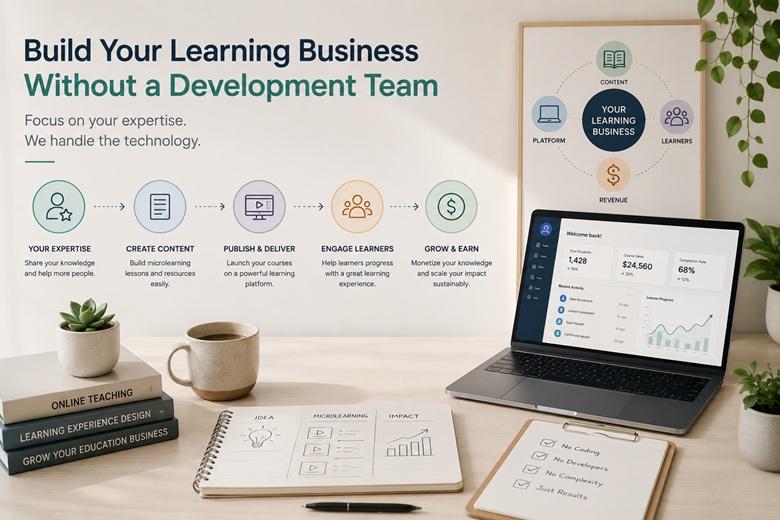
Building a learning business does not always require hiring
a full development team, especially in the early and growth stages. Many
creators, academies, coaches, communities, and training providers need a
professional way to deliver courses, manage learners, monetize expertise, and
build a branded learning experience, but they may not be ready to recruit
product managers, backend engineers, mobile developers, UI designers, QA
testers, and DevOps specialists. This article explains how training providers
can build a learning business using white-label learning infrastructure instead
of creating a platform from zero. It explores what a development team usually
handles, which responsibilities can be reduced through platform infrastructure,
and what still needs to be managed by the business owner.
- Quick
Answer
- Why
Learning Businesses Often Overestimate the Need for Custom Development
- What
a Full Development Team Actually Handles
- How
White-Label Infrastructure Reduces Technical Burden
- What
You Still Need to Build as a Learning Business
- White-Label
Platform vs Internal Development Team
- Practical
Roadmap for Building Without a Full Tech Team
- Common
Mistakes When Avoiding a Development Team
- Conclusion
- FAQ
Quick Answer
A training provider can build a learning business without
hiring a full development team by using white-label learning infrastructure for
the platform layer, while focusing internal effort on content, audience,
learning design, marketing, partnerships, learner support, and business
operations.
This approach is useful because many learning businesses do
not need to become software companies. They need a reliable system for
delivering courses, managing learners, tracking progress, supporting mobile
access, monetizing content, and presenting a branded experience. A white-label
learning platform can provide much of that technical foundation without
requiring the provider to build and maintain every feature independently.
However, this does not mean the business can ignore
technology decisions. The provider still needs to choose the right platform,
define the learner journey, prepare content, manage operations, review data,
and improve the learning experience over time.
The main trade-off is control versus complexity. Custom
development can offer deeper flexibility, but white-label infrastructure can be
more practical for providers that need speed, focus, and operational
efficiency.

Why Learning Businesses Often Overestimate the Need for Custom Development
When a creator, academy, or training provider starts
thinking seriously about building a learning business, the first instinct is
often to think about technology ownership.
They imagine having their own website, their own app, their
own dashboard, their own payment system, their own certificate system, and
their own learner database. This ambition is understandable. A serious learning
business needs more than scattered links, manual files, and informal
communication channels.
But the mistake is assuming that professional infrastructure
must always be custom-built.
In reality, many learning businesses need a strong delivery
system before they need a software product team. The immediate business
challenge is usually not how to invent new learning technology. It is how to
package expertise into structured content, attract the right learners, deliver
programs reliably, support completion, and create a monetization model that
works.
A custom platform can become a distraction when the business
model is still developing. The team may spend months discussing technical
features before validating course demand. Budget may go into app development
before the provider understands learner behavior. Energy may shift from
teaching and marketing into managing software vendors, bug lists, feature
requests, and technical timelines.
A learning business should not become a software project before it has proven the learning offer.
This does not mean custom development is never useful. Some
mature institutions, enterprises, or large-scale learning companies may require
specialized systems, deep integrations, proprietary workflows, or complex data
architecture. In those situations, an internal development team can be
strategic.
But for many creators and training providers, the early
question should be more practical: “What parts of the learning business truly
need custom development, and what parts can be handled by existing
infrastructure?”
White-label learning infrastructure exists for this reason.
It allows training businesses to operate with a branded platform experience
without carrying the full weight of software development from the beginning.
The goal is not to avoid technology. The goal is to avoid
building technology before the business model requires it.
What a Full Development Team Actually Handles
To understand the value of white-label infrastructure,
training providers need to understand what a full development team normally
does.
A learning platform is not just a public website. It is a
digital product with multiple layers. Each layer requires decisions,
maintenance, and technical skill.
A product manager or technical lead usually translates
business requirements into product specifications. A UI/UX designer plans the
user experience. Frontend developers build the interface learners and admins
use. Backend developers create the logic behind accounts, content access,
payments, progress tracking, and data storage. Mobile developers build and
maintain Android or iOS apps. QA testers check whether the system works
properly. DevOps or infrastructure engineers manage deployment, hosting, uptime,
security, and performance.
Even after launch, the work continues. Mobile operating
systems change. Browsers update. Payment providers adjust requirements. Bugs
appear. Users request improvements. Admins need better reporting. Security
patches must be applied. Content teams need new workflows. Business teams ask
for new pricing logic or access rules.
A full development team may handle:
- Platform
architecture
- User
registration and login
- Course
content management
- Video
and file delivery
- Learner
progress tracking
- Payment
integration
- Admin
dashboards
- Mobile
app development
- Notification
systems
- Analytics
and reporting
- Security
and permissions
- Testing
and bug fixing
- Hosting
and deployment
- App
store maintenance
- Feature
development and updates
For a training provider, this list is important because each
area has cost and risk. If handled well, custom technology can become a
competitive advantage. If handled poorly, it can delay growth and create
operational instability.
|
Technical Area |
Why It Matters |
Risk If Not Managed Well |
|
User accounts |
Learners need secure access |
Login issues and support overload |
|
Course management |
Content must be organized |
Confusing learner experience |
|
Progress tracking |
Providers need learning visibility |
Weak completion data |
|
Payment flow |
Monetization must be reliable |
Failed transactions or manual work |
|
Mobile compatibility |
Learners increasingly expect flexible access |
Poor experience across devices |
|
Maintenance |
Platform must remain stable |
Bugs, downtime, and rising costs |
This is why “build your own platform” should not be treated
as a simple decision. It is a long-term operational commitment.

How White-Label Infrastructure Reduces Technical Burden
White-label learning infrastructure reduces technical burden
by giving training providers a ready platform foundation that can be adapted to
their brand and learning model.
Instead of building core platform functions from zero, the
provider uses existing infrastructure for course delivery, learner management,
mobile access, content organization, progress tracking, analytics, and other
essential learning operations. The provider can then focus more on the business
layer: who the learners are, what programs to offer, how to price them, how to
improve content, and how to grow demand.
This is especially useful for training providers that want
to appear professional without hiring a large internal technical team. A
branded learning experience can support credibility, but the provider does not
have to carry the full cost of platform engineering.
White-label infrastructure may reduce the need to hire:
- Backend
developers for core learning logic
- Mobile
developers for app-based learning delivery
- DevOps
specialists for basic platform operations
- QA
testers for every platform release
- Product
designers for foundational learning flows
- Engineers
for common learning features already available in the platform
This does not remove all technical responsibility. The
provider still needs platform setup, configuration decisions, content
migration, user management planning, and integration discussions if required.
But the work is different. The provider is not building the entire system from
zero. It is configuring and operating on top of existing infrastructure.
White-label infrastructure shifts the training provider’s
role from software builder to learning business operator.
For FitAcademy, this is where white-label learning platform
positioning becomes strategically relevant. A provider can launch a branded
microlearning environment, deliver mobile-first courses, manage learning
programs, and build learner relationships without needing to recruit a complete
software development function at the start.
This connects closely with How
Training Providers Can Launch a Branded Learning App Without Building From
Scratch, which explains the app launch side of the decision. The current
discussion focuses more specifically on team structure and technical capacity.
FitAcademy
Build Your Learning Business Without Starting From Zero
FitAcademy helps creators, academies, and training providers use white-label learning infrastructure to launch branded microlearning experiences without hiring a full development team.
Explore FitAcademy White LabelWhat You Still Need to Build as a Learning Business
Using white-label infrastructure does not mean the learning
business is already built. It only means the provider does not have to build
the entire technology layer independently.
The real business still requires strategic work.
The first thing to build is a clear learning offer. The
provider must define what problem the course solves, who it is for, why the
content is valuable, and what learners should be able to do after completing
it. Without a clear offer, even a strong platform will feel empty.
The second thing to build is curriculum structure. Expertise
must be converted into a learning path. This may involve modules, short
lessons, practical examples, quizzes, reflection tasks, resources, assignments,
or completion criteria. A platform can host content, but it cannot
automatically turn expertise into effective learning.
The third thing to build is audience trust. A learning
business grows when people believe the provider can help them achieve a
meaningful outcome. Trust may come from content marketing, community
engagement, professional credibility, testimonials, partnerships, or repeated
learner success.
The fourth thing to build is operational discipline. Someone
must manage uploads, course updates, learner support, payment issues,
onboarding, reporting, and quality control. White-label infrastructure reduces
technical complexity, but it does not eliminate operational responsibility.
The fifth thing to build is a growth model. The provider
needs a plan for attracting learners, converting interest into enrollment,
encouraging completion, and creating repeat purchase or long-term engagement.
|
Business Layer |
What the Provider Must Own |
Why It Matters |
|
Learning offer |
Topic, audience, outcome, value proposition |
Creates demand |
|
Curriculum |
Modules, lessons, activities, progression |
Creates learning clarity |
|
Brand trust |
Positioning, credibility, communication |
Creates confidence |
|
Operations |
Support, updates, reporting, admin workflow |
Creates consistency |
|
Growth model |
Marketing, pricing, partnerships, retention |
Creates sustainability |
Infrastructure can carry the platform. It cannot carry an unclear learning business.

White-Label Platform vs Internal Development Team
The choice between a white-label platform and an internal
development team is not only a technical decision. It is a strategic resource
allocation decision.
Hiring a development team may be appropriate when the
learning business has unique technical requirements, sufficient capital,
long-term product ambition, and the management capability to lead software
development. This can make sense for companies that want to build proprietary
technology as a core asset.
A white-label platform may be more practical when the
provider’s main competitive advantage is expertise, content, audience,
facilitation, certification, industry relationships, or community access. In
this case, technology is still important, but it is an enabler rather than the
central product being invented.
The decision should be based on what the business needs to
control deeply.
If the provider needs a highly specialized algorithm,
complex enterprise integration, unique compliance architecture, or proprietary
product logic, internal development may become necessary. But if the provider
mainly needs branded course delivery, learner management, monetization support,
mobile access, and analytics, white-label infrastructure may be enough for the
current stage.
|
Decision Factor |
White-Label Platform |
Internal Development Team |
|
Best for |
Fast branded learning delivery |
Proprietary software product development |
|
Cost structure |
Platform and setup-based |
Salaries, tools, infrastructure, management |
|
Speed to market |
Faster in many cases |
Slower due to build process |
|
Technical control |
Limited by platform capabilities |
High |
|
Operational burden |
Lower |
Higher |
|
Strategic focus |
Learning business growth |
Product and software ownership |
|
Suitable stage |
Early to growth stage |
Mature or heavily funded stage |
For many training providers, the practical question is not
“Which option is better forever?” It is “Which option fits our current stage?”
A provider may start with white-label infrastructure to
validate and grow the learning business. Later, if the business becomes large
enough and specific enough, it may decide to develop custom components,
integrations, or proprietary systems. The path does not have to be
all-or-nothing.
For providers evaluating broader platform models, Join
Platform vs White-Label Platform: Which Model Fits Your Organization? provides
a related comparison between joining an existing platform and operating a
white-label learning environment.
Practical Roadmap for Building Without a Full Tech Team
A learning business can be built more realistically when the
provider separates platform infrastructure from business development.
The first step is to define the business category. Is the
provider selling self-paced courses, cohort-based programs, certification
training, community learning, corporate packages, or expert-led microlearning?
This decision affects content structure, pricing, support, and platform needs.
The second step is to validate the first learning offer.
Before investing heavily in platform setup, the provider should know which
audience it serves and whether the learning topic has demand. This can be done
through workshops, pilot cohorts, pre-sales, webinars, community feedback, or
existing client requests.
The third step is to prepare a focused content system.
Rather than trying to build a huge course library, the provider should create
one strong program that represents the quality of the brand. This program
becomes the foundation for the first learner experience.
The fourth step is to choose white-label infrastructure that
fits the intended workflow. Important considerations include mobile access,
course organization, admin management, learner tracking, monetization features,
branding flexibility, support model, and future expansion.
The fifth step is to launch with controlled scope. A small
pilot group can help test whether learners understand the platform, complete
lessons, ask fewer support questions, and perceive the experience as
professional.
The sixth step is to review data and improve operations. The
provider should look at completion patterns, learner questions, sales
performance, course feedback, and support issues.
The seventh step is to expand gradually. Once the first
program is stable, the provider can add more courses, create bundles, offer
institutional packages, or develop a membership-based learning ecosystem.

This roadmap helps the provider stay focused. The priority
is not to build the biggest platform immediately. The priority is to build a
learning business that can operate, learn, and grow.
For providers that already have programs and want to serve
more learners with the same team, How
to Scale Online Training Programs Without Expanding Your Team explains the
operational scaling side in more detail.
Common Mistakes When Avoiding a Development Team
Avoiding a full development team can be a smart decision,
but only if the provider understands what it still needs to manage.
The first mistake is assuming that white-label means no
technical thinking. Even if the provider does not code the platform, it still
needs to make platform decisions. Branding, course categories, user access,
payment flow, reporting needs, and learner communication must be planned.
The second mistake is choosing a platform only because it is
cheaper than hiring developers. Cost matters, but the real question is whether
the platform supports the business model. A low-cost system that creates manual
work, weak reporting, or poor learner experience can become expensive over
time.
The third mistake is expecting the platform provider to
define the learning business. A white-label partner may provide infrastructure,
but the training provider must define the audience, course promise, content
quality, pricing, and learner success strategy.
The fourth mistake is ignoring future growth. A provider may
choose a basic setup that works for the first course but becomes limiting when
it wants to add more programs, learner groups, certificates, corporate clients,
or analytics requirements.
The fifth mistake is underestimating internal ownership.
Even without a development team, someone must own the learning operation. This
may be the founder, course manager, content lead, or program coordinator.
|
Mistake |
Why It Creates Risk |
Better Approach |
|
Treating white-label as no technical decision |
Setup becomes unclear |
Plan platform workflow carefully |
|
Choosing only by lowest cost |
Manual work may increase later |
Evaluate operational fit |
|
Expecting the platform to define the business |
Learning offer stays weak |
Own strategy internally |
|
Ignoring future growth |
Platform may become limiting |
Choose for current and near-term needs |
|
Having no internal owner |
Operations become inconsistent |
Assign learning operations responsibility |
The better approach is to treat white-label infrastructure
as a strategic shortcut, not a substitute for business leadership. It reduces
the need for a full development team, but it does not remove the need for clear
decision-making.
Conclusion
A learning business does not need to begin as a software
company.
For many creators, academies, coaches, communities, and
training providers, the smarter path is to use existing white-label learning
infrastructure while focusing internal energy on the work that truly
differentiates the business: expertise, curriculum, learner outcomes, brand
trust, partnerships, and growth.
Hiring a full development team can make sense when the
organization has mature technical needs, strong capital, and proprietary
product ambitions. But for many providers, especially in the early and growth
stages, custom development may create more complexity than value.
White-label infrastructure offers a practical middle path.
It allows training providers to operate a branded learning platform, deliver
mobile-first courses, manage learners, and build a more professional digital
learning business without building every technical layer from scratch.
The strategic question is not whether technology matters. It
does. The better question is which technology should be built, which should be
configured, and which should be handled through existing infrastructure so the
learning business can grow with focus.
FitAcademy
Build Your Learning Business With White-Label Infrastructure
FitAcademy helps training providers launch branded microlearning platforms without hiring a full development team, so they can focus on content, learners, monetization, and long-term growth.
Explore White-LabelFAQ
Can I build a learning business without developers?
Yes. Many learning businesses can start and grow using
white-label learning platforms, no-code tools, or managed learning
infrastructure. Developers may become useful later for custom integrations or
proprietary systems, but a full development team is not always necessary at the
beginning.
What does a white-label learning platform replace?
A white-label learning platform can reduce the need to build
core learning infrastructure from scratch, such as course delivery, learner
access, progress tracking, mobile learning, admin management, and reporting. It
does not replace business strategy, content creation, learner support,
marketing, or operational ownership.
When should a training provider hire a development
team?A development team may be needed when the learning business
requires highly custom features, proprietary technology, complex integrations,
strict internal control, or large-scale product development. If the provider’s
immediate need is branded course delivery and learner management, white-label
infrastructure may be more practical.
Is white-label infrastructure suitable for creators?
Yes, especially for creators who already have expertise,
audience trust, or a clear course idea and want to build a more professional
learning experience. A white-label platform can help creators move beyond
scattered content delivery and create a branded environment for learners.
What should I focus on if I do not hire developers?
Focus on the learning offer, curriculum structure, audience
development, pricing, learner onboarding, content quality, support workflow,
and marketing. These areas determine whether the learning business works. The
platform provides infrastructure, but the provider must still build the
business around it.
Can I move from white-label to custom development
later?
In many cases, yes, but the ease of transition depends on
platform structure, data access, business requirements, and technical planning.
Some providers use white-label infrastructure to validate and grow first, then
later add custom integrations or proprietary systems when the business case
becomes stronger.