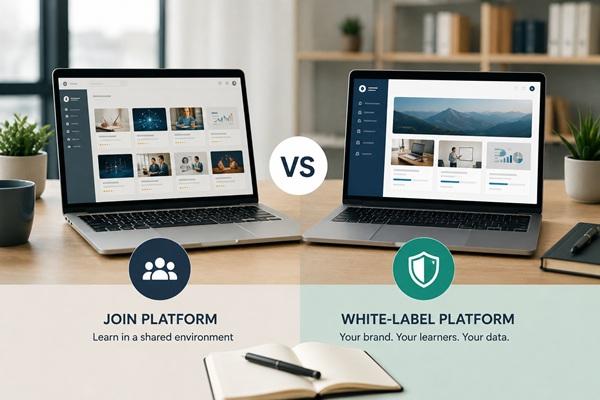
Organizations that want to launch online learning do not
always need the same platform model. Some need a fast, economical way to start
delivering courses under an existing platform environment. Others need a
branded learning ecosystem with stronger control over audience, learner data,
mobile access, monetization, and long-term platform ownership. This is where
the difference between a Join Platform model and a White-Label Platform model
becomes important. This article explains how both models work, who each model
fits best, what trade-offs decision-makers should understand, and how
organizations can choose the right path based on maturity, budget, brand
strategy, operational readiness, and growth ambition.
- Quick
Answer
- Why
This Decision Matters for Learning Strategy
- What
the Join Platform Model Means
- What
the White-Label Platform Model Means
- Join
Platform vs White-Label Platform
- When
Join Platform Is the Better Fit
- When
White-Label Platform Is the Better Fit
- How
Budget, Brand, Data, and Operations Shape the Decision
- Common
Mistakes When Choosing a Platform Model
- Practical
Decision Framework for Organizations
- Conclusion
- FAQ
- Related
Articles
- SEO
Metadata
- GEO
Readiness
Quick Answer
Join Platform is usually better for organizations, creators,
or training providers that want to start quickly, reduce setup complexity, and
use an existing learning platform environment without investing immediately in
a fully branded infrastructure. It can be useful for early-stage programs,
pilot projects, small academies, community learning, or organizations that want
to validate demand before committing to a larger platform model.
White-Label Platform is usually better for organizations
that need stronger brand ownership, direct learner relationships, deeper data
visibility, custom learning experience, mobile-first delivery, and long-term
education infrastructure. It fits institutions, training providers, corporate
learning teams, associations, and creators who want to build their own branded
learning ecosystem.
The best choice depends on strategic readiness. If the
priority is speed, affordability, and simplicity, Join Platform may be enough.
If the priority is brand control, audience ownership, scalability, and platform
differentiation, White-Label Platform is usually the stronger long-term option.

Why This Decision Matters for Learning Strategy
Choosing between Join Platform and White-Label Platform is
not only a pricing decision. It is a strategic decision about how an
organization wants to enter, operate, and scale online learning.
At an early stage, many organizations simply need a
practical way to publish content, enroll learners, and test whether their
education program works. They may not yet have a large audience, dedicated
learning operations team, custom brand requirements, or a clear monetization
model. For them, joining an existing platform can reduce friction and make the
first launch more realistic.
But as learning becomes more central to the organization’s
identity or business model, the requirements change. The organization may need
its own branded learner experience, stronger audience ownership, better learner
analytics, more flexible program packaging, and a platform that can support
long-term growth.
This is why FitAcademy positions both models differently.
Join Platform can serve organizations that need an economical and faster
starting point. White-Label Platform serves organizations that need branded
learning infrastructure and deeper control.
The broader digital education environment also supports this
distinction. The European Commission’s Digital Education Action Plan sets a
vision for high-quality, inclusive, and accessible digital education that helps
education and training systems adapt to the digital age. European
Commission Digital Education Action Plan OECD’s Digital Education Outlook
2023 also frames digital education as an ecosystem issue involving platforms,
tools, governance, and data use rather than isolated software adoption. OECD
Digital Education Outlook 2023
For decision-makers, the lesson is simple: the platform
model should match the organization’s learning maturity.
A small creator does not need to behave like a national
training institution on day one. A large institution should not depend on a
lightweight model if learning is becoming a long-term public service or
strategic capability channel. The right model depends on timing, capacity, and
ambition.
The best platform model is not the most advanced one. It is
the one that matches the organization’s current readiness and future direction.
What the Join Platform Model Means
The Join Platform model means an organization, creator,
training provider, or community launches learning programs inside an existing
learning platform environment.
Instead of building a dedicated branded system, the
organization joins a platform that already provides the basic infrastructure.
This may include course hosting, learner access, content management, mobile
access, payment or enrollment features, and reporting, depending on the
platform configuration.
The main advantage is speed and simplicity.
A training provider can start offering online modules
without building a platform from scratch. A creator can package expertise into
structured lessons without managing a full technology stack. A community can
offer member education without heavy technical setup. A small institution can
test digital programs before investing in branded infrastructure.
For organizations that are still validating their learning
model, this can be commercially sensible. They can test content, learner
demand, pricing, program structure, and operational workload before deciding
whether they need a fully branded platform.
Join Platform is especially useful when:
- the
organization wants to start quickly
- budget
is limited
- the
audience is still small
- the
program is still experimental
- technical
resources are limited
- brand
customization is not yet critical
- the
organization needs a lower-risk pilot
- the
main goal is learning delivery, not platform ownership
However, the model also has limits. Because the organization
joins an existing environment, customization may be more limited. Brand
presence may not feel fully independent. Data access may depend on platform
rules. The learner experience may be shaped partly by the host platform.
Long-term differentiation may be harder if the organization wants to build a
premium education brand.
Join Platform is often the practical first step. White-label is often the strategic scaling step.

What the White-Label Platform Model Means
The White-Label Platform model means the organization
launches a learning platform under its own brand, while the technology
infrastructure is provided by a platform partner.
This model is designed for organizations that want a
stronger sense of ownership. The learning experience can feel like the
organization’s own academy, training portal, mobile learning app, certification
platform, or professional development ecosystem.
White-label does not simply mean changing colors or adding a
logo. In a serious learning infrastructure context, it means creating a branded
environment where the organization can shape learner access, program structure,
content pathways, analytics, communication, monetization, and long-term growth.
A white-label platform can support:
- branded
web and mobile learning experience
- custom
learning program structure
- direct
learner onboarding
- stronger
learner relationship management
- data-informed
learning operations
- certificates,
pathways, or completion tracking
- paid
programs, memberships, or institutional access models
- integration
with broader business or education workflows
- scalable
delivery for multiple audiences or programs
This model is more suitable when learning is not merely an
experiment, but part of the organization’s strategy.
For example, a training provider may want to become known as
a specialized academy in its field. A professional association may want to
deliver member education under its own identity. A corporate learning team may
need a branded platform for partner training or workforce development. A
creator with a loyal audience may want to build a premium learning destination
rather than depend only on social platforms or marketplaces.
The benefit is stronger control. The trade-off is greater
responsibility. Organizations need clearer content planning, learner support,
platform governance, marketing, analytics review, and operational consistency.
White-label becomes valuable when the organization is ready
not only to launch learning, but to operate learning as a long-term asset.
Join Platform vs White-Label Platform
Both models can support online learning, but they optimize
for different needs.
|
Aspect |
Join Platform |
White-Label Platform |
|
Main purpose |
Start delivering learning quickly inside an existing
platform |
Build a branded learning ecosystem under the
organization’s identity |
|
Best fit |
Early-stage programs, pilots, creators, small training
providers, communities |
Institutions, established training providers, corporate
learning, associations, scaling creators |
|
Setup complexity |
Lower |
Higher than Join Platform, but lower than full custom
development |
|
Brand control |
Limited to available platform options |
Stronger brand ownership and learner experience control |
|
Speed to launch |
Usually faster |
Requires more preparation and configuration |
|
Budget requirement |
More economical starting point |
Higher investment, usually better for long-term strategy |
|
Learner relationship |
Partly shaped by the host platform environment |
More directly connected to the organization’s brand |
|
Data visibility |
Depends on shared platform features and policies |
Can be structured more closely around organization needs |
|
Scalability |
Suitable for testing and early delivery |
Better for long-term growth, multi-program delivery, and
branded education |
|
Operational responsibility |
Lower |
Higher, because the organization controls more of the
ecosystem |
|
Strategic value |
Access and validation |
Ownership and differentiation |
This comparison should not be interpreted as “basic versus
premium” only. It is more accurate to see the two models as different stages or
strategies.
Join Platform can be the right choice when simplicity
matters. White-Label Platform can be the right choice when ownership matters.
An organization may start with Join Platform and later move
to White-Label once it has validated demand, built an audience, refined its
content, and clarified its business model. Another organization may begin
directly with White-Label because it already has a brand, audience,
institution-level requirements, or strategic mandate.
The important thing is to avoid choosing a model only
because it sounds more advanced. A white-label platform can be underused if the
organization is not ready to manage it. A Join Platform model can become
limiting if the organization already needs brand ownership and data control.
FitAcademy
Compare the Right Learning Platform Model for Your Organization
FitAcademy offers flexible learning platform paths for organizations that want to start quickly through Join Platform or build stronger branded learning infrastructure through White-Label.
Explore White-Label / Join PlatformWhen Join Platform Is the Better Fit
Join Platform is often the better fit when the organization
is still learning how its audience responds to online education.
This model works well for early-stage programs. A creator
may have expertise and followers but not yet know which course format will
sell. A community may want to test member education before building a full
academy. A training provider may want to digitize one program before
redesigning the whole business. A small organization may need to launch quickly
because the immediate need is delivery, not infrastructure ownership.
Join Platform can also be useful when the internal team is
small. If there is no dedicated technical team, learning operations team, or
digital product manager, a lighter platform model reduces workload. The
organization can focus on content, learner communication, and program
validation.
Budget is another important factor. Not every organization
should invest heavily before proving demand. A more economical platform entry
point can make learning innovation more accessible.
Join Platform may be the better choice when the organization
says:
- “We
need to test this first.”
- “We
do not have a large learner base yet.”
- “We
want to launch without heavy setup.”
- “Brand
ownership is not our biggest concern right now.”
- “We
need a practical way to deliver learning online.”
- “We
want to validate demand before committing to a bigger platform.”
The limitation is that Join Platform may not support
long-term differentiation as strongly as white-label. If the learning program
grows, the organization may eventually need more control over branding, user
experience, data, monetization, and communication.
This is why Join Platform should be treated as a strategic
starting model, not necessarily the final destination.

When White-Label Platform Is the Better Fit
White-Label Platform is the better fit when learning is
already connected to brand strategy, audience ownership, institutional
credibility, or business growth.
This model is suitable for organizations that want the
learning platform itself to become a strategic asset. The platform is not only
a delivery channel; it is part of how the organization builds trust, serves
learners, and scales education programs.
A training provider may choose white-label because it wants
to build a recognizable academy. A company may choose it because partner or
customer training needs to feel official and aligned with the brand. A
professional association may choose it because member education strengthens
long-term engagement. A creator may choose it because the audience is already
large enough to support a dedicated learning destination.
White-label may also be better when data visibility is
important. If the organization needs to understand learner behavior, improve
learning paths, analyze completion patterns, and connect learning data with
business decisions, a more controlled platform environment becomes valuable.
White-label is especially relevant when the organization
says:
- “Our
learning experience must carry our brand.”
- “We
need stronger control over learner data.”
- “We
want to build a long-term academy.”
- “We
serve multiple programs or learner groups.”
- “We
need mobile-first access under our identity.”
- “We
want to monetize learning more strategically.”
- “We
need a platform that supports future scale.”
The limitation is readiness. White-label requires more
planning than Join Platform. The organization should prepare content structure,
learner journey, brand identity, operating roles, support workflow, data
requirements, and growth strategy.
A white-label platform is powerful when the organization is
ready to use it as infrastructure. It can feel excessive if the organization
only needs a simple place to upload one course.
White-label is strongest when the organization has a clear
reason to own the learning experience, not just a desire to look more branded.
How Budget, Brand, Data, and Operations Shape the Decision
The choice between Join Platform and White-Label Platform
becomes clearer when viewed through four decision factors: budget, brand, data,
and operations.
Budget affects the starting point. Join Platform is usually
more accessible because it reduces setup and customization requirements. This
makes it suitable for experiments, pilots, and early-stage learning businesses.
White-label usually requires a higher investment because it involves more
configuration, branding, and strategic setup. However, that investment may be
justified when the platform supports long-term growth or revenue.
Brand affects learner perception. If the learning experience
is secondary, Join Platform may be enough. If the learning experience
represents the organization’s credibility, white-label becomes more important.
Brand matters especially for premium academies, institutional programs,
professional certification, corporate learning, and public-facing training.
Data affects decision quality. If the organization only
needs basic reporting, Join Platform may work. If it needs deeper learner
analytics, segmentation, engagement tracking, and data-informed program
improvement, white-label can provide stronger alignment depending on platform
capabilities.
Operations affect sustainability. Join Platform reduces
operational burden, but may limit customization. White-label provides more
control, but requires more responsibility. Organizations must manage content
updates, learner support, communication, program structure, analytics review,
and platform governance.
This is also why data governance should not be ignored.
UNESCO’s technical guide for online education platforms highlights the
importance of personal data security in online learning environments. UNESCO
personal data security technical guide for online education platforms OECD
also emphasizes governance and trust as important parts of digital education
ecosystems. OECD
digital education ecosystems and governance
|
Decision Factor |
Join Platform Priority |
White-Label Platform Priority |
|
Budget |
Lower starting cost and faster validation |
Higher strategic investment for long-term ownership |
|
Brand |
Basic presence inside an existing platform |
Branded academy, portal, or app experience |
|
Data |
Basic reporting is enough |
Deeper learner analytics and ownership are important |
|
Operations |
Small team, simple delivery, limited setup |
Dedicated program management and growth planning |
|
Audience |
Early-stage or still being validated |
Existing audience or clear acquisition strategy |
|
Growth |
Testing one or a few programs |
Scaling multiple programs, cohorts, or learner segments |

Common Mistakes When Choosing a Platform Model
The first mistake is choosing White-Label too early. Some
organizations want a fully branded platform before validating content demand,
learner needs, pricing, or operational capacity. This can create unnecessary
complexity. A polished platform does not solve unclear positioning or weak
content.
The second mistake is staying too long in Join Platform. A
shared environment may be enough at the beginning, but it can become limiting
once the organization needs stronger brand identity, learner ownership, data
access, or monetization flexibility. Growth can expose limitations that were
invisible during the pilot stage.
The third mistake is comparing only subscription price.
Platform cost should include setup, content production, staff time, learner
support, reporting, payment workflow, customization needs, and future migration
risk. The cheapest option is not always the most economical over time.
The fourth mistake is ignoring learner experience. A
platform model should be chosen based on how learners will actually access and
complete learning. If learners are mobile-first, busy, distributed, or need
short lessons, the platform should support that behavior.
The fifth mistake is assuming platform ownership guarantees
business success. White-label provides infrastructure, but the organization
still needs audience development, content quality, marketing, learner support,
and continuous improvement.
The sixth mistake is not planning migration. If an
organization starts with Join Platform and expects to move to White-Label
later, it should think early about content structure, learner records,
branding, data export, and communication continuity.
A platform model should reduce strategic friction, not create a more expensive version of the wrong operating model.
Practical Decision Framework for Organizations
A practical decision framework can help organizations choose
between Join Platform and White-Label Platform more confidently.
Start with the learning objective. Is the organization
trying to test an idea, support a small audience, launch quickly, or validate
demand? If yes, Join Platform may be the sensible first step. Is the
organization trying to build a branded academy, scale programs, manage learner
data, and create long-term audience value? If yes, White-Label may be more
appropriate.
Next, evaluate audience maturity. If the organization does
not yet know who will enroll or pay, starting lighter may reduce risk. If the
audience is already defined and reachable, a branded platform may help convert
trust into structured learning participation.
Then review operational capacity. White-label requires
someone to manage content, learners, analytics, support, and program updates.
If the organization is not ready for that, Join Platform can keep the model
simpler while capacity develops.
After that, assess brand importance. If the program is
internal, temporary, or experimental, brand control may be less urgent. If the
program represents the organization publicly, brand control becomes more
important.
Finally, examine long-term platform dependency. If the
organization expects learning to become a strategic business or institutional
function, it should avoid choosing a model that blocks future growth.
|
Organization Situation |
Better Starting Model |
Why |
|
New creator testing a first paid course |
Join Platform |
Lower setup burden and faster demand validation |
|
Small training provider digitizing one workshop |
Join Platform |
Practical entry point before investing in full
infrastructure |
|
Community offering member education for the first time |
Join Platform |
Easier pilot with limited operational complexity |
|
Established academy with multiple programs |
White-Label Platform |
Stronger brand control, program structure, and learner
continuity |
|
Institution launching public education initiatives |
White-Label Platform |
Better fit for credibility, governance, access, and
long-term delivery |
|
Company training partners or external users |
White-Label Platform |
More official brand experience and stronger control over
learner access |
|
Creator with a strong audience and premium education offer |
White-Label Platform |
Supports direct monetization, branded learning, and repeat
programs |
The decision does not have to be permanent. A staged
approach can be effective: start with Join Platform, validate the learning
model, then move to White-Label when ownership becomes strategically important.
For organizations still clarifying the broader ecosystem
shift, why
organizations are moving from LMS platforms to white-label learning ecosystems
provides the awareness-level context. For organizations comparing shared
marketplace models, white-label
learning platform vs marketplace platform explains the ownership difference
more directly.
Conclusion
Join Platform and White-Label Platform are not competing
answers to the same problem. They are different models for different stages of
learning growth.
Join Platform is practical when the organization wants to
start quickly, keep costs manageable, reduce operational complexity, and
validate whether its learning program works. It is often the better choice for
early-stage creators, small training providers, pilot programs, and communities
that need a simple way to begin.
White-Label Platform is strategic when the organization
wants stronger control over brand, learner relationships, data, mobile learning
experience, monetization, and long-term education infrastructure. It is better
suited for institutions, established training providers, companies,
associations, and creators who are ready to build a branded learning ecosystem.
The best decision starts with honesty. What is the
organization ready to manage today? What does it need to own tomorrow? How
important are brand, data, learner continuity, and growth? The clearer those
answers are, the easier it becomes to choose the right platform model.
FitAcademy
Choose the FitAcademy Model That Matches Your Learning Strategy
Whether you want to start quickly through Join Platform or build a branded learning ecosystem through White-Label, FitAcademy helps organizations choose a practical path for scalable digital learning.
Explore White-Label / Join PlatformFAQ
What is the main difference between Join Platform and White-Label Platform?
Join Platform lets an organization launch learning programs
inside an existing platform environment with less setup and lower complexity.
White-Label Platform allows the organization to create a branded learning
experience under its own identity with stronger control over learner
relationships, data, and long-term platform strategy.
Is Join Platform only for beginners?
Not always. Join Platform can be useful for pilots, small
programs, community learning, temporary initiatives, or organizations that want
a lower-risk way to start. It is especially practical when the organization
does not yet need full branding, deep customization, or advanced ownership
features.
When should an organization move from Join Platform to White-Label?
An organization should consider moving when learning becomes
strategically important to its brand, revenue, audience relationship, or
institutional mission. Signs include multiple programs, growing learner base,
need for stronger data access, demand for branded experience, and a clear plan
for long-term learning operations.
Is White-Label Platform better than Join Platform?
Not universally. White-label is better when ownership,
branding, data, and scalability matter. Join Platform is better when speed,
affordability, and simplicity matter more. The right choice depends on the
organization’s readiness, budget, audience size, operational capacity, and
learning goals.
Can an organization start with Join Platform and later upgrade to White-Label?
Yes, a staged path can be practical. Organizations can begin
with Join Platform to validate content, audience demand, and delivery workflow.
Once they have stronger traction and clearer requirements, they can move toward
White-Label. It is important to plan content structure and learner data
carefully from the beginning.
What should organizations prepare before choosing White-Label?
They should prepare brand identity, target learner segments,
content structure, learner journey, data requirements, monetization model,
support workflow, and internal responsibilities. White-label provides stronger
infrastructure, but the organization still needs operational readiness to use
it effectively.