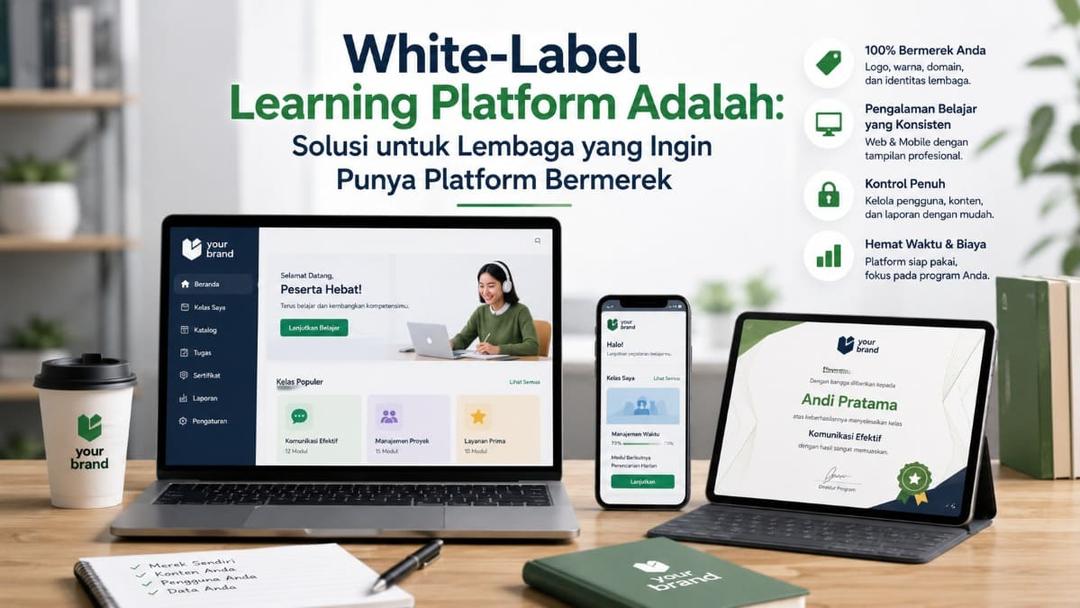
For training providers, a branded learning app is no longer
only a technical asset. It can become the central environment where learners
discover courses, complete lessons, track progress, receive updates, and
associate the learning experience with the provider’s brand. But building an
app from scratch requires product strategy, engineering, infrastructure,
maintenance, UX design, content operations, and long-term support. This article
explains how creators, academies, coaches, and training businesses can launch a
branded learning app using white-label learning infrastructure instead of
developing everything internally. It covers the strategic value, operational
requirements, trade-offs, implementation steps, common mistakes, and how to
decide whether a white-label approach fits your training business.
- Quick
Answer
- Why
Training Providers Are Moving Toward Branded Learning Apps
- The
Problem With Building a Learning App From Scratch
- What
a White-Label Learning App Actually Provides
- Branded
App vs Custom-Built App vs Marketplace
- What
Training Providers Should Prepare Before Launching
- Practical
Implementation: From Content to App Launch
- Common
Mistakes When Launching a Branded Learning App
- Conclusion
- FAQ
Quick Answer
Training providers can launch a branded learning app without
building from scratch by using a white-label learning platform. Instead of
hiring a full development team to design, code, test, maintain, and
continuously improve a custom app, the provider uses existing learning
infrastructure that can be adapted with its own branding, content, learner
experience, and business model.
This approach matters because many training businesses need
more control than a marketplace can offer, but they may not be ready for the
cost and operational burden of custom software development. A branded learning
app can help training providers create a more professional learner experience,
strengthen brand recall, manage course delivery, support mobile learning, and
build a direct relationship with learners.
The trade-off is important: white-label infrastructure
reduces technical complexity, but it does not remove the need for clear content
strategy, learner onboarding, course structure, pricing, support, and
marketing. The app is not the business by itself. It is the delivery system
that helps the training business operate more professionally.

Why Training Providers Are Moving Toward Branded Learning Apps
For many creators and training providers, online learning
used to begin with a simple question: “Where can I upload my course?”
That question is no longer enough.
As online training becomes more competitive, the real
question becomes: “Where does the learner experience live, and who owns that
relationship?”
A training provider may start by selling courses through
social media, video platforms, messaging groups, spreadsheets, shared folders,
or public course marketplaces. These channels can be useful in the early stage
because they are accessible and familiar. They help validate whether people are
interested in the topic, whether the instructor can attract demand, and whether
the content has commercial potential.
But as the learning business grows, operational friction
usually becomes more visible. Learners ask where to access materials.
Certificates are managed manually. Payment confirmation takes time. Course
updates are scattered across different channels. Progress tracking becomes
difficult. The brand experience feels fragmented because the learner moves
between multiple tools that were never designed as one learning journey.
A branded learning app addresses this problem by giving the
training provider a dedicated environment for learning delivery. The app
becomes the place where learners can access lessons, continue modules, receive
notifications, complete activities, review learning materials, and return to
the provider’s ecosystem.
A branded app is not just a digital container. It is the learning environment your audience remembers.
For creators, coaches, academies, and professional training
providers, this matters because trust is built through repeated experience. If
every learning interaction happens inside third-party channels, the learner may
remember the instructor, but the provider’s own learning brand may remain weak.
If the experience happens inside a branded app, every login, course page,
notification, and completion moment reinforces the provider’s identity.
This is especially relevant for training providers that want
to move from one-time course sales toward a more structured learning business.
A branded app can support:
- Paid
online courses
- Cohort-based
learning
- Microlearning
programs
- Professional
development content
- Membership-based
education
- Certification
or completion tracking
- Internal
training for communities or organizations
- Creator-led
learning ecosystems
The strategic value is not only visual branding. It is
continuity. The learner does not simply buy a course. The learner enters a
learning system that belongs to the training provider.
For training providers, the shift from selling content to
operating a learning experience is often the point where platform ownership
becomes strategically important.
The Problem With Building a Learning App From Scratch
Building a learning app from scratch can sound attractive.
In theory, it gives the training provider full control over features, design,
user experience, data structure, payment flow, content format, and future
development.
In practice, custom development is rarely just a one-time
project.
A learning app requires more than a homepage and a video
player. It usually needs user registration, authentication, content management,
course sequencing, learner progress tracking, payment logic, notifications,
admin dashboards, reporting, security updates, device compatibility, bug
fixing, app store compliance, user support, hosting infrastructure, and ongoing
maintenance.
For a training provider whose core strength is expertise,
curriculum, facilitation, or audience building, this can become a major
distraction. The team may begin with the goal of launching a learning business
but end up managing software specifications, development delays, technical
bugs, feature requests, and maintenance costs.
The challenge is not that custom development is wrong. For
some mature organizations with large budgets, specialized requirements, and
internal product teams, custom development may make sense. The problem is that
many training providers choose custom development before they fully understand
the operational commitment.
A custom app may require decisions such as:
- Who
designs the learner journey?
- Who
maintains the backend system?
- Who
updates the app when mobile operating systems change?
- Who
fixes payment or login issues?
- Who
manages hosting, security, and backups?
- Who
builds analytics and reporting?
- Who
supports instructors and learners?
- Who
improves the system after launch?
These questions matter because learning technology does not
stop at launch. Once learners begin using the app, expectations increase. They
expect stable access, smooth navigation, reliable progress tracking, clear
communication, and fast support when something does not work.
|
Area |
Building From Scratch |
Using White-Label Infrastructure |
|
Initial technical work |
High |
Lower |
|
Time to launch |
Often longer |
Usually faster |
|
Development team requirement |
Significant |
Reduced |
|
Branding control |
Potentially very high |
Strong, depending on platform |
|
Maintenance responsibility |
Mostly internal |
Shared or handled by platform provider |
|
Feature flexibility |
High but costly |
Based on available platform capabilities |
|
Best fit |
Mature organizations with product teams |
Training providers that need branded delivery without full
software development |
The key issue is not only cost. It is focus. A training
provider that spends too much energy building technology may delay the real
business work: creating useful courses, attracting learners, improving
completion, building trust, and monetizing expertise.

What a White-Label Learning App Actually Provides
A white-label learning app gives training providers a way to
launch a branded learning experience using existing technology infrastructure.
The platform is already developed, but the experience can be adapted so the
provider can present courses, learning programs, and learner journeys under its
own brand.
This is different from simply uploading content to a
marketplace. In a marketplace, the platform’s brand is usually dominant. The
learner may discover many other instructors and courses inside the same
environment. The provider gets access to infrastructure, but the relationship
is often shaped by the marketplace’s rules, interface, pricing options, data
access, and algorithmic visibility.
A white-label learning app is designed around the provider’s
brand. Depending on the platform, this may include branded visuals, custom
domain or app identity, course catalog structure, learning dashboard,
notifications, certificates, learner management, analytics, and monetization
features.
For FitAcademy, the strategic relevance is clear: training
providers can use white-label learning infrastructure to launch a branded
microlearning experience without building the entire platform independently.
This is especially useful for creators, academies, and training businesses that
want a more professional delivery system but still need a practical path to
implementation.
A white-label learning app may support several operational
needs:
- Course
and lesson delivery
- Mobile-first
learning access
- Microlearning
content structure
- Learner
registration and access control
- Progress
tracking
- Course
completion records
- Payment
or monetization flow
- Learning
analytics
- Notifications
and reminders
- Branded
learner experience
- Admin
management for content and users
White-label infrastructure does not replace learning
strategy. It gives training providers a stronger operating system for
delivering that strategy.
The important distinction is that white-label infrastructure
reduces the burden of software ownership, but it does not eliminate business
responsibility. The provider still needs to define the course promise,
audience, pricing, learning flow, content quality, onboarding process, and
support model.
A branded app can make the learning business look more
professional, but the learning experience must still be designed with care.
Learners will not stay only because the app has the provider’s logo. They stay
when the content is relevant, the experience is clear, and the program helps
them make progress.
Branded App vs Custom-Built App vs Marketplace
Before launching a branded learning app, training providers
should understand the difference between the main platform paths available to
them.
There is no single best model for every provider. The right
choice depends on business stage, budget, audience ownership, operational
capacity, technical resources, and long-term ambition.
A marketplace can be useful when the provider wants access
to an existing audience and does not need strong brand control. It is often
easier to start, but the provider may have limited control over learner data,
pricing structure, experience design, and customer relationship.
A custom-built app can be useful when the provider has
highly specific requirements and enough budget to support long-term software
development. It offers the most flexibility, but it also creates the highest
operational burden.
A white-label learning app sits between these models. It
gives the provider more brand control than a marketplace, while avoiding much
of the complexity of building from scratch.
|
Decision Factor |
Marketplace |
White-Label Learning App |
Custom-Built App |
|
Brand visibility |
Usually limited |
Stronger |
Full control |
|
Learner relationship |
Platform-influenced |
More direct |
Fully direct |
|
Technical responsibility |
Low |
Moderate to low |
High |
|
Launch speed |
Fast |
Relatively fast |
Often slow |
|
Flexibility |
Limited by marketplace rules |
Based on platform capabilities |
Highly flexible |
|
Operational complexity |
Low at first |
Manageable |
High |
|
Best for |
Testing demand |
Building a branded learning business |
Complex proprietary learning systems |
A creator who is still testing a course idea may begin with
simple channels or a marketplace. But a training provider that already has an
audience, recurring programs, institutional clients, or a clear niche may need
more control over the learning environment.
This is where white-label can become attractive. It allows
the provider to look more established, organize learning more systematically,
and create a more coherent learner journey without immediately becoming a
software company.
For a deeper comparison of platform ownership models,
readers can also review Join
Platform vs White-Label Platform: Which Model Fits Your Organization?.
The platform choice shapes not only how courses are delivered, but how the learning business grows.
FitAcademy
Launch a Branded Learning Experience Without Starting From Zero
FitAcademy helps creators, academies, and training providers build a branded microlearning platform using white-label infrastructure, so they can focus more on content, learners, and business growth.
Explore FitAcademy White LabelWhat Training Providers Should Prepare Before Launching
A branded learning app works best when the training provider
has clarity before implementation begins. The technology can provide the
structure, but the provider must define what the learning business is trying to
achieve.
The first preparation is audience clarity. A training
provider should know who the app is for, what problem the audience wants to
solve, and what kind of learning experience they expect. A leadership training
provider, for example, may need structured modules, progress tracking, and
certificates. A creator teaching practical business skills may need short
mobile lessons, community touchpoints, and simple payment flow. A professional
association may need member access, expert-led courses, and scalable content
delivery.
The second preparation is content structure. Many training
providers already have valuable knowledge, but that knowledge may exist in
workshop slides, long recordings, PDF materials, live session notes, or
informal teaching frameworks. Before launching an app, the provider should
decide how the material will be transformed into a digital learning experience.
This may include:
- Breaking
long lessons into shorter modules
- Organizing
content by skill level or learning outcome
- Creating
a clear course sequence
- Adding
quizzes, reflection tasks, or practice activities
- Defining
completion criteria
- Preparing
downloadable resources
- Planning
course updates over time
The third preparation is the business model. A branded
learning app can support different monetization approaches, but the provider
should avoid launching without a clear commercial logic. Possible models
include individual course sales, subscription access, bundled programs,
corporate packages, certification fees, cohort-based programs, or member-only
learning libraries.
The fourth preparation is operational ownership. Even with
white-label infrastructure, someone still needs to manage content uploads,
learner communication, support questions, course updates, promotional
campaigns, reporting, and quality control.
The most successful branded learning apps are not launched
as technology projects. They are launched as learning operations with a clear
audience, content system, and business model.

Practical Implementation: From Content to App Launch
Launching a branded learning app should not begin with every
possible feature. It should begin with the smallest strong version of the
learning experience.
For many training providers, the practical path starts with
one clear program. This may be a flagship course, a professional training
package, a certification-oriented module, or a paid microlearning series.
Starting with one focused program allows the provider to test the learner
journey, refine the content structure, and understand operational needs before
expanding into a larger catalog.
A practical implementation workflow may look like this:
- Define
the core learning promise
The provider should identify the specific transformation or outcome the course is meant to support. For example, “help small business owners understand basic digital marketing,” or “train new staff on customer service standards.” - Convert
expertise into a structured curriculum
The material should be organized into modules, lessons, and learning checkpoints. This is where long-form training content can be adapted into microlearning-friendly units. - Prepare
the branded experience
The provider defines brand elements, course categories, app positioning, learner onboarding flow, certificate style, and communication tone. - Configure
platform operations
This may include user access, pricing, payment flow, admin roles, learner groups, notifications, and reporting needs. - Launch
to a controlled audience first
Instead of opening everything publicly from day one, the provider can launch to a pilot group, existing customers, community members, or a small cohort. - Review
learning and business data
Completion patterns, learner questions, drop-off points, sales performance, and support issues can reveal what needs improvement. - Expand
gradually
Once the first program is stable, the provider can add more courses, bundles, corporate packages, or membership-based learning paths.
This staged approach is important because a branded learning
app should not become a large empty platform. It should feel active, useful,
and intentional from the first learner experience.
Training providers that want to scale delivery further can
also connect this approach with how
to scale online training programs without expanding your team. The branded
app creates the infrastructure, while operational design determines how
efficiently the provider can grow.

Common Mistakes When Launching a Branded Learning App
A branded learning app can create strong strategic value,
but only when it is planned realistically. Many training providers make the
mistake of treating the app as the whole solution rather than the delivery
infrastructure.
The first common mistake is focusing only on visual
branding. A logo, color palette, and app name matter, but they do not
automatically create a strong learning experience. Learners care about clarity,
relevance, progress, and ease of use. Branding should support the experience,
not hide weak content structure.
The second mistake is launching too many courses at once. A
large catalog may look impressive, but if the content is uneven, outdated, or
poorly organized, learners may feel overwhelmed. A focused flagship program is
often more useful than a broad but shallow course library.
The third mistake is ignoring learner onboarding. Many
providers assume learners will know what to do after they log in. In reality,
learners need clear guidance: where to start, how long the program takes, what
they will achieve, how progress is tracked, and what support is available.
The fourth mistake is choosing a platform only by price. Low
cost may look attractive at the beginning, but the real question is whether the
platform supports the provider’s long-term learning operations. A cheaper tool
can become expensive if it creates manual work, limits monetization, weakens
learner experience, or prevents useful reporting.
The fifth mistake is underestimating content operations.
Courses need updates, learner questions need responses, and learning data needs
review. A branded app can make operations easier, but it cannot manage the
learning business without human ownership.
|
Mistake |
Why It Happens |
Better Approach |
|
Treating branding as only a logo |
Visual identity feels easier than learning design |
Design the full learner journey |
|
Launching too many courses |
Providers want the app to look complete |
Start with one strong flagship program |
|
Ignoring onboarding |
Providers assume learners will self-navigate |
Give learners a clear starting path |
|
Choosing only by price |
Initial budget pressure feels urgent |
Evaluate long-term operational fit |
|
Forgetting content maintenance |
Focus stays on launch day |
Plan updates, support, and analytics review |
A better approach is to treat the branded app as part of a
broader learning business system. The provider should connect platform
decisions with audience strategy, course design, marketing, learner success,
analytics, and monetization.
For providers that are still deciding whether they need
their own technical team, the next strategic question is covered in how
to build a learning business without hiring a full development team.
Conclusion
A branded learning app can help training providers move
beyond scattered course delivery and create a more professional, recognizable,
and scalable learning experience. But the smartest path is not always to build
everything from scratch.
For many creators, academies, and training businesses,
white-label learning infrastructure offers a practical middle path. It gives
the provider stronger brand presence and more control than a marketplace, while
reducing the technical burden of custom app development. This allows the
provider to focus on the parts of the business that create long-term value:
useful content, learner trust, clear outcomes, effective delivery, and
repeatable operations.
The strategic point is simple: a branded app should not be
treated as a vanity product. It should be treated as learning infrastructure.
When the platform, content, business model, and learner journey work together,
the app becomes more than a place to host courses. It becomes the operating
layer of the training provider’s digital learning business.
FitAcademy
Explore White-Label Learning Infrastructure for Your Training Business
FitAcademy helps training providers launch branded, mobile-first microlearning experiences without building the entire platform from scratch. It is designed for teams that want to focus on learners, content, and growth while using ready learning infrastructure.
Explore White-LabelFAQ
What is a branded learning app?
A branded learning app is a mobile learning application that
presents courses, lessons, learner progress, notifications, and other learning
activities under a training provider’s own brand. It is different from a
generic course marketplace because the learner experience is centered around
the provider’s identity, content structure, and learning journey.
Do training providers need to build their own app from scratch?
Not always. Building from scratch may be useful for
organizations with very specific requirements and strong technical resources.
However, many training providers can use white-label learning infrastructure to
launch a branded app faster and with less development complexity. The decision
depends on budget, technical capacity, platform requirements, and long-term
business goals.
Is a white-label learning app the same as an LMS?
A white-label learning app can include LMS-like functions
such as course delivery, learner management, progress tracking, and reporting.
The difference is that the experience is adapted to the provider’s brand and
often designed for mobile-first access. Some white-label systems function as
full learning platforms, while others focus on specific delivery or
monetization needs.
Who should consider a white-label learning app?
Creators, coaches, academies, professional training
providers, communities, and institutions may consider a white-label learning
app when they already have content, audience demand, or recurring training
programs. It is especially relevant when the provider wants stronger brand
control, more direct learner relationships, and a more organized digital
learning experience.
What should be prepared before launching a branded learning app?
Training providers should prepare their audience definition,
course structure, learning outcomes, brand identity, pricing model, learner
onboarding plan, content update process, and support workflow. The platform can
provide infrastructure, but the provider still needs a clear learning and
business strategy.
Can a branded learning app help monetize expertise?
Yes, it can support monetization by giving training
providers a more structured environment for selling courses, programs,
memberships, or learning packages. However, monetization depends on audience
trust, content relevance, pricing, marketing, learner experience, and
consistent value delivery. The app supports the business model, but it does not
guarantee revenue by itself.