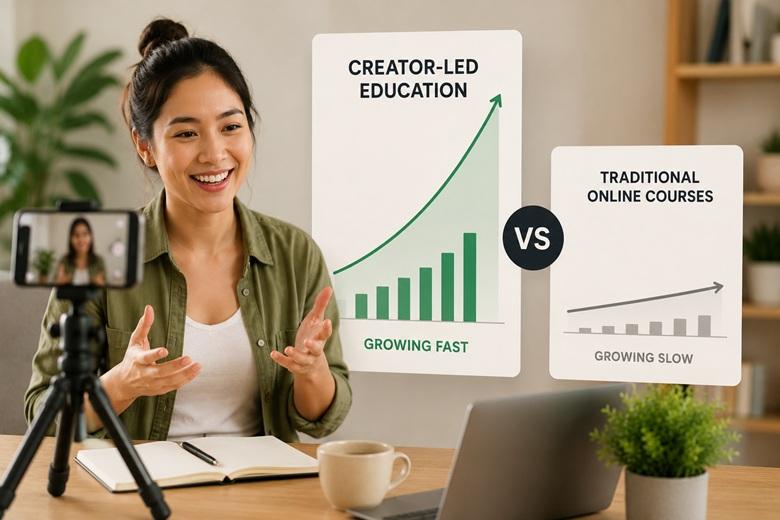
Creator-led education is changing how people discover,
trust, and buy learning experiences. Instead of relying only on traditional
online courses from institutions or large platforms, many learners now follow
coaches, creators, practitioners, and niche experts who teach from real
experience and build direct audience relationships. This shift matters because
education is becoming more personal, community-driven, mobile-friendly, and
outcome-oriented. For creators, coaches, and education entrepreneurs, the opportunity
is no longer limited to selling long courses. They can build compact learning
products, microlearning programs, paid communities, and specialized learning
pathways around their expertise. This article explains why creator-led
education is growing, how it differs from traditional online courses, what
learners expect, and how creators can turn audience trust into structured
learning businesses.
- Quick
Answer
- What
Creator-Led Education Means
- Why
Learners Are Moving Beyond Traditional Online Courses
- The
Trust Advantage Behind Creator-Led Learning
- How
Microlearning Supports Creator-Led Education
- Creator-Led
Education vs Traditional Online Courses
- What
This Shift Means for Coaches, Creators, and Education Businesses
- How
Creators Can Build a Learning Experience Without Overcomplicating It
- Risks
and Limitations of Creator-Led Education
- Conclusion
- FAQ
Quick Answer
Creator-led education is growing because learners
increasingly want practical, relatable, and specialized learning experiences
from people they already trust. Traditional online courses often focus on broad
curriculum delivery, while creator-led education usually starts from audience
relationships, personal expertise, niche problems, and real-world application.
This shift does not mean traditional online courses are
disappearing. Institutions, universities, corporate academies, and large
learning platforms still play important roles, especially for formal
credentials and comprehensive training. But many learners now prefer shorter,
more focused, mobile-friendly learning experiences that help them solve
specific problems quickly.
Creator-led education is especially relevant for coaches,
consultants, professional creators, independent educators, and niche experts.
These individuals often have direct audience access, strong personal
credibility, and practical knowledge that can be packaged into microlearning
products, workshops, memberships, or learning communities.
The main operational implication is that creators need more
than content. To build a sustainable education business, they need structure,
learner access, payment systems, learning analytics, mobile delivery, and a
platform model that supports growth without forcing them to build everything
from scratch.

What Creator-Led Education Means
Creator-led education refers to learning experiences built
around independent creators, coaches, consultants, practitioners, educators, or
niche experts who teach directly to an audience. These creators may use social
media, newsletters, webinars, communities, podcasts, live sessions, or learning
platforms to share knowledge and build trust before offering structured paid
learning products.
The key word is not only “creator.” It is “led.”
In creator-led education, the learning experience is shaped
by the creator’s perspective, expertise, method, audience relationship, and
communication style. The creator is not simply uploading content into a course
platform. They are often building a learning pathway from their own
intellectual property, frameworks, personal experience, client work,
professional practice, or community insights.
This makes creator-led education different from generic
content publishing. A creator who shares tips on social media is creating
educational content. But a creator who turns those tips into a structured
learning pathway, with lessons, exercises, learner access, paid products, and
measurable progression, is building an education business.
Creator-led education grows when audience trust becomes structured learning value.
The rise of creator-led education is connected to several
broader shifts. Digital platforms have made it easier for individuals to build
audiences without traditional gatekeepers. Learners have become more
comfortable learning from practitioners outside formal institutions. Mobile
learning has changed when and how people consume educational content.
Microlearning has made shorter, focused learning formats more acceptable.
Creator monetization tools have also made it easier to sell directly to
audiences.
External research reflects this wider creator economy
momentum. For example, Grand View Research estimated the global creator economy
market at USD 252.33 billion in 2025, with growth driven by personalized
content, direct-to-fan monetization, and digital platforms that help
individuals become content entrepreneurs. creator
economy market research
For FitAcademy’s audience, the most important point is this:
creator-led education is not just a content trend. It is a learning business
model.
A coach with a proven method can become a microlearning
provider. A consultant with repeatable frameworks can package advisory
knowledge into paid learning modules. A creator with strong audience trust can
create a learning community. A training provider can collaborate with
subject-matter creators to deliver more practical programs.
The creator becomes the source of trust. The platform
becomes the infrastructure. The learning product becomes the bridge between the
two.
Why Learners Are Moving Beyond Traditional Online Courses
Traditional online courses solved an important problem: they
made education more accessible beyond physical classrooms. Learners could study
from anywhere, access recorded material, and learn at their own pace. For many
subjects, this model still works.
But the online course format also created new problems.
Many courses became too long, too generic, too passive, or
too disconnected from real learner needs. Learners often bought courses and
never completed them. Some courses offered large amounts of content but limited
guidance. Others were designed around what the instructor wanted to teach
rather than what the learner urgently needed to solve.
Creator-led education is growing partly because it responds
to these gaps.
Learners are not always looking for the biggest course. They
often want the clearest path. They want someone who understands their context,
speaks their language, and teaches with practical relevance.
A freelancer may not want a 40-hour business course. They
may want a concise module on pricing their first service package. A new manager
may not need a full leadership degree. They may need a short program on running
one-on-one meetings. A small business owner may not want a broad digital
marketing course. They may need step-by-step guidance to create a simple offer
and promote it through familiar channels.
This is where creator-led learning becomes attractive. It
often feels more direct, more personal, and more connected to the learner’s
immediate problem.
The growth of creator-led education is not only about new
technology. It is also about learner frustration with generic content and a
stronger demand for practical, contextual guidance.
Another reason learners are moving beyond traditional
courses is the changing role of trust. In many cases, learners discover
creators long before they buy from them. They watch free content, read posts,
join webinars, follow discussions, and observe how the creator thinks. By the
time a paid learning product is offered, the learner already has a sense of the
creator’s teaching style.
Traditional courses often start with a curriculum.
Creator-led education often starts with trust.
That trust can reduce hesitation, especially for niche
topics where the learner wants practical insight rather than formal academic
authority. This does not remove the need for quality. A creator-led product
still needs structure, accuracy, and clear learning outcomes. But the buyer
journey is different because the relationship often begins before the course
exists.

The Trust Advantage Behind Creator-Led Learning
Trust is one of the strongest advantages in creator-led
education. Traditional learning providers often rely on institutional
authority, brand recognition, certification, or formal curriculum design.
Creators often rely on relationship-based authority.
This relationship-based authority can come from several
sources:
- consistent
free educational content
- demonstrated
professional experience
- personal
storytelling and transparency
- audience
interaction and feedback
- niche
expertise
- visible
methods, frameworks, or opinions
- community
participation
- proof
of practical application
A creator who teaches consistently in public allows learners
to evaluate them before buying. This is powerful because education is a
trust-based purchase. Learners are not only buying information. They are buying
the belief that this person can help them understand something, solve
something, or move forward.
For coaches and creators, this creates a major strategic
advantage. They do not need to compete only on course length, production value,
or platform size. They can compete on relevance, clarity, credibility, and
audience fit.
A career coach who speaks directly to mid-career
professionals may outperform a generic career course for that audience. A
business mentor who understands local small business realities may feel more
useful than a broad entrepreneurship course. A fashion educator with a strong
editorial point of view may create more learner loyalty than a generic style
course library.
This does not mean creator-led education should reject
educational discipline. In fact, trust can be damaged quickly when a learning
product feels unstructured, inaccurate, or shallow. The creator’s relationship
with the audience creates the sale, but the learning experience determines
whether the audience continues.
Trust may sell the first learning product, but structure earns the second purchase.
This is why creator-led education needs infrastructure. A
creator may build trust on social media, but paid education requires a more
reliable environment. Learners need access to lessons, progress tracking,
payment confirmation, completion status, materials, updates, and support. The
learning experience should feel intentional, not improvised.
For creators building serious education businesses, trust
and infrastructure must work together.
How Microlearning Supports Creator-Led Education
Microlearning is one of the reasons creator-led education
has become more practical. ATD describes microlearning as short pieces of
content that enhance learning and performance, often accessible on demand when
learners need them. microlearning
definition from ATD
This format fits creators because many creators already
teach in short, focused ways. They explain one idea in a video, one framework
in a carousel, one mistake in a post, one story in a newsletter, or one process
in a live session. Microlearning turns that natural teaching style into a
structured learning product.
The difference is design.
A short video on social media may create interest. A
microlearning lesson should create progress. It should have a defined
objective, a clear place in the learning journey, and a practical action for
the learner.
For example, a creator who teaches personal finance might
publish free tips about saving money. In a microlearning product, those ideas
could become:
- Lesson
1: Identify your monthly spending pattern
- Lesson
2: Separate fixed, flexible, and emotional expenses
- Lesson
3: Create a weekly budget checkpoint
- Lesson
4: Build a simple emergency fund plan
- Lesson
5: Review common budgeting mistakes
This is not just content repackaging. It is educational
sequencing.
Microlearning also lowers the operational barrier for
creators. A traditional course may require many hours of video, complex
curriculum planning, and a long production cycle. A microlearning product can
start smaller, validate demand faster, and improve through learner feedback.

Microlearning is also aligned with mobile learner behavior.
Many learners do not sit at a desk for long study sessions every day. They
learn between work tasks, during commutes, after meetings, or in short windows
of free time. Shorter lessons can make learning feel more accessible,
especially for busy professionals and entrepreneurial audiences.
For FitAcademy, this is where creator-led education connects
directly to platform strategy. A creator may have expertise and audience trust,
but a microlearning platform helps turn that into structured delivery. It
supports the transition from scattered content to organized learning.
Readers who want to go deeper into monetization can continue
with how
coaches and creators can monetize knowledge with microlearning.
FitAcademy
Turn Creator Expertise Into Structured Learning
FitAcademy’s Join Platform option helps creators, coaches, and education entrepreneurs launch microlearning experiences without building their own platform from scratch. It gives creators a practical way to organize lessons, manage learner access, and test paid education products.
Join the PlatformCreator-Led Education vs Traditional Online Courses
Creator-led education and traditional online courses are not
enemies. They serve different needs and often overlap. Many creator-led
businesses eventually build robust course libraries. Many traditional providers
now work with creators, practitioners, and industry experts to make learning
feel more relevant.
The difference is usually in how the learning relationship
begins and how the product is positioned.
Traditional online courses often begin with curriculum,
platform, institution, or subject category. Creator-led education often begins
with a person, a perspective, a problem, or a community.
|
Aspect |
Traditional Online Courses |
Creator-Led Education |
|
Starting point |
Curriculum or institution |
Creator expertise and audience trust |
|
Learner relationship |
Often platform-led or institution-led |
Often creator-led and community-driven |
|
Typical format |
Longer course modules or full programs |
Short lessons, microlearning, workshops, cohorts,
memberships |
|
Trust signal |
Brand, credential, institution, certification |
Personal credibility, niche expertise, audience
relationship |
|
Content style |
Structured but sometimes generic |
Contextual, practical, personality-driven |
|
Speed of production |
Often slower and more formal |
Often faster and more iterative |
|
Best use case |
Comprehensive learning, formal training, certification |
Practical skills, niche learning, applied guidance,
audience-based education |
|
Main risk |
Low engagement or generic content |
Lack of structure or overdependence on creator personality |
Traditional courses are still important when learners need
formal depth, recognized certification, standardized curriculum, or
institutional accountability. Creator-led education is especially strong when
learners need practical interpretation, niche relevance, faster implementation,
or a trusted guide.
For example, a corporate compliance course may need formal
structure and auditability. A creator-led lesson may be better for helping
entrepreneurs write their first sales message. A university-level program may
be appropriate for academic knowledge. A practitioner-led micro-course may be
more useful for learning a specific tool, workflow, or professional habit.
The strongest learning ecosystems may combine both.
Institutions can collaborate with creators. Creators can use structured
platforms. Training providers can bring practitioner voices into formal
programs. Coaches can build microlearning libraries that support live coaching.
This is why the future of online education is unlikely to be
one format replacing another. It is more likely to be a blended ecosystem where
learners choose based on trust, outcome, convenience, credibility, and
relevance.
Creator-led education grows fastest where traditional
courses feel too broad, too slow, or too disconnected from the learner’s
immediate context.
What This Shift Means for Coaches, Creators, and Education Businesses
For coaches and creators, the growth of creator-led
education creates a clear opportunity: expertise can become a learning
business, not just content output.
This requires a mindset shift.
The creator is not only asking, “What should I post?” They
are asking, “What learning journey can I design?” The coach is not only asking,
“How many clients can I serve this month?” They are asking, “Which parts of my
method can become scalable learning assets?” The educator is not only asking,
“What do I know?” They are asking, “What does my audience need to understand,
practice, and complete?”
This shift can create several business advantages.
First, creators can diversify revenue beyond sponsorships
and platform monetization. This matters because algorithm changes, ad revenue
fluctuations, and brand deal availability can make creator income unstable. A
paid learning product creates a more direct relationship with learners.
Second, creators can serve more people without relying
entirely on one-to-one time. A coach may still offer premium consulting, but
foundational teaching can be delivered through microlearning. This helps
protect time while giving learners a more affordable entry point.
Third, creators can build stronger audience ownership.
Social platforms are useful for discovery, but they do not always provide full
control over reach, learner data, or customer relationships. A structured
learning environment helps creators move part of the relationship into a more
owned channel.
Fourth, education businesses can use creators as
subject-matter partners. A training provider does not need to produce every
program internally. It can collaborate with practitioners and creators who
already understand specific communities.
Finally, creator-led education can create a more modular
learning business. Instead of one massive course, the creator can build a
portfolio of short programs, each solving a different problem. Over time, these
modules can become pathways, bundles, memberships, or certification tracks.

This is where platform selection becomes strategic. A
creator can begin with simple tools, but growth usually requires better systems
for content organization, payment, learner access, analytics, and mobile
delivery.
For creators considering platform options, the related
article how
to build a learning business without hiring a full development team
explains how education businesses can avoid overbuilding while still launching
with professional infrastructure.
How Creators Can Build a Learning Experience Without Overcomplicating It
One of the biggest advantages of creator-led education is
speed. Creators often understand their audience deeply and can respond quickly
to learner needs. But speed can become a weakness when creators launch products
without enough structure.
The best approach is simple but intentional.
Creators should begin with one specific learner problem.
This problem should come from real audience signals: repeated questions,
comments, client struggles, webinar discussions, search queries, or community
conversations.
Next, they should define the learner outcome. A good outcome
is practical and observable. “Understand marketing” is too broad. “Create a
simple weekly content plan for a consulting business” is clearer.
Then, creators should design a short learning sequence. A
microlearning product does not need to cover everything. It should cover the
minimum useful path from confusion to action.
After that, creators should choose the right delivery model.
Some topics fit self-paced lessons. Others need live support, community
discussion, templates, or assignments. The delivery model should match the
difficulty of the learner transformation.
The creator should also decide how the offer connects to the
wider business. Is it an entry-level product? A membership benefit? A lead-in
to coaching? A paid workshop? A certification module? A recurring program?
Finally, creators should review learner behavior. Completion
rates, learner questions, support requests, quiz results, and feedback can
reveal whether the product is actually working.
|
Launch Step |
Key Question |
Practical Output |
|
Identify audience problem |
What does my audience repeatedly struggle with? |
One focused learning topic |
|
Define outcome |
What should learners complete or improve? |
Clear learning promise |
|
Build short sequence |
What is the shortest useful path? |
5–10 focused lessons |
|
Choose delivery model |
Does this need self-paced, live, or community support? |
Product format |
|
Publish and test |
Will learners buy and complete it? |
First version of the offer |
|
Review data |
Where do learners drop off or get stuck? |
Improvement plan |
A Join Platform model can be useful at this stage because
creators may not yet need full platform ownership. They need a practical way to
test whether their audience will pay for structured learning. Once the offer is
validated and the creator has multiple products, deeper platform ownership may
become more relevant.
Creators who want to speed up content production can also
read how
AI is changing microlearning content production. AI may help with
outlining, scripting, summarizing, quiz drafting, and content repurposing, but
creators still need to validate accuracy and preserve their own teaching
judgment.
Risks and Limitations of Creator-Led Education
Creator-led education has strong momentum, but it also has
limitations. Understanding these risks is important because audience trust can
be fragile.
The first risk is weak instructional design. A creator may
be excellent at explaining ideas in short posts but less experienced at
building learning progression. A paid learning product needs more than engaging
content. It needs objectives, sequence, practice, and clarity.
The second risk is overdependence on personality. Personal
branding can attract learners, but the learning experience should not depend
entirely on charisma. If the product lacks structure, learners may enjoy the
creator but fail to achieve meaningful progress.
The third risk is platform dependency. Creators who rely
only on social platforms may lose reach due to algorithm changes, account
issues, shifting audience behavior, or changes in monetization policy. This is
one reason many creators eventually build email lists, communities, and owned
learning environments.
The fourth risk is credibility. Not every creator is
qualified to teach every topic. This matters especially in areas involving
finance, health, legal issues, professional certification, or technical skills.
Creators should be clear about scope, limitations, and evidence.
The fifth risk is operational overload. A creator who
launches too many products too quickly may struggle with updates, learner
support, content maintenance, and customer experience.
A better approach is to grow gradually. Start with one
strong offer, improve it, build a repeatable production workflow, and expand
only when the system can support it.
Creator-led education becomes sustainable when the creator
treats learning quality, platform operations, and learner trust as part of the
same business system.
Conclusion
Creator-led education is growing because learners
increasingly value practical guidance from people they trust. Traditional
online courses still matter, especially for formal, comprehensive, or
credentialed learning. But many learners now want more focused, relatable,
mobile-friendly education that helps them solve immediate problems and apply
knowledge quickly.
For coaches, creators, and education entrepreneurs, this
shift opens a powerful opportunity. Audience trust can become a learning
business when it is supported by structure, microlearning design, platform
infrastructure, and a clear learner journey. The creator does not need to build
a large academy from day one. They can begin with focused learning products,
test demand, improve based on learner feedback, and grow into a broader
education ecosystem over time.
The creators who benefit most from this trend will not be
those who simply publish more content. They will be those who design better
learning experiences. They will understand that monetization depends not only
on visibility, but on helping learners move from attention to action.
FitAcademy
Launch Creator-Led Learning With FitAcademy
FitAcademy’s Join Platform option helps creators, coaches, and education entrepreneurs turn audience trust into structured microlearning experiences. Start with a focused learning offer, manage learner access, and build your education business without developing a full platform from scratch.
Join the PlatformFAQ
What is creator-led education?
Creator-led education is learning designed and delivered by
independent creators, coaches, consultants, educators, or practitioners who
teach directly to their audience. It often grows from audience trust, niche
expertise, and practical experience. Unlike traditional course models that
usually begin with an institution or curriculum, creator-led education often
begins with a person, a problem, and a community.
Why is creator-led education becoming popular?
Creator-led education is growing because learners want
practical, relatable, and specific guidance. Many people already follow
creators they trust, so buying a learning product from them feels more natural.
The rise of mobile learning, microlearning, paid communities, and
direct-to-audience monetization also makes it easier for creators to package
expertise into structured learning experiences.
Is creator-led education better than traditional online courses?
Not always. Creator-led education is often better for niche
skills, practical guidance, short learning paths, and audience-based
communities. Traditional online courses may be better for formal credentials,
deep academic study, compliance training, or standardized programs. The best
choice depends on the learner’s goal, required depth, credibility needs, and
preferred learning format.
How can creators turn their audience into learners?
Creators can start by identifying repeated audience
problems, defining a clear learning outcome, and building a short structured
offer around that need. Instead of selling general knowledge, they should
package a specific transformation. A microlearning product, paid workshop,
membership, or cohort program can help convert audience trust into a more
intentional learning relationship.
Do creators need a learning platform?
Creators do not always need a full platform at the
beginning, but they usually need some structured system for payments, learner
access, content delivery, progress tracking, and support. A Join Platform model
can help creators test paid learning offers without building their own platform
first. As the business grows, platform ownership may become more important.
What are the biggest risks of creator-led education?
The biggest risks include weak
instructional design, overdependence on personality, platform dependency,
unclear credibility, and operational overload. A creator may have strong
audience trust but still need better learning structure. Sustainable creator-led
education requires clear outcomes, reliable delivery, learner feedback, and a
platform setup that can support growth.