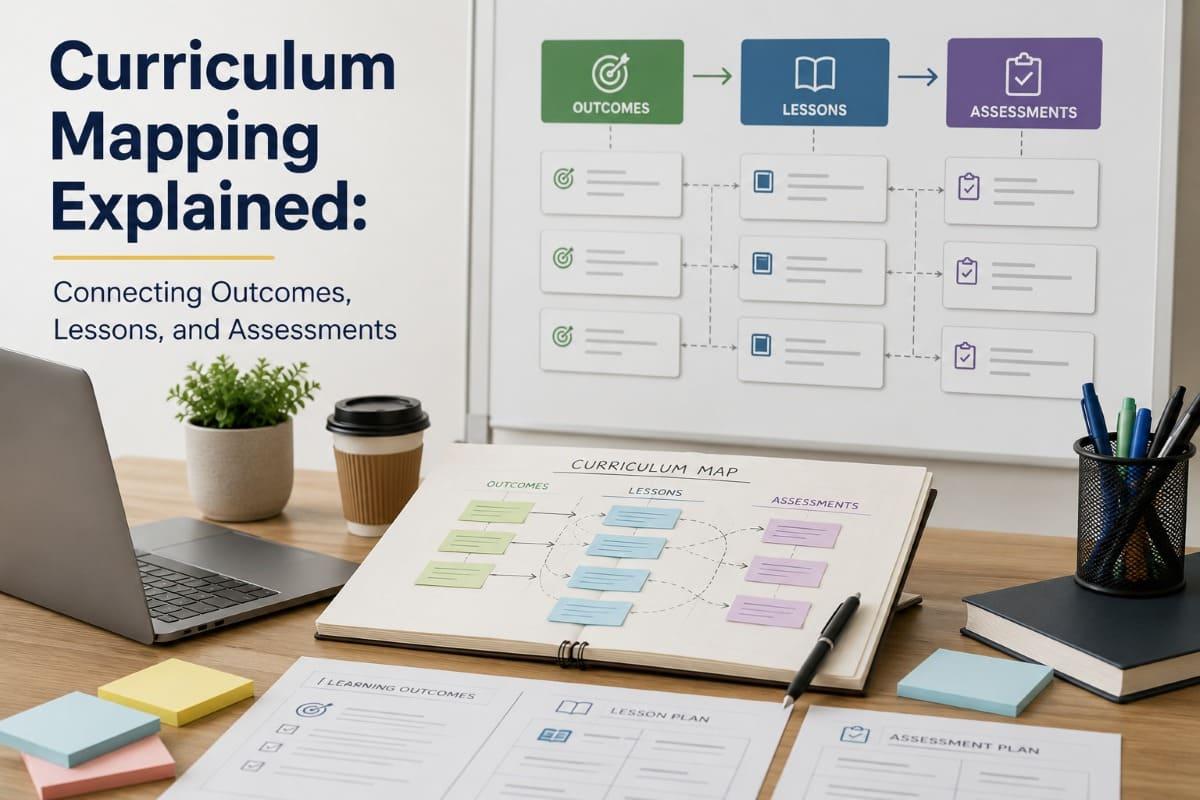
Curriculum mapping is a structured process for showing how
learning outcomes connect with courses, modules, lessons, activities, and
assessments. It helps educators and program teams determine whether learners
receive sufficient opportunities to encounter, practise, and demonstrate the
capabilities a program promises to develop.
This article explains how institutions, trainers,
instructional designers, and program managers can create and use a practical
curriculum map. It covers different mapping levels, useful map formats,
alignment indicators, implementation steps, common design problems, and the
operational implications for online, blended, mobile-first, and microlearning
programs. The aim is not to create more documentation, but to make the learning
journey visible enough to review, improve, deliver, and scale.
- Quick
Answer
- What
Curriculum Mapping Actually Means
- The
Core Components of a Useful Curriculum Map
- Choose
the Right Mapping Level
- How
to Build a Curriculum Map Step by Step
- How
to Read a Curriculum Map and Find Design Problems
- Turn
Mapping Findings Into Practical Decisions
- Common
Curriculum Mapping Mistakes
- FAQ
- Conclusion
Quick Answer
Curriculum mapping is the process of documenting where
learning outcomes are introduced, developed, practised, assessed, and
demonstrated across a course or education program.
A basic curriculum map often uses a matrix. Learning
outcomes appear in rows, while courses, modules, lessons, or assessments appear
in columns. Each cell indicates how a particular part of the curriculum
contributes to an outcome.
The map helps educators answer practical questions:
- Is
every important outcome taught?
- Do
learners receive enough practice before assessment?
- Are
some outcomes repeated unnecessarily?
- Do
assessments measure the capability described by the outcome?
- Does
learner progression become more demanding over time?
- Are
there lessons or assessments that do not support any stated outcome?
Curriculum mapping matters because a course can contain
strong individual lessons while still producing an incomplete or fragmented
learning journey. The map makes relationships visible so that educators,
subject-matter experts, facilitators, and program managers can review the
curriculum as a connected system.
Its value depends on how it is used. A detailed spreadsheet
alone does not improve learning. The map must lead to decisions about
sequencing, content, practice, assessment, delivery, and program improvement.

What Curriculum Mapping Actually Means
Curriculum mapping makes the structure and alignment of a
learning program visible.
At the simplest level, it shows where particular learning
outcomes are addressed. More developed maps may also document:
- how
deeply each outcome is taught;
- which
learning activities support it;
- where
learners practise the capability;
- which
assessments produce evidence;
- when
feedback is provided;
- which
delivery methods are used;
- where
prerequisite relationships exist;
- which
standards or competencies are addressed.
The University of Waterloo describes curriculum mapping as a
way to gain a snapshot of a program, examine how outcomes flow through it, and
identify gaps and redundancies. More complex maps may also include teaching
methods and assessments.
University
of Waterloo curriculum mapping guidance
Curriculum mapping can be used at several levels.
An educator may map:
- one
course outcome across several modules;
- module
outcomes across individual lessons;
- program
outcomes across multiple courses;
- professional
competencies across an entire certification pathway;
- workforce
capabilities across onboarding, training, coaching, and workplace
assessment.
Although the resulting document is frequently called a map,
it often looks more like a matrix, table, or structured database than a
geographical map.
The purpose is not visual complexity. The purpose is to
expose relationships that are difficult to see when course outlines, lesson
plans, assessments, and learning resources are stored separately.
Curriculum mapping is not the same as a course outline
A course outline usually tells learners what topics,
activities, schedules, and requirements they will encounter.
A curriculum map performs a different function. It shows how
those components contribute to intended learning outcomes.
For example, an outline may show that a leadership course
contains modules on communication, delegation, coaching, and performance
management.
A curriculum map asks:
- Which
outcome does each module support?
- At
what level is the outcome addressed?
- Where
do learners practise it?
- Which
assessment provides credible evidence?
- Is
the capability reinforced later?
- Are
any outcomes insufficiently supported?
The outline describes the course. The map tests its internal
logic.
Curriculum mapping is not merely content inventory
A content inventory lists available materials such as:
- videos;
- readings;
- presentations;
- templates;
- quizzes;
- case
studies;
- workshop
recordings.
This can support content management, but it does not
necessarily show whether those resources contribute to meaningful learning
progression.
A curriculum map connects resources and experiences to
outcomes. It makes the purpose of each component explicit.
Curriculum mapping is not program evaluation by itself
A curriculum map can reveal whether the planned curriculum
appears coherent. It cannot prove that learners have achieved the outcomes.
The map represents curriculum intent and design.
Evidence from assessments, learner performance, facilitator observations,
workplace application, and other evaluation methods is still required to
understand actual results.
This distinction is important.
A map may show that an outcome is assessed in Module 5. That
does not automatically mean:
- the
assessment is well designed;
- learners
receive sufficient practice;
- scoring
is reliable;
- learners
achieve the outcome;
- the
learning transfers into professional practice.
Curriculum mapping creates a foundation for evaluation, but
it is not a substitute for evaluation.
A curriculum map shows where learning is supposed to happen. Assessment evidence shows whether it actually happened.
|
Document or Process |
Primary Purpose |
Main Question |
|
Course outline |
Communicate course content and requirements |
What will the course include? |
|
Content inventory |
Record available learning materials |
What resources do we already have? |
|
Curriculum map |
Connect outcomes, learning experiences, and assessments |
How does each component contribute to learning? |
|
Assessment plan |
Define how learning evidence will be collected |
How will achievement be measured? |
|
Program evaluation |
Examine implementation, results, and improvement needs |
Is the program working as intended? |
Curriculum mapping is most useful when it functions as a
decision-making tool rather than a documentation exercise.
The Core Components of a Useful Curriculum Map
There is no single curriculum-map template that works for
every organization.
A university degree, a short professional course, a
workforce-development program, and a mobile microlearning pathway have
different operational requirements.
However, most useful maps connect four core components:
- learning
outcomes;
- learning
experiences;
- assessments;
- progression.
Learning outcomes
Learning outcomes define what learners should know, perform,
create, evaluate, or apply.
Depending on the mapping level, these may be:
- institutional
outcomes;
- program
outcomes;
- professional
competencies;
- course
outcomes;
- module
outcomes;
- lesson
objectives.
The map should distinguish between these levels.
For example:
Program outcome:
Participants can manage routine employee performance issues fairly and
consistently.
Course outcome:
Participants can conduct a structured performance conversation.
Module outcome:
Participants can prepare specific evidence and questions before the
conversation.
These statements are related, but they are not
interchangeable.
The program outcome describes a broader capability. The
course and module outcomes contribute to it at increasingly specific levels.
Detailed guidance on constructing these statements belongs
in How
to Write Clear Learning Objectives That Guide Better Content. Within
curriculum mapping, the immediate priority is determining where each outcome is
supported.
Learning experiences
Learning experiences include the activities through which
learners develop the intended capability.
They may include:
- explanations
and demonstrations;
- readings
and videos;
- guided
exercises;
- discussions;
- case
analysis;
- simulations;
- workplace
projects;
- peer
review;
- coaching;
- reflective
activities;
- repeated
practice;
- mobile
microlearning;
- live
workshops.
A map does not need to document every minor activity. It
should capture the experiences that make a meaningful contribution to the
outcome.
For instance, watching a video about difficult conversations
may introduce a communication framework. A role-play may provide practice. A
workplace assignment may require application in context.
These activities serve different instructional functions and
should not be recorded as though they provide equivalent learning
opportunities.
Assessments and evidence
Assessments determine how learners demonstrate progress or
achievement.
They may be:
- diagnostic;
- formative;
- summative;
- performance-based;
- knowledge-based;
- self-assessed;
- peer-reviewed;
- facilitator-reviewed;
- workplace-observed.
A useful curriculum map identifies not only where an
assessment occurs but also which outcome it measures.
Carnegie Mellon University emphasizes that learning
objectives, assessments, and instructional strategies should reinforce one
another. Assessments should reveal how well learners have achieved the intended
learning, while instruction should prepare them to do so.
Carnegie
Mellon University guidance on instructional alignment
An assessment may be present in a module but still be poorly
aligned.
For example:
- Outcome:
Analyse the causes of a workplace performance issue.
- Assessment:
Define five performance-management terms.
The assessment may measure relevant knowledge, but it does
not measure the analytical capability described in the outcome.
Progression
Progression shows how a capability develops over time.
A map should help the team determine whether learners:
- encounter
the concept;
- build
foundational knowledge;
- practise
with guidance;
- apply
the capability independently;
- integrate
it with other capabilities;
- demonstrate
it in a realistic context.
Many curriculum maps use codes to indicate progression. One
common approach is:
- I
— Introduced
- P
— Practised or Reinforced
- D
— Demonstrated or Assessed
Other institutions may use labels such as:
- Introduced,
Reinforced, Mastered;
- Exposure,
Development, Proficiency;
- Awareness,
Application, Demonstration;
- Foundation,
Intermediate, Advanced.
The labels are less important than having clear definitions.
For example:
Introduced may mean learners encounter the concept
and receive an initial explanation.
Practised may mean learners apply the concept with
guidance and receive feedback.
Demonstrated may mean learners independently produce
evidence against defined criteria.
The term “mastered” should be used carefully. A single
course assessment may show satisfactory performance under specific conditions,
but it may not establish enduring mastery in every professional context.

Choose the Right Mapping Level
Before building the map, determine what decision it needs to
support.
Trying to document every course, lesson, activity,
assessment, resource, standard, and platform interaction in one file can create
an unmanageable system.
A useful map has a defined scope.
Program-level curriculum mapping
A program-level map usually connects broad program outcomes
with:
- courses;
- modules;
- program
stages;
- major
assessments;
- professional
competencies;
- accreditation
requirements.
It helps leaders examine the learning journey across the
whole program.
Typical questions include:
- Where
is each program outcome introduced?
- Which
courses reinforce it?
- Where
is achievement assessed?
- Do
learners encounter the outcomes in a logical progression?
- Are
some courses duplicating the same material?
- Are
important outcomes supported only once?
- Do
elective pathways create inconsistent learner experiences?
A simplified program-level map may look like this:
|
Program Outcome |
Course 1 |
Course 2 |
Course 3 |
Final Project |
|
Diagnose a workplace performance issue |
I |
P |
P |
D |
|
Conduct a structured conversation |
I |
P |
D |
D |
|
Create an improvement plan |
— |
I |
P |
D |
|
Monitor and evaluate progress |
— |
I |
P |
D |
The map reveals progression but does not yet show the
individual lessons or assessment details.
Course-level curriculum mapping
A course-level map connects course outcomes with:
- modules;
- lessons;
- activities;
- formative
assessments;
- final
assessments.
It helps instructional designers and educators verify that
the course has a coherent internal structure.
A simplified course map might look like this:
|
Course Outcome |
Module 1 |
Module 2 |
Module 3 |
Module 4 |
Final Simulation |
|
Recognize performance issues |
I |
P |
— |
— |
D |
|
Prepare evidence and questions |
I |
P |
P |
— |
D |
|
Conduct a performance conversation |
— |
I |
P |
P |
D |
|
Agree on and document actions |
— |
— |
I |
P |
D |
This map can quickly reveal whether learners are assessed on
a capability they have not had sufficient opportunity to practise.
Lesson-level mapping
A lesson-level map provides more detailed alignment between:
- lesson
objectives;
- content;
- activities;
- resources;
- progress
checks.
This level is useful when:
- multiple
educators produce content;
- lessons
need consistent quality standards;
- a
course is being converted into microlearning;
- content
is frequently revised;
- lessons
are reused across pathways;
- an
organization needs detailed production specifications.
However, lesson-level mapping can become administratively
heavy. It should be used where the added detail supports a real design,
production, governance, or quality-assurance need.
Competency or standards mapping
Some programs must show how their curriculum connects to:
- professional
standards;
- occupational
competencies;
- regulatory
requirements;
- accreditation
criteria;
- organizational
capability frameworks;
- industry
certification requirements.
In this case, the external competencies may appear as
additional rows or columns.
The map can show where each requirement is:
- taught;
- practised;
- assessed;
- documented;
- reviewed.
This does not remove the need for evidence. If an
organization claims that a competency is assessed, it should be able to
identify the assessment, scoring criteria, and learner evidence that support
that claim.
|
Mapping Level |
Main Unit of Analysis |
Best Used For |
Primary Users |
|
Program level |
Outcomes across courses or stages |
Program review and strategic alignment |
Academic leaders, program managers, curriculum committees |
|
Course level |
Outcomes across modules and assessments |
Course design and redesign |
Educators, trainers, instructional designers |
|
Lesson level |
Objectives across activities and resources |
Detailed production and quality control |
Content developers, facilitators, production teams |
|
Competency level |
External standards across the curriculum |
Compliance, accreditation, and professional pathways |
Institutions, regulators, certification teams |
The best curriculum map is not the most detailed map. It is
the simplest map that makes the required decision possible.
How to Build a Curriculum Map Step by Step
Curriculum mapping can be completed through a spreadsheet,
database, specialized mapping tool, learning platform report, or collaborative
workshop.
The technology matters less than the quality of the
decisions and definitions behind the map.
Step 1: Define the purpose of the map
Begin with the decision or problem the map needs to address.
Possible purposes include:
- designing
a new program;
- restructuring
an existing course;
- preparing
for accreditation;
- identifying
gaps and unnecessary repetition;
- aligning
several courses around shared outcomes;
- converting
classroom training into online delivery;
- introducing
microlearning;
- reviewing
assessment coverage;
- standardizing
content across facilitators;
- building
role-based learning pathways.
A map built for accreditation may require more formal
evidence than a map used to reorganize a short creator-led course.
The purpose determines the required scope and level of
detail.
Step 2: Select the outcomes to map
Create a controlled list of the outcomes, competencies, or
standards that will form one axis of the map.
Before mapping, review whether the outcomes are:
- distinct;
- understandable;
- observable
where appropriate;
- relevant
to the program purpose;
- written
at a consistent level;
- realistic
for the program duration.
Avoid mapping a mixture of vague aspirations, detailed
lesson tasks, business targets, and learning outcomes in the same list without
distinguishing their levels.
For example:
- “Increase
learner confidence” may be a desired learner perception.
- “Complete
the course” is a participation measure.
- “Conduct
a structured client interview” is a performance outcome.
- “Improve
employment rates” is a broader program or social outcome.
All may matter, but they require different evidence and
should not automatically occupy the same layer of the curriculum map.
Step 3: Select the curriculum units
Choose what will appear on the other axis.
Depending on the scope, these units may be:
- courses;
- modules;
- lessons;
- program
stages;
- assessments;
- projects;
- workplace
experiences;
- coaching
sessions;
- certification
checkpoints.
Use units that are meaningful for decision-making.
If the purpose is to evaluate assessment alignment, mapping
only courses may be too broad. If the purpose is to review overall program
coverage, mapping every individual video may be unnecessarily detailed.
Step 4: Define the mapping codes
Establish a small, clearly defined coding system.
For example:
- I
— Introduced: Learners encounter the outcome and receive initial
guidance.
- P
— Practised: Learners apply the capability and receive feedback.
- D
— Demonstrated: Learners produce independent evidence against defined
criteria.
- A
— Assessed: A formal assessment measures the outcome.
Some teams may combine D and A. Others may need to
distinguish between an informal demonstration and a formal assessed
performance.
The coding rules should explain what evidence is required
before a cell can receive a particular code.
Without shared definitions, different educators may
interpret “covered,” “reinforced,” or “mastered” very differently.
Step 5: Gather information from the people closest to
deliveryCurriculum maps should not be based only on official course
descriptions.
There may be significant differences between:
- the
documented curriculum;
- the
curriculum educators actually deliver;
- the
activities learners actually complete;
- the
assessed curriculum;
- the
learning experience learners perceive.
Gather information from:
- course
owners;
- subject-matter
experts;
- facilitators;
- assessors;
- content
developers;
- learning
operations teams;
- representative
learners;
- workplace
supervisors where relevant.
Possible evidence includes:
- course
outlines;
- lesson
plans;
- assessment
briefs;
- rubrics;
- learning-platform
content;
- learner
instructions;
- facilitator
guides;
- certification
requirements;
- sample
learner work.
Step 6: Populate the first version
Record where each outcome is introduced, practised,
demonstrated, or assessed.
At this stage, document the current curriculum rather than
immediately redesigning it.
This creates a more accurate baseline.
Teams sometimes map the curriculum they believe should exist
rather than the experience learners currently receive. That makes it difficult
to identify genuine gaps.
Where evidence is unclear, mark the cell for verification
rather than guessing.
Step 7: Add assessment information
Identify which assessments provide evidence for each
outcome.
The map may record:
- assessment
name;
- assessment
type;
- formative
or summative purpose;
- individual
or group completion;
- scoring
method;
- rubric
criteria;
- delivery
stage;
- required
performance level.
Then review whether the assessment demand matches the
outcome.
For example:
|
Intended Outcome |
Learning Experience |
Assessment |
Alignment Review |
|
Explain the stages of a process |
Video, diagram, guided discussion |
Short-answer explanation |
Aligned |
|
Apply the process to a routine case |
Worked example and guided practice |
Scenario analysis |
Aligned |
|
Perform the process independently |
Demonstration and repeated practice |
Observed simulation |
Aligned |
|
Evaluate alternative approaches |
One introductory reading |
Terminology quiz |
Poorly aligned |
The final row reveals two problems:
- the
learning activity does not provide sufficient preparation for evaluation;
- the
assessment measures recall rather than evaluation.
Step 8: Review progression
Read the map horizontally and vertically.
Reading across one outcome shows how it develops through the
curriculum.
Reading down one course or module shows which outcomes that
component supports.
Look for patterns such as:
- an
outcome introduced repeatedly but never practised;
- an
outcome assessed before it is taught;
- advanced
assessment without sufficient feedback;
- several
assessments measuring the same narrow capability;
- important
outcomes concentrated in one module;
- excessive
repetition without increasing difficulty;
- modules
that do not contribute to any stated outcome.
Step 9: Validate the map collaboratively
Review the first version with people responsible for:
- curriculum
design;
- content
accuracy;
- delivery;
- assessment;
- learner
support;
- program
operations;
- technology;
- quality
assurance.
Curriculum mapping can reveal disagreements about what a
course is intended to achieve. These disagreements are useful when surfaced
early.
For example, one facilitator may believe a module is
intended to build awareness, while another treats it as preparation for
independent professional practice.
The map creates a concrete basis for resolving that
difference.
Step 10: Prioritize changes
Do not attempt to solve every issue at once.
Classify findings by:
- importance
to the learning outcome;
- risk
to learners or the organization;
- frequency
of the problem;
- implementation
difficulty;
- required
resources;
- relationship
with other curriculum changes.
A missing practice opportunity before a high-stakes
assessment may require immediate action. A minor content repetition may be
addressed during the next routine update.

FitAcademy
Connect Course Design With Learning Delivery
Curriculum mapping clarifies how outcomes, modules, activities, and assessments should work together. FitAcademy helps institutions, educators, and training providers translate that structure into a branded, mobile-first learning environment with organized content, learner pathways, assessments, and progress tracking.
Learn More About FitAcademyHow to Read a Curriculum Map and Find Design Problems
Completing the matrix is only the beginning.
The real value comes from interpreting patterns and deciding
what they mean for learners, educators, and program operations.
Look for outcome gaps
An outcome gap exists when an important capability is not
sufficiently supported.
Possible patterns include:
- an
outcome does not appear anywhere;
- it
appears only in optional content;
- it
is introduced but never practised;
- it
is assessed without preparation;
- it
depends on a module not available to every learner;
- it
is addressed only through passive content when performance is expected.
A gap does not always require a new course. It may be
resolved through:
- a
revised activity;
- additional
guided practice;
- a
stronger example;
- a
workplace assignment;
- a
new assessment criterion;
- clearer
facilitator guidance;
- an
adjusted module sequence.
Look for unnecessary repetition
Repetition is not automatically a problem.
Important capabilities often need to be revisited. The issue
is whether the repetition supports development.
Productive reinforcement might move from:
- initial
explanation;
- guided
example;
- structured
practice;
- independent
application;
- integration
in a complex situation.
Unproductive repetition may involve several modules
presenting similar introductory explanations without increasing complexity or
requiring application.
This can increase:
- learner
fatigue;
- production
cost;
- course
duration;
- facilitator
workload;
- content-maintenance
requirements.
Look for isolated assessments
An isolated assessment measures a capability that is not
clearly supported by earlier learning experiences.
For example, learners may be asked to produce a complete
business plan after watching short videos about entrepreneurship, without
receiving:
- worked
examples;
- templates;
- staged
practice;
- feedback
on drafts;
- opportunities
to analyse existing plans.
The final task may appear authentic, but the learning
pathway does not adequately prepare learners for it.
Alignment requires more than placing an assessment at the
end of the course. Learners need opportunities to develop the relevant
knowledge and capabilities beforehand.
Look for cognitive-level mismatch
The action required by the outcome should be reflected in
both the activity and assessment.
A mismatch occurs when:
- the
outcome asks learners to analyse, but activities focus on memorization;
- the
outcome asks learners to create, but assessment uses only multiple-choice
questions;
- the
outcome asks learners to perform, but the course provides only reading;
- the
outcome asks learners to evaluate, but learners never examine competing
alternatives.
A knowledge check may still be useful as one component. The
problem occurs when it is treated as sufficient evidence for a more demanding
capability.
Look for overloaded modules
A module may support too many outcomes at once.
This is not always incorrect, especially in integrated
projects. However, an overloaded introductory module may:
- move
too quickly;
- offer
insufficient practice;
- make
assessment criteria unclear;
- overwhelm
beginners;
- make
content difficult to update.
The map can reveal whether one module is carrying an
unrealistic share of the curriculum.
Look for weak progression
A program may cover the right outcomes without increasing
the level of learner responsibility.
For example, the same capability may be marked as
“introduced” in four consecutive courses but never move toward independent
demonstration.
A progression review should ask:
- Does
complexity increase?
- Does
learner support gradually decrease?
- Do
contexts become more realistic?
- Are
capabilities integrated?
- Does
feedback prepare learners for later performance?
- Is
there a meaningful final demonstration?
Look for orphan content
Orphan content does not clearly support any stated learning
outcome.
Examples may include:
- a
long historical overview;
- a
guest lecture added because the speaker was available;
- an
advanced tool demonstration unrelated to the expected performance;
- an
inherited presentation retained from an older course;
- repeated
definitions already covered elsewhere.
Orphan content is not necessarily poor content. It may
simply belong in:
- an
optional resource library;
- a
different course;
- an
advanced pathway;
- a
separate event;
- supporting
reference material.
When every lesson is important, the curriculum has not yet made enough decisions.
Turn Mapping Findings Into Practical Decisions
Curriculum mapping should lead to changes that improve
learning and delivery.
The findings may affect course design, content operations,
assessment, technology, staffing, and program governance.
Revise the learning sequence
If the map shows that learners encounter advanced tasks too
early, the team may need to:
- move
foundational modules;
- introduce
prerequisite learning;
- divide
a complex module;
- add
guided examples;
- delay
independent assessment;
- create
an alternative pathway for experienced learners.
Sequence changes should be reflected consistently across:
- course
navigation;
- facilitator
plans;
- assessment
deadlines;
- learner
communication;
- access
rules;
- certificates
and completion requirements.
Add or strengthen practice
If an outcome is explained but not practised, the program
may need:
- scenarios;
- simulations;
- short
exercises;
- peer
discussion;
- draft
submissions;
- workplace
tasks;
- coaching;
- repeated
application.
The form of practice should match the capability.
A communication skill requires more than reading. A
decision-making capability requires realistic choices. A technical procedure
may require demonstration under appropriate conditions.
Redesign assessments
Mapping may show that an assessment:
- measures
the wrong capability;
- appears
too early;
- combines
too many outcomes;
- relies
too heavily on recall;
- lacks
clear criteria;
- produces
limited evidence;
- cannot
be delivered consistently at scale.
The response might involve:
- changing
the assessment format;
- adding
a rubric;
- introducing
formative checkpoints;
- dividing
a large assessment into stages;
- adding
authentic scenarios;
- improving
assessor guidance;
- using
sampling rather than reviewing every minor task.
Remove or reposition content
Curriculum maps often reveal content that is:
- duplicated;
- peripheral;
- outdated;
- too
advanced;
- too
detailed for the target learner;
- better
treated as reference material.
Removing content can improve a course as much as adding
content.
A shorter program may produce a clearer learning journey
when the remaining material is better aligned with its outcomes.
Create differentiated pathways
A single program may serve learners with different:
- roles;
- experience
levels;
- language
needs;
- professional
responsibilities;
- regional
requirements;
- prior
qualifications.
The map can identify which outcomes should be:
- common
to every learner;
- role-specific;
- optional;
- advanced;
- completed
through prior-learning recognition;
- addressed
through additional support.
A hybrid architecture may combine a shared core with
specialist pathways.
Improve content governance
The map can become part of the organization’s
content-governance process.
For each course or module, teams may record:
- outcome
ownership;
- content
owner;
- review
date;
- assessment
owner;
- prerequisite
relationships;
- version
history;
- delivery
format;
- intended
audience;
- related
standards;
- update
priority.
This is particularly useful when several departments,
educators, creators, or external partners contribute content.
Configure the learning platform around the curriculum
The curriculum map should inform how the online learning
environment is configured.
Relevant platform decisions may include:
- module
ordering;
- prerequisite
rules;
- scheduled
content release;
- role-based
access;
- diagnostic
pathways;
- assessment
placement;
- feedback
workflows;
- completion
requirements;
- certificate
rules;
- learner
reminders;
- progress
dashboards;
- reporting
categories.
A platform can organize content efficiently, but the
curriculum map defines the educational logic the platform should support.
In a mobile-first or microlearning program, the map also
helps prevent short lessons from becoming disconnected fragments.
Each microlearning unit should still have a clear
relationship with:
- a
module outcome;
- a
broader program capability;
- an
application opportunity;
- a
progress or assessment strategy.
A well-structured course
architecture developed from learning goals establishes the pathway.
Curriculum mapping then makes the relationships within that pathway easier to
verify and manage.

Common Curriculum Mapping Mistakes
Mapping too much detail too early
Teams sometimes begin by documenting every lesson, video,
activity, reading, assessment item, and platform interaction.
The result becomes difficult to complete and even harder to
maintain.
A better approach is to begin with:
- the
main outcomes;
- major
curriculum units;
- progression
levels;
- significant
assessments.
Additional detail can be added where it supports a specific
decision.
Using vague mapping codes
Labels such as “covered,” “included,” or “addressed” are
open to interpretation.
One educator may use “covered” to mean that a topic was
mentioned. Another may use it to mean that learners completed an assessed
performance.
Use codes with operational definitions. Specify what must
occur before a course or module can be classified as introduced, practised,
demonstrated, or assessed.
Treating all mapped relationships as equally strong
Placing a mark in a cell does not show the quality or depth
of the relationship.
A ten-minute introduction and a multi-week applied project
should not automatically receive equivalent classifications.
Where depth matters, include progression levels or
supporting notes.
Mapping the intended curriculum without checking
deliveryOfficial documents may not reflect actual practice.
Facilitators may:
- omit
activities because of limited time;
- add
their own content;
- change
the sequence;
- use
different assessment standards;
- interpret
outcomes differently.
Curriculum mapping should compare documented intent with
actual delivery where possible.
Assuming repetition equals reinforcement
Repeated content becomes reinforcement only when learners
engage with the capability at a deeper or more independent level.
Showing the same introductory presentation in several
modules is duplication, not progression.
The map should distinguish between:
- repeated
exposure;
- guided
practice;
- application;
- integration;
- independent
demonstration.
Focusing on content while ignoring assessment
A map that records only where topics are taught provides an
incomplete view.
Learners may receive extensive content without producing
credible evidence that they can apply it.
Assessments, practice opportunities, and feedback should be
visible in the mapping process.
Treating the map as a compliance file
A curriculum map may be created for accreditation, quality
assurance, or an internal review and then stored without further use.
Its long-term value comes from supporting:
- course
updates;
- assessment
review;
- facilitator
onboarding;
- pathway
design;
- platform
configuration;
- learner
support;
- program
evaluation.
The map should have an owner, review schedule, and defined
role in curriculum decision-making.
Confusing curriculum alignment with program
effectivenessA well-aligned map shows that the intended learning
experience is logically structured.
It does not establish that:
- learners
participate;
- educators
deliver the curriculum consistently;
- assessments
are reliable;
- learners
achieve the outcomes;
- the
capability transfers into practice;
- the
program creates its intended organizational or social impact.
Those questions require a broader education
program evaluation process.
FAQ
What is the main purpose of curriculum mapping?
The main purpose is to make the relationships between
learning outcomes, courses or modules, learning activities, and assessments
visible. This allows educators and program teams to identify gaps, unnecessary
repetition, weak progression, and misaligned assessments. The map provides a
shared reference for curriculum design, review, delivery, quality assurance,
and improvement.
What should be included in a curriculum map?
A basic map should include the intended learning outcomes
and the courses, modules, or lessons that support them. More detailed maps may
also include progression levels, learning activities, assessments,
competencies, delivery formats, prerequisites, and review information. Include
only details that support the purpose of the mapping exercise and can be
maintained realistically.
How is a curriculum map different from a lesson plan?
A lesson plan explains how a particular learning session or
lesson will be delivered. It may include objectives, content, activities,
timing, resources, and assessment. A curriculum map examines relationships
across a broader structure. It shows how lessons, modules, courses, and
assessments collectively contribute to outcomes and learner progression.
How often should a curriculum map be updated?
The map should be reviewed when outcomes change, courses are
redesigned, assessments are revised, professional standards are updated, or
delivery data reveals a curriculum problem. Institutions may also use a
scheduled annual or program-review cycle. Minor updates can be recorded
continuously, while a deeper review may occur after sufficient evidence has
been collected.
Can curriculum mapping be used for short online courses?
Yes. A short course can use a lightweight map connecting its
main outcome with modules, activities, and assessments. The process is
especially valuable when converting existing materials into online or
microlearning formats because it helps prevent fragmentation. The map does not
need to be complex; a concise table may provide sufficient visibility.
Does a curriculum map prove that learners achieved the outcomes?
No. A map shows where outcomes are intended to be taught,
practised, and assessed. It does not prove learner achievement. Evidence of
achievement must come from appropriately designed assessments, learner work,
observed performance, and other direct or indirect evaluation methods. The map
helps determine where that evidence should be collected.
Conclusion
Curriculum mapping connects the promises of an education
program with the experiences and evidence provided to learners.
By showing where outcomes are introduced, practised,
demonstrated, and assessed, a curriculum map allows educators and program teams
to examine the learning journey as a connected system rather than a collection
of separate courses or content assets.
A useful map can reveal:
- outcomes
that receive insufficient support;
- repeated
content that does not increase in complexity;
- assessments
that do not match the intended capability;
- modules
that carry too many responsibilities;
- learning
experiences that do not contribute to stated outcomes;
- weak
progression between foundational and advanced learning.
The process should remain proportionate to the decision
being made.
A short professional course may need a simple matrix. A
multi-course institution, regulated training provider, or workforce-development
program may require a more detailed system connecting program outcomes,
professional standards, assessments, and operational responsibilities.
The map itself is not the final product. Its value lies in
the decisions it enables.
When curriculum mapping informs sequencing, assessment,
content production, platform configuration, and program review, it becomes a
practical foundation for clearer learning delivery and more scalable education
operations.
Curriculum mapping turns invisible assumptions about learning into visible decisions that a program team can examine and improve.
FitAcademy
Build a Connected Learning Experience
FitAcademy helps institutions, educators, and training providers organize structured courses, assessments, learner pathways, and mobile-first delivery within a branded learning environment. Use clearer curriculum logic to support a learning program that is easier to deliver, manage, and improve.
Learn More About FitAcademy