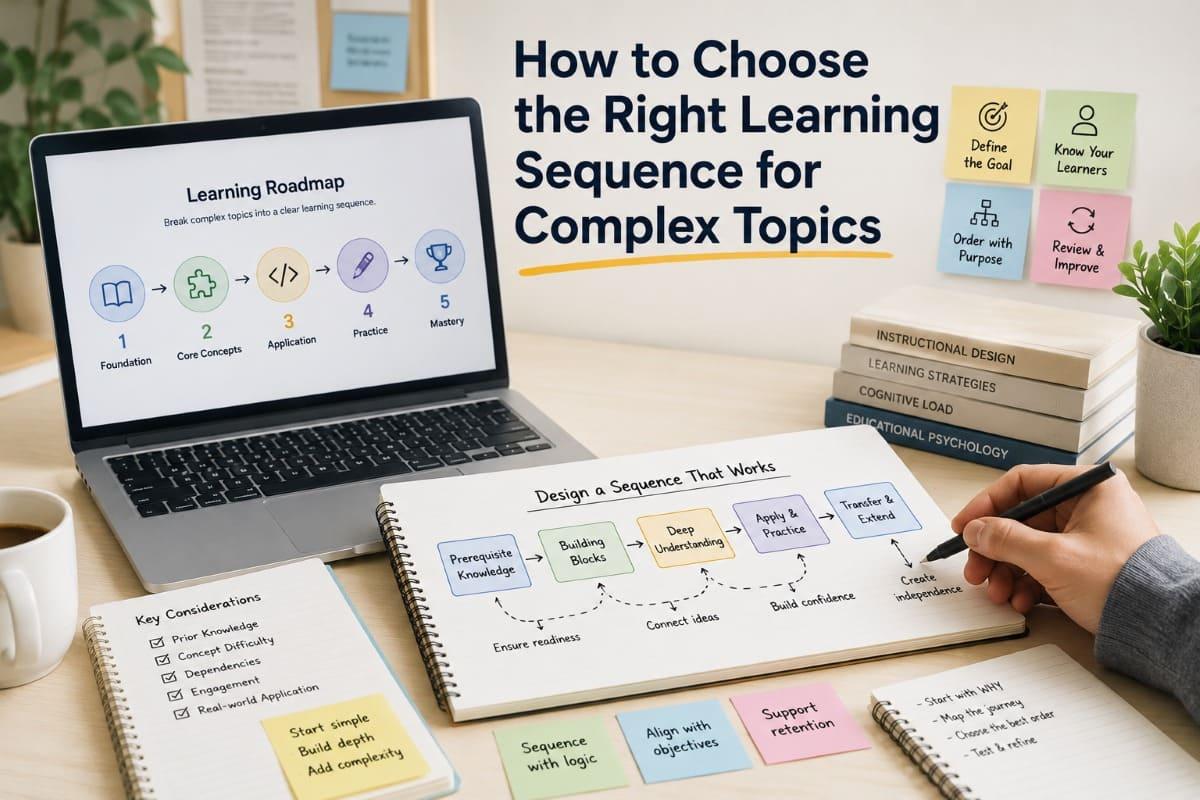
Complex topics are difficult to teach not only because they
contain many ideas, but because those ideas depend on one another. A poor
learning sequence can make capable learners feel confused, while a
well-designed sequence helps them build knowledge step by step, connect
concepts, practice meaningfully, and apply what they learn with confidence.
This article explains how teachers, trainers, and training providers can choose
the right learning sequence for complex subjects such as technical skills, professional
workflows, academic concepts, compliance training, entrepreneurship, or
industry-specific knowledge. It also shows how sequencing decisions connect to
online learning strategy, microlearning, learner engagement, and scalable
course delivery through a structured learning platform.
- Quick
Answer
- Why
Learning Sequence Matters for Complex Topics
- Start
With the Learning Outcome, Not the Content List
- Five
Practical Learning Sequence Models for Complex Topics
- How
to Choose the Right Sequence for Your Course
- Turning
a Learning Sequence Into a Scalable Online Program
- Common
Mistakes When Sequencing Complex Learning Content
- Conclusion
- FAQ
Quick Answer
The right learning sequence for a complex topic is the order
in which learners should encounter ideas, examples, practice tasks, and
assessments so they can move from basic understanding to confident application.
A strong sequence does not simply follow the instructor’s expertise or the
order of a textbook. It considers learner readiness, prerequisite knowledge,
cognitive load, real-world workflow, task complexity, and the final performance
learners are expected to demonstrate.
For teachers, trainers, and training providers, sequencing
matters because it affects comprehension, completion, engagement, and transfer.
A beginner-friendly sequence may start with foundations before application. A
professional training sequence may follow real workplace tasks. A certification
course may move from concepts to guided practice, then to assessment. A
microlearning program may divide the topic into smaller steps that learners can
complete progressively.
The key trade-off is balance. If the sequence is too simple,
learners may not develop deeper skill. If it is too advanced too early, they
may become overwhelmed. The best sequence gives learners enough structure to
progress and enough challenge to build real capability.

Why Learning Sequence Matters for Complex Topics
Complex topics usually contain layers. Learners may need
vocabulary before concepts, concepts before procedures, procedures before
judgment, and judgment before independent performance. When those layers are
presented in the wrong order, the course becomes harder than it needs to be.
This is why sequencing is one of the most important
decisions in learning design. It shapes how learners experience difficulty.
A topic may be complex because it includes:
- many
unfamiliar terms;
- abstract
concepts;
- procedural
steps;
- decision-making
rules;
- exceptions
and edge cases;
- practical
application;
- assessment
requirements;
- industry
context;
- different
learner starting points.
For example, a course on digital marketing analytics should
not begin with advanced attribution modeling if learners do not yet understand
traffic sources, campaign goals, conversion tracking, and basic reporting. A
sewing course should not begin with complex garment construction before
learners understand measurement, fabric behavior, tools, and basic seams. A
teacher training program should not ask participants to design assessments
before they understand learning objectives.
Complexity becomes manageable when learners meet the right idea at the right moment.
For online learning, sequencing becomes even more important
because the instructor is not always present to correct confusion immediately.
In a classroom, a teacher can notice hesitation, pause, explain again, and
adjust. In a self-paced course, the sequence itself must provide more guidance.
A strong learning sequence helps learners answer three
silent questions:
- What
should I understand first?
- Why
does this lesson matter?
- What
should I do next?
If a course cannot answer those questions clearly, learners
may still consume content, but they may not build usable knowledge.
A learning sequence is not just an instructional design
decision. It is also a learner experience decision because it determines
whether the course feels clear, supportive, and worth continuing.
This is especially relevant for training providers that want
to scale online courses. Once a program moves into a learning platform, the
content structure becomes part of the product experience. The order of modules,
lesson titles, progress indicators, quizzes, assignments, and certificates all
influence how learners perceive quality.
A well-sequenced course feels intentional. A poorly
sequenced course feels like a content library.
Start With the Learning Outcome, Not the Content List
Many course creators begin sequencing by listing everything
they know about a topic. This is understandable, especially when the instructor
has deep expertise. But expert knowledge does not automatically translate into
learner-ready structure.
The better starting point is the learning outcome.
Ask: by the end of this course, what should learners be able
to do, explain, decide, produce, or improve?
This question changes the sequencing process. Instead of
asking, “What content should I include?” the designer asks, “What must learners
experience in order to reach the outcome?”
A strong outcome helps identify:
- prerequisite
knowledge;
- essential
concepts;
- practice
activities;
- examples
and demonstrations;
- assessment
tasks;
- support
materials;
- optional
enrichment content.
For example, if the outcome is “learners can create a basic
financial projection for a small business,” the sequence should not begin with
every possible financial term. It should begin with the business decision the
projection supports, then introduce revenue assumptions, cost categories, cash
flow logic, spreadsheet structure, guided examples, learner practice, and
review.
The content list may be long. The learning path should be
selective.
Use prerequisite logic
Prerequisite logic means identifying what learners must know
before the next idea makes sense.
For a complex topic, prerequisite logic may include:
- vocabulary
before explanation;
- concept
before procedure;
- demonstration
before practice;
- guided
practice before independent task;
- simple
case before complex case;
- common
pattern before exception;
- feedback
before assessment.
This does not mean every course must be slow. It means the
course should avoid asking learners to perform tasks before they have the
mental tools to perform them.
For example, in a course on curriculum design, learners may
need to understand learning objectives before they can design assessments. They
may need assessment logic before they can design activities. They may need
activity design before they can create a full module.
That kind of sequence builds capability progressively.
Separate “nice to know” from “needed now”
Complex topics often fail because too much information
appears too early. Experts naturally see connections everywhere. Beginners do
not.
A practical sequence should separate:
- needed
now: information required to understand or perform the current task;
- needed
later: information that will matter in a future lesson;
- nice
to know: context that enriches understanding but is not essential;
- reference
material: information learners can revisit when needed.
This is where online learning platforms can support better
design. Instead of forcing every detail into the main lesson, training
providers can place deeper references, downloadable guides, templates, or
advanced explanations in supporting resources.

Five Practical Learning Sequence Models for Complex Topics
There is no single best sequence for every course. The right
model depends on the topic, the learners, and the expected outcome.
Below are five practical sequencing models that teachers,
trainers, and training providers can use.
|
Sequence Model |
Best For |
How It Works |
Main Risk |
|
Foundation-to-Application |
Academic concepts, technical basics, beginner courses |
Learners build core understanding before applying it |
Can feel slow if learners already know the basics |
|
Simple-to-Complex |
Skills with increasing difficulty |
Learners start with easy cases and move toward harder ones |
May oversimplify real-world complexity |
|
Workflow-Based |
Professional training, operational skills, business
processes |
Lessons follow the order of real tasks in practice |
Can confuse beginners if prerequisites are missing |
|
Problem-Based |
Advanced learners, case-based training, leadership skills |
Learners begin with a realistic problem and learn what
they need to solve it |
Can overwhelm learners without enough scaffolding |
|
Spiral Sequence |
Long programs, complex capability development |
Key ideas return repeatedly at deeper levels |
Requires strong curriculum planning |
1. Foundation-to-application sequence
This model starts with essential concepts, then moves toward
examples, practice, and application.
It works well when learners are new to a topic. For example,
a beginner course on instructional design may begin with learning objectives,
then assessment alignment, content structure, activity design, and evaluation.
This sequence is useful when misunderstanding the foundation
would make later lessons fragile.
The risk is that learners may feel they are waiting too long
to do something practical. To avoid this, include small application tasks
early, even while teaching foundations.
2. Simple-to-complex sequence
This model introduces an easy version of a task first, then
gradually increases difficulty.
It works well for skills such as coding, sewing, language
learning, data analysis, lesson planning, and software training. Learners first
complete a simple task with clear guidance. Later, they handle more variables,
exceptions, or realistic constraints.
For example, a data analytics course may begin with reading
a simple dashboard, then interpreting trends, comparing segments, identifying
anomalies, and recommending decisions.
The risk is oversimplification. If the simple version is too
far from real practice, learners may struggle when complexity appears later.
3. Workflow-based sequence
This model follows the order of real-world work.
It is effective for professional and operational training. A
course on launching an online class, for example, may follow the real workflow:
define audience, set learning outcomes, outline modules, create lessons, build
assessments, upload to platform, onboard learners, review analytics, and
improve the program.
Workflow-based learning is practical because learners can
immediately see how the course connects to action.
The risk is that real workflows are not always
beginner-friendly. Sometimes a task appears early in the workflow but requires
background knowledge. In that case, the designer should add short prerequisite
lessons or support resources.
4. Problem-based sequence
This model begins with a real problem, scenario, or
challenge.
It works well for learners who already have some background
knowledge. For example, a teacher development program may begin with a
classroom challenge: learners are disengaged, assessment results are weak, or
lessons are not aligned with outcomes. Participants then learn the concepts
needed to diagnose and solve the problem.
Problem-based sequencing can increase relevance because
learners see the purpose of learning immediately.
The risk is cognitive overload. If the problem is too
complex too early, learners may feel lost. Scaffolding is essential.
5. Spiral sequence
A spiral sequence revisits the same core ideas multiple
times, each time with greater depth or complexity.
It is useful for long programs where mastery develops over
time. For example, a teacher training pathway may revisit learning objectives
in several contexts: lesson planning, assessment design, curriculum mapping,
learner feedback, and program evaluation.
This model supports retention and transfer because learners
do not encounter an idea only once.
The risk is poor planning. If repetition feels accidental,
learners may think the course is redundant. The designer must make each return
more advanced, more applied, or more contextual.
A strong sequence does not always move in a straight line.
Some topics require repetition, practice, feedback, and return before learners
can use knowledge independently.
How to Choose the Right Sequence for Your Course
Choosing the right learning sequence requires more than
instructional instinct. It requires a practical diagnosis of the topic and the
learners.
A good decision process includes five questions.
1. What type of complexity are learners facing?
Not all complexity is the same.
A topic may be difficult because it is conceptually
abstract, technically detailed, procedurally long, emotionally sensitive, or
context-dependent. Each type of complexity suggests a different sequence.
|
Type of Complexity |
Example |
Recommended Sequence |
|
Conceptual complexity |
Learning theory, finance, strategy |
Foundation-to-application |
|
Procedural complexity |
Software use, production workflow, compliance process |
Workflow-based or simple-to-complex |
|
Performance complexity |
Teaching, selling, coaching, leadership |
Demonstration, practice, feedback, reflection |
|
Decision complexity |
Business cases, diagnosis, professional judgment |
Problem-based or case-based |
|
Long-term mastery |
Language learning, professional certification, curriculum
design |
Spiral sequence |
2. Who are the learners?
The same topic may need different sequences for different
learners.
Beginners need more orientation, vocabulary, examples, and
guided practice. Intermediate learners may need comparison, diagnosis, and
application. Advanced learners may benefit from cases, exceptions, critique,
and independent projects.
This article focuses on choosing the sequence for a complex
topic. For a deeper discussion of level-based pathways, see how
to design learning paths for beginner intermediate and advanced learners.
3. What should learners be able to do after the course?
If the goal is awareness, the sequence may move from problem
to concept to simple examples. If the goal is skill development, the sequence
needs practice and feedback. If the goal is certification, the sequence must
prepare learners for assessment standards.
A course that only explains concepts may not be enough when
the expected outcome is workplace performance.
For example, a training provider teaching food safety cannot
rely only on definitions. Learners need scenarios, decision rules, hazard
identification practice, and assessment. A course teaching online teaching
methods cannot only explain pedagogy. Learners need to design actual lesson
components.
4. Where are learners likely to get stuck?
Strong sequencing anticipates friction.
Learners may struggle when:
- a
concept is too abstract;
- too
many terms appear at once;
- a
procedure has hidden steps;
- examples
are not realistic;
- practice
tasks are too difficult;
- feedback
comes too late;
- lessons
are too long;
- assessment
does not match instruction.
When designing the sequence, identify the likely confusion
points and place support before or immediately after them.
This is especially important in microlearning. Short lessons
can improve focus, but only if the sequence still makes the learning journey
coherent. Short content without progression becomes fragmented.
5. What delivery format will support the sequence?
A live workshop, self-paced course, blended program,
mobile-first microlearning path, and cohort-based training program may all
require different sequencing choices.
For example:
- a
live session can use discussion and immediate clarification;
- a
self-paced course needs clearer instructions and transitions;
- a
mobile-first course benefits from shorter lessons and visible progress;
- a
blended program can place concepts online and use live time for
application;
- a
cohort program can sequence peer discussion after individual preparation.
This is where platform strategy matters. A learning platform
should not only host videos. It should support modules, lesson order, quizzes,
progress tracking, resources, learner communication, and updates.
FitAcademy
Turn Your Learning Sequence Into a Real Online Program
FitAcademy helps teachers, trainers, and training providers organize lessons into structured, branded microlearning programs that learners can follow step by step.
Join Platform
Turning a Learning Sequence Into a Scalable Online Program
A sequence becomes more valuable when it can be delivered
consistently. For training providers, this is where curriculum design connects
with learning operations.
A scalable online program needs more than good content. It
needs a structure that learners can navigate without constant instructor
intervention.
Map the course into modules
Start by grouping lessons into modules. Each module should
represent a meaningful step in the learning journey.
A practical structure may look like this:
- Module
1: orientation and outcome;
- Module
2: foundations and vocabulary;
- Module
3: core concepts;
- Module
4: guided examples;
- Module
5: practice tasks;
- Module
6: real-world application;
- Module
7: assessment or project;
- Module
8: next steps and continued learning.
This is not a universal template, but it shows how a complex
topic can be shaped into a progressive experience.
Design transitions between lessons
Transitions are often overlooked. Learners need to know why
one lesson leads to the next.
A good transition might say:
“Now that you understand how to define a learning objective,
the next step is to choose an assessment method that proves whether the
objective has been achieved.”
This kind of transition creates continuity.
Without transitions, online courses can feel like isolated
videos.
Add practice at the right moments
Practice should not appear only at the end. For complex
topics, learners need small practice opportunities throughout the sequence.
Examples include:
- reflection
questions;
- short
quizzes;
- worksheet
completion;
- scenario
analysis;
- peer
discussion;
- template
use;
- mini-projects;
- upload
assignments;
- self-checklists.
The more performance-based the outcome, the more practice
the sequence needs.
Use platform features to support progression
A branded online learning platform can help make the
sequence visible and manageable. Useful features include:
- module
structure;
- lesson
completion tracking;
- mobile
access;
- quizzes
and assignments;
- downloadable
resources;
- certificates;
- learner
analytics;
- announcements;
- discussion
or support features;
- content
updates.
For organizations that want ownership over the learner
experience, a structured platform is often more strategic than sending learners
through disconnected files, video links, or messaging groups.
For a broader platform perspective, see 7
features every modern learning platform should have in 2026.
The more complex the topic, the more important the learning
environment becomes. Learners need not only content, but visible progression,
support, and feedback.
Common Mistakes When Sequencing Complex Learning Content
Even experienced educators can make sequencing mistakes,
especially when converting offline expertise into online training.
Mistake 1: Following the expert’s mental model
Experts often organize knowledge differently from beginners.
They may start with advanced distinctions because those distinctions feel
important. But learners may need simpler anchors first.
The better approach is to design from the learner’s entry
point, not the expert’s internal map.
Mistake 2: Teaching everything before practice
Some courses delay practice until the end because the
instructor wants learners to “understand everything first.” This often
backfires. Learners may forget earlier material or fail to see its relevance.
A better sequence alternates explanation, example, practice,
and feedback.
Mistake 3: Making every lesson the same size
Complex topics do not always divide evenly. Some lessons
need to be short and focused. Others need more demonstration or practice.
Microlearning does not mean every lesson must be
artificially tiny. It means each learning unit should have a clear purpose and
manageable scope.
Mistake 4: Ignoring learner differences
A single sequence may not work equally well for all
learners. Some may need prerequisite refreshers. Others may want to move
faster.
This does not mean every course needs a fully personalized
path. But it may need optional review lessons, diagnostic quizzes, or
recommended pathways.
For this topic, see how
to support learners with different levels of knowledge and ability.
Mistake 5: Treating the platform as an afterthought
When the course sequence is clear in the instructor’s head
but poorly represented in the platform, learners experience confusion. Lesson
order, module names, progress indicators, and assessment placement all matter.
The platform should make the learning logic visible.

Conclusion
Choosing the right learning sequence for a complex topic is
not about finding a perfect universal formula. It is about making deliberate
instructional decisions based on outcomes, learner readiness, task complexity,
and delivery format.
For some courses, the best path begins with foundations. For
others, it begins with a real workflow, a simple task, or a practical problem.
Long programs may need a spiral structure where learners revisit important
ideas at deeper levels. The sequence should reduce unnecessary confusion while
preserving meaningful challenge.
For teachers and trainers, good sequencing improves clarity.
For training providers, it also improves scalability. A well-sequenced program
is easier to deliver online, easier to update, easier to support, and easier
for learners to complete independently.
When complex expertise is organized into clear modules,
guided practice, and visible progression, the learning experience becomes more
than content delivery. It becomes a structured pathway toward capability.
FitAcademy
Build Structured Learning Programs With FitAcademy
FitAcademy helps educators, creators, and training providers turn expertise into branded online learning programs with organized modules, mobile-first lessons, learner progress tracking, and scalable delivery.
Join PlatformFAQ
What is a learning sequence?
A learning sequence is the planned order in which learners
encounter content, examples, activities, practice, feedback, and assessment. It
helps learners move from what they already know toward the outcome they are
expected to achieve. In complex topics, sequencing is important because
learners often need prerequisite knowledge before they can understand or apply
advanced ideas.
What is the best sequence for teaching complex topics?
There is no single best sequence for every complex topic. A
foundation-to-application sequence works well for beginners. A workflow-based
sequence works well for professional tasks. A problem-based sequence can work
for learners with prior knowledge. A spiral sequence is useful for long-term
mastery. The best choice depends on learner level, topic complexity, and
expected performance.
Should online courses always start with theory?
No. Some courses need theory first, especially when concepts
are unfamiliar. But many online courses benefit from starting with a practical
problem, simple example, or real-world context before introducing theory. The
key is to make the sequence understandable. Theory should appear when it helps
learners make better sense of the task.
How do I sequence lessons for beginners?
For beginners, start with orientation, core vocabulary,
simple concepts, and guided examples. Avoid introducing too many exceptions too
early. Give learners small practice tasks before asking them to complete
complex assignments. Beginners usually need clear transitions, visible
progress, and reassurance that each lesson is building toward a practical
outcome.
How does microlearning affect learning sequence?
Microlearning can make complex topics easier to manage by
breaking learning into focused units. However, microlearning only works well
when the units are connected by a clear sequence. If short lessons are
delivered without progression, learners may experience fragmented content
rather than structured learning. Each microlearning unit should support the
next step in the path.
How can a learning platform support better sequencing?
A learning platform can support sequencing through modules,
lesson order, progress tracking, quizzes, assignments, certificates, mobile
access, and learner analytics. These features help learners understand where
they are, what comes next, and how each lesson contributes to the outcome. For
training providers, platform structure also supports scalability and
consistency.