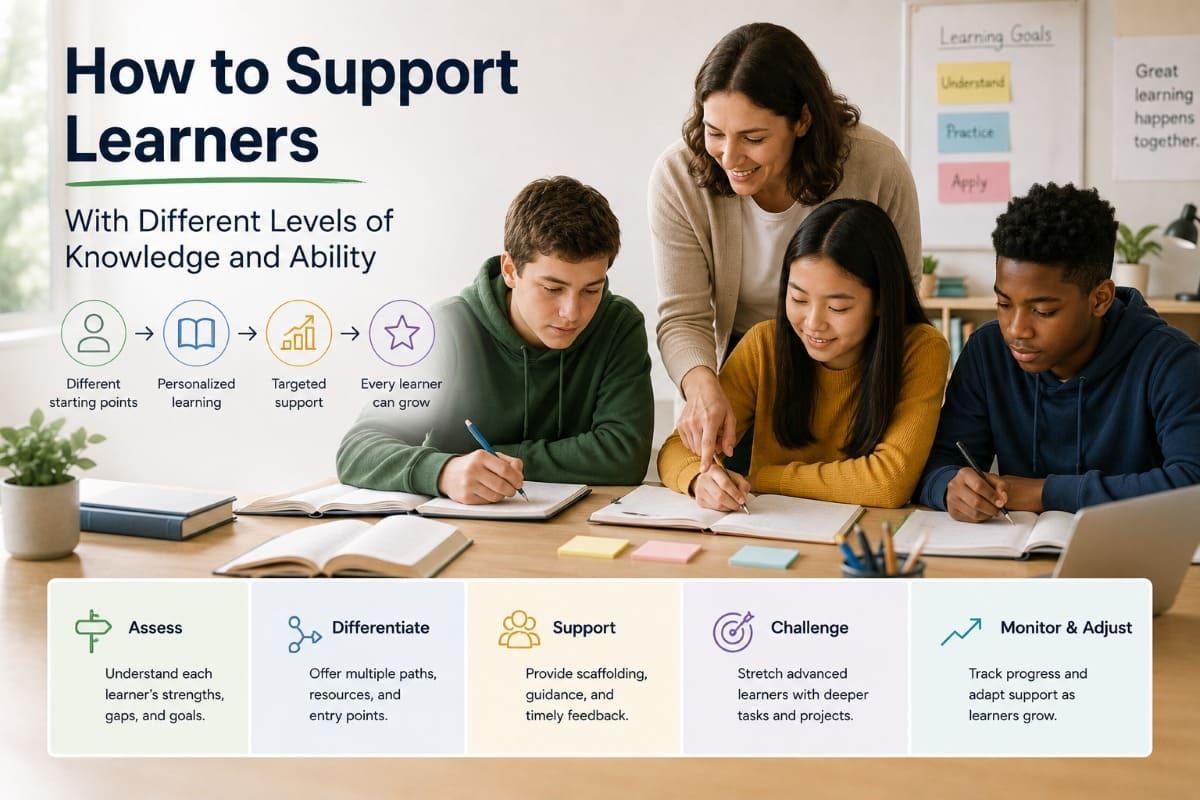
Learners rarely enter a course with the same background,
confidence, ability, pace, or goal. Some need foundational support. Others need
practice, challenge, or real-world application. For teachers, trainers, and
training providers, supporting different learner levels is not about creating a
separate course for every individual. It is about designing flexible structures
that help more learners access the content, stay engaged, and make meaningful
progress. This article explains how to support learners with different levels
of knowledge and ability through diagnostic checks, prerequisite lessons,
flexible pathways, scaffolding, practice options, feedback, and platform-based
learner support. It also shows how a structured learning platform can help
providers scale support without making operations unnecessarily complicated.
- Quick
Answer
- Why
Learner Differences Matter in Course Design
- Identify
Learner Readiness Before Designing Support
- Use
Scaffolding to Help Learners Progress
- Design
Flexible Pathways Without Creating Chaos
- Support
Learners Through Practice, Feedback, and Resources
- How
Learning Platforms Help Scale Learner Support
- Common
Mistakes When Supporting Mixed-Level Learners
- Conclusion
- FAQ
Quick Answer
To support learners with different levels of knowledge and
ability, design the course so learners can enter with different starting
points, receive appropriate support, and progress toward the same or related
outcomes. This can be done through diagnostic questions, prerequisite lessons,
optional refreshers, guided practice, varied examples, flexible assignments,
progress tracking, and feedback loops.
The goal is not to lower expectations. The goal is to reduce
unnecessary barriers while keeping the learning meaningful and appropriately
challenging. Beginners may need definitions, examples, and step-by-step
guidance. Intermediate learners may need practice, feedback, and
troubleshooting. Advanced learners may need complex scenarios, independent
projects, or specialization.
For teachers and trainers, this improves clarity and learner
confidence. For training providers, it also improves course completion, learner
satisfaction, and operational scalability. A learning platform can support this
by organizing content into modules, pathways, resources, assessments, and
learner progress dashboards. The best approach balances flexibility with
structure so learners feel supported without becoming lost.

Why Learner Differences Matter in Course Design
Every learning program contains variation.
Even when learners join the same course, they may differ in
prior knowledge, confidence, language ability, digital skills, learning pace,
motivation, available time, professional context, and access to support. A
course that ignores these differences may appear efficient, but it often
creates hidden friction.
Some learners may feel lost from the beginning. Others may
feel bored because the course moves too slowly. Some may understand the theory
but struggle with application. Others may complete lessons but fail to transfer
learning into real work.
This is why learner support is not an optional extra. It is
part of good learning design.
A useful principle comes from Universal Design for Learning,
which encourages educators to anticipate learner variability and reduce
barriers in the learning environment. In practical terms, this means designing
learning experiences with flexible ways to access content, engage with tasks,
and demonstrate progress. Universal
Design for Learning Guidelines
Different learners do not always need different goals. Often, they need different routes toward meaningful progress.
For training providers, this matters commercially as well as
educationally. Learners who feel unsupported are more likely to disengage, skip
lessons, ask repetitive support questions, or abandon the program. Learners who
feel appropriately guided are more likely to continue, complete, recommend, and
return for advanced programs.
Supporting mixed-level learners is especially important in:
- professional
training programs;
- online
academies;
- creator-led
courses;
- workforce
development;
- certification
programs;
- community
education;
- corporate
onboarding;
- skills-based
microlearning;
- mobile-first
learning environments.
In these contexts, learners rarely start from the same
place. A structured support strategy helps the provider serve a broader
audience without diluting the learning experience.
Supporting learner differences is not about making a course
easier. It is about making the path clearer, fairer, and more usable for more
learners.
Identify Learner Readiness Before Designing Support
Before adding support materials, first understand where
learners are likely to begin.
Learner readiness refers to the knowledge, skills,
confidence, and context learners bring into the course. Without this
understanding, support design becomes guesswork.
A training provider may assume learners are beginners, then
bore experienced learners. Another provider may assume learners are already
comfortable with the subject, then overwhelm newcomers. Both problems come from
unclear readiness assumptions.
Use diagnostic questions
A diagnostic check helps learners identify their starting
point.
It does not need to be long or technical. A simple
diagnostic can ask:
- Have
you studied this topic before?
- Can
you explain the key terms?
- Have
you applied this skill in real work?
- What
is your main goal for joining this course?
- Which
task feels most difficult right now?
- How
confident are you with the tools used in this course?
The result can recommend a starting pathway, prerequisite
module, refresher lesson, or advanced track.
|
Diagnostic Result |
Learner Need |
Suggested Support |
|
Low prior knowledge |
Orientation and foundations |
Beginner module, glossary, simple examples |
|
Basic understanding |
Practice and feedback |
Guided exercises, quizzes, scenario tasks |
|
Strong knowledge but low confidence |
Reassurance and structure |
Checklists, model answers, low-risk practice |
|
Strong capability |
Challenge and application |
Advanced cases, project work, specialization |
|
Uneven skills |
Targeted support |
Optional refreshers and recommended lessons |
Distinguish knowledge, ability, and confidence
A learner may know the concept but lack ability to apply it.
Another learner may have ability but low confidence. Another may have
confidence but weak foundational knowledge.
These differences require different support.
For example, in a course on online teaching:
- a
beginner may need to learn what a learning objective is;
- an
intermediate learner may need to write better objectives;
- an
advanced learner may need to align objectives across a full curriculum;
- a
low-confidence learner may need examples and templates;
- a
highly capable learner may need a challenging project.
This is why support should not be based only on course
completion. It should be based on readiness and performance.
Create learner profiles without stereotyping
Learner profiles can help course designers anticipate common
needs. However, they should not become rigid categories.
Useful learner profiles might include:
- new
learner with no prior experience;
- experienced
practitioner new to online delivery;
- busy
professional with limited study time;
- learner
who needs practical templates;
- learner
preparing for certification;
- advanced
learner seeking specialization.
These profiles guide design decisions, but learners should
still have room to move between pathways.

Use Scaffolding to Help Learners Progress
Scaffolding means giving learners enough support to complete
a task they could not yet complete independently, then gradually reducing that
support as their ability grows.
In practical course design, scaffolding can include:
- definitions
before advanced terminology;
- worked
examples before independent tasks;
- templates
before open-ended projects;
- guided
practice before assessment;
- checklists
before submission;
- hints
before full answers;
- feedback
before final evaluation;
- simple
cases before complex cases.
Scaffolding is especially useful for complex topics because
learners often need structure before they can handle ambiguity.
Start with guided support
Beginners usually need more visible support.
For example, instead of asking learners to “create a
training module,” the course might first guide them through smaller steps:
- define
the learner audience;
- write
one learning outcome;
- choose
one lesson topic;
- create
a short explanation;
- add
one practice task;
- write
one quiz question;
- review
the lesson using a checklist.
This turns a difficult task into a manageable process.
Reduce support gradually
The goal of scaffolding is not dependence. Learners should
become more independent over time.
A practical progression may look like this:
|
Stage |
Support Level |
Example |
|
Demonstration |
High support |
Instructor shows how to complete the task |
|
Guided Practice |
High-medium support |
Learner completes task with prompts |
|
Structured Practice |
Medium support |
Learner uses checklist or template |
|
Independent Practice |
Low support |
Learner completes task without step-by-step help |
|
Real-World Application |
Minimal support |
Learner applies skill in authentic context |
This progression works well for online learning because it
can be built into modules, lesson sequences, assignments, and project
milestones.
Use scaffolding for advanced learners too
Scaffolding is not only for beginners.
Advanced learners may also need support when facing
unfamiliar complexity. For example, an experienced trainer may know how to
teach live workshops but need support when designing mobile-first
microlearning, learning analytics, or scalable certification pathways.
In this case, the support may not be basic definitions. It
may be frameworks, rubrics, case comparisons, or strategic decision tools.
Scaffolding should change as learners grow. Early support
explains the task. Later support helps learners make better decisions.
Design Flexible Pathways Without Creating Chaos
Flexibility is valuable, but too much flexibility can
confuse learners.
If a course offers too many options without guidance,
learners may not know what to choose. If a course is too rigid, learners with
different needs may struggle or disengage.
The best design balances structure and choice.
Use a core path with optional support
One practical model is to create a core learning path that
all learners can follow, then add optional support around it.
The core path includes the essential lessons required to
reach the outcome. Optional support may include:
- prerequisite
lessons;
- glossary;
- beginner
refreshers;
- advanced
extensions;
- templates;
- extra
examples;
- practice
library;
- live
support sessions;
- community
discussion;
- recommended
next modules.
This avoids creating a separate course for every learner
type while still offering flexibility.
|
Course Element |
Purpose |
Required or Optional |
|
Core Lessons |
Teach essential outcomes |
Required |
|
Prerequisite Lessons |
Support learners who need foundations |
Optional or recommended |
|
Practice Tasks |
Build capability |
Required |
|
Extra Examples |
Clarify concepts for learners who need more support |
Optional |
|
Advanced Cases |
Challenge experienced learners |
Optional |
|
Final Assessment |
Check outcome achievement |
Required |
|
Resource Library |
Support review and application |
Optional |
Make pathway choices visible
Flexible pathways only work when learners understand them.
A course should clearly explain:
- who
should start with the foundation module;
- who
can skip to intermediate practice;
- which
lessons are required;
- which
resources are optional;
- what
must be completed for a certificate;
- what
to do after finishing the course.
This can be supported through lesson descriptions, module
labels, onboarding pages, progress indicators, and recommendation messages
inside the learning platform.
Avoid overwhelming learners with too many branches
Not every course needs complicated personalization.
For many training providers, three simple pathways are
enough:
- Foundation
path for learners who need basics;
- Core
path for the main learning outcome;
- Advanced
path for deeper application.
This structure is easier to manage and easier for learners
to understand.
For a deeper discussion of level-based course structure, see
how
to design learning paths for beginner intermediate and advanced learners.
FitAcademy
Build Flexible Learning Paths Without Operational Complexity
FitAcademy helps teachers, trainers, and training providers organize content into structured learning paths with modules, lessons, resources, progress tracking, and mobile-first learner access.
Join Platform
Support Learners Through Practice, Feedback, and Resources
Learner support is not only about explaining content more
clearly. It is also about helping learners practice, receive feedback, and
access the right resource at the right time.
This is especially important when the course outcome
involves performance.
A learner may understand a concept after watching a lesson.
But understanding does not always mean they can apply it. Application requires
practice.
Offer different practice levels
Mixed-level learners often need different levels of
practice.
For example:
- beginners
may need guided worksheets;
- intermediate
learners may need scenarios;
- advanced
learners may need open-ended projects;
- low-confidence
learners may need model answers;
- experienced
learners may need challenge tasks.
The same topic can support different practice levels without
changing the whole course.
|
Practice Type |
Best For |
Example |
|
Guided Practice |
Beginners |
Complete a partially filled template |
|
Scenario Practice |
Intermediate learners |
Choose the best response to a realistic case |
|
Troubleshooting Practice |
Learners with basic experience |
Identify and fix mistakes |
|
Project Practice |
Advanced learners |
Create a complete deliverable |
|
Reflection Practice |
Professional learners |
Connect learning to real work |
Use feedback before final assessment
Feedback should appear before learners are judged.
This may include:
- quiz
explanations;
- example
answers;
- self-check
rubrics;
- peer
feedback;
- instructor
comments;
- automated
progress indicators;
- revision
opportunities;
- discussion
prompts.
Feedback helps learners correct misunderstanding while they
still have time to improve.
Build a resource layer
A resource layer gives learners support without interrupting
the main lesson flow.
Useful resources include:
- glossary;
- templates;
- checklists;
- examples
library;
- short
review videos;
- downloadable
worksheets;
- case
studies;
- FAQ
pages;
- troubleshooting
guides;
- recommended
next lessons.
For complex topics, this resource layer is often the
difference between a course that feels overwhelming and a course that feels
manageable.
For related lesson design strategy, see how
to break down complex subjects into easy-to-understand lessons.
How Learning Platforms Help Scale Learner Support
Supporting different learner levels becomes difficult when
everything is managed manually.
A trainer may begin with email attachments, video links,
chat groups, and spreadsheets. This can work for a small pilot, but it becomes
harder as the learner base grows.
A learning platform helps turn support into a system.
Organize support inside the learning journey
Instead of sending learners to scattered resources, a
platform can place support where it is needed:
- prerequisite
lesson before a difficult module;
- glossary
link inside the course;
- quiz
after a key concept;
- checklist
before assignment submission;
- progress
dashboard after each module;
- advanced
extension after the core lesson;
- certificate
after completion.
This keeps support contextual.
Use learner analytics carefully
Learner analytics can help training providers identify where
learners struggle.
For example, analytics may show:
- where
learners stop progressing;
- which
quizzes have low scores;
- which
lessons are skipped;
- which
assignments need more clarification;
- which
modules take longer than expected.
These signals do not automatically explain the problem, but
they help providers investigate and improve the course.
A low quiz score may mean the lesson was unclear, the
assessment was misaligned, or learners lacked prerequisite knowledge. The data
should guide review, not replace instructional judgment.
Support mobile-first learning behavior
Many learners study in short sessions across devices. A
mobile-first platform can support this by making lessons easier to access,
resume, and complete.
Useful design choices include:
- shorter
lesson units;
- clear
module titles;
- visible
progress;
- downloadable
resources;
- simple
navigation;
- quizzes
that work well on mobile;
- reminders
or announcements;
- easy
access to certificates.
This does not mean every course should be reduced to tiny
fragments. It means the learning experience should respect real learner
behavior.

Scalable learner support is not only about adding more
instructors. It is about designing the course environment so the right support
appears at the right moment.
Common Mistakes When Supporting Mixed-Level Learners
Supporting different learner levels requires practical
judgment. Too little support creates confusion. Too much support creates
complexity. The challenge is to design support that is useful, visible, and
manageable.
Mistake 1: Assuming one average learner
Many courses are designed for an imagined average learner.
In reality, learner variation is normal.
A better approach is to identify likely learner groups and
design support for common differences in readiness, confidence, and ability.
Mistake 2: Creating too many pathways too early
Some training providers overcorrect by creating too many
tracks, options, and branches. This can make the course harder to manage and
harder for learners to navigate.
Start with a simple structure: foundation, core, and
advanced. Expand only when learner data shows a clear need.
Mistake 3: Treating support as remedial
Support should not feel like punishment for weaker learners.
Optional refreshers, templates, examples, and checklists can
benefit many learners, including experienced professionals. Position support as
a normal part of learning, not as a sign of failure.
Mistake 4: Giving advanced learners only more content
Advanced learners do not always need more lectures. They
often need better problems, realistic cases, independent projects, or
opportunities to specialize.
Challenge should come from deeper application, not
unnecessary content volume.
Mistake 5: Ignoring platform usability
Even well-designed support can fail if learners cannot find
it.
Module labels, navigation, progress tracking, resource
placement, and onboarding instructions all influence whether learners use the
available support.
For sequencing strategy, see how
to choose the right learning sequence for complex topics.
Support works best when it feels like part of the learning journey, not a separate rescue system.
Conclusion
Supporting learners with different levels of knowledge and
ability is one of the most practical challenges in modern learning design. It
requires more than empathy. It requires structure.
A good course anticipates variation. It helps beginners
build foundations, gives intermediate learners practice and feedback, and
offers advanced learners deeper application. It uses diagnostic checks,
scaffolding, optional resources, flexible pathways, and clear progress markers.
It also avoids unnecessary complexity by keeping the learning journey
understandable.
For teachers and trainers, this improves instructional
quality. For training providers, it improves scalability. When learner support
is built into the course design and delivered through a structured platform,
the provider can serve a broader audience without relying only on manual
intervention.
The goal is not to create a different course for every
learner. The goal is to design a learning environment where more learners can
find the right next step and continue progressing with confidence.
FitAcademy
Support More Learners With Structured Online Programs
FitAcademy helps educators, creators, and training providers build branded learning experiences with flexible pathways, organized resources, mobile-first access, and learner progress tracking.
Join PlatformFAQ
How do you support learners with different knowledge levels?
Support learners with different knowledge levels by using
diagnostic checks, prerequisite lessons, optional refreshers, guided practice,
and flexible pathways. Beginners may need foundations and examples.
Intermediate learners may need practice and feedback. Advanced learners may
need complex cases or independent projects. The key is to provide different
support routes without making the course confusing.
What is scaffolding in learning design?
Scaffolding is temporary support that helps learners
complete tasks they cannot yet do independently. It may include examples,
templates, prompts, checklists, guided practice, or feedback. As learners
improve, the support is gradually reduced so they can perform more
independently. Scaffolding is useful for both beginners and advanced learners
facing unfamiliar complexity.
Should every course have beginner, intermediate, and advanced tracks?
Not every course needs three separate tracks. Some courses
only need optional prerequisite lessons, core modules, and advanced extensions.
Larger academies, certification programs, or mixed-level audiences may benefit
from formal beginner, intermediate, and advanced pathways. The right structure
depends on the topic, audience, outcome, and operational capacity.
How can online learning platforms support mixed-level learners?
Online learning platforms can support mixed-level learners
through module structure, level tags, prerequisite lessons, quizzes,
assignments, resources, progress tracking, certificates, and analytics. These
features help learners find the right starting point and help providers
identify where learners need more support or clearer instruction.
How do you avoid making flexible learning paths too complicated?
Start with a simple structure. Create one core pathway, then
add optional foundation support and advanced extensions. Use clear labels,
onboarding instructions, progress indicators, and recommended next steps. Avoid
too many branches unless learner data shows that additional pathways are
necessary.
What kind of support do advanced learners need?
Advanced learners often need realistic challenges, complex
scenarios, independent projects, specialization options, peer critique, and
strategic decision-making tasks. They usually do not need more basic
explanation. They need opportunities to apply knowledge in more complex,
authentic, and context-sensitive ways.