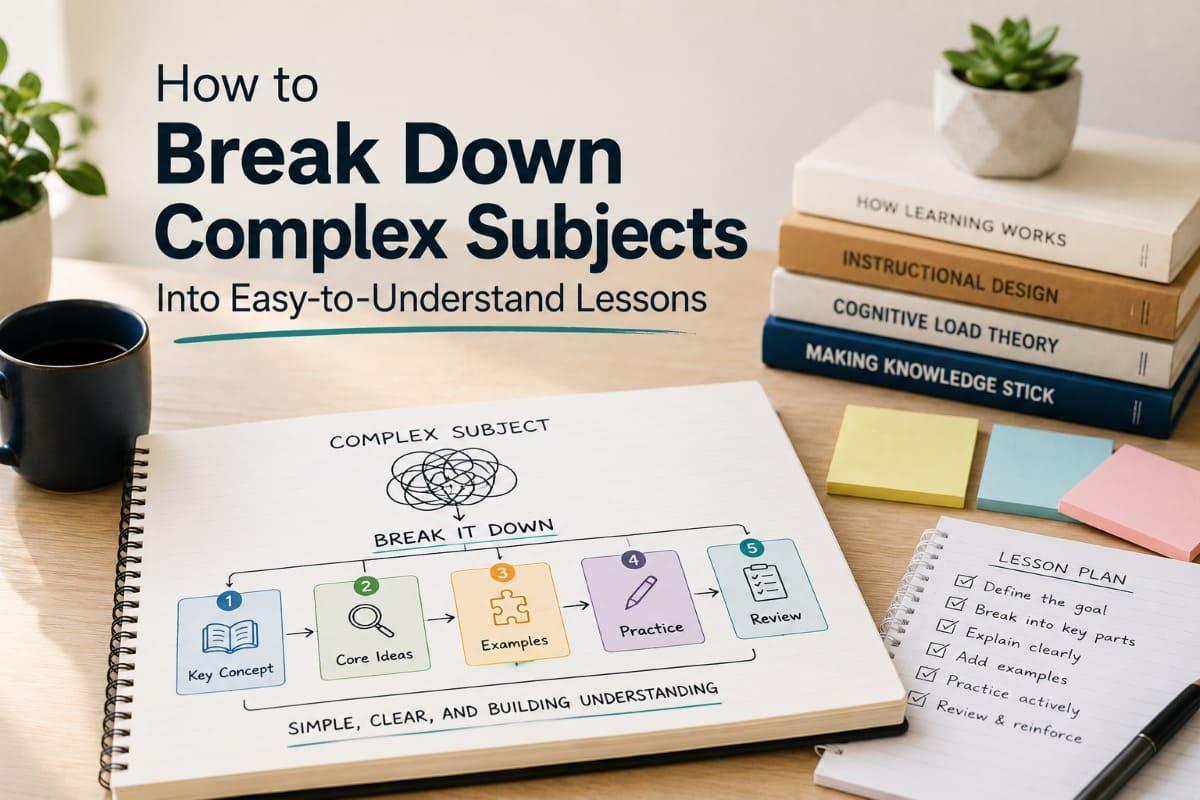
Complex subjects become easier to teach when they are broken
into clear, purposeful lessons that help learners understand one idea, practice
one skill, or make one decision at a time. For teachers, trainers, and training
providers, this is one of the most important parts of learning design. A
complex subject should not be simplified by removing depth. It should be
structured so learners can build understanding progressively, connect ideas,
and apply knowledge in realistic situations. This article explains how to break
down complex subjects into easy-to-understand lessons using outcomes, concept
mapping, learner readiness, examples, practice, and microlearning structure. It
also shows how a learning platform can help organize complex expertise into a
scalable, learner-friendly online program.
- Quick
Answer
- Why
Complex Subjects Feel Difficult to Learners
- Start
by Defining the Learning Outcome
- Map
the Subject Before Creating Lessons
- Break
the Topic Into Lesson-Sized Learning Units
- Use
Examples, Analogies, and Practice to Make Ideas Clear
- Turn
Complex Subjects Into Microlearning Programs
- Common
Mistakes When Simplifying Complex Subjects
- Conclusion
- FAQ
Quick Answer
To break down a complex subject into easy-to-understand
lessons, start by defining what learners should be able to do after the
learning experience. Then map the subject into major concepts, prerequisite
knowledge, practical skills, examples, common mistakes, and application tasks.
Each lesson should focus on one clear learning goal rather than trying to
explain the entire topic at once.
A good lesson-sized unit usually contains a focused
explanation, a simple example, a practical activity, and a short check for
understanding. The goal is not to make the subject shallow. The goal is to
reduce unnecessary confusion so learners can build knowledge step by step.
For teachers, trainers, and training providers, this process
is especially important when converting expertise into online courses, mobile
learning, or microlearning programs. Complex subjects need structure, sequence,
and visible progression. Without that structure, learners may consume content
but fail to understand how the ideas connect. With the right breakdown, a
complex subject becomes a guided learning journey.

Why Complex Subjects Feel Difficult to Learners
A subject is not always difficult because it is inherently
advanced. Sometimes it feels difficult because the explanation is not organized
around the learner’s starting point.
Experts often understand a subject as a network of connected
ideas. They can move quickly between concepts, exceptions, tools, terminology,
and practical judgment. Learners do not have that network yet. They need
structure before they can see the whole picture.
This is why complex subjects often become overwhelming when
teachers or trainers present too much too soon.
Learners may struggle because:
- they
do not understand the vocabulary;
- they
cannot see why the topic matters;
- the
lesson assumes prior knowledge;
- too
many ideas are introduced at once;
- examples
are too abstract;
- practice
comes too late;
- the
sequence is unclear;
- the
course jumps from explanation to assessment too quickly;
- the
topic is delivered as a content library rather than a learning path.
For example, a course about curriculum design may be
confusing if it begins with multiple instructional design theories before
learners understand what a learning objective is. A course about financial
planning may feel overwhelming if it starts with advanced forecasting before
learners understand revenue, cost, cash flow, and assumptions. A course about
fashion production may become difficult if learners are asked to understand
garment costing before they understand fabric, construction, labor, and production
flow.
Complexity becomes easier to learn when the structure becomes visible.
For online learning, this challenge is even more important.
In a live classroom, learners can ask questions immediately. In a self-paced
learning platform, the lesson structure must carry more responsibility. The
platform, module order, lesson titles, examples, quizzes, and resources must
help learners understand what to do next.
A well-designed lesson breakdown helps learners move from
confusion to clarity by answering four questions:
- What
is the main idea?
- Why
does it matter?
- How
does it work?
- What
should I do with it?
If a lesson answers those questions clearly, learners are
more likely to stay engaged and make progress.
Breaking down a complex subject is not the same as making it
basic. It means designing a route through complexity so learners can reach
understanding without being overwhelmed.
Start by Defining the Learning Outcome
The first mistake many trainers make is starting with the
content.
They ask, “What should I explain?” before asking, “What
should learners be able to do?”
This creates long lessons that may contain useful
information but lack direction. A stronger approach begins with the learning
outcome.
A learning outcome defines the capability learners should
gain. It may describe something learners can explain, demonstrate, create,
analyze, decide, or improve.
For example:
- Learners
can identify the parts of a basic lesson plan.
- Learners
can calculate simple production costs.
- Learners
can create a beginner-friendly sewing practice schedule.
- Learners
can compare two platform options for online training.
- Learners
can design a short assessment aligned with a learning objective.
Each of these outcomes gives the lesson a clear purpose.
Use outcome-first thinking
Outcome-first thinking changes how a subject is broken down.
Instead of dividing a subject based on chapter titles,
divide it based on what learners need to understand or perform.
For example, a broad topic like “online course creation” can
become smaller learning outcomes:
- define
the target learner;
- write
a learning objective;
- outline
course modules;
- create
a short lesson script;
- design
a quiz;
- upload
content to a platform;
- review
learner progress;
- improve
the course based on feedback.
Each outcome can become one lesson, one activity, or one
module depending on complexity.
This makes the subject easier to manage.
Distinguish knowledge, skill, and judgment
Not all lessons have the same type of goal.
Some lessons teach knowledge. Others teach skill. Others
teach judgment.
|
Lesson Type |
Main Purpose |
Example |
|
Knowledge Lesson |
Help learners understand a concept |
What is a learning objective? |
|
Skill Lesson |
Help learners perform a task |
How to write a measurable learning objective |
|
Judgment Lesson |
Help learners make a better decision |
How to choose the right objective for a beginner course |
This distinction matters because each lesson type needs a
different design.
A knowledge lesson needs explanation and examples.
A skill lesson needs demonstration and practice.
A judgment lesson needs scenarios, comparison, and feedback.
When these are mixed carelessly, lessons become confusing. A
trainer may explain a concept, ask learners to perform a task, and then assess
judgment before learners are ready.
Better lesson design separates these stages.
Map the Subject Before Creating Lessons
Before writing lesson content, create a subject map.
A subject map shows the relationship between major ideas,
prerequisite knowledge, practical skills, examples, and application tasks. It
helps prevent two common problems: missing important foundations and
overloading learners with unnecessary details.
A subject map does not need to be complicated. It can begin
with five categories:
- core
concepts;
- key
vocabulary;
- practical
skills;
- common
mistakes;
- real-world
applications.
For example, if the topic is “designing a microlearning
course,” the map might look like this:
|
Category |
Example Content |
|
Core Concepts |
Microlearning, learning objective, module structure,
learner progress |
|
Key Vocabulary |
Lesson unit, assessment, completion tracking, mobile-first
learning |
|
Practical Skills |
Writing short lessons, creating quizzes, organizing
modules |
|
Common Mistakes |
Making lessons too short without sequence, skipping
practice, unclear outcomes |
|
Real-World Applications |
Employee onboarding, creator-led courses, training
provider programs |
Once the map is clear, the trainer can decide what belongs
in the main course, what belongs in optional resources, and what should be
saved for a more advanced pathway.

Identify prerequisites
Prerequisites are the ideas learners need before the next
lesson makes sense.
For example, learners should understand learning objectives
before designing assessments. They should understand fabric types before making
garment construction decisions. They should understand basic data metrics
before interpreting a dashboard.
If prerequisites are missing, learners may still complete
the lesson but fail to understand it deeply.
A practical way to identify prerequisites is to ask:
- What
terms must learners know first?
- What
concept supports this task?
- What
simple example should come before the complex example?
- What
mistake will learners make if they skip the foundation?
- What
should be reviewed before the assessment?
Prerequisite thinking is especially useful for training
providers that teach mixed-level audiences. Beginners may need prerequisite
modules. Intermediate learners may only need a short refresher. Advanced
learners may be able to skip directly to application.
For level-based design, see how
to design learning paths for beginner intermediate and advanced learners.
Separate the main path from supporting resources
Not every useful detail belongs inside the main lesson.
Complex subjects often contain definitions, exceptions,
background context, advanced examples, templates, references, and technical
notes. If all of these appear in the main lesson, learners may lose the central
idea.
A better structure is to separate:
- main
lesson content;
- optional
deep-dive explanations;
- downloadable
templates;
- examples
library;
- glossary;
- advanced
notes;
- review
checklist.
This creates a cleaner learning experience while preserving
depth.
The main lesson should carry the learning journey.
Supporting resources should deepen understanding without interrupting
progression.
Break the Topic Into Lesson-Sized Learning Units
A complex subject becomes easier when each lesson has a
limited, purposeful scope.
A lesson-sized unit should usually answer one focused
question or support one specific learner action.
For example, instead of creating one long lesson called
“Assessment Design,” a trainer can break it into smaller lessons:
- What
is assessment alignment?
- How
do you choose between quiz, assignment, and project?
- How
do you write a simple quiz question?
- How
do you create a rubric?
- How
do you review assessment results?
- How
do you improve a lesson based on assessment data?
Each lesson becomes easier to understand because it has one
clear purpose.
Use the “one lesson, one job” rule
The “one lesson, one job” rule means every lesson should
have a specific function.
A lesson may exist to:
- introduce
a concept;
- explain
a process;
- demonstrate
a task;
- show
an example;
- guide
practice;
- correct
a misconception;
- prepare
learners for assessment;
- support
reflection;
- connect
learning to real-world use.
When one lesson tries to do too many of these jobs at once,
it becomes harder to follow.
This does not mean lessons must be extremely short. Some
lessons need more explanation. But the learner should always understand the
main job of the lesson.
Choose the right lesson size
There is no universal lesson length that works for every
subject. A lesson should be long enough to make the idea clear, but focused
enough to remain manageable.
A practical lesson unit often includes:
- a
clear lesson title;
- a
short introduction;
- one
main concept or task;
- one
example;
- one
practice activity or reflection;
- one
check for understanding;
- one
transition to the next lesson.
This structure works well for online learning because it
supports clarity, mobile access, and learner progress tracking.
Use progressive difficulty
Complex subjects should move from easier forms to more
realistic forms.
For example:
|
Stage |
Lesson Focus |
Example |
|
1 |
Simple concept |
What is a learning objective? |
|
2 |
Guided example |
Identify the objective in a sample lesson |
|
3 |
Basic practice |
Write one objective for a short lesson |
|
4 |
Comparison |
Compare weak and strong objectives |
|
5 |
Application |
Create objectives for a full module |
|
6 |
Review |
Revise objectives based on feedback |
This progression helps learners build confidence before they
handle complexity.
For a deeper view of sequencing, see how
to choose the right learning sequence for complex topics.
FitAcademy
Turn Complex Expertise Into Clear Online Lessons
FitAcademy helps teachers, trainers, and training providers organize complex subjects into structured, mobile-first learning programs with clear modules, lessons, quizzes, and learner progress tracking.
Join PlatformUse Examples, Analogies, and Practice to Make Ideas Clear
Breaking down a complex subject is not only about dividing
content. It is also about making each part understandable.
Three tools are especially useful: examples, analogies, and
practice.
Use concrete examples
Examples help learners see how an idea works.
For instance, if a lesson explains “assessment alignment,”
the concept may feel abstract. But if the trainer shows a learning objective, a
mismatched quiz, and a better-aligned task, learners can see the problem
clearly.
Good examples should be:
- realistic;
- relevant
to the learner;
- simple
enough to understand;
- connected
to the lesson outcome;
- followed
by explanation.
Avoid examples that are impressive but too complicated.
Beginners need clarity before sophistication.
Use analogies carefully
Analogies can help learners understand unfamiliar concepts
by connecting them to familiar experiences.
For example, a learning path can be compared to a guided
route through a city. The destination is the learning outcome. The modules are
major stops. The lessons are smaller steps. The assessments show whether
learners are still on track.
However, analogies should not replace precise explanation.
They should open understanding, not oversimplify the subject.
Add practice before assessment
Many courses explain a concept and then immediately test
learners. This can feel efficient, but it may not support learning.
Practice should come before formal assessment.
For example, after teaching learners how to create a lesson
objective, give them a low-risk practice activity. Then show a model answer or
checklist. Only after that should the course ask them to submit an assessed
task.
Practice helps learners make mistakes while the stakes are
still low.

Turn Complex Subjects Into Microlearning Programs
Microlearning can be useful for complex subjects when it is
designed as a sequence, not as disconnected short content.
A complex subject cannot usually be solved with random short
videos. Learners need progression. They need to know how one lesson connects to
the next.
A microlearning program breaks a larger topic into smaller
units that are easier to complete, revisit, and apply. This is especially
useful for busy learners, professional training, mobile learning, creator-led
education, and workforce development.
Design micro-units around learner actions
A good microlearning unit should have a clear action.
For example:
- identify
one common mistake;
- complete
one short checklist;
- analyze
one scenario;
- practice
one technique;
- answer
one decision question;
- revise
one part of a project;
- apply
one concept to real work.
This keeps the microlearning experience practical.
Organize micro-units into a visible pathway
Short lessons need a larger structure.
A microlearning pathway may include:
- orientation
module;
- foundation
lessons;
- core
skill lessons;
- practice
tasks;
- scenario-based
lessons;
- review
checkpoints;
- final
project or assessment;
- next
recommended pathway.
This allows learners to experience progress instead of
consuming isolated pieces of content.
Use platform features to support understanding
A learning platform can support complex subject breakdown
through:
- module
organization;
- lesson
sequencing;
- mobile-first
access;
- quizzes
and assignments;
- downloadable
resources;
- progress
tracking;
- certificates;
- learner
analytics;
- recommended
next lessons;
- content
updates.
For training providers, this matters because learning design
and learning operations are connected. A clear breakdown is easier to deliver,
easier to update, and easier to scale.
For broader platform planning, see 7
features every modern learning platform should have in 2026.
Microlearning works best when each small lesson belongs to a larger learning journey.

Common Mistakes When Simplifying Complex Subjects
Simplifying a complex subject requires care. The goal is
clarity, not oversimplification.
Mistake 1: Removing too much depth
Some trainers simplify by removing important nuance. This
may make the lesson easier at first, but it can create misunderstanding later.
A better approach is to keep the main lesson simple while
placing deeper details in later lessons or supporting resources.
Mistake 2: Starting with terminology
Vocabulary matters, but a lesson that begins with too many
definitions may feel dry and disconnected.
It is often better to start with a learner problem, simple
example, or practical scenario. Then introduce terms when learners need them.
Mistake 3: Explaining without showing
Complex ideas become easier when learners can see examples.
If a course explains “good lesson structure” but never shows
a weak lesson and a stronger lesson, learners may not understand the
difference. Show the concept in use.
Mistake 4: Breaking content into pieces without
sequenceBreaking a subject into smaller lessons is useful only when
the pieces are connected.
If the lessons are too fragmented, learners may understand
individual parts but fail to see the whole system.
The solution is to use module introductions, transitions,
recap lessons, and clear pathway design.
Mistake 5: Treating all learners as beginners
Simple does not always mean beginner-level. Some learners
may already understand the basics and need application, troubleshooting, or
advanced cases.
Offer optional refreshers, diagnostic checks, or level-based
pathways when the audience has mixed ability.
For related support strategies, see how
to support learners with different levels of knowledge and ability.
The best simplification preserves the integrity of the
subject while reducing the learner’s unnecessary mental burden.
Conclusion
Breaking down complex subjects into easy-to-understand
lessons is one of the most valuable skills in learning design. It helps
teachers explain better, helps learners progress with confidence, and helps
training providers turn expertise into scalable online programs.
The process begins with outcomes. Once the outcome is clear,
the subject can be mapped into concepts, vocabulary, skills, examples,
mistakes, and applications. From there, each lesson should have a focused job:
explain one idea, demonstrate one task, guide one practice activity, or support
one decision.
A complex subject should not be made shallow. It should be
made navigable.
For online learning, this becomes even more important.
Learners need structure they can follow independently. A learning platform can
help make that structure visible through modules, lesson sequences, quizzes,
resources, progress tracking, and mobile-first access.
When complex expertise is broken down well, learners do not
just consume information. They build understanding step by step.
FitAcademy
Build Easy-to-Follow Learning Programs With FitAcademy
FitAcademy helps educators, creators, and training providers turn complex expertise into structured, branded learning programs that learners can follow across web and mobile.
Join PlatformFAQ
How do you simplify a complex subject for learners?
Simplify a complex subject by starting with the learning
outcome, identifying prerequisite knowledge, mapping the main concepts, and
turning the subject into smaller lesson-sized units. Use simple examples,
guided practice, and clear transitions between lessons. The goal is not to
remove depth, but to help learners understand the subject progressively.
What makes a lesson easy to understand?
A lesson is easier to understand when it has one clear
purpose, uses plain explanations, includes relevant examples, gives learners a
chance to practice, and checks understanding before moving forward. It should
also connect clearly to the previous and next lesson so learners can see the
learning journey.
How small should each lesson be?
A lesson should be small enough to focus on one main idea or
task, but complete enough to help learners understand and apply it. There is no
universal length. In microlearning, lessons are usually shorter, but the more
important rule is that each lesson has a clear learning goal and fits into a
larger sequence.
What is the difference between simplifying and oversimplifying?
Simplifying makes a subject clearer without distorting it.
Oversimplifying removes important context, nuance, or limitations. A good
course can keep the main lesson simple while placing deeper explanations,
advanced cases, and technical details in later lessons or supporting resources.
Can complex subjects work in microlearning format?
Yes, complex subjects can work in microlearning format when
short lessons are connected by a clear pathway. Microlearning is less effective
when lessons are random or disconnected. For complex subjects, each
microlearning unit should support a specific concept, action, practice task, or
decision within a larger learning journey.
How can a learning platform help with complex subjects?
A learning platform helps organize complex subjects into
modules, lessons, quizzes, assignments, resources, and progress tracking. This
makes the learning structure visible to learners and easier for training
providers to manage. It also supports mobile learning, content updates,
certificates, and scalable delivery.