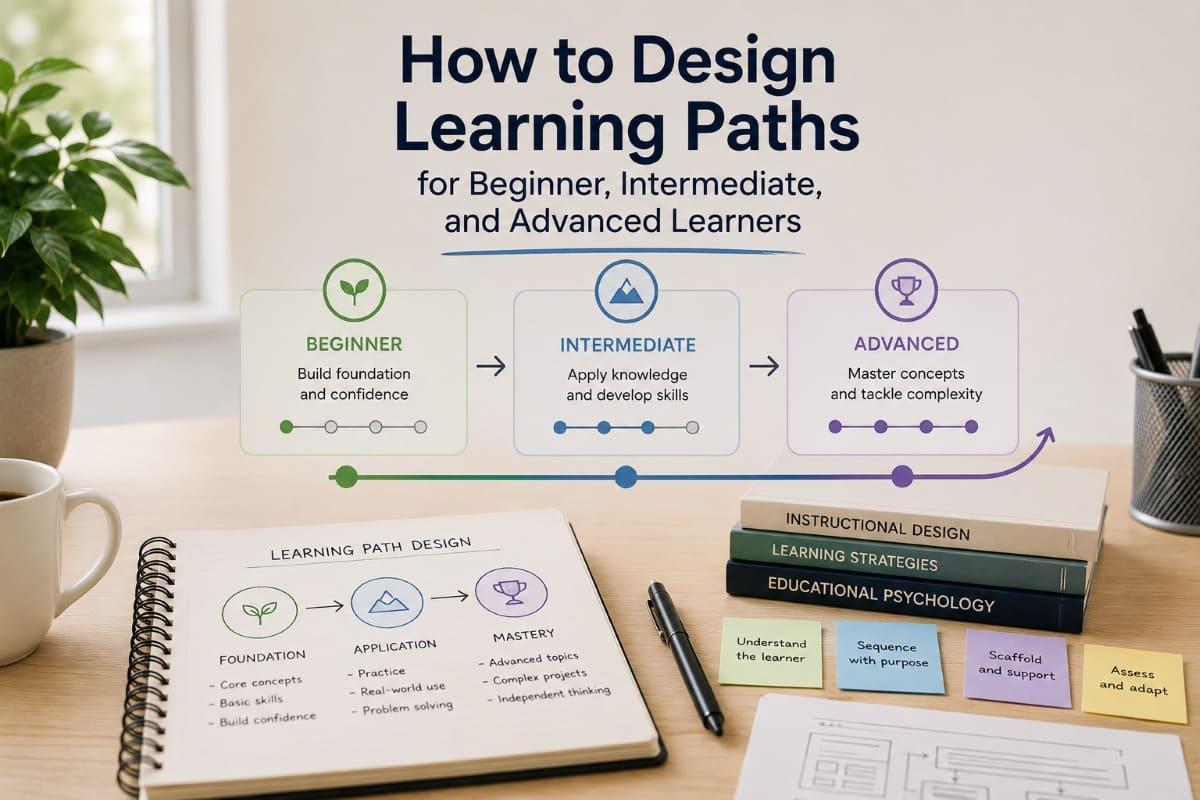
A learning path helps learners move through a subject at the
right level of challenge, support, and application. For teachers, trainers, and
training providers, this becomes especially important when learners enter a
program with different backgrounds, goals, confidence levels, and practical
needs. A beginner may need orientation and foundations. An intermediate learner
may need structured practice and feedback. An advanced learner may need
real-world scenarios, independent projects, or specialization. This article
explains how to design learning paths for beginner, intermediate, and advanced
learners without creating unnecessary complexity. It also shows how level-based
pathways can improve learner experience, online course structure, microlearning
delivery, and scalable training operations through a branded learning platform.
- Quick
Answer
- Why
Level-Based Learning Paths Matter
- Define
What Beginner, Intermediate, and Advanced Really Mean
- Build
Each Path Around Capability, Not Content Volume
- Design
the Beginner Path: Clarity, Confidence, and Foundations
- Design
the Intermediate Path: Practice, Feedback, and Transfer
- Design
the Advanced Path: Judgment, Specialization, and Real-World Application
- How
to Deliver Multiple Learning Paths Without Overcomplicating Operations
- Common
Mistakes in Level-Based Learning Path Design
- Conclusion
- FAQ
Quick Answer
To design learning paths for beginner, intermediate, and
advanced learners, start by defining what learners at each level should be able
to do, not just what content they should consume. A beginner path should build
orientation, vocabulary, foundational concepts, and early confidence. An
intermediate path should focus on structured practice, feedback, comparison,
troubleshooting, and applied tasks. An advanced path should develop judgment,
independence, specialization, and real-world performance.
The goal is not to create three completely separate courses
for every topic. In many cases, training providers can design one structured
program with optional entry points, diagnostic checks, prerequisite lessons,
advanced extensions, and recommended next steps. This makes the learning
experience more flexible without becoming operationally difficult to manage.
Level-based learning paths matter because learners rarely
start from the same place. When a course assumes everyone is a beginner,
experienced learners may disengage. When it assumes everyone is advanced,
beginners may feel lost. A good learning path gives each learner a clear route
toward progress.

Why Level-Based Learning Paths Matter
Most learners do not arrive with identical knowledge,
confidence, or goals.
In one training program, a beginner may still be trying to
understand basic terminology. An intermediate learner may already understand
the concepts but struggle to apply them consistently. An advanced learner may
want deeper cases, specialization, or strategic decision-making.
If all of them receive the same learning experience, the
course may feel too difficult for some and too basic for others.
This is the central challenge of level-based learning
design.
A learning path is not only a sequence of lessons. It is a
guided route through a subject based on learner readiness and desired
capability. For training providers, it helps answer practical questions:
- Where
should learners start?
- What
should they already know before entering this module?
- What
support do beginners need?
- What
practice do intermediate learners need?
- What
challenge do advanced learners need?
- When
should learners move to the next level?
- How
can the platform show progress clearly?
A good learning path does not label learners permanently. It helps them find the next useful step.
This distinction matters. Beginner, intermediate, and
advanced should not become rigid categories. They are temporary positions in a
learning journey. Someone may be advanced in one topic and beginner in another.
A business owner may understand strategy but be a beginner in analytics. A
teacher may be experienced in classroom delivery but new to online course
design.
For online learning, this flexibility is especially
important. Learners may join from different regions, industries, institutions,
and professional backgrounds. Some may study on mobile devices between work
responsibilities. Others may need a structured certification pathway. Others
may only want to strengthen one practical skill.
Level-based learning paths work best when they guide
progression without making learners feel locked into a fixed identity.
For teachers and trainers, level-based paths improve
instructional clarity. For training providers, they also improve product
strategy. A well-designed pathway can support onboarding, learner retention,
course bundling, certification, membership programs, and long-term learner
relationships.
That is why learning path design is both an educational
decision and a platform strategy decision.
Define What Beginner, Intermediate, and Advanced Really Mean
Before designing lessons, define the levels.
Many programs use beginner, intermediate, and advanced as
marketing labels. But if those labels are not clearly defined, they can confuse
learners and weaken the course experience.
A beginner course is not simply “easy.” An advanced course
is not simply “longer.” Each level should describe a different stage of
capability.
|
Learner Level |
Typical Learner Situation |
Main Learning Need |
Best Learning Focus |
|
Beginner |
New to the topic or lacks confidence |
Orientation and foundations |
Clear concepts, simple examples, guided steps |
|
Intermediate |
Understands basics but needs consistency |
Practice and application |
Scenarios, feedback, comparison, troubleshooting |
|
Advanced |
Can apply skills but needs depth |
Judgment and specialization |
Complex cases, independent projects, strategic decisions |
Beginner means “needs orientation”
A beginner may not know the vocabulary, tools, assumptions,
or common mistakes in a field. They need more context before they can perform
well.
For example, a beginner in learning design may need to
understand what a learning objective is, why assessment alignment matters, and
how lesson structure affects learner comprehension.
The beginner path should reduce unnecessary confusion.
Intermediate means “needs applied control”
An intermediate learner usually understands the basics but
cannot yet apply them reliably across different situations.
For example, an intermediate trainer may know how to create
a lesson plan but struggle to adapt it for online delivery, microlearning, or
learners with different abilities.
The intermediate path should build consistency.
Advanced means “needs judgment”
An advanced learner can perform core tasks but needs deeper
decision-making ability.
For example, an advanced training provider may already run
online courses but now wants to design multi-level certification programs,
improve learner analytics, or build a scalable learning ecosystem.
The advanced path should develop strategic and contextual
judgment.

Build Each Path Around Capability, Not Content Volume
A common mistake in course design is assuming that higher
levels simply need more content.
Beginners get five lessons. Intermediate learners get ten.
Advanced learners get twenty.
This may look logical, but it is not always good learning
design. A level should be defined by the type of capability learners are
building, not merely the amount of content they consume.
A beginner may need fewer concepts but more explanation. An
intermediate learner may need fewer lectures but more practice. An advanced
learner may need less instruction but more complex tasks.
A stronger way to design each path is to ask:
- What
should learners be able to do at this level?
- What
decisions should they be able to make?
- What
mistakes should they be able to avoid?
- What
examples should they understand?
- What
type of practice should they complete?
- What
evidence shows they are ready to move forward?
Use performance milestones
Performance milestones make learning paths clearer.
For example, in a course about online course creation, the
milestones might look like this:
|
Level |
Performance Milestone |
Evidence of Progress |
|
Beginner |
Can outline a simple course structure |
Draft module map with basic lesson flow |
|
Intermediate |
Can design lessons with activities and assessments |
Completed lesson plan with practice task and quiz |
|
Advanced |
Can build a scalable learning program |
Full learning pathway with onboarding, analytics, and
improvement plan |
This gives learners a reason to progress. It also gives the
training provider a clearer basis for assessment, certification, and course
packaging.
Avoid “content dumping”
When experts design advanced material, they may be tempted
to include everything they know. This can make advanced courses feel dense but
not necessarily useful.
Advanced learners often need stronger problems, not just
more information.
For example, instead of giving advanced learners twenty
additional lectures about curriculum theory, ask them to redesign a real
learning program, diagnose a weak module, or compare different learning path
strategies.
This keeps the path practical.
The difference between levels is not only how much learners
know. It is how independently and accurately they can use what they know.
Design the Beginner Path: Clarity, Confidence, and Foundations
The beginner path should help learners feel oriented, not
overwhelmed.
Beginners need a clear sense of what the topic is, why it
matters, how the course is organized, and what success looks like. They also
need early wins. If the first lessons feel too abstract, technical, or
demanding, learners may disengage before they build confidence.
A strong beginner path usually includes:
- orientation
to the topic;
- simple
definitions;
- core
vocabulary;
- common
use cases;
- step-by-step
demonstrations;
- low-risk
practice;
- visual
examples;
- short
quizzes;
- clear
progress markers.
Start with the learner’s problem
Beginners often learn better when they understand the
practical reason behind the subject.
For example, instead of starting a course with “Introduction
to Instructional Design Models,” a trainer might begin with: “Why some lessons
confuse learners even when the content is correct.”
That opening gives the learner a problem they can recognize.
Then the course can introduce learning objectives,
sequencing, examples, practice, and assessment.
Use simple examples before complex cases
A beginner path should avoid exceptions too early. Teach the
common pattern first.
For example, in a beginner entrepreneurship course, do not
begin with complex fundraising structures. Start with customer problem, offer,
pricing, delivery, and simple financial logic.
Once the learner has a foundation, complexity can be
introduced gradually.
Make progress visible
Beginners often need reassurance that they are moving
forward. In an online learning platform, this can be supported through:
- short
modules;
- completion
indicators;
- lesson
checklists;
- simple
quizzes;
- downloadable
templates;
- milestone
badges;
- recommended
next lessons.
This is not just a motivational feature. It helps learners
understand where they are in the learning journey.
FitAcademy
Create Beginner-Friendly Learning Paths With FitAcademy
FitAcademy helps teachers, trainers, and training providers organize lessons into clear, mobile-first learning paths that guide learners from orientation to practical progress.
Join PlatformDesign the Intermediate Path: Practice, Feedback, and Transfer
Intermediate learners usually do not need everything
explained from zero. They need to apply what they know more consistently.
This is where many courses become weak. They either repeat
beginner content or jump too quickly into advanced theory. A good intermediate
path sits between explanation and independence.
It should help learners:
- compare
options;
- apply
concepts in different contexts;
- troubleshoot
mistakes;
- receive
feedback;
- improve
consistency;
- connect
theory to real work;
- prepare
for more advanced tasks.
Use scenarios and variations
Intermediate learners benefit from varied examples.
For instance, a trainer learning course design may already
understand learning objectives. The intermediate path can now show how
objectives change across different contexts:
- a
short workshop;
- a
self-paced online course;
- a
corporate training module;
- a
certification program;
- a
mobile-first microlearning path.
This helps learners transfer knowledge instead of memorizing
one format.
Add feedback loops
Intermediate progress depends heavily on feedback.
Feedback may come from instructors, peers, automated
quizzes, self-assessment checklists, rubric-based review, or platform
analytics. The format depends on the course, but the purpose is the same:
learners need to see the gap between their current performance and the expected
standard.
In an online course, feedback can be built into:
- quiz
explanations;
- model
answers;
- assignment
rubrics;
- peer
discussion prompts;
- instructor
review;
- progress
analytics;
- reflection
tasks.
Focus on decision-making
Intermediate learners should begin making choices, not just
following steps.
For example, instead of asking, “Write a learning
objective,” ask, “Choose the best learning objective for this course outcome
and explain why.”
That small shift moves learners toward judgment.

Design the Advanced Path: Judgment, Specialization, and Real-World Application
Advanced learners need depth, but depth does not always mean
more lectures.
They often need realistic complexity.
An advanced path should include:
- complex
cases;
- strategic
trade-offs;
- independent
projects;
- simulations;
- specialization
tracks;
- peer
critique;
- portfolio
work;
- capstone
assignments;
- advanced
resources;
- real-world
constraints.
Use authentic tasks
An authentic task resembles the real work learners need to
perform.
For example:
- A
teacher designs a complete unit plan.
- A
training provider builds a multi-module online course.
- A
business coach creates a client learning pathway.
- A
corporate learning team designs onboarding for different employee roles.
- A
fashion instructor creates a structured beginner-to-advanced sewing
program.
The task should require learners to apply judgment, not
simply recall information.
Offer specialization routes
Advanced learners often have different goals. Some may want
leadership skills. Others may want technical depth. Others may want business
application.
A single advanced path can include optional specialization
routes, such as:
- advanced
teaching practice;
- assessment
design;
- learner
analytics;
- platform
operations;
- certification
program design;
- content
monetization;
- community-based
learning;
- mobile
learning strategy.
This approach allows training providers to serve advanced
learners without creating entirely separate programs for every niche.
Require synthesis
Advanced learners should connect ideas across modules.
For example, a capstone project might ask learners to design
a complete learning pathway that includes outcomes, beginner onboarding,
intermediate practice, advanced application, assessment, and improvement
metrics.
This type of synthesis shows whether learners can use the
learning, not just finish the course.
Advanced learning is less about receiving harder information and more about making better decisions with it.
How to Deliver Multiple Learning Paths Without Overcomplicating Operations
Designing multiple paths can sound difficult. But training
providers do not always need to create three separate course ecosystems.
A practical approach is to design a shared learning
architecture with flexible entry points.
|
Operational Approach |
How It Works |
Best Use Case |
|
Diagnostic Entry |
Learners answer questions before starting |
Mixed-level audiences |
|
Required Foundations |
Everyone completes core basics first |
Certification or compliance training |
|
Optional Refreshers |
Beginners use support lessons; others skip them |
Professional training |
|
Level-Based Tracks |
Separate beginner, intermediate, and advanced routes |
Large programs or academies |
|
Modular Progression |
Learners unlock deeper modules over time |
Microlearning and membership models |
Use diagnostic checks
A diagnostic quiz or self-assessment helps learners choose
the right starting point.
This does not need to be complicated. A short diagnostic can
ask about prior experience, confidence, goals, and ability to complete sample
tasks.
The result can recommend:
- start
with beginner foundations;
- skip
to intermediate practice;
- enter
advanced specialization;
- review
specific prerequisite lessons.
Use shared core content
Some content can serve all levels if positioned carefully.
For example, all learners may need to understand the main
framework. Beginners may receive a simple explanation. Intermediate learners
may apply it through scenarios. Advanced learners may critique or adapt it.
This reduces content duplication.
Use platform structure to guide choice
A learning platform can make pathway design easier through:
- course
categories;
- level
tags;
- recommended
modules;
- progress
tracking;
- prerequisite
lessons;
- certificates;
- learner
dashboards;
- mobile
access;
- content
bundles;
- analytics.
For training providers, this matters operationally. Without
a platform structure, multiple learning paths can become difficult to manage
across spreadsheets, video folders, chat groups, and manual messages.
A structured platform makes the pathway visible to learners
and manageable for the provider.
For related planning, see how
to choose the right learning sequence for complex topics.

Common Mistakes in Level-Based Learning Path Design
Level-based pathways can improve learning experience, but
only if they are designed carefully. Poorly designed levels can create
confusion, duplication, or unnecessary operational burden.
Mistake 1: Using level labels without clear criteria
If “beginner,” “intermediate,” and “advanced” are only
marketing labels, learners may choose the wrong path. This can lead to
frustration or disengagement.
A better approach is to define each level by readiness,
performance, and expected outcome.
Mistake 2: Making advanced courses unnecessarily complicated
Advanced does not mean confusing. It means deeper judgment,
more realistic application, and greater independence.
If advanced content becomes dense without clear purpose,
even capable learners may struggle to see its value.
Mistake 3: Repeating too much content across levels
Some repetition is useful, especially when learners revisit
concepts with deeper application. But copying the same material across levels
can make the pathway feel inefficient.
Use shared foundations, then differentiate by task
complexity.
Mistake 4: Ignoring learner movement between levels
Learners should know how to move from beginner to
intermediate, or from intermediate to advanced. If the transition is unclear,
the learning path becomes a set of disconnected courses.
Use milestones, assessments, certificates, or project
submissions to show readiness.
For more on simplifying difficult material, see how
to break down complex subjects into easy-to-understand lessons.
Mistake 5: Designing paths that are too difficult to operate
A training provider may design an ambitious pathway with too
many tracks, assignments, live sessions, reviews, and certificates. But if the
team cannot maintain it, learner experience may decline.
The better strategy is to start with a manageable pathway
and improve it based on learner data.
A learning path should be sophisticated enough to support
different learners, but simple enough for the provider to operate consistently.
Conclusion
Designing learning paths for beginner, intermediate, and
advanced learners is not about creating more content for the sake of variety.
It is about helping learners enter at the right point, receive the right level
of support, and progress toward meaningful capability.
Beginners need clarity and confidence. Intermediate learners
need practice and feedback. Advanced learners need judgment, specialization,
and real-world application. When these differences are reflected in the course
structure, learners are more likely to understand where they are, what they
need, and how to move forward.
For teachers and trainers, level-based pathways improve
instructional quality. For training providers, they also create stronger online
learning products. A clear pathway can support course bundles, certification,
membership programs, learner retention, and scalable delivery.
The most effective learning paths are not rigid ladders.
They are guided routes that help different learners keep moving.
FitAcademy
Launch Multi-Level Learning Paths With FitAcademy
FitAcademy helps educators, creators, and training providers build branded learning experiences with structured modules, mobile-first lessons, learner progress tracking, and flexible pathways for different learner levels.
Join PlatformFAQ
What is a learning path?
A learning path is a structured route that guides learners
through lessons, activities, practice, and assessments toward a specific
outcome. It may include required modules, optional refreshers, level-based
tracks, or recommended next steps. In online learning, a learning path helps
learners understand where to begin, what to complete, and how to progress.
How do you separate beginner, intermediate, and advanced learners?
Separate learners by readiness and capability, not only by
how much content they have completed. Beginners need orientation and
foundations. Intermediate learners can understand the basics but need practice
and feedback. Advanced learners can apply skills but need deeper judgment,
complex cases, or specialization. A diagnostic quiz or self-assessment can help
place learners appropriately.
Do I need three separate courses for three learner levels?
Not always. Some programs need separate beginner,
intermediate, and advanced courses. Others can use one structured program with
optional refreshers, diagnostic entry points, advanced extensions, or modular
progression. The right structure depends on the topic, audience size,
certification needs, and operational capacity of the training provider.
What should a beginner learning path include?
A beginner learning path should include orientation, basic
vocabulary, simple concepts, guided examples, low-risk practice, and clear
progress markers. The goal is to build confidence and reduce confusion.
Beginners should not be overloaded with exceptions, advanced theory, or complex
tasks before they understand the foundation.
What makes an advanced learning path effective?
An advanced learning path is effective when it develops
judgment, independence, and real-world application. It should include complex
cases, strategic decisions, authentic projects, critique, synthesis, or
specialization. Advanced learners usually need meaningful challenge, not just
longer lessons or more information.
How can a learning platform support level-based pathways?
A learning platform can support level-based pathways through
course categories, module structure, level tags, progress tracking, quizzes,
certificates, recommended lessons, and learner analytics. These features help
learners choose the right path and help training providers manage multiple
learning routes more consistently.