Clear learning objectives describe what learners should be
able to know, perform, create, teams a practical basis for selecting material,
designing activities, developing assessments, and deciding what does not belong
in a course.
This guide explains how educators, trainers, instructional
designers, institutions, and program managers can write objectives that are
specific, learner-centered, observable, achievable, and aligned with the
intended level of performance. It covers objective structure, action verbs,
learning levels, practical rewriting methods, alignment checks, and common
mistakes. It also explains how well-written objectives can improve content
production and learning delivery across classroom, online, blended, mobile-first,
and microlearning programs.
- Quick
Answer
- Why
Clear Learning Objectives Matter
- What
a Strong Learning Objective Contains
- Match
the Objective to the Right Learning Level
- How
to Write Learning Objectives Step by Step
- Turn
Objectives Into Better Learning Content
- Align
Objectives, Activities, and Assessments
- Practical
Examples: From Vague to Clear
- Common
Mistakes When Writing Learning Objectives
- FAQ
- Conclusion
Quick Answer
A clear learning objective states what learners should be
able to do after completing a course, module, lesson, or learning activity.
A practical objective usually includes:
- the
learner;
- an
observable action;
- the
knowledge, skill, product, or situation involved;
- any
important condition;
- the
expected standard, when necessary.
For example:
By the end of the module, frontline supervisors will be able
to document a routine performance issue using the organization’s evidence and
reporting guidelines.
This objective is more useful than “understand performance
management” because it identifies a visible learner action, a specific context,
and a standard that can guide content and assessment.
Clear objectives help course teams decide:
- what
learners need to study;
- what
examples should be included;
- what
learners need to practise;
- how
achievement can be assessed;
- which
content is unnecessary;
- how
one lesson contributes to the wider course.
The objective should be demanding enough to represent
meaningful learning but realistic for the available time, learner profile,
delivery method, and level of support.
An objective is not clear merely because it contains an
action verb. The action, content, activity, and assessment must describe the
same level and type of learning.

Why Clear Learning Objectives Matter
A learning objective is a design decision.
It establishes what the learning experience is expected to
help learners achieve. Once that expectation is clear, educators can make more
disciplined decisions about content, instruction, practice, assessment, and
delivery.
Without clear objectives, course production often begins
with questions such as:
- What
topics should we cover?
- Which
presentation should we use?
- How
many videos should we produce?
- What
does the subject-matter expert want to explain?
- Which
resources do we already have?
These questions are operationally useful, but they should
not be the starting point.
A stronger starting question is:
What should learners be able to do differently after
completing this learning experience?
That question shifts attention from information delivery to
learner capability.
Carnegie Mellon University describes learning objectives as
student-centered statements of what learners should be able to do by the end of
a learning experience. Writing them helps instructors move beyond what they
want to cover and clarify what learners are expected to achieve.
Carnegie
Mellon University guidance on learning objectives
Objectives establish the scope of the content
A subject can contain far more knowledge than one course can
reasonably teach.
Consider a short course on digital marketing. Potential
content could include:
- audience
research;
- branding;
- search
marketing;
- social
media;
- advertising;
- analytics;
- email
marketing;
- content
production;
- conversion
optimization;
- customer
retention;
- marketing
technology.
Without defined objectives, the course may become a
compressed overview of every topic.
An objective such as:
Learners will be able to create a basic content plan for one
target audience and one marketing goal.
creates a clearer boundary.
The course may still introduce several marketing concepts,
but the content should primarily help learners:
- identify
an audience;
- define
a goal;
- select
content themes;
- choose
appropriate channels;
- create
a manageable publishing schedule;
- explain
how the plan supports the goal.
Material that does not support this capability can be
reduced, repositioned as optional reference material, or moved into another
course.
Objectives guide activity design
An objective indicates what learners need to practise.
If the objective asks learners to identify, they may
need examples and classification exercises.
If it asks them to analyse, they need information
that can be examined, compared, and interpreted.
If it asks them to perform, they need opportunities
to observe, practise, receive feedback, and repeat the task.
If it asks them to create, they need criteria,
models, staged production, and a way to review the final output.
The action described by the objective should therefore
influence the learning experience.
Objectives provide a basis for assessment
Assessment should produce evidence related to the stated
objective.
For example:
Objective:
Learners will be able to conduct a structured client interview.
Weak assessment:
A multiple-choice quiz about interview terminology.
Better assessment:
A recorded or observed interview evaluated against defined criteria.
The knowledge quiz may still be useful as a progress check,
but it is insufficient evidence of the performance described by the objective.
Objectives improve collaboration
Education programs often involve several contributors:
- educators;
- subject-matter
experts;
- instructional
designers;
- facilitators;
- assessment
designers;
- video
producers;
- graphic
designers;
- learning-platform
administrators;
- program
managers.
Clear objectives give these contributors a shared reference.
A video producer can understand what the explanation must
enable. An assessment designer can determine what evidence is required. A
facilitator can see where learners need practice. A program manager can
identify what the course is expected to contribute.
Objectives help learners understand expectations
Learners benefit when they know what they are expected to
achieve.
A clear objective can help them determine:
- what
deserves attention;
- what
they will be asked to practise;
- what
successful performance looks like;
- how
a lesson relates to their goals;
- whether
the course is relevant to their needs.
However, listing formal objectives at the beginning of a
course is not enough. The objectives should also be reflected in the
activities, assessment instructions, feedback, and learner journey.
A useful learning objective does not merely describe an
educational intention. It provides criteria for deciding what the course should
teach, ask learners to do, and measure.
What a Strong Learning Objective Contains
Different institutions use different terminology and
objective-writing frameworks.
Some use “learning objective” and “learning outcome”
interchangeably. Others distinguish between them by treating an objective as an
intended result and an outcome as the result learners actually demonstrate.
In practice, the terminology matters less than internal
consistency.
For this article:
- a learning
goal is a broad educational direction;
- a learning
objective is a specific statement of intended learner capability;
- a learning
outcome may be used as an alternative term where an institution
follows that convention.
Cornell University notes that learning outcomes are also
commonly called objectives or goals and describes them as statements of what
learners will learn in a program, course, unit, or class session.
Cornell
University guidance on defining learning outcomes
A strong objective generally contains four components.
1. The learner
The statement should focus on what the learner will do—not
what the educator will present.
Instructor-centered statement:
Introduce participants to the principles of customer
service.
Learner-centered objective:
Participants will be able to explain how three
customer-service principles apply to routine service interactions.
The instructor may still introduce the principles, but that
is a teaching activity rather than the intended learning result.
Useful learner references include:
- learners;
- participants;
- students;
- supervisors;
- technicians;
- new
employees;
- community
facilitators;
- course
creators;
- healthcare
workers;
- specific
role groups.
Where the audience is already obvious, the statement may
begin directly with the action:
Compare two possible responses to a customer complaint.
2. An observable action
The objective should identify what learners will do with the
knowledge or skill.
Observable actions may include:
- identify;
- describe;
- explain;
- classify;
- compare;
- apply;
- calculate;
- demonstrate;
- diagnose;
- analyse;
- evaluate;
- design;
- construct;
- produce;
- facilitate;
- document;
- revise.
The verb should correspond to the intended level of
learning.
Words such as “know,” “learn,” “appreciate,” “be aware of,”
and “understand” may express legitimate educational intentions, but they do not
clearly specify what evidence learners should produce.
“Understand” is not inherently meaningless. The problem is
that understanding can be demonstrated in many different ways.
A learner might demonstrate understanding by:
- explaining;
- interpreting;
- comparing;
- applying;
- predicting;
- illustrating;
- summarizing;
- distinguishing.
The objective should state which form of evidence is
expected.
Instead of:
Understand workplace safety procedures.
Consider:
Explain the purpose of the five required workplace safety
procedures.
or:
Apply the required safety procedures during a supervised
equipment-startup task.
These objectives represent different learning expectations.
The first focuses on explanation, while the second requires performance.
3. The content or capability
The action verb requires an object.
“Analyse” alone is incomplete. The objective must specify
what learners will analyse.
For example:
Analyse customer feedback to identify recurring service
problems.
The content or capability may involve:
- a
concept;
- a
process;
- a
situation;
- a
professional decision;
- a
data set;
- a
physical procedure;
- a
communication task;
- a
product;
- a
problem;
- a
piece of evidence.
The description should be specific enough to define the
learning scope.
Compare:
Create a plan.
with:
Create a four-week onboarding plan for a new
customer-service employee.
The second version provides clearer direction for content
production and assessment.
4. Conditions or criteria, when necessary
Some objectives benefit from stating the conditions under
which performance will occur or the criteria that define acceptable work.
Conditions may include:
- using
a provided template;
- without
consulting reference materials;
- using
approved equipment;
- within
a simulated scenario;
- based
on a supplied case;
- during
a supervised practice session;
- using
organizational guidelines;
- with
access to specified resources.
Criteria may include:
- meeting
defined safety requirements;
- including
required components;
- staying
within an acceptable error range;
- completing
the task within an operational time limit;
- achieving
a specified rubric level;
- following
legal or organizational standards.
For example:
Using the organization’s incident-reporting template,
participants will document a routine safety incident with all mandatory
information included.
The condition and criterion are useful because the course
must prepare learners to use a specific tool and meet an identifiable standard.
The University of Central Florida’s Objective Builder uses a
condition, audience, behavior, and degree framework to support measurable
objective writing.
University
of Central Florida Objective Builder
Not every objective needs all four elements written
explicitly.
An objective can become difficult to read when excessive
conditions and measurement criteria are forced into one sentence. Include
details that materially affect learning or assessment, and place additional
requirements in the assessment instructions or rubric when appropriate.
|
Component |
Question to Answer |
Example |
|
Learner |
Who will perform? |
Frontline supervisors |
|
Action |
What will they do? |
Document |
|
Content or capability |
What will they work with? |
A routine performance issue |
|
Condition |
Under what circumstances? |
Using the organization’s template |
|
Criterion |
What standard must be met? |
Including all required evidence and follow-up actions |
A complete objective could therefore read:
Using the organization’s template, frontline supervisors
will document a routine performance issue, including the required evidence,
agreed actions, and follow-up date.
The best objective is not the one with the most components. It is the one that makes the intended learner performance unmistakably clear.

Match the Objective to the Right Learning Level
Choosing an action verb is not simply a writing exercise. It
represents a decision about the depth and type of learning expected.
Bloom’s Taxonomy is commonly used to distinguish levels of
cognitive learning. The revised cognitive categories are generally represented
as:
- remember;
- understand;
- apply;
- analyse;
- evaluate;
- create.
The taxonomy can help course teams consider whether learners
need to recall information, interpret it, apply it, examine relationships, make
justified judgements, or produce something new.
University
of Waterloo overview of Bloom’s Taxonomy
Remember
At this level, learners retrieve or recognize information.
Possible actions include:
- define;
- identify;
- list;
- name;
- recall;
- recognize;
- match.
Example:
Identify the five stages of the organization’s
complaint-handling process.
This level may be appropriate when accurate recall is
necessary before a learner can perform a more complex task.
Understand
Learners explain meaning, interpret information, or
represent an idea in another form.
Possible actions include:
- describe;
- explain;
- summarize;
- interpret;
- classify;
- compare;
- illustrate.
Example:
Explain why each stage of the complaint-handling process is
necessary.
This objective requires more than recalling the stages.
Learners must explain their purpose.
Apply
Learners use knowledge or a process in a situation.
Possible actions include:
- apply;
- calculate;
- complete;
- demonstrate;
- implement;
- perform;
- use;
- solve.
Example:
Apply the complaint-handling process to a routine customer
scenario.
The learner now needs to use the process rather than merely
describe it.
Analyse
Learners examine information, distinguish components, and
identify relationships or causes.
Possible actions include:
- analyse;
- categorize;
- compare;
- differentiate;
- diagnose;
- examine;
- organize;
- investigate.
Example:
Analyse a customer complaint to distinguish the immediate
issue from the underlying service failure.
Evaluate
Learners make a judgement using evidence, standards, or
defined criteria.
Possible actions include:
- assess;
- critique;
- evaluate;
- justify;
- prioritize;
- recommend;
- review;
- validate.
Example:
Evaluate three possible responses to a customer complaint
and justify the most appropriate option using organizational policy.
Create
Learners combine elements to produce an original plan,
product, process, or solution.
Possible actions include:
- construct;
- create;
- design;
- develop;
- formulate;
- produce;
- plan;
- revise.
Example:
Design a service-recovery plan for a recurring customer
complaint pattern.
|
Learning Level |
Learner Demand |
Example Objective |
Possible Evidence |
|
Remember |
Retrieve information |
Identify the stages of the process |
Short-answer or matching task |
|
Understand |
Explain meaning |
Explain the purpose of each stage |
Written or verbal explanation |
|
Apply |
Use knowledge |
Apply the process to a routine scenario |
Scenario response |
|
Analyse |
Examine relationships |
Analyse the cause of a service failure |
Case analysis |
|
Evaluate |
Make a justified judgement |
Recommend a response using defined criteria |
Written recommendation |
|
Create |
Produce a new solution |
Design a service-recovery plan |
Project or presentation |
Do not force every objective toward the highest level
Higher-order thinking is not automatically appropriate for
every lesson.
Learners may need to remember terminology, recognize
hazards, or identify components before they can complete more complex work.
The design question is not:
How can every objective use an advanced verb?
It is:
What level of performance is genuinely required, and what
foundation does the learner need to reach it?
A short microlearning lesson may intentionally focus on
recognition. A complete professional pathway may move from recognition to
application and independent performance over several modules.
Do not rely on the verb alone
Some verbs can represent different cognitive demands
depending on the task.
“Compare,” for example, may involve a simple identification
of differences or a more demanding analysis of competing strategies.
“Design” may describe a meaningful professional task or a
superficial formatting exercise.
The objective should clarify:
- the
object of the action;
- the
context;
- the
complexity;
- the
expected evidence;
- the
criteria used to judge performance.
An action verb signals the intended learning level, but the
complete task determines its actual complexity.
How to Write Learning Objectives Step by Step
The following process can be used for program, course,
module, lesson, or activity objectives.
Step 1: Start with the real-world expectation
Ask what learners will need to do outside the learning
environment.
This may involve:
- performing
a task;
- making
a decision;
- communicating
with someone;
- creating
a professional output;
- applying
a standard;
- solving
a problem;
- explaining
a concept;
- evaluating
evidence;
- responding
to a situation.
For example, the real-world expectation might be:
New supervisors need to respond appropriately when an
employee’s performance falls below an agreed standard.
This statement is still broad, but it identifies a relevant
professional situation.
Step 2: Define the scope of the learning experience
Determine what level of that capability can realistically be
developed in the available course, module, or lesson.
A two-hour module may not make an inexperienced supervisor
fully competent in performance management.
It may realistically prepare the supervisor to:
- recognize
a routine performance issue;
- gather
initial evidence;
- prepare
for a first conversation;
- know
when to seek HR support.
The objective should reflect what the learning experience
can reasonably support.
Avoid claiming a level of capability that would require
extensive supervised practice, workplace experience, or professional judgement
beyond the scope of the course.
Step 3: Select the intended level of performance
Decide whether learners need to:
- recall;
- explain;
- apply;
- analyse;
- evaluate;
- create;
- perform
a physical or interpersonal skill;
- demonstrate
an attitude or professional practice.
The intended level should match the real-world requirement.
A safety course may require learners to recognize hazards,
explain controls, and perform an approved procedure. These are related but
distinct objectives.
Step 4: Choose an observable action
Select a verb that describes the evidence learners should
produce.
Instead of:
Learn about customer personas.
Use:
Create a basic customer persona from supplied audience
research.
Instead of:
Become familiar with garment measurement.
Use:
Record the required body measurements using the provided
measurement procedure.
Instead of:
Understand effective feedback.
Use:
Deliver specific feedback using the
situation-behaviour-impact structure.
Step 5: Specify the object of the action
Clarify what learners will identify, apply, analyse, create,
or perform.
Weak:
Evaluate effectively.
Clearer:
Evaluate a proposed project plan against the organization’s
feasibility criteria.
The object defines the content boundary and helps the team
determine which examples, explanations, and practice tasks are required.
Step 6: Add meaningful conditions
Include a condition when the environment or resources
materially change the performance.
For example:
Using a supplied data set, calculate monthly
customer-retention rates.
The supplied data set is relevant because the task is not
asking learners to gather data. It focuses on calculation and interpretation.
Another example:
Without consulting the emergency reference card, identify
the first three actions required after detecting a gas leak.
The absence of a reference card may be justified where
immediate recall is essential. It would be inappropriate if workers are
normally expected to use the card in practice.
Conditions should reflect realistic performance rather than
create unnecessary difficulty.
Step 7: Add criteria where a standard matters
The objective may include criteria when accuracy,
completeness, safety, quality, or timing is central to the expected
performance.
For example:
Assemble the component in the correct sequence without
omitting any required safety check.
A criterion may also be placed in a rubric rather than the
objective.
The objective might state:
Produce a client proposal that addresses the identified
business problem.
The rubric can then define:
- required
sections;
- evidence
quality;
- feasibility;
- clarity;
- budget
accuracy;
- presentation
standards.
Step 8: Check whether the objective can be assessed
Ask:
- What
would the learner produce or demonstrate?
- What
evidence would show successful performance?
- Can
that evidence be collected within the course?
- Who
will assess it?
- What
criteria will be used?
- Does
the delivery environment support the assessment?
If the team cannot describe credible evidence, the objective
may still be too vague or ambitious.
Step 9: Check whether the course provides adequate preparation
An objective is not useful if the course does not prepare
learners to achieve it.
If learners are expected to evaluate a complex case, they
may need:
- conceptual
foundations;
- evaluation
criteria;
- worked
examples;
- comparison
activities;
- guided
case analysis;
- feedback;
- independent
practice.
If the available content consists only of one short
explanatory video, the objective and learning experience are misaligned.
Step 10: Rewrite for clarity and economy
Remove language that does not improve meaning.
Overwritten:
Upon successful completion of this comprehensive
instructional module, participating learners should have developed the ability
to effectively demonstrate an understanding of how to apply the organization’s
basic incident-recording procedure.
Clearer:
By the end of the module, participants will be able to
document a routine incident using the organization’s reporting procedure.
A learning objective should be precise, but it does not need
to sound bureaucratic.

Turn Objectives Into Better Learning Content
Clear objectives improve content by creating a filter.
Every explanation, example, activity, resource, and media
format should have a recognizable relationship with what learners are expected
to achieve.
Use the objective to identify essential knowledge
Ask what learners must know before they can perform the
stated action.
Consider this objective:
Analyse a customer complaint to identify the service
failure, contributing factors, and appropriate response.
Learners may need to understand:
- categories
of service failure;
- customer-impact
indicators;
- evidence
sources;
- root-cause
concepts;
- organizational
response options;
- escalation
requirements.
These areas form the essential knowledge base.
The educator does not need to include every theory of
customer experience. The content should support the analytical task described
in the objective.
Select examples that represent the intended performance
Examples should help learners recognize what successful
application looks like.
For the complaint-analysis objective, the course might
include:
- one
complete worked example;
- one
example with insufficient evidence;
- one
example involving several possible causes;
- one
example requiring escalation;
- one
contrasting example that is not a service failure.
Variation matters because learners need to distinguish when
and how the capability applies.
Match the media format to the learning requirement
The objective can help determine whether content should be
delivered through:
- text;
- diagram;
- audio;
- demonstration
video;
- scenario;
- interactive
exercise;
- discussion;
- simulation;
- coached
practice;
- workplace
task.
A short article may explain a concept efficiently. A
demonstration video may be more suitable for showing a physical procedure. A
scenario may help learners practise judgement. A simulation may be necessary
for interpersonal or technical performance.
The most visually impressive format is not always the most
educationally appropriate.
Separate learning content from reference content
Some information must be learned and applied during the
course. Other information is primarily needed at the moment of work.
For example, learners may need to understand when an
incident must be reported, but they may not need to memorize every field in a
complex reporting form.
The course could teach:
- how
to recognize a reportable incident;
- why
accurate documentation matters;
- how
to locate the correct form;
- how
to complete common sections;
- where
to seek help.
The detailed reporting guide can remain available as a job
aid.
This distinction can reduce unnecessary content and make the
learning experience more practical.
Use objectives to control microlearning scope
A microlearning unit should focus on a narrow, meaningful
objective.
Weak microlearning objective:
Understand project management.
More realistic:
Identify whether a project task is on schedule, at risk, or
delayed using the supplied status data.
The narrower objective gives the content producer a
manageable scope and provides a clear basis for a short scenario or progress
check.
Several microlearning objectives can contribute to a broader
module outcome.
For example:
Module outcome:
Prepare an accurate weekly project-status update.
Microlearning objectives:
- Classify
tasks by status.
- Identify
schedule and resource risks.
- Summarize
completed and outstanding work.
- Recommend
one appropriate corrective action.
- Record
the information in the status template.
The short units remain connected because they contribute to
one broader capability.
FitAcademy
Turn Clear Objectives Into Structured Digital Learning
Clear learning objectives make it easier to organize modules, develop focused microlearning content, design assessments, and track learner progress. FitAcademy helps institutions, educators, and training providers deliver these learning experiences through a branded, mobile-first platform.
Learn More About FitAcademyAlign Objectives, Activities, and Assessments
A well-written objective is only useful when the wider
learning experience aligns with it.
Instructional alignment means that:
- the
objective states the intended learner performance;
- the
activities prepare learners for that performance;
- the
assessment asks learners to demonstrate it;
- the
success criteria evaluate the relevant quality.
Carnegie Mellon University states that assessments, learning
objectives, and instructional strategies should closely align so that they
reinforce one another.
Carnegie
Mellon University guidance on instructional alignment
The University of Waterloo similarly explains that intended
outcomes, assessments, and learning activities should work together, including
at the same expected level of performance.
University
of Waterloo guidance on aligning outcomes, assessments, and instruction
Alignment at the knowledge level
Objective:
Identify the required components of a project brief.
Suitable content:
- definition
of each component;
- labelled
example;
- common
omissions.
Suitable activity:
- identify
components in sample briefs.
Suitable assessment:
- label
or select the required components in a new example.
The objective does not yet require learners to create a
complete project brief.
Alignment at the application level
Objective:
Complete a project brief for a routine internal project using the
organization’s template.
Suitable content:
- component
explanations;
- completed
example;
- organizational
requirements;
- common
quality problems.
Suitable activity:
- complete
sections of a guided project brief;
- review
a peer or model response;
- revise
an incomplete example.
Suitable assessment:
- produce
a complete project brief from a supplied scenario.
A terminology quiz alone would not provide adequate
evidence.
Alignment at the evaluation level
Objective:
Evaluate a project brief and recommend whether it is ready for approval.
Suitable content:
- approval
criteria;
- examples
of acceptable and weak briefs;
- risk
and feasibility considerations.
Suitable activity:
- compare
two briefs;
- apply
an approval checklist;
- discuss
conflicting evidence.
Suitable assessment:
- evaluate
a new brief and justify the recommendation.
The assessment needs to examine the quality of the learner’s
judgement and reasoning.
|
Objective |
Misaligned Activity or Assessment |
Better-Aligned Approach |
|
Demonstrate equipment shutdown |
Read a shutdown manual and complete a terminology quiz |
Observe a demonstration, practise the sequence, and
complete an assessed performance |
|
Analyse sales data |
Watch a presentation about sales terminology |
Examine sample data, identify patterns, and submit an
analysis |
|
Facilitate a coaching conversation |
Write definitions of coaching concepts |
Review examples, practise through role-play, and conduct
an observed conversation |
|
Design a marketing plan |
Answer multiple-choice questions about marketing |
Develop a plan from a realistic business scenario using
defined criteria |
|
Evaluate a proposal |
Recall the sections of a proposal |
Apply evaluation criteria and justify an approval decision |
Check alignment before producing content
A simple pre-production review can prevent costly revisions.
For every objective, document:
- the
intended action;
- the
essential content;
- the
required activity;
- the
assessment evidence;
- the
success criteria;
- the
delivery requirements.
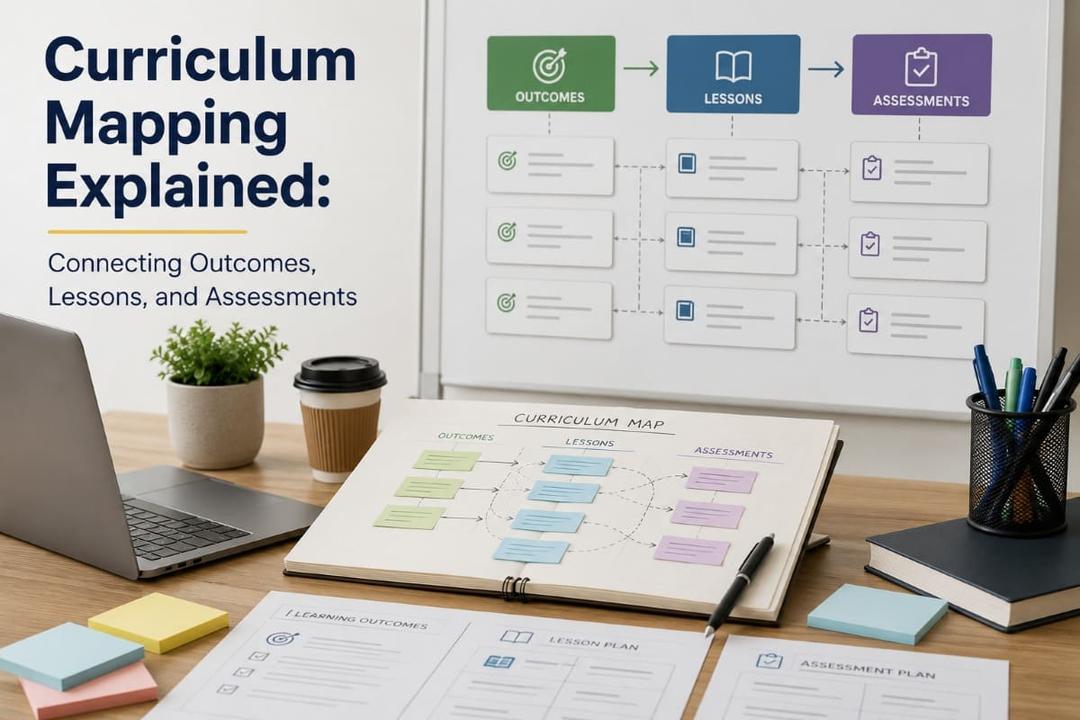
This information can be incorporated into a curriculum
map connecting outcomes, lessons, and assessments.
If the objective, activity, and assessment do not align,
revise the design before producing videos, graphics, quizzes, or platform
configurations.
A polished course can still be instructionally weak when the
learner practises one thing and is assessed on another.
Practical Examples: From Vague to Clear
The following examples show how broad intentions can be
translated into more useful objectives.
|
Vague Statement |
Clearer Learning Objective |
What Improved |
|
Understand customer service |
Apply the organization’s five-step response process to a
routine customer complaint |
Observable action, process, and context |
|
Learn about workplace safety |
Identify four common hazards in a supplied workplace
scenario |
Specific action, quantity, and situation |
|
Know how to create content |
Produce a one-week content plan for one audience and
communication goal |
Defined output and scope |
|
Appreciate data privacy |
Explain how three data-handling practices reduce privacy
risk in the learner’s role |
Demonstrable evidence and job relevance |
|
Become familiar with sewing measurements |
Record the required body measurements using the course
measurement procedure |
Performance and method |
|
Understand project risk |
Classify project risks by probability and impact using the
supplied matrix |
Observable decision and tool |
|
Improve presentation skills |
Deliver a five-minute project update with a clear
recommendation and supporting evidence |
Specific performance and quality indicators |
|
Learn leadership |
Conduct a structured delegation conversation that
clarifies the task, authority, deadline, and follow-up |
Professional action and required components |
Example 1: Knowledge objective
Broad intention:
Learners should know the organization’s data-retention
policy.
Clear objective:
By the end of the lesson, employees will be able to identify
the correct retention period for four common document categories.
This objective supports content about document categories
and retention requirements. It can be assessed through realistic classification
questions.
Example 2: Analytical objective
Broad intention:
Learners should understand why projects become delayed.
Clear objective:
Using a supplied project-status report, learners will
analyse the contributing causes of a schedule delay and distinguish
controllable from external factors.
The course now needs to explain relevant delay factors,
provide examples, and allow learners to practise analysing evidence.
Example 3: Interpersonal skill objective
Broad intention:
Managers should learn how to coach their employees.
Clear objective:
During a simulated meeting, managers will conduct a
15-minute coaching conversation that establishes the issue, invites employee
reflection, agrees on one action, and sets a follow-up date.
The objective identifies a practical performance and the
required components.
A rubric can evaluate:
- clarity;
- questioning;
- listening;
- relevance
of the agreed action;
- follow-up
planning.
Example 4: Creative production objective
Broad intention:
Learners should understand curriculum design.
Clear objective:
Learners will create a four-module course blueprint that
connects one overall learning goal with module objectives, learning activities,
and progress checks.
This objective requires a product. The course should
therefore provide:
- a
blueprint template;
- an
example;
- design
principles;
- staged
practice;
- feedback
criteria.
Example 5: Technical procedure objective
Broad intention:
Participants will know how to operate the machine safely.
Clear objective:
Under supervised conditions, participants will complete the
equipment-startup procedure in the required sequence without omitting a safety
check.
The objective focuses on observable performance in an
appropriate environment.
Knowledge checks may support the process, but the assessment
needs a practical demonstration.
Example 6: Affective or values-related objective
Objectives related to attitudes and values can be more
difficult to assess.
Broad intention:
Participants will value inclusive communication.
Possible objective:
Participants will revise a workplace message to remove
exclusionary assumptions and explain how the changes improve accessibility and
inclusion.
The course cannot directly prove a permanent personal value
change. It can, however, ask learners to recognize issues, make decisions,
explain reasoning, and demonstrate relevant communication practices.
Example 7: Microlearning objective
Broad intention:
Understand phishing.
Clear objective:
Given five sample messages, employees will identify the
messages that require security verification and select the appropriate
reporting action.
The objective is focused enough for a short learning unit
and directly connected to workplace action.
Vague objectives describe the topic. Clear objectives describe what learners will do with it.

Common Mistakes When Writing Learning Objectives
Describing the educator’s activity
Weak:
Teach participants how to create a budget.
This describes what the educator intends to do.
Better:
Participants will create a monthly operating budget from
supplied income and expense data.
The revised statement focuses on learner performance.
Using a topic as the objective
Weak:
Introduction to project management.
This may be a module title, but it is not an objective.
Better:
Explain how scope, time, and cost constraints affect a
routine project plan.
A topic label can remain in navigation, while the objective
clarifies what learners should achieve.
Using vague verbs without specifying evidence
Weak:
Understand workplace communication.
Better:
Compare assertive, passive, and aggressive responses in
three workplace scenarios.
or:
Deliver an assertive response to a routine workplace
request.
Both objectives may contribute to “understanding,” but they
require different content and evidence.
Combining too many actions in one objective
Overloaded:
Learners will identify, explain, apply, analyse, evaluate,
and create a complete digital marketing strategy.
This statement combines several learning levels and may
represent an entire course rather than one objective.
A better approach is to separate the progression:
- Identify
the main components of a digital marketing strategy.
- Explain
how audience needs influence channel selection.
- Analyse
performance data from a sample campaign.
- Evaluate
alternative channel strategies.
- Create
a marketing plan for a defined business scenario.
Separating objectives improves curriculum mapping and
assessment design.
Writing objectives that are too small
Overly narrow:
Click the blue button to open the next page.
This is usually a navigation instruction rather than a
meaningful learning objective.
Objectives should describe learning, not every interaction
within the platform.
Choosing an impressive verb without providing
sufficient learningAn objective may use “analyse,” “evaluate,” or “create” even
when the course offers only introductory content.
For example:
Evaluate competing financial strategies.
If learners receive one short explanation and no evaluation
criteria, examples, practice, or feedback, the objective is aspirational rather
than operationally supported.
Either strengthen the learning experience or reduce the
objective to a realistic level.
Adding arbitrary measurement criteria
Some objective-writing advice encourages numerical criteria
in every statement.
This can lead to requirements such as:
Learners will explain the concept with 80 percent accuracy.
It may be unclear how an explanation becomes “80 percent
accurate.”
Use quantitative criteria only when they are meaningful,
measurable, and connected to the real performance standard.
Rubrics may be more appropriate for judging complex outputs.
Ignoring the learner’s starting point
An objective may be achievable for experienced professionals
but unrealistic for beginners.
Before finalizing objectives, consider:
- prior
knowledge;
- language
proficiency;
- professional
experience;
- access
to tools;
- available
time;
- learning
support;
- opportunities
for practice;
- accessibility
needs.
A diagnostic activity or prerequisite may be needed when
learners enter with significantly different capabilities.
Confusing participation with learning
Statements such as these do not describe learning
achievement:
- watch
all videos;
- attend
the workshop;
- complete
five modules;
- participate
in the discussion;
- spend
two hours in the platform.
These may be participation requirements, but they do not
show what learners know or can do.
Completion data should not be treated as equivalent to
learning evidence.
Writing objectives after producing the content
When objectives are added after videos, slides, and quizzes
have already been produced, they may merely describe the existing material
rather than guide design.
This reverses their strategic role.
Objectives should ideally be clarified before full
production. Existing courses can still be improved by reviewing what learners
genuinely need to achieve and then restructuring the content accordingly.
Failing to connect objectives across levels
A lesson objective may be clear in isolation but unrelated
to the module or course outcome.
For example:
Course outcome:
Manage a small project from initiation to review.
Lesson objective:
Describe the history of project-management software.
The lesson may be interesting, but its contribution to the
course outcome is unclear.
Objectives should form a hierarchy:
- program
outcomes;
- course
outcomes;
- module
outcomes;
- lesson
objectives;
- activity
objectives where needed.
A clear course
structure built from learning goals helps ensure that lower-level
objectives contribute to the broader learner journey.
Treating objectives as permanently fixed
Objectives should not be changed casually, especially when
linked to accreditation, certification, or assessment standards.
However, they should be reviewed when:
- learner
needs change;
- professional
practices evolve;
- assessment
evidence reveals persistent problems;
- the
delivery environment changes;
- content
is divided into new pathways;
- the
objective proves impossible to assess;
- learners
consistently interpret expectations differently.
Objectives are part of curriculum governance, not one-time
administrative text.
When teams repeatedly struggle to design suitable content or
assessment, the underlying problem may be an unclear or unrealistic objective.
FAQ
What is a learning objective?
A learning objective is a statement describing what learners
should be able to know, perform, create, evaluate, or apply after a defined
learning experience. It should focus on the learner and provide enough clarity
to guide content, activities, and assessment. Institutions may also use the
term “learning outcome” for the same or a closely related purpose.
What is the difference between a learning goal and a
learning objective?A learning goal describes a broad educational direction,
such as improving leadership capability. A learning objective defines a more
specific intended performance, such as conducting a structured delegation
conversation. Goals provide direction, while objectives translate that
direction into capabilities that can guide course design and assessment.
How many learning objectives should a course have?
There is no universal number. A course should have enough
objectives to represent its essential capabilities without creating an
unmanageable list. A short course may have three to five major objectives,
while a longer program may require more. Detailed lesson objectives should
contribute to broader module and course outcomes rather than operate
independently.
Can “understand” be used in a learning objective?
“Understand” can express a valid educational intention, but
it does not clearly specify what learners will do to demonstrate understanding.
Replace or supplement it with an observable action such as explain, compare,
interpret, apply, or analyse. The appropriate verb depends on the evidence
learners are expected to produce.
Does every learning objective need a numerical target?
No. Numerical criteria are useful when performance involves
meaningful quantities, accuracy levels, time requirements, or safety
tolerances. Complex communication, analysis, and creative work may be better
evaluated through qualitative criteria or rubrics. Do not add arbitrary
percentages merely to make an objective appear measurable.
How can learning objectives improve online or microlearning content?
Objectives help online course teams keep each unit focused,
select appropriate media, design relevant interactions, and create meaningful
progress checks. In microlearning, a narrow objective prevents short lessons
from becoming disconnected information fragments. Multiple micro-objectives can
contribute to one broader module or course capability.
Conclusion
Clear learning objectives translate educational intention
into design direction.
They specify what learners should be able to do, what
content is essential, what kind of practice is required, and what evidence can
demonstrate achievement.
A useful objective is:
- centered
on the learner;
- specific
about the expected action;
- clear
about the content or capability;
- realistic
for the audience and duration;
- supported
by appropriate activities;
- assessable
through credible evidence;
- connected
to broader course and program outcomes.
Action verbs matter, but they are only one part of the
objective.
The real test is whether the objective, content, activity,
assessment, and performance criteria describe the same intended learning.
When these elements align, content production becomes more
focused. Subject-matter experts know what knowledge is essential. Instructional
designers can select suitable activities. Assessment designers can identify
meaningful evidence. Learners can understand what is expected. Program managers
can connect individual lessons with wider outcomes.
Clear objectives also support scalable learning operations.
They make it easier to develop modular content, organize
mobile-first pathways, maintain curriculum maps, revise assessments, brief
content contributors, and evaluate whether a course is delivering the intended
capability.
The purpose is not to produce perfectly worded
administrative statements. It is to create enough instructional clarity for a
learning experience to be intentionally designed, consistently delivered, and
meaningfully assessed.
When the intended learner action is clear, better decisions about content, practice, assessment, and delivery become possible.
FitAcademy
Build Focused Learning Experiences Around Clear Objectives
FitAcademy helps institutions, educators, and training providers organize objective-led courses, focused microlearning content, assessments, learner pathways, and progress tracking within a branded mobile-first learning environment.
Learn More About FitAcademy