An education program cannot be judged only by enrollment,
attendance, course completion, or learner satisfaction. These indicators show
whether people participated and how they experienced the program, but they do
not establish whether learners gained the intended capabilities, applied them
in practice, or achieved meaningful longer-term outcomes.
This article explains how educators, institutions, training
providers, instructional designers, and program managers can evaluate whether
an education program is working. It covers logic models, evaluation questions,
indicators, baseline data, learning evidence, behavior change, outcome
measurement, attribution, and continuous improvement. It also shows how
learning-platform data can support evaluation without being mistaken for proof
of learning or impact.
- Quick
Answer
- Define
What “Working” Means Before Measuring It
- Build
a Clear Program Logic
- Measure
the Full Evidence Chain
- Design
a Practical Evaluation Plan
- Interpret
Results Without Overclaiming
- Turn
Evaluation Findings Into Program Improvements
- Common
Evaluation Mistakes
- FAQ
- Conclusion
Quick Answer
To determine whether an education program is working,
measure more than participation and completion.
A practical evaluation should examine five connected
questions:
- Did
the program reach the intended learners?
- Was
it delivered as planned and at an acceptable quality?
- Did
learners develop the intended knowledge, skills, or capabilities?
- Did
they apply those capabilities in relevant settings?
- Did
the expected organizational, professional, educational, or social outcomes
occur?
Begin by defining the program’s intended results and the
activities expected to produce them. Then select a manageable set of
indicators, data sources, comparison points, and evaluation questions.
Useful evidence may include:
- enrollment
and participation data;
- learner
assessments;
- observed
performance;
- learner
work products;
- facilitator
records;
- workplace
or classroom observations;
- interviews
and surveys;
- platform
analytics;
- operational
or organizational indicators.
The main limitation is attribution. An outcome occurring
after a program does not automatically mean the program caused it. External
factors, learner characteristics, workplace support, economic conditions, and
other interventions may also influence results.
Evaluation should therefore support credible decisions
rather than search for one perfect metric.

Define What “Working” Means Before Measuring It
The question “Is the program working?” appears simple, but
it can refer to several different judgments.
A funder may want to know whether the program created
measurable social outcomes.
An institution may want to know whether learners achieved
the stated competencies.
A training provider may need to understand whether
participants completed the course and valued the experience.
An employer may care about whether employees apply the
learning and improve workplace performance.
A program manager may need to know whether delivery is
consistent, affordable, and scalable.
All of these questions are legitimate, but they require
different evidence.
Participation is not the same as learning
Enrollment, attendance, platform access, lesson views, and
completion rates show whether learners entered and progressed through the
program.
They can help identify:
- access
barriers;
- participation
patterns;
- withdrawal
points;
- technical
problems;
- differences
between learner groups;
- modules
that may be too difficult or time-consuming.
However, participation does not prove that learning
occurred.
A learner can:
- complete
every video without understanding the content;
- pass
through lessons without meaningful practice;
- remain
active in the platform but avoid difficult tasks;
- finish
a course without being able to apply the capability.
Completion is an operational indicator. It becomes more
meaningful when interpreted alongside evidence of learning and application.
Satisfaction is not the same as effectiveness
Learner feedback is valuable.
It can reveal:
- whether
instructions were clear;
- whether
examples felt relevant;
- whether
facilitators were supportive;
- whether
the platform was easy to use;
- whether
the workload was manageable;
- whether
learners perceived the course as useful.
However, a highly rated program may still produce weak
learning outcomes.
Learners may enjoy:
- an
engaging speaker;
- polished
videos;
- easy
assessments;
- entertaining
activities;
- a
short and convenient format.
These qualities can support participation, but they do not
automatically demonstrate capability development.
The opposite can also occur. A demanding program may receive
mixed satisfaction scores while producing strong professional learning.
Satisfaction should therefore be interpreted as evidence
about learner experience, not as a substitute for learning evidence.
Learning is not the same as application
A learner may perform well during a course but fail to use
the capability afterward.
Possible reasons include:
- limited
opportunity to apply it;
- lack
of supervisor support;
- organizational
policies that conflict with the training;
- insufficient
tools or resources;
- fear
of making mistakes;
- competing
workload;
- an
environment that rewards old behavior;
- a
gap between the training scenario and real practice.
This means that an education program can succeed at teaching
while failing to produce workplace or community change.
The distinction matters because the solution may not be more
content.
The organization may instead need:
- clearer
procedures;
- management
support;
- coaching;
- job
aids;
- practice
opportunities;
- changes
to incentives;
- access
to equipment;
- follow-up
accountability.
Outcomes are not automatically impact
Suppose employment among program participants rises after a
job-readiness course.
This is encouraging, but other factors may have contributed:
- improvement
in the labor market;
- participants’
prior experience;
- recruitment
campaigns;
- personal
networks;
- additional
training;
- changes
in local hiring demand.
An outcome evaluation can examine whether employment
improved. A stronger impact evaluation asks what would likely have happened
without the program.
That question generally requires a comparison strategy, such
as:
- a
credible comparison group;
- randomized
assignment where appropriate and ethical;
- repeated
measurements over time;
- statistical
adjustment;
- matched
participants;
- carefully
examined contribution evidence.
Not every program needs a formal impact evaluation. The
design should match the importance of the decision, the maturity of the
program, available resources, and the strength of the claim being made.
A program can be popular, well delivered, and widely completed without producing the capability or outcome it was created to achieve.
|
Evidence Area |
What It Can Show |
What It Cannot Prove by Itself |
|
Enrollment |
Whether learners entered the program |
Whether they participated meaningfully |
|
Attendance or platform activity |
Whether learners accessed learning experiences |
Whether they understood or applied them |
|
Completion |
Whether learners met completion rules |
Whether meaningful learning occurred |
|
Satisfaction |
How learners perceived the experience |
Whether capabilities improved |
|
Assessment performance |
Whether learners demonstrated specified learning |
Whether they will apply it in real settings |
|
Workplace or community application |
Whether behavior or practice changed |
Whether the program alone caused the change |
|
Longer-term outcomes |
Whether desired results occurred |
Whether those results are attributable to the program |
Before selecting metrics, define which decision the
evaluation must support. The most useful evidence depends on what someone needs
to decide next.
Build a Clear Program Logic
Evaluation becomes difficult when the program itself has not
clearly explained how its activities are expected to produce results.
A logic model or program roadmap helps address this problem.
It creates a visible relationship between:
- the
need being addressed;
- program
resources;
- learning
activities;
- immediate
outputs;
- short-term
outcomes;
- intermediate
outcomes;
- longer-term
outcomes;
- contextual
factors.
The CDC Program Evaluation Framework describes logic models
as tools for connecting program activities with intended outcomes and for
showing how shorter-term results may lead toward broader outcomes.
CDC
guidance on describing a program and developing a logic model
Start with the need
The need explains why the education program exists.
Examples include:
- new
supervisors lack experience managing performance problems;
- young
adults struggle to meet entry-level logistics job requirements;
- community
educators need stronger digital teaching skills;
- garment
workers require updated safety practices;
- small
business owners lack basic financial management capability.
The need should be supported by credible evidence where
possible.
This might include:
- employer
interviews;
- learner
assessments;
- workforce
data;
- performance
records;
- observation;
- community
consultation;
- industry
standards;
- previous
program findings.
A program should not be evaluated against a problem it was
never realistically designed to solve.
For example, an eight-module employability course may
improve interview preparation and workplace communication. It may not be
capable of solving regional unemployment, limited job availability,
transportation barriers, or employer discrimination.
Identify the inputs
Inputs are the resources required to deliver the program.
They may include:
- instructors
and facilitators;
- subject-matter
experts;
- learning
content;
- funding;
- technology;
- classrooms;
- mobile
devices;
- assessment
systems;
- employer
partners;
- mentors;
- learner
support staff;
- data
and evaluation capacity.
Input measures help program managers understand what was
invested and whether the program had the resources required for implementation.
They do not indicate success by themselves.
Define the activities
Activities describe what the program actually does.
Examples include:
- delivering
modules;
- facilitating
workshops;
- providing
coaching;
- assigning
practical projects;
- assessing
learner performance;
- connecting
learners with employers;
- supporting
workplace practice;
- issuing
credentials;
- sending
reminders;
- providing
mentoring.
Activities should be specific enough that evaluators can
determine whether they occurred as intended.
Distinguish outputs from outcomes
Outputs are the immediate products of program activity.
Examples include:
- number
of courses delivered;
- number
of learners enrolled;
- number
of coaching sessions completed;
- number
of assessments conducted;
- number
of certificates issued;
- number
of employers participating.
Outcomes describe changes in learners, organizations, or
communities.
Examples include:
- increased
knowledge;
- improved
technical skill;
- stronger
job-search behavior;
- greater
instructional capability;
- adoption
of a safer procedure;
- improved
employee performance;
- increased
employment;
- reduced
operational error.
This distinction prevents a common reporting problem:
presenting activity volume as evidence of effectiveness.
“Five hundred learners completed the program” describes
reach and output.
“Learners demonstrated improved capability in assessed
workplace simulations” describes a learning outcome.
“Participants were more likely to enter relevant employment”
describes a broader outcome that requires stronger evidence.
Sequence the outcomes
Outcomes usually occur over different time horizons.
A program might expect the following sequence:
Short-term outcomes
- learners
understand the procedure;
- learners
demonstrate the skill in a controlled activity;
- learners
report greater confidence;
- learners
create an action plan.
Intermediate outcomes
- learners
apply the procedure at work;
- supervisors
observe improved performance;
- learners
continue using the skill;
- organizations
change relevant practices.
Longer-term outcomes
- performance
errors decline;
- employment
retention improves;
- service
quality increases;
- organizational
productivity changes;
- community
outcomes improve.
A sequence helps identify when evidence should reasonably be
collected.
It may be realistic to measure knowledge at course
completion. It may be unrealistic to measure job retention immediately after
the final module.
Record assumptions and contextual factors
Programs depend on assumptions.
A digital skills course may assume that learners have:
- access
to a suitable device;
- reliable
connectivity;
- sufficient
language proficiency;
- time
to practise;
- access
to relevant software.
A workforce program may assume that:
- employers
have vacancies;
- the
curriculum matches real job requirements;
- learners
can travel to work;
- credentials
are recognized;
- workplace
supervisors support application.
External and contextual factors should be documented because
they affect how findings are interpreted.
A weak employment result could reflect:
- inadequate
training;
- an
inappropriate target group;
- poor
employer engagement;
- a
decline in available jobs;
- geographical
barriers;
- insufficient
duration;
- several
of these factors at once.

|
Logic Model Element |
Example for a Job-Readiness Program |
|
Need |
Entry-level applicants lack role-specific workplace and
recruitment capabilities |
|
Inputs |
Trainers, learning platform, employer partners,
curriculum, assessment tools, mentors |
|
Activities |
Mobile lessons, practical workshops, role simulations,
coaching, employer sessions |
|
Outputs |
Modules delivered, learners assessed, coaching sessions
completed, employer interactions |
|
Short-term outcomes |
Improved role knowledge, communication, technical
practice, and interview performance |
|
Intermediate outcomes |
Stronger job applications, improved workplace behavior,
employer-validated capability |
|
Longer-term outcomes |
Entry into relevant work, improved retention, progression
into higher-responsibility roles |
|
Contextual factors |
Local vacancies, transport, employer demand, wages,
learner availability, economic conditions |
A logic model does not prove that the program works. It
makes the program’s assumptions visible enough to test.
Measure the Full Evidence Chain
A strong evaluation combines several forms of evidence
rather than relying on one headline number.
A practical education-program evidence chain can be
organized into six levels.
Level 1: Reach and access
Reach asks whether the intended population entered the
program.
Possible indicators include:
- number
of eligible learners identified;
- enrollment
rate;
- representation
of priority learner groups;
- geographic
coverage;
- device
or connectivity access;
- participation
by gender, role, location, or other relevant categories;
- reasons
eligible learners did not enroll.
Reach should be interpreted against the program’s target
population.
A program enrolling 1,000 people may still have limited
reach if it was designed for 100,000 potential learners. A specialized program
serving 30 people may be successful if the intended cohort is small and clearly
defined.
Equity also matters.
An overall enrollment figure can conceal whether:
- rural
participants were excluded;
- learners
with disabilities faced access barriers;
- workers
on certain shifts could not participate;
- language
requirements excluded relevant groups;
- women
or other priority groups experienced higher withdrawal.
Level 2: Participation and implementation
This level examines whether the program was delivered and
used as intended.
Possible indicators include:
- attendance;
- active
participation;
- module
progression;
- completion;
- time
between learning activities;
- facilitator
adherence to the delivery plan;
- assessment
participation;
- technical
support requests;
- coaching
attendance;
- use
of optional resources;
- content-release
or reminder performance.
Implementation evidence helps distinguish between two
questions:
- Was
the program model weak?
- Was
a potentially useful program implemented poorly?
If learners did not receive the planned coaching, practice,
or feedback, weak outcomes should not automatically be interpreted as proof
that the intended model was ineffective.
Level 3: Learner experience
Experience data explains how learners perceived and
navigated the program.
Possible indicators include:
- perceived
relevance;
- clarity
of instruction;
- facilitator
quality;
- platform
usability;
- workload;
- psychological
safety;
- accessibility;
- confidence
in using the learning;
- perceived
barriers;
- reasons
for withdrawal.
Use a mixture of:
- structured
surveys;
- open-response
questions;
- interviews;
- focus
groups;
- support
records;
- learner
observation.
Avoid asking only whether learners “liked” the program.
More useful questions include:
- Which
activity best prepared you for the final task?
- Where
did you feel unable to progress?
- Which
examples did not match your work context?
- What
prevented you from applying the learning?
- What
support would have made application easier?
Level 4: Learning
Learning evidence examines whether participants developed
the intended knowledge, skills, judgement, or capability.
Possible methods include:
- pre-
and post-assessments;
- practical
demonstrations;
- simulations;
- case
analysis;
- portfolios;
- projects;
- written
outputs;
- observed
performance;
- oral
explanations;
- assessment
rubrics;
- structured
peer review.
The method should align with the learning objective.
If the objective requires learners to perform a procedure,
evidence should include performance.
If the objective requires learners to evaluate alternatives,
assessment should examine reasoning and judgement.
If the objective requires learners to create a professional
output, the evaluation should review the output against appropriate criteria.
A multiple-choice quiz can be useful for assessing selected
knowledge. It is rarely sufficient evidence for complex professional
performance.
Clear learning
objectives that guide content and assessment provide the foundation for
deciding what learning evidence should be collected.
Level 5: Application and behavior
Application asks whether learners use the capability in the
relevant environment.
Possible evidence includes:
- workplace
observation;
- supervisor
assessment;
- classroom
observation;
- review
of work products;
- platform-based
follow-up tasks;
- learner
activity logs;
- customer
or client feedback;
- repeated
self-report;
- documented
procedural compliance;
- changes
in professional practice.
Timing matters.
A follow-up conducted two days after the course may be too
early for meaningful application. A follow-up conducted one year later may face
low response rates and weak memory.
Evaluation timing should reflect:
- when
learners are expected to use the skill;
- how
frequently the relevant situation occurs;
- whether
organizational support is available;
- how
quickly the behavior should become visible.
Self-report can provide useful information, but it should be
interpreted carefully.
Learners may:
- overestimate
their application;
- report
socially desirable behavior;
- confuse
intention with actual practice;
- have
difficulty remembering frequency.
Where feasible, combine self-report with another source.
Level 6: Broader outcomes and impact
Broader outcomes depend on the purpose of the program.
They may include:
- employment;
- job
retention;
- promotion;
- productivity;
- reduced
errors;
- improved
safety;
- stronger
student achievement;
- improved
service quality;
- business
formation;
- business
survival;
- community
participation;
- organizational
capability;
- reduced
operating costs.
These indicators may be important, but they are influenced
by many factors beyond education.
The stronger the causal claim, the stronger the evaluation
design needs to be.
A program may reasonably report:
Seventy percent of responding participants entered relevant
employment within six months.
A stronger claim such as:
The program caused a 70 percent employment rate.
requires evidence about what would have occurred without the
program.
Impact evaluation specifically addresses causality by
comparing observed outcomes with a credible estimate of the outcomes that would
have occurred in the absence of the intervention.
Better
Evaluation overview of impact evaluation
Add efficiency, equity, and sustainability
A program may produce positive outcomes while remaining
difficult to sustain or scale.
Additional evaluation questions may include:
- What
did the program cost per learner?
- What
did it cost per successful outcome?
- Which
components required the most staff time?
- Were
outcomes similar across learner groups?
- Which
groups experienced barriers?
- Can
facilitators deliver the model consistently?
- Can
content and assessments be maintained?
- Can
the technology support a larger cohort?
- Do
positive results persist after support ends?
Efficiency should not be interpreted only as minimizing
cost.
A less expensive program may also provide weaker support,
lower assessment quality, or reduced access.
The relevant question is whether resources are proportionate
to the results and requirements of the program.

The further an outcome is from the learning experience, the more carefully evaluators must examine other explanations for the result.
Design a Practical Evaluation Plan
Evaluation should be designed before or during program
planning, not added only after delivery.
Early planning makes it possible to establish:
- baseline
measures;
- consistent
data definitions;
- assessment
standards;
- consent
and privacy procedures;
- follow-up
mechanisms;
- comparison
strategies;
- reporting
responsibilities.
The CDC framework describes evaluation as a sequence that
includes assessing context, describing the program, focusing questions and
design, gathering credible evidence, generating conclusions, and acting on
findings.
CDC
Program Evaluation Framework
Step 1: Identify the intended users
Ask who will use the findings.
Possible users include:
- educators;
- program
managers;
- institutional
leaders;
- funders;
- employers;
- community
partners;
- curriculum
committees;
- facilitators;
- learners;
- platform
and operations teams.
Different users need different information.
A facilitator may need rapid feedback after the first
cohort.
A funder may need outcome evidence after one year.
An institutional leader may need cost and scalability
information before approving expansion.
Step 2: Define the intended decisions
Evaluation should support a decision.
Examples include:
- continue
the program;
- revise
the curriculum;
- change
the learner selection criteria;
- improve
facilitator training;
- add
workplace practice;
- redesign
an assessment;
- expand
to another region;
- reduce
or redirect funding;
- move
delivery online;
- adopt
a white-label platform;
- discontinue
an ineffective component.
When the intended decision is unclear, evaluation plans
often collect large amounts of data that no one uses.
Step 3: Prioritize evaluation questions
A program cannot investigate everything equally.
Useful evaluation questions might include:
Implementation questions
- Did
the program reach the intended learners?
- Were
the required activities delivered?
- Did
learners receive the planned practice and feedback?
- Which
barriers affected participation?
Learning questions
- Did
learners demonstrate the intended capabilities?
- Which
outcomes were achieved most or least consistently?
- Did
results differ by prior experience or learner group?
Application questions
- Did
learners use the capability after the program?
- What
enabled or prevented application?
- Was
workplace or institutional support sufficient?
Outcome questions
- Did
the expected professional, educational, or organizational results occur?
- Were
the outcomes sustained?
- Were
there unintended effects?
Efficiency questions
- What
resources were required?
- Which
components contributed most to outcomes?
- Is
the delivery model sustainable at a larger scale?
Prioritize questions according to:
- decision
importance;
- program
maturity;
- available
time;
- data
access;
- evaluation
cost;
- ethical
considerations;
- feasibility.
Step 4: Define indicators precisely
An indicator needs an operational definition.
For example, “course completion” could mean:
- opening
every lesson;
- watching
a percentage of every video;
- submitting
all assignments;
- passing
the final assessment;
- meeting
attendance requirements;
- completing
practical assessment;
- receiving
a certificate.
These are not equivalent.
Similarly, “employment” could mean:
- any
paid work;
- full-time
work;
- work
related to the training;
- employment
lasting at least three months;
- formal
employment;
- self-employment;
- an
internship.
The definition should match the program claim.
Step 5: Select data sources
Use data that can credibly answer the evaluation question.
|
Evaluation Question |
Possible Indicator |
Possible Data Source |
|
Did the program reach the target group? |
Percentage of enrolled learners meeting eligibility
criteria |
Registration and eligibility records |
|
Was the program delivered as intended? |
Percentage of required activities completed |
Facilitator records and platform data |
|
Did learners improve? |
Change in assessed capability |
Baseline and final assessment |
|
Can learners perform the skill? |
Percentage meeting rubric standard |
Simulation or observed performance |
|
Did learners apply the skill? |
Documented use in relevant settings |
Observation, work products, supervisor review |
|
Did the expected outcome occur? |
Employment, retention, performance, or service indicator |
Administrative records, verified follow-up |
|
Was the program equitable? |
Outcome differences between relevant groups |
Disaggregated program and assessment data |
|
Was the program efficient? |
Cost per learner or successful outcome |
Financial and outcome records |
Step 6: Establish a baseline
A baseline shows the situation before the intervention.
Without it, a final score may be difficult to interpret.
Suppose learners score 78 out of 100 at the end of a course.
That result could represent:
- a
substantial improvement from 40;
- a
modest improvement from 72;
- no
improvement from 78;
- a
decline from 85.
Possible baseline approaches include:
- pre-assessment;
- existing
performance data;
- historical
records;
- prior
work samples;
- supervisor
ratings;
- retrospective
baseline questions where no earlier data exists.
Retrospective self-report is weaker than direct baseline
evidence but may still provide contextual information when better data is
unavailable.
Step 7: Select a comparison approach
Not every evaluation requires a control group, but every
conclusion needs a credible reference point.
Possible comparisons include:
- before
versus after;
- target
versus actual;
- participant
group versus similar non-participant group;
- one
delivery model versus another;
- current
cohort versus previous cohort;
- performance
during implementation versus later maintenance;
- different
learner groups;
- observed
result versus established professional standard.
Before-and-after comparisons are practical but cannot rule
out every external influence.
Comparison groups can strengthen inference but may differ in
important ways.
Experimental designs can support causal conclusions but may
be costly, impractical, or inappropriate.
The evaluation report should explain the strength and
limitations of the design.
Step 8: Combine quantitative and qualitative evidence
Quantitative data shows scale, frequency, difference, or
change.
Qualitative evidence can explain why patterns occurred.
For example:
Quantitative finding:
Completion among night-shift employees was lower.
Qualitative explanation:
Interviews revealed that live support was unavailable during their working
schedule.
Together, the evidence provides a more actionable result.
A mixed-method approach may combine:
- platform
data;
- assessment
results;
- surveys;
- interviews;
- observation;
- facilitator
logs;
- learner
work;
- administrative
outcomes.
Step 9: Set data-collection timing
Evaluation should follow the expected result timeline.
A possible schedule is:
- before
the program: baseline and learner profile;
- during
delivery: participation and implementation;
- immediately
after: learning and experience;
- one
to three months later: early application;
- three
to twelve months later: broader outcomes;
- later
follow-up: sustainability where relevant.
The timeline should be realistic.
Frequent follow-up can burden learners and staff. Infrequent
follow-up may miss important changes or make participants difficult to contact.
Step 10: Plan ethical and responsible data use
Evaluation may involve personal, educational, employment, or
performance data.
Program teams should determine:
- what
data is genuinely necessary;
- who
can access it;
- how
consent or notification will be handled;
- how
long records will be retained;
- how
data will be protected;
- how
small groups will be reported;
- whether
participation in evaluation creates risk;
- how
findings will be communicated fairly.
Learners should not be exposed to unnecessary harm because
they provided honest feedback or performed poorly in a developmental
assessment.
FitAcademy
Connect Learning Delivery With Meaningful Program Evidence
FitAcademy helps institutions, educators, and training providers organize courses, assessments, learner pathways, completion records, and mobile-first learning activity in one branded environment. These operational data can support evaluation when combined with appropriate learning, application, and outcome evidence.
Learn More About FitAcademyInterpret Results Without Overclaiming
Collecting data is not the same as producing a credible
conclusion.
The interpretation should consider:
- data
quality;
- program
context;
- missing
information;
- alternative
explanations;
- variation
between learners;
- practical
significance;
- limitations
in the evaluation design.
Examine data quality first
Before interpreting results, ask:
- Were
definitions applied consistently?
- Were
assessments scored reliably?
- Did
enough learners respond?
- Were
respondents different from non-respondents?
- Were
platform records complete?
- Were
follow-up outcomes verified?
- Were
comparison groups reasonably similar?
- Did
facilitators record implementation consistently?
A precise-looking percentage can still be misleading when
the underlying data is incomplete or inconsistent.
Report denominators clearly
Consider the statement:
Eighty percent of learners entered employment.
The meaning depends on the denominator.
It could mean:
- 80
percent of everyone enrolled;
- 80
percent of course completers;
- 80
percent of people who responded to follow-up;
- 80
percent of learners who were available for work.
Suppose 100 learners enrolled, 70 completed, 50 responded to
follow-up, and 40 reported employment.
The result could be reported as:
- 40
percent of enrolled learners;
- 57
percent of completers;
- 80
percent of follow-up respondents.
All three calculations are mathematically correct, but they
communicate different realities.
The report should show the relevant denominator and
follow-up rate.
Separate statistical change from meaningful change
A measured difference may be small enough to have limited
practical value.
Conversely, a meaningful operational improvement may occur
in a small pilot where formal statistical testing is not appropriate.
Ask:
- Was
the change large enough to matter?
- Did
learners meet a defined performance standard?
- Did
the result affect practice?
- Did
the benefit justify the resources used?
- Was
the improvement sustained?
- Did
it occur across learner groups?
Examine variation, not only averages
An average can conceal important differences.
A program may produce strong overall results while:
- beginners
make little progress;
- one
region underperforms;
- learners
using mobile devices face greater difficulty;
- one
facilitator produces much stronger results;
- learners
with lower language proficiency withdraw more often;
- experienced
participants benefit more than the target group.
Disaggregated analysis can reveal whether the program works:
- for
whom;
- under
which conditions;
- with
which delivery approach;
- at
what level of support.
Care is required when reporting very small groups, both for
privacy and because small numbers can produce unstable results.
Distinguish contribution from attribution
Programs often contribute to outcomes alongside other
influences.
For example, a teacher-development program may contribute to
improved classroom practice together with:
- school
leadership;
- peer
collaboration;
- teaching
resources;
- policy
changes;
- educator
experience;
- student
characteristics.
Where causal attribution cannot be established, the
evaluation can still examine contribution.
Useful questions include:
- Did
the program produce the expected short-term capabilities?
- Did
learners apply them?
- Do
participants and stakeholders describe a plausible program influence?
- Did
changes occur after relevant activities?
- Are
alternative explanations stronger?
- Did
outcomes vary with the intensity or quality of participation?
Use cautious language such as:
- was
associated with;
- may
have contributed to;
- participants
demonstrated;
- outcomes
improved during the program period;
- the
evidence is consistent with;
- the
evaluation cannot confirm causality.
Investigate unintended outcomes
Programs can produce results that were not originally
planned.
Positive unintended outcomes may include:
- stronger
professional networks;
- increased
learner confidence;
- collaboration
between organizations;
- new
employment partnerships;
- reuse
of learning resources.
Negative unintended outcomes may include:
- excessive
workload;
- exclusion
of learners with limited technology access;
- pressure
to complete assessments dishonestly;
- reduced
attention to unmeasured responsibilities;
- credential
inflation;
- inequitable
access to advanced opportunities.
Evaluation should create space for these findings rather
than measure only predefined success indicators.
Avoid converting dashboards into conclusions
Learning-platform dashboards may show:
- active
users;
- sessions;
- lesson
completion;
- time
spent;
- quiz
attempts;
- assessment
scores;
- device
use;
- return
activity.
These data can support monitoring and identify patterns.
They do not automatically explain:
- why
learners behaved that way;
- whether
the content produced understanding;
- whether
assessment was valid;
- whether
learning transferred;
- whether
the program caused broader outcomes.
Analytics require interpretation alongside educational and
contextual evidence.
The purpose of evaluation is not to make every result look
positive. It is to produce an explanation credible enough to improve the next
decision.
Turn Evaluation Findings Into Program Improvements
An evaluation has limited value if findings remain in a
report without changing decisions or practice.
The evaluation plan should identify:
- who
will review findings;
- when
decisions will be made;
- who
owns each response;
- which
changes require approval;
- when
changes will be tested;
- how
the next cohort will be monitored.
Use findings to improve learner targeting
Evaluation may show that:
- learners
entered without required prerequisites;
- the
target group was defined too broadly;
- advanced
learners received little value;
- eligibility
rules excluded people likely to benefit;
- the
program addressed a capability not required by employers.
Possible responses include:
- clearer
selection criteria;
- diagnostic
assessments;
- foundation
modules;
- advanced
pathways;
- role-specific
learning;
- improved
learner communication.
Improve course structure and curriculum alignment
Weak learning results may indicate that learners did not
receive a coherent progression.
The program team may need to:
- revise
module order;
- reduce
unnecessary content;
- add
prerequisite learning;
- strengthen
examples;
- divide
an overloaded module;
- improve
the relationship between outcomes and assessments.
A clear
course structure built from learning goals helps connect evaluation
findings to specific design changes.
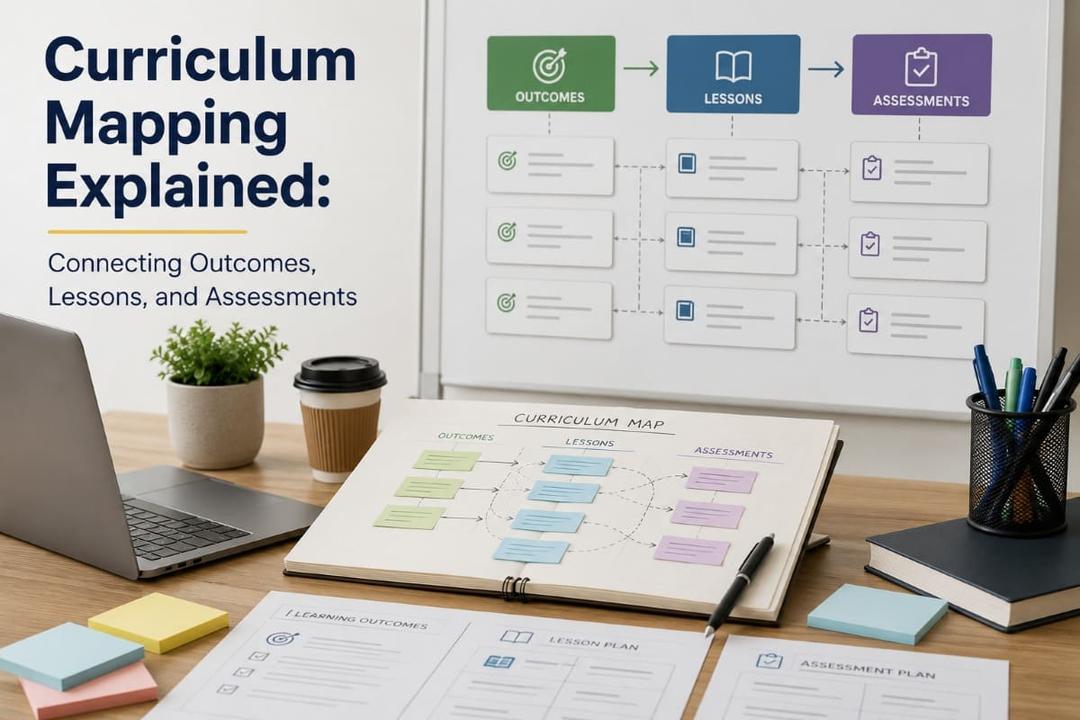
A detailed curriculum
map connecting outcomes, lessons, and assessments can show where gaps or
misalignment occur.
Strengthen practice and feedback
Learners may understand concepts but fail to perform.
This often indicates insufficient:
- modelling;
- guided
practice;
- realistic
scenarios;
- repetition;
- feedback;
- independent
application.
The solution may involve changing the learning activity
rather than adding more explanation.
Redesign assessments
Assessment evidence may reveal that:
- questions
are too easy;
- scoring
criteria are unclear;
- assessments
measure recall instead of application;
- facilitator
scoring is inconsistent;
- learners
can complete tasks without demonstrating the intended capability;
- assessments
do not reflect real situations.
Possible improvements include:
- stronger
rubrics;
- performance-based
tasks;
- assessor
calibration;
- staged
assessments;
- authentic
scenarios;
- clearer
standards;
- independent
quality review.
Address delivery inconsistency
Different results between cohorts may reflect:
- facilitator
variation;
- inconsistent
feedback;
- missing
activities;
- different
schedules;
- uneven
technology access;
- local
adaptation;
- varying
learner support.
The program may need:
- facilitator
training;
- delivery
guides;
- minimum
implementation standards;
- observation
and coaching;
- platform-based
standardization;
- clearer
adaptation rules.
Standardization should protect essential program components
without eliminating appropriate contextual adaptation.
Improve application conditions
When learning results are strong but behavior change is
weak, investigate the environment.
Possible actions include:
- involve
supervisors;
- provide
job aids;
- establish
follow-up coaching;
- create
application assignments;
- revise
workplace procedures;
- provide
necessary tools;
- align
incentives;
- schedule
practice opportunities;
- recognize
successful application.
This is a critical diagnosis.
More training will not solve a problem caused by missing
authority, equipment, opportunity, or management support.
Decide whether to scale
A successful pilot is not automatically ready for expansion.
Before scaling, examine:
- whether
outcomes were achieved consistently;
- which
components were essential;
- staff
capability;
- facilitator
availability;
- technology
capacity;
- learner-support
requirements;
- assessment
workload;
- cost
per learner;
- content
governance;
- differences
between locations;
- likely
changes in implementation quality.
Scaling can reduce effectiveness if the original results
depended on intensive support that cannot be maintained.
A branded learning platform may support consistent content, learner access, assessment records, communication, and analytics. It does not remove the need for curriculum quality, facilitation, application support, and program evaluation.

|
Evaluation Finding |
Possible Interpretation |
Potential Response |
|
High enrollment, low participation |
Access after registration is difficult or program
relevance is unclear |
Improve onboarding, scheduling, reminders, and learner
communication |
|
High completion, weak assessment results |
Completion rules do not represent learning or instruction
is insufficient |
Strengthen practice, assessment alignment, and learner
support |
|
Strong learning, weak workplace application |
Environmental barriers prevent transfer |
Add supervisor support, job aids, coaching, and
application opportunities |
|
Strong average result, large group differences |
Program is not equally accessible or effective |
Investigate barriers and adapt delivery or support |
|
Positive outcomes, high delivery cost |
Model may be effective but difficult to sustain |
Identify essential components and redesign lower-value
activities |
|
Strong pilot, weaker scaled delivery |
Implementation quality declined during expansion |
Improve facilitator preparation, quality standards, and
monitoring |
|
High satisfaction, limited learning |
Program is engaging but insufficiently demanding |
Strengthen activities, feedback, and assessment |
|
Low satisfaction, strong performance |
Program may be effective but unnecessarily difficult or
poorly supported |
Improve usability and support without weakening standards |
Evaluation becomes valuable when evidence changes the design, delivery, or management of the program.
Common Evaluation Mistakes
Measuring only what the platform records easily
Digital platforms make some data readily available:
- login
frequency;
- lesson
views;
- completion;
- time
spent;
- quiz
scores.
These indicators are useful but incomplete.
Teams should begin with the evaluation question and then
identify the required evidence—not allow available dashboard metrics to define
success.
Treating completion as the primary outcome
Completion indicates that learners met a defined platform or
program requirement.
It may be influenced by:
- reminders;
- incentives;
- mandatory
participation;
- course
length;
- assessment
difficulty;
- interface
design.
A higher completion rate can be positive, but it does not
establish meaningful capability development.
Using satisfaction as proof of learning
Learner satisfaction should be reported as experience
evidence.
Avoid conclusions such as:
Ninety percent of learners liked the course, proving that it
was effective.
A more accurate interpretation would be:
Most respondents rated the course positively; learning
effectiveness was examined separately through assessment evidence.
Collecting data without a decision
Organizations sometimes build extensive dashboards because
the data are available.
Without a clear use, reporting becomes an administrative
burden.
Every significant indicator should connect to:
- an
evaluation question;
- a
decision;
- a
responsible user;
- an
expected review cycle.
Starting evaluation after the program ends
Late evaluation planning often means:
- no
baseline;
- inconsistent
learner records;
- missing
consent or privacy arrangements;
- unclear
indicators;
- no
follow-up contact mechanism;
- assessments
that cannot answer evaluation questions.
Plan the minimum evaluation framework before delivery
begins.
Measuring too many indicators
A large indicator list can reduce data quality and overwhelm
staff.
Prioritize indicators that are:
- relevant;
- clearly
defined;
- feasible;
- sufficiently
reliable;
- useful
for decisions;
- proportionate
to program risk and investment.
More data do not automatically produce better understanding.
Ignoring implementation quality
Weak outcomes may result from a weak program theory, poor
content, or poor implementation.
Without process evidence, the organization may not know
which explanation is more credible.
Record whether learners received the essential elements of
the intended program.
Using only self-reported outcomes
Self-report can provide valuable information about
experience, confidence, perceived behavior, and barriers.
It becomes weak when used as the only evidence of:
- technical
competence;
- workplace
performance;
- employment;
- productivity;
- compliance;
- long-term
impact.
Combine it with direct or verified evidence where practical.
Claiming causality from a simple before-and-after result
Improvement after a program does not automatically prove
that the program caused it.
Before-and-after data can show change. Stronger causal
conclusions require consideration of:
- external
events;
- natural
development;
- prior
trends;
- participant
selection;
- other
interventions;
- measurement
effects;
- comparison
evidence.
Claims should match the evaluation design.
Reporting only positive results
Selective reporting reduces credibility and prevents
learning.
A useful evaluation should examine:
- strengths;
- limitations;
- variation;
- unintended
outcomes;
- implementation
problems;
- uncertainty;
- unresolved
questions.
Negative or mixed findings do not automatically mean the
program should end. They may show how it can be improved or where it works
best.
Ignoring equity
An overall result can conceal unequal access or outcomes.
Where appropriate and ethically responsible, examine whether
results vary by:
- learner
role;
- experience
level;
- geography;
- delivery
mode;
- device
access;
- language;
- disability
or accessibility needs;
- other
contextually relevant factors.
The objective is not simply to create more demographic
reporting. It is to identify and address avoidable barriers.
Evaluating outcomes too early
Longer-term results need time to develop.
A program should not be declared ineffective because a
result that was expected after six months was measured immediately after
completion.
The logic model should guide the evaluation timeline.
Failing to act on findings
Repeated surveys and assessments can reduce trust if
learners and facilitators never see any change.
Program teams should communicate:
- what
was learned;
- what
will change;
- what
cannot yet change;
- what
requires further investigation.
This turns evaluation into part of program governance rather
than a reporting exercise.
The most damaging evaluation mistake is not an imperfect
method. It is collecting evidence that the organization has no intention or
capacity to use.
FAQ
What is the difference between monitoring and evaluation?
Monitoring is the ongoing collection and review of
information about program delivery, participation, outputs, and emerging
performance. Evaluation uses systematically gathered evidence to answer defined
questions about implementation, outcomes, efficiency, or impact. Monitoring can
show that completion is declining; evaluation investigates why and what the
pattern means for the program.
Is course completion a valid measure of program success?
Completion is a valid operational indicator, but it should
not be treated as sufficient evidence of learning or impact. It shows that
learners met the program’s completion conditions. Combine it with assessment,
application, and outcome evidence to determine whether participants developed
and used the intended capabilities.
How many indicators should an education program track?
There is no universal number. Use the smallest set that
adequately answers the priority evaluation questions. A practical set may
include indicators for reach, implementation, learner experience, learning,
application, and key outcomes. Each indicator should have a clear definition,
data source, owner, collection schedule, and intended use.
Should every program use pre- and post-assessments?
Pre- and post-assessments are useful when the program needs
to measure change in a capability and both assessments can be aligned reliably.
They are not necessary for every program. In some cases, performance against a
defined standard, historical evidence, comparison groups, work samples, or
repeated observations may be more appropriate.
How can online learning-platform data support evaluation?
Platform data can show access, participation, progression,
assessment attempts, completion, device use, and selected engagement patterns.
It can help identify where learners stop or require support. It should be
combined with valid assessment and contextual evidence because digital activity
alone does not prove understanding, application, or impact.
When is an impact evaluation necessary?
Impact evaluation is most appropriate when decision-makers
need credible evidence that the program caused observed outcomes, particularly
for major funding, policy, or scaling decisions. It may require experimental or
quasi-experimental methods and sufficient resources. Many programs can begin
with strong implementation and outcome evaluation before attempting causal
impact analysis.
Conclusion
Determining whether an education program is working requires
a clear definition of success and evidence that extends beyond enrollment,
completion, and satisfaction.
A credible evaluation examines whether:
- the
intended learners were reached;
- the
program was implemented as designed;
- learners
received an appropriate experience;
- the
intended capabilities developed;
- learners
applied those capabilities;
- broader
outcomes occurred;
- results
were equitable, efficient, and sustainable.
These areas form an evidence chain.
Weakness at one point can affect everything that follows.
Learners cannot benefit from activities they cannot access. They cannot
demonstrate a capability they were not prepared to practise. They may not apply
learning in an environment that does not support the new behavior.
A logic model helps make these relationships explicit. Clear
evaluation questions then determine what data should be collected, from whom,
at what time, and for which decision.
No single method answers every question.
Platform analytics can support monitoring. Assessments can
show learning. Observation and work products can show application.
Administrative records can show broader outcomes. Comparison designs can
strengthen conclusions about contribution or causality.
The strength of the conclusion must remain proportionate to
the strength of the evidence.
Most importantly, evaluation should lead to action. Findings
should inform learner targeting, curriculum design, assessment, facilitation,
support systems, platform configuration, resource allocation, and scaling
decisions.
An education program is not proven effective because it has
produced an attractive dashboard or positive testimonial. It becomes more
credible when its intended logic is clear, its evidence is appropriate, its
limitations are acknowledged, and its findings are used to improve the next
learning experience.
The most useful evaluation does not merely ask whether the program succeeded. It explains what worked, for whom, under which conditions, and what should change next.
FitAcademy
Build a More Measurable Learning Program
FitAcademy helps institutions, educators, and training providers manage structured courses, assessments, learner pathways, completion records, and mobile-first delivery within a branded learning environment. Combine these operational insights with appropriate learning and outcome evidence to support better program decisions.
Learn More About FitAcademy