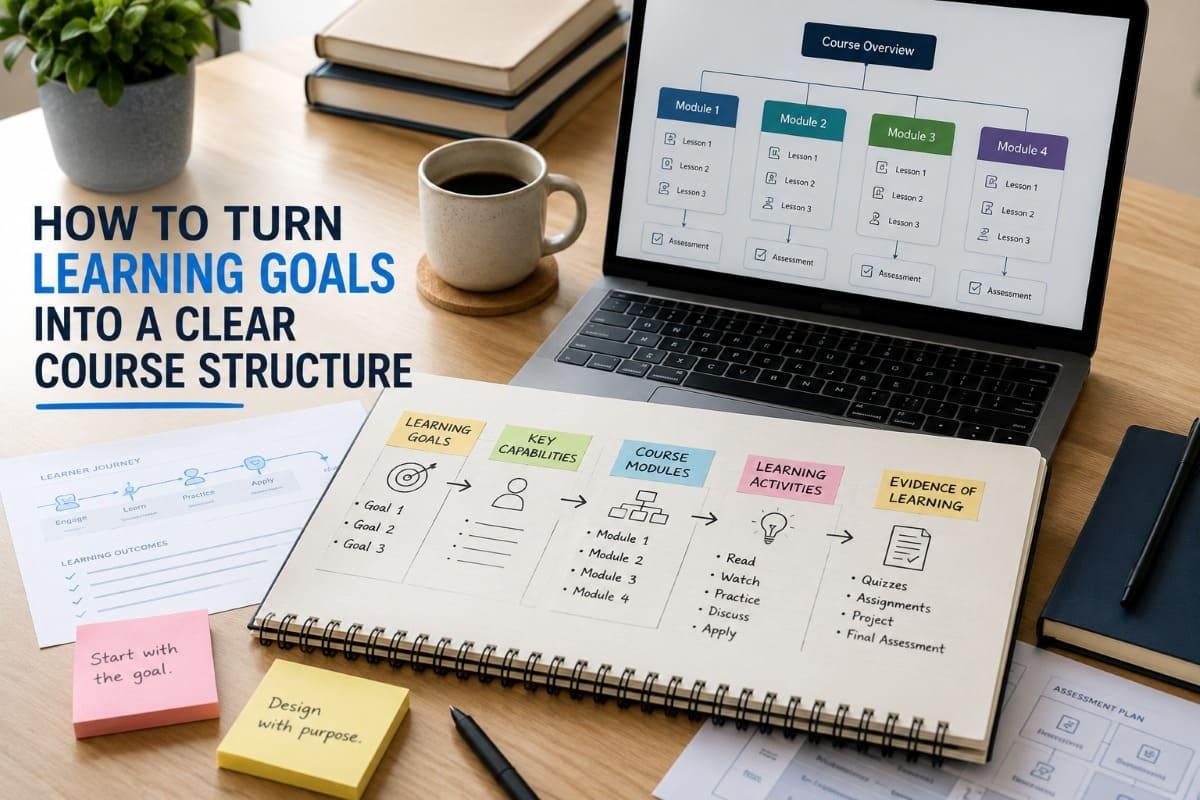
A clear course structure begins with a precise understanding
of what learners should be able to understand, perform, create, or apply by the
end of the learning experience. Instead of organizing a course around available
presentations, readings, or subject-matter topics, educators can work backward
from the intended learner outcome.
This article explains how educators, trainers, instructional
designers, institutions, and program managers can translate broad learning
goals into a coherent sequence of modules, lessons, activities, and progress
checks. It covers practical course architecture models, sequencing decisions,
implementation workflows, common design mistakes, and the operational
implications of delivering structured learning through classroom, online,
blended, mobile-first, or microlearning environments.
- Quick
Answer
- Why
Learning Goals Often Fail to Shape a Course
- The
Goal-to-Structure Framework
- Turn
a Broad Goal Into a Learning Journey
- Choose
the Right Course Architecture
- Build
Modules That Produce Visible Progress
- A
Practical Course-Structuring Workflow
- Common
Mistakes That Weaken Course Structure
- FAQ
- Conclusion
Quick Answer
To turn learning goals into a clear course structure, begin
by defining the change learners should demonstrate by the end of the course.
Next, determine what evidence would show that the change has occurred. Then
identify the knowledge, skills, decisions, and practice learners need before
they can produce that evidence.
These capabilities can be grouped into modules and arranged
according to the order in which learning should develop. The sequence should
not simply follow a textbook, an existing presentation deck, or the
subject-matter expert’s preferred topic order.
A practical course structure connects five elements:
- the
overall learning goal;
- evidence
of successful learning;
- prerequisite
knowledge and capabilities;
- modules
and lessons;
- practice,
feedback, and application.
This approach applies to academic courses, workforce
programs, professional training, creator-led education, and institutional
learning initiatives.
The main trade-off is between coverage and focus. Adding
more content can make a course appear comprehensive, but it may weaken the
learner journey. A clear structure prioritizes the content and activities that
genuinely help learners reach the intended result.

Why Learning Goals Often Fail to Shape a Course
Most education and training programs begin with a meaningful
ambition.
An institution may want to improve teaching quality. A
company may want supervisors to manage teams more effectively. A training
provider may want participants to become job-ready. A creator may want learners
to develop a practical skill.
The problem is that these ambitions are often too broad to
determine what a course should contain.
A goal such as “improve leadership capability” does not yet
explain:
- which
leadership situations learners must handle;
- what
decisions they should be able to make;
- what
successful performance looks like;
- which
knowledge is essential;
- what
learners must practise;
- how
progress will be demonstrated.
Without these decisions, course development can easily
become content collection.
Subject-matter experts gather presentations, articles,
videos, frameworks, interviews, and examples that appear relevant. Each item
may be valuable individually, but the resulting course does not necessarily
create a clear learning pathway.
Learners may understand the separate topics yet still
struggle to see:
- why
one lesson follows another;
- which
material is most important;
- how
the content relates to their real responsibilities;
- what
they are expected to do differently;
- how
individual activities contribute to the final outcome.
A goal-first design process addresses this problem by
treating learning outcomes, evidence, content, activities, and sequencing as
connected decisions.
The process is commonly associated with backward design:
educators first identify the intended learning results, determine what evidence
would demonstrate those results, and then plan the instruction needed to
prepare learners.
Carnegie
Mellon University course design guidance
A goal-first approach does not make subject knowledge less
important. It changes how that knowledge is selected and organized.
For example, a project management course could include:
- project
methodologies;
- terminology;
- planning
tools;
- stakeholder
management;
- budgeting;
- risk
management;
- documentation;
- leadership;
- reporting;
- project
evaluation.
All of these topics may be relevant. However, relevance
alone does not determine whether they belong in the same course.
A clearer design question would be:
Which capabilities must learners develop to plan and
manage the specific type of project this course is intended to address?
That question establishes boundaries. It helps the design
team distinguish between:
- essential
learning;
- supporting
knowledge;
- optional
enrichment;
- reference
material;
- content
that belongs in a different course.
|
Design Area |
Content-First Course |
Goal-First Course |
|
Starting point |
Existing materials and expert knowledge |
Intended learner capability |
|
Content selection |
Based on general topic relevance |
Based on contribution to the outcome |
|
Module sequence |
Follows chapters or presenter preference |
Follows learner progression and prerequisites |
|
Assessment |
Added after content production |
Planned early as evidence of learning |
|
Learner experience |
May feel informative but fragmented |
More likely to feel purposeful and connected |
|
Main risk |
Excess content with unclear application |
Scope may become too narrow if goals are poorly defined |
A course becomes clearer when every major component has a
defined role in helping learners move toward the intended result.
The Goal-to-Structure Framework
A useful course-planning framework contains four connected
design layers:
- the
intended learner change;
- evidence
of successful learning;
- the
capabilities required to produce that evidence;
- the
modules, lessons, and experiences that develop those capabilities.
Each layer should inform the next.
Layer 1: Define the intended learner change
Begin by defining what should be different after the course.
The change may involve:
- knowledge
learners can explain;
- procedures
they can perform;
- decisions
they can make;
- problems
they can solve;
- behaviours
they can demonstrate;
- professional
outputs they can create;
- standards
they can apply;
- situations
they can evaluate.
A useful end-state should be specific enough to guide course
design but broad enough to allow realistic variation in learner performance.
Consider the difference between these two statements:
Participants will understand performance management.
and:
Participants will be able to prepare for and conduct a
structured performance conversation with an employee.
The first statement points toward a broad area of knowledge.
It does not clearly indicate the required depth of learning or how the course
should be organized.
The second statement suggests several teachable
capabilities:
- recognizing
a performance issue;
- gathering
evidence;
- preparing
the conversation;
- communicating
clearly;
- responding
to the employee;
- documenting
agreed actions.
Detailed methods for refining these statements belong in the
related guide on how
to write clear learning objectives. At the course-structure stage, the
priority is to define an end-state that can meaningfully guide the learning
journey.
Layer 2: Identify evidence of successful learning
Before deciding what to teach, determine what learners would
need to produce or demonstrate.
Evidence may include:
- a
completed work product;
- a
practical demonstration;
- a
case analysis;
- a
scenario response;
- a
decision supported by reasoning;
- a
portfolio;
- an
observed performance;
- an
applied project;
- a
presentation;
- a
professional action plan.
The appropriate evidence depends on the significance and
complexity of the learning goal.
A short awareness course may use scenario-based questions. A
technical course may require learners to perform a procedure. A leadership
program may use simulations, reflective analysis, workplace assignments, or
observed conversations.
The evidence should provide meaningful information about
whether learners can meet the intended expectation.
A course about giving feedback, for example, should not rely
entirely on multiple-choice questions about feedback terminology. Knowledge
questions may be useful, but they do not demonstrate whether the learner can
conduct an effective feedback conversation.
Layer 3: Identify the required capabilities
Once the final evidence is clear, identify what learners
must know and be able to do before they can produce it.
For a performance-conversation course, the required
capabilities might include:
- distinguishing
performance concerns from other workplace issues;
- gathering
specific and relevant evidence;
- reviewing
expected standards;
- structuring
the conversation;
- asking
constructive questions;
- listening
to the employee’s explanation;
- agreeing
on actions and timelines;
- documenting
and following up.
This list begins to reveal the course structure.
Some capabilities may become individual lessons. Others may
require an entire module with explanations, demonstrations, practice
activities, feedback, and application.
Layer 4: Design modules, lessons, and learning
experiencesOnly after the first three layers are reasonably clear
should the team decide:
- how
many modules are required;
- which
capabilities belong together;
- what
sequence supports progression;
- where
learners need practice;
- where
feedback should occur;
- what
content can be optional;
- what
must be taught synchronously;
- what
can be delivered independently;
- what
resources learners will need after the course.
A course structure is not a container for content. It is a pathway from intention to demonstrated capability.

Turn a Broad Goal Into a Learning Journey
A broad learning goal rarely translates directly into a list
of modules. It first needs to be interpreted as a progression.
Consider an institutional workforce program with the
following goal:
Enable frontline supervisors to manage routine employee
performance issues fairly and consistently.
This goal combines several capabilities.
Learners need to recognize an issue, gather relevant
information, select an appropriate response, conduct a conversation, agree on
actions, document the outcome, and follow up.
Instead of creating one module for every available topic,
the design team can organize the course around stages of professional action.
A possible learning journey could be:
- Recognize
the situation
Identify performance concerns and determine when intervention is appropriate. - Prepare
the response
Gather evidence, review expectations, and plan the conversation. - Conduct
the conversation
Communicate concerns, listen to the employee, and clarify the issue. - Agree
on actions
Establish responsibilities, timelines, support, and expected improvement. - Document
and follow up
Record decisions, monitor progress, and respond if improvement does not occur.
The modules now follow the learner’s professional workflow.
This can make the course easier to understand because the structure reflects
what learners will eventually need to do.
The same principle applies across different subject areas.
A sewing course might move from:
- measurement;
- pattern
preparation;
- fabric
preparation;
- cutting;
- construction;
- fitting;
- finishing.
A business course might progress from:
- identifying
an opportunity;
- understanding
the target customer;
- validating
demand;
- developing
an offer;
- planning
operations;
- launching;
- reviewing
performance.
A healthcare training course might move from:
- recognizing
a condition;
- assessing
the situation;
- selecting
an intervention;
- performing
the intervention;
- documenting
the result;
- escalating
when required.
A teacher-development course might progress from:
- identifying
learner needs;
- establishing
objectives;
- planning
instruction;
- facilitating
learning;
- checking
understanding;
- reviewing
results.
The sequence should not automatically follow chronological
action in every course.
Sometimes learners need conceptual foundations before they
can understand a practical workflow. In other cases, seeing a complete task or
realistic problem at the beginning can help learners understand why each
foundational component matters.
The appropriate sequence depends on:
- learners’
prior knowledge;
- task
complexity;
- safety
and compliance implications;
- course
duration;
- access
to practice environments;
- dependencies
between capabilities;
- how
soon the learning will be applied;
- the
level of support available.
Sequence modules according to the logic of learner
development, not merely the order in which an expert prefers to explain the
subject.
A detailed curriculum
mapping process can later document how individual outcomes connect with
lessons, activities, assessments, and resources. At the initial structuring
stage, the priority is to establish a coherent learning journey.
Choose the Right Course Architecture
Not every course should follow the same structural model.
A tightly regulated technical program, an optional
professional-development library, and a creator-led microlearning course may
require very different architectures.
Four models are particularly useful.
Sequential architecture
In a sequential course, learners complete modules in a
defined order. Each stage prepares them for the next.
This model is appropriate when:
- skills
depend on prerequisites;
- learners
must follow a procedure;
- mistakes
could create safety or compliance risks;
- the
course leads toward a complex final performance;
- consistency
is more important than learner choice.
Examples include:
- technical
certification;
- equipment
operation;
- laboratory
procedures;
- accounting
fundamentals;
- structured
employee onboarding;
- regulated
professional training.
The main limitation is inflexibility. Experienced learners
may be required to complete material they already know unless the program
includes diagnostic testing, exemptions, or alternative pathways.
Modular architecture
A modular course consists of relatively independent learning
units.
Learners may complete all modules or select those most
relevant to their roles, needs, or current challenges.
This model can work well for:
- continuing
professional development;
- product
knowledge libraries;
- role-based
workforce training;
- membership
education;
- short
microlearning programs;
- learning
programs with diverse audiences;
- elective
professional courses.
A modular structure supports flexibility and makes
individual content units easier to update.
However, designers must clearly communicate prerequisite
relationships. Without clear guidance, a collection of modules can become a
content library rather than a structured learning experience.
Spiral or progressive-reinforcement architecture
A spiral structure revisits important concepts at increasing
levels of complexity.
Learners encounter an idea, practise it in a relatively
simple context, and return to it later in a more demanding situation.
This architecture is useful when:
- capability
develops through repeated practice;
- professional
judgement is important;
- learners
need to integrate several skills;
- one
exposure is unlikely to produce reliable performance;
- the
program extends over a longer period.
Examples may include:
- leadership
development;
- clinical
education;
- language
learning;
- teacher
development;
- consulting
skills;
- complex
sales training.
The main challenge is coordination. Repeated topics must
develop in complexity rather than simply repeat the same explanation.
Hybrid architecture
A hybrid structure combines required sequential learning
with flexible or elective modules.
For example, all participants may complete a core pathway
before selecting role-specific or specialist modules.
This model is useful when an organization needs both:
- consistent
foundational capability;
- flexibility
for different roles or experience levels.
The main operational risk is complexity. Program teams need
clear rules for prerequisites, learner access, module completion,
certifications, and reporting.
|
Architecture |
Best Used When |
Main Strength |
Main Limitation |
|
Sequential |
Capabilities have clear prerequisites |
Creates controlled progression |
May restrict experienced learners |
|
Modular |
Learners have different roles or needs |
Supports flexibility and easier updates |
May weaken the sense of progression |
|
Spiral |
Skills require repeated application |
Supports reinforcement and increasing complexity |
Requires careful coordination |
|
Hybrid |
Programs combine core and elective learning |
Balances consistency and personalization |
Can become operationally complicated |

Build Modules That Produce Visible Progress
Once the overall architecture is selected, each module
should represent a meaningful step toward the final learning goal.
A module should not exist simply because there is enough
material to fill it. It should have a clear function within the learning
journey.
A practical module blueprint contains six elements.
1. Module purpose
Explain why the module exists and how it contributes to the
broader course goal.
The purpose should be understandable to both the
course-development team and the learner.
2. Expected capability
Define what learners should be able to do after completing
the module.
This does not need to become a lengthy formal statement at
the early planning stage. It should, however, be clear enough to guide content
selection and activity design.
3. Essential content
Identify the concepts, procedures, examples, principles, or
frameworks required for the expected capability.
Content that does not directly support the capability should
be questioned, moved to optional resources, or reserved for another course.
4. Learning activity
Decide what learners will do with the content rather than
simply how they will consume it.
Depending on the course, learners may:
- analyse
an example;
- make
a decision;
- complete
a process;
- compare
alternatives;
- practise
a skill;
- solve
a problem;
- create
an output;
- reflect
on an experience;
- apply
a framework at work.
5. Evidence or progress check
Determine how learners and instructors will know whether the
intended capability is developing.
The progress check may be:
- a
short scenario;
- a
knowledge check;
- an
observation;
- a
practical task;
- a
draft output;
- a
peer review;
- a
facilitator review;
- a
reflective explanation.
6. Connection to the next stage
Show how the module prepares learners for subsequent
learning.
This connection is particularly important in long courses
and microlearning programs, where short lessons may otherwise feel isolated.
For example, a module on preparing for a performance
conversation might include:
- a
concise explanation of evidence-based preparation;
- examples
of strong and weak documentation;
- a
scenario in which learners identify missing evidence;
- a
conversation-planning template;
- a
short preparation exercise;
- feedback
before the learner moves to conversation practice.
The module has an identifiable purpose. It prepares learners
to conduct a fair, specific, and evidence-based conversation later in the
course.
Module length does not need to be uniform.
One module may require ten minutes. Another may require
several hours, multiple activities, or repeated workplace practice. The
appropriate length depends on the complexity of the capability, not on a
requirement to make every module visually equal.
In mobile-first or microlearning environments, a module may
be divided into shorter lessons while preserving the same developmental logic.
One module could contain:
- a
two-minute introduction;
- a
five-minute concept explanation;
- a
short scenario;
- a
practical workplace task;
- a
reflection;
- a
progress check.
The main risk is fragmentation.
Short learning units should remain visibly connected to the
module capability and the overall course goal. Otherwise, microlearning can
become a collection of disconnected content pieces rather than a coherent
learning journey.
FitAcademy
Turn Your Course Blueprint Into a Deliverable Learning Experience
A clear course structure becomes easier to manage when modules, learner access, assessments, progress tracking, and mobile delivery operate within one connected environment. Explore how FitAcademy supports institutions, educators, and training providers in delivering structured branded learning programs.
Learn More About FitAcademyA Practical Course-Structuring Workflow
The following workflow can be used to design a new course or
restructure an existing program.
Step 1: Clarify the learner and the performance problem
Begin by identifying who the course is for and what
situation has created the need for learning.
Ask:
- What
are learners expected to do in their role?
- What
are they currently unable to do consistently?
- What
prior knowledge can reasonably be assumed?
- What
environmental factors affect performance?
- What
constraints may affect participation?
- Where
and when will the learning be applied?
This step prevents the design team from treating all
learners as if they have the same needs.
A program for first-time supervisors should not
automatically use the same structure as a program for experienced managers,
even if both address leadership.
Step 2: Define the final capability
Describe what successful learners should be able to do after
completing the course.
Avoid starting with module labels such as:
- Introduction;
- Fundamentals;
- Intermediate
Concepts;
- Advanced
Topics;
- Additional
Resources.
These labels may be useful later, but they do not reveal the
learner transformation.
Start instead with the practical, intellectual, or
professional capability the course is expected to support.
Step 3: Identify acceptable evidence
Determine how learners could demonstrate the final
capability.
This step exposes vague goals.
If the design team cannot describe credible evidence of
success, the goal may still be too broad, ambiguous, or unrealistic for the
available course duration.
Evidence does not always need to be formally graded. It may
be demonstrated through:
- guided
practice;
- a
simulation;
- workplace
observation;
- a
project;
- a
facilitated discussion;
- a
portfolio item;
- a
professional action;
- an
explanation of reasoning.
Step 4: Break the final capability into components
List the decisions, skills, concepts, and prerequisite
knowledge required for the final performance.
Then separate the list into three groups:
- capabilities
learners should already possess;
- capabilities
that must be developed in the course;
- useful
knowledge that can remain optional or be addressed elsewhere.
This is an important scope-control step.
Not every relevant topic needs to become mandatory course
content.
Step 5: Group related capabilities into modules
Combine capabilities that serve one meaningful purpose.
A module should usually answer a recognizable learner
question, such as:
- How
do I recognize the problem?
- How
do I prepare?
- How
do I perform the task?
- How
do I evaluate the result?
- What
should I do when the standard process does not work?
Avoid combining unrelated capabilities merely to reduce the
number of modules.
At the same time, avoid creating a separate module for every
minor concept. Excessive fragmentation can make navigation more difficult and
weaken the learner’s understanding of the overall process.
Step 6: Sequence the modules
Review the prerequisite relationships and the level of
cognitive or practical demand.
Learners may need to:
- recognize
before they diagnose;
- explain
before they evaluate;
- practise
components before integrating them;
- observe
an example before attempting the task;
- receive
feedback before moving to a higher-stakes activity;
- understand
a principle before adapting it to unfamiliar situations.
Sequence should also support motivation.
An opening problem, realistic scenario, demonstration, or
example can help learners understand why foundational material matters.
Step 7: Add practice and feedback
A course structure is incomplete if it specifies only
content.
Decide where learners will:
- retrieve
important information;
- use
a process;
- analyse
an example;
- compare
possible responses;
- make
a decision;
- create
an output;
- receive
feedback;
- revise
their performance;
- apply
learning in their real environment.
Practice should gradually become more demanding.
Early activities may provide guidance and examples. Later
activities can require learners to combine multiple capabilities with less
support.
Step 8: Select the delivery format
Determine which parts of the course should be delivered
through:
- independent
online learning;
- live
facilitation;
- classroom
instruction;
- workplace
assignments;
- peer
discussion;
- coaching;
- mobile
microlearning;
- reference
resources;
- practical
demonstrations.
Delivery decisions should follow the learning requirement.
A video may be useful for showing a process, but it may not
replace practice. A live workshop may support discussion, but it may be
inefficient for delivering basic information that learners could review
independently.
Step 9: Test the blueprint before producing content
Review the proposed structure with subject-matter experts,
facilitators, representative learners, program managers, and learning-platform
teams.
Each group can examine the structure from a different
perspective.
Subject-matter experts can ask:
- Is
anything essential missing?
- Is
the sequence technically accurate?
- Are
any concepts presented too early or too late?
Facilitators can ask:
- Can
this structure be delivered realistically?
- Where
will learners require additional support?
- Are
the activities manageable within the available time?
Representative learners can ask:
- Is
the pathway understandable?
- Does
the course appear relevant to the problems they face?
- Are
the expectations clear?
Program managers can ask:
- Can
the program be scheduled and supported?
- Are
staffing, assessment, and reporting requirements realistic?
- Can
the design be maintained at scale?
Platform and operations teams can ask:
- Can
prerequisites and access rules be configured?
- Can
the required activities be delivered?
- Can
learner progress and completion be tracked?
- Are
mobile and accessibility requirements addressed?
A blueprint review can prevent significant rework after
videos, assessments, presentations, and platform configurations have already
been produced.
|
Course Blueprint Element |
Example |
|
Overall goal |
Supervisors manage routine performance issues fairly and
consistently |
|
Final evidence |
Conduct and document a simulated performance conversation |
|
Module 1 |
Recognize and classify performance concerns |
|
Module 2 |
Gather evidence and prepare the conversation |
|
Module 3 |
Conduct a constructive conversation |
|
Module 4 |
Agree on actions and document outcomes |
|
Module 5 |
Follow up and respond to continued underperformance |
|
Reinforcement |
Workplace checklist, manager feedback, and follow-up
scenario |
Course production should begin after the learning pathway is
reasonably stable. Producing content too early can make weak structural
decisions expensive to change.

Common Mistakes That Weaken Course Structure
Organizing the course around available content
This often happens when an organization already owns
presentations, manuals, webinar recordings, videos, or workshop materials.
The content is uploaded into a learning platform and divided
into folders labelled as modules.
The operational consequence is that learners receive
information without a deliberately designed progression. Platform data may show
that materials were opened or completed, but it may not demonstrate whether
learners developed the intended capability.
A better approach is to define the learning pathway first
and then decide which existing materials genuinely support it.
Some resources may fit directly. Others may need to be
revised, divided, converted into reference material, or removed.
Giving every topic equal importance
Not all topics make an equal contribution to the course
goal.
When every concept receives the same amount of time and
emphasis, critical capabilities may receive insufficient practice while
peripheral information expands the course unnecessarily.
Design teams should establish a clear hierarchy:
- essential
learning;
- supporting
learning;
- optional
enrichment;
- reference
material.
This hierarchy makes the course easier to navigate, deliver,
update, and evaluate.
Creating modules that are too broad
A module called “Leadership Skills” could include:
- communication;
- delegation;
- coaching;
- conflict
management;
- decision-making;
- motivation;
- performance
management;
- team
development.
Such a broad module is difficult to teach, practise, and
assess as one coherent unit.
It is usually better to organize modules around a narrower
capability, decision, responsibility, or professional task.
Creating too many small modules
The opposite problem also occurs.
Design teams sometimes create a separate module for every
concept, video, or document. Learners may then face a long navigation menu with
little indication of how the pieces connect.
Short content is not automatically microlearning.
Effective microlearning requires focused objectives,
meaningful context, clear connections, and an identifiable role within the
broader learning pathway.
Treating assessment as a final-course activity
When assessments are designed only after all content has
been produced, they may test what is easiest to ask rather than what learners
genuinely need to demonstrate.
This frequently results in quizzes that measure terminology
or recall even when the course goal involves application, judgement, or
performance.
Progress checks should be distributed across the learning
journey. They help learners identify misunderstandings before moving into more
complex work and provide useful information for facilitators and program teams.
Program-level evaluation is explored further in how
to measure whether an education program is actually working.
Ignoring delivery constraints during design
A course structure may appear effective on paper but become
impractical when implemented.
Common constraints include:
- limited
facilitator availability;
- unreliable
internet access;
- mobile-only
learners;
- restricted
time during working hours;
- large
learner cohorts;
- multilingual
audiences;
- accessibility
requirements;
- limited
access to equipment;
- limited
opportunities for workplace practice;
- complex
organizational approval processes.
These conditions should influence the architecture from the
beginning.
For example, a course for mobile-first frontline workers may
need:
- shorter
learning units;
- clear
stopping points;
- downloadable
resources;
- simple
navigation;
- low-bandwidth
media;
- activities
that can be completed during work;
- reminders
and progress tracking.
A leadership cohort may require a different structure
involving:
- scheduled
discussions;
- peer
feedback;
- facilitator
coaching;
- workplace
projects;
- reflection
over several weeks.
Confusing platform structure with learning structure
Creating categories, folders, pages, and lesson menus inside
an online learning platform does not automatically create a coherent course.
The platform structure should reflect the instructional
structure.
Module navigation, prerequisites, release rules,
assessments, reminders, certificates, learner support, and analytics should
reinforce the pathway rather than compensate for an unclear design.
This becomes particularly important when programs are scaled
through a white-label learning platform.
A branded learning environment can support consistency,
learner management, data visibility, and operational control. However, the
quality of the learner experience still depends on the logic of the course
itself.
FAQ
How many modules should a course have?
There is no universally correct number. The appropriate
number depends on the complexity of the learning goal, learners’ prior
experience, the delivery format, and the amount of practice required. A short
awareness course may contain three modules, while a professional certification
may contain many more. Each module should represent a meaningful stage of
progression rather than an arbitrary quantity of content.
Should every course use backward design?
Backward design is useful in many academic, professional,
and workforce-learning contexts because it connects intended results, evidence,
and instruction. However, the level of formality can vary. A short information
module may require a lightweight process, while regulated, competency-based, or
certification programs generally need more detailed alignment, documentation,
assessment, and quality review.
What is the difference between course structure and curriculum mapping?
Course structure defines the major learning journey: the
modules, sequence, and progression learners will follow. Curriculum mapping
documents the relationships between outcomes, lessons, activities, assessments,
resources, and sometimes external standards. Course structure establishes the
pathway. Curriculum mapping provides a more detailed view of whether every
component is appropriately aligned within that pathway.
Should a course begin with theory or practical application?
The answer depends on the learner, the task, and the risks
involved. Some courses require foundational concepts before safe or accurate
practice is possible. In other situations, an opening problem, demonstration,
or scenario can establish relevance before theory is introduced. The sequence
should support understanding and performance rather than follow a fixed
theory-first or practice-first rule.
Can one course structure serve learners with different experience levels?
It can, but the design may need diagnostic assessments,
optional foundation modules, role-specific pathways, exemptions, or elective
content. Without these mechanisms, beginners may become overwhelmed while
experienced learners repeat material they already know. A hybrid structure with
a shared core and flexible modules often provides a practical balance between
consistency and personalization.
How often should a course structure be reviewed?
A course should be reviewed after pilot delivery, when
assessment results reveal persistent difficulties, when learner roles or
requirements change, or when significant content updates are introduced.
Completion rates alone are insufficient. Teams should also examine learner
performance, facilitator observations, feedback, navigation behaviour,
workplace application, and the continued relevance of the intended outcomes.
Conclusion
Turning learning goals into a clear course structure
requires more than dividing a subject into chapters.
Educators and program teams need to define the learner
change they are seeking, determine what evidence would demonstrate that change,
identify the capabilities learners must develop, and arrange those capabilities
into a purposeful sequence.
The strongest course structures are selective.
They distinguish essential learning from useful background
information, provide opportunities for practice and feedback, and account for
the environment in which learning will be delivered.
A clear blueprint also improves learning operations.
It helps subject-matter experts understand what content is
needed, gives facilitators a coherent delivery pathway, enables platform teams
to configure the learner experience, and provides program managers with a
stronger basis for monitoring and evaluation.
Course structure should not be treated as permanently fixed.
Learner performance, facilitator observations, assessment results, workplace
application, and operational data may reveal where sequencing, pacing, module
boundaries, or delivery methods should be revised.
Course structure is therefore both an instructional-design
decision and an ongoing program-management responsibility.
Clear learning goals establish direction. Clear course structure makes that direction teachable, deliverable, and measurable.
FitAcademy
Build a Learning Journey That Can Grow With Your Program
FitAcademy provides branded learning infrastructure for organizations, educators, and training providers that need to organize courses, deliver mobile-first learning, manage learners, and scale structured education programs.
Learn More About FitAcademy