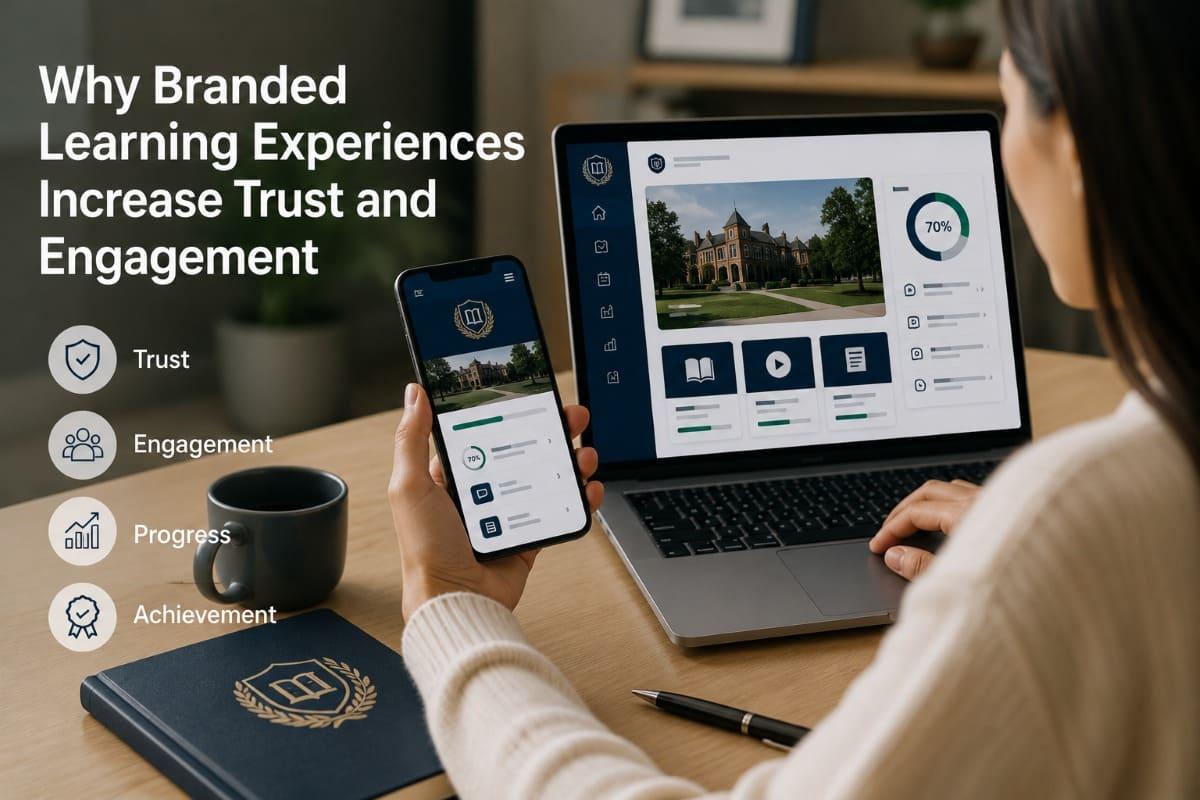
A branded learning experience connects an organization’s
identity, educational standards, communication, learner support, and digital
infrastructure within one recognizable environment. It can help learners
understand who provides the program, what they can expect, where to obtain
support, and how their participation connects with a broader institution or
professional community.
The value extends beyond logos and colors. A well-designed
branded platform can create greater consistency across enrollment, learning,
assessment, communication, certification, and continued engagement. It can also
give institutions, training providers, and education businesses greater control
over learner relationships and data.
Branding alone does not guarantee trust or engagement. Its
effect depends on whether the experience is credible, accessible, secure,
educationally valuable, and operationally reliable.
- Quick
Answer
- Branding
in Learning Is More Than Visual Identity
- How
a Branded Learning Experience Can Build Trust
- How
Branding Can Support Learner Engagement
- What
a Complete Branded Learning Experience Includes
- Choosing
the Right Platform Ownership Model
- How
to Build a Branded Learning Experience
- How
to Measure Trust and Engagement
- Common
Branded Learning Experience Mistakes
- FAQ
- Conclusion
Quick Answer
A branded learning experience can increase trust and
engagement by making the relationship between the learner and the education
provider clearer, more consistent, and easier to navigate.
Learners encounter the same institutional identity across
the domain, website, mobile application, course interface, emails, support
channels, assessments, certificates, and follow-up communication. This
continuity may reduce uncertainty, strengthen recognition, and make the
platform feel like an intentional part of the institution rather than an
unrelated third-party service.
Branding can also support engagement when it is combined
with clear learning paths, relevant content, visible instructor presence,
reliable technology, personalized communication, community interaction, and
accessible support.
However, adding a logo to a generic platform is not enough.
Trust depends on the quality of the entire experience, including privacy,
security, accessibility, content accuracy, transparency, and learner support.
Engagement also depends on instructional design and perceived value.
Organizations should therefore treat branding as part of
their learning infrastructure and relationship strategy, not merely as a visual
customization project.
Branding in Learning Is More Than Visual Identity
When organizations discuss branded learning platforms, the
conversation often begins with visual elements:
- Logo
placement
- Brand
colors
- Typography
- Course
thumbnails
- Application
icons
- Branded
certificates
- Custom
domains
These elements matter because they help learners recognize
the organization. However, visual identity represents only the most visible
layer of a branded experience.
The deeper experience includes every interaction through
which learners form an impression of the program and its provider.
A learner may encounter the organization through:
- A
campaign or invitation
- A
registration page
- A
payment or enrollment process
- An
onboarding email
- A
web or mobile learning environment
- An
instructor introduction
- A
lesson sequence
- An
assessment
- A
reminder or notification
- A
support conversation
- A
certificate
- A
recommendation for the next program
- A
professional or learner community
When these touchpoints feel disconnected, the learner may
struggle to understand who is responsible for the experience.
For example, the invitation may come from an educational
institution, but registration takes place on a marketplace with unfamiliar
branding. Course emails may arrive from a generic system address. The learning
interface may not mention the institution clearly, while the certificate uses
another visual style.
None of these differences necessarily makes the program
illegitimate. Together, however, they may create avoidable uncertainty.
A branded learning experience creates continuity between
these moments. It connects the organization’s identity with its educational
offer, service standards, communication, and learner relationship.
A learning brand is not only what learners see. It is the
pattern of expectations created by every interaction with the education
provider.

Brand Recognition Is Only the Starting Point
Recognition helps learners identify the provider, but
recognition alone does not create a strong experience.
A platform may display an organization’s logo while
retaining:
- A
generic domain
- Unrelated
system emails
- Confusing
navigation
- Inconsistent
terminology
- Limited
support information
- Unclear
data practices
- Generic
course templates
- Platform-controlled
learner communication
- Certificates
dominated by the technology provider’s identity
This is visual customization rather than complete experience
ownership.
A stronger branded environment aligns what the learner sees
with how the program operates. The visual identity, tone of voice, navigation,
content quality, instructor presence, support, privacy information, and
credentialing system should reinforce one another.
Branding Should Clarify Responsibility
In education, trust partly depends on knowing who is
responsible.
Learners should be able to identify:
- Who
provides the program
- Who
created or reviewed the content
- Who
teaches or facilitates the course
- Who
handles learner support
- Who
stores learner data
- Who
issues the certificate
- What
the qualification or completion record represents
- How
the organization can be contacted
- What
happens after the program ends
A branded learning environment can make these relationships
more visible.
This becomes especially important when an institution works
with technology vendors, content partners, external instructors, professional
associations, or accreditation bodies. The learner should not have to interpret
a complex supplier structure to understand the educational relationship.
How a Branded Learning Experience Can Build Trust
Trust is not produced by design alone. It develops when the
organization demonstrates competence, consistency, transparency, reliability,
and appropriate care for learners.
A branded platform can provide the environment in which
these qualities become visible.
1. It Connects the Platform With a Recognizable Provider
Learners may be more comfortable registering, sharing
information, making payments, or completing professional training when they can
clearly identify the organization behind the experience.
A recognizable domain, institutional name, consistent
interface, and verified contact details can help answer an important learner
question:
“Am I in the right place?”
This is particularly relevant for:
- Paid
education programs
- Professional
certifications
- Mandatory
workforce training
- Public-sector
learning programs
- University
extension courses
- Community
education
- Health
or safeguarding education
- Programs
involving personal data
- Courses
promoted through social media
- International
education offers
Recognition is not proof of quality or legitimacy.
Fraudulent services can imitate visual identities. Institutions must therefore
combine branding with secure technical practices, transparent information, and
verifiable contact channels.
2. It Creates Consistency Across the Learner Journey
Consistency reduces the number of times learners must
reinterpret an environment.
When terminology, navigation, communication, and visual
presentation remain coherent, learners can focus more attention on the learning
task instead of repeatedly determining how different systems work.
For example, an organization might use the same:
- Program
name across marketing and learning
- Terminology
for lessons and modules
- Instructor
profiles
- Support
contact details
- Completion
requirements
- Visual
hierarchy
- Tone
of communication
- Privacy
explanations
- Certificate
information
Consistency does not mean that every page must look
identical. It means that the experience follows a recognizable logic.
A mobile interface may require different navigation from a
desktop interface. A certificate may use a more formal layout than a lesson
page. The underlying identity and learner expectations should nevertheless
remain aligned.
Consistency tells learners that the experience is intentional, managed, and connected to an accountable provider.
3. It Makes Institutional Presence More Visible
Online learning can sometimes feel detached from the
institution, instructor, or community delivering it.
Research on online learning does not establish that visual
branding alone causes higher engagement. It does, however, consistently
identify environmental factors such as social presence, teacher interaction,
platform experience, support, and perceived connection as relevant to learner
engagement.
A branded experience can support these factors by making
institutional presence visible throughout the learning journey.
This may include:
- Welcome
messages from identifiable instructors
- Profiles
showing instructor expertise
- Institution-specific
examples
- Regular
program communication
- Visible
learner support
- Community
spaces
- Instructor
feedback
- Scheduled
events
- Institutional
announcements
- A
recognizable learning application
- Certificates
connected to the provider
research
on factors influencing online learning engagement
research
on social presence and online learning engagement
The connection between branding and engagement should
therefore be understood as indirect and conditional.
Branding can strengthen the environment in which
institutional and social presence are delivered. The quality of teaching,
communication, interaction, and support still determines whether that presence
becomes meaningful.
4. It Provides a Clearer Trust Framework for Data and Privacy
Learners share significant information with digital
education platforms. Depending on the program, this may include:
- Names
and contact information
- Employment
details
- Educational
records
- Assessment
results
- Payment
information
- Uploaded
assignments
- Images
or audio recordings
- Course
activity
- Accessibility
requirements
- Professional
credentials
- Communication
history
A branded platform gives the organization an opportunity to
explain how this information is handled within the learning context.
Clear privacy information should identify:
- The
organization responsible for learner data
- The
platform or service providers involved
- The
purposes for which data is collected
- Who
can access the information
- How
long records are retained
- Whether
data is transferred across jurisdictions
- How
learners can request access or deletion
- Whether
artificial intelligence processes learner information
- Which
analytics or tracking technologies are used
The OECD has emphasized that digital education ecosystems
require governance arrangements that protect stakeholder data and privacy and
ensure that technology use does not work to their detriment.
OECD
digital education ecosystems and governance
The 1EdTech TrustEd Apps framework similarly places data
privacy, transparency, and trusted technology evaluation within education
technology procurement.
Brand control should not be used to hide the role of
technology providers. It should make accountability clearer.
5. It Reinforces the Meaning of Credentials
A certificate is more credible when learners and third
parties can understand:
- Who
issued it
- What
program was completed
- What
the learner was required to do
- Whether
an assessment was involved
- When
the credential was issued
- Whether
it expires
- How
it can be verified
- Which
institution or professional body stands behind it
A branded certificate connects the achievement with an
identifiable provider.
However, the logo does not create credential value. The
value comes from the issuing organization’s credibility, the quality of the
learning program, the assessment standard, and the transparency of the
credential.
Organizations should avoid using decorative certificates to
imply accreditation, licensing, or professional recognition that the program
does not possess.

How Branding Can Support Learner Engagement
Learner engagement includes more than opening a course or
watching a video.
It may include:
- Beginning
a program
- Returning
after the first session
- Completing
learning activities
- Participating
in discussion
- Asking
questions
- Responding
to feedback
- Applying
new knowledge
- Completing
assessments
- Joining
further programs
- Recommending
the experience
- Remaining
connected to the learning community
A branded environment can support these behaviors through
several mechanisms.
It Creates a Stronger Sense of Continuity
Learners are more likely to understand where a course fits
when it is visibly connected to the organization’s broader educational offer.
A lesson may be part of:
- A
structured curriculum
- An
employee development pathway
- A
professional certification
- A
membership program
- A
creator education business
- An
institutional orientation process
- A
public-service initiative
- A
community development program
- A
sequence of paid courses
A branded platform can show this relationship more clearly
than a collection of unrelated course links.
Learners can see what they have completed, what comes next,
which programs are relevant, and how their activity contributes to a longer
learning journey.
It Supports More Relevant Communication
When an organization controls learner communication, it can
send messages based on the actual program relationship.
Examples include:
- Welcome
and onboarding messages
- Course-start
reminders
- Notifications
about incomplete lessons
- Instructor
feedback
- Assessment
deadlines
- Certificate
availability
- Recommendations
based on completed programs
- Invitations
to community discussions
- Updates
to learning materials
- Renewal
reminders
- Relevant
advanced programs
This communication can feel more coherent when it comes from
the education provider rather than from several disconnected systems.
The organization must still avoid excessive notifications.
Relevance, timing, consent, and learner control remain important.
It Can Strengthen Belonging
Belonging does not come from a color palette. It develops
when learners feel that they are recognized members of a meaningful educational
environment.
Branding can provide a shared identity around which
community interaction is organized.
This may involve:
- Cohort
identities
- Program-specific
communities
- Instructor
introductions
- Learner
profiles
- Discussion
spaces
- Peer
recognition
- Shared
events
- Alumni
groups
- Member-only
content
- Institution-specific
challenges
- Progress
milestones
- Community
stories
These elements can help learners perceive that they are
participating in something larger than an isolated content transaction.
The institution must ensure that community features are
moderated, accessible, safe, and relevant. An empty discussion forum does not
create belonging simply because it is branded.
It Reduces Friction Between Learning Touchpoints
Engagement can decline when learners must repeatedly move
between unfamiliar systems.
A fragmented journey may require learners to:
- Register
on one platform
- Pay
through another service
- Receive
lessons through email
- Watch
videos on a public platform
- Submit
assignments through a form
- Join
discussions through a separate application
- Download
certificates from another system
Multiple tools are not inherently problematic. Specialized
systems may be necessary. The problem arises when the learner must manage the
integration personally.
A branded learning environment can provide a more coherent
entry point, even when several underlying tools are involved.
Single sign-on, synchronized progress, unified navigation,
consistent communication, and shared learner records can reduce operational
friction.
It Helps the Organization Continue the Learner Relationship
On a third-party marketplace, the learner’s primary
relationship may remain with the marketplace rather than the education
provider.
The provider may have limited control over:
- Learner
communication
- Recommendations
- Pricing
presentation
- Platform
navigation
- Customer
data
- Community
development
- Cross-program
pathways
- Mobile
application identity
- Future
product offers
A branded platform can allow the organization to maintain a
more direct relationship, subject to consent, privacy rules, and responsible
communication practices.
This can support:
- Program
progression
- Course
renewal
- Membership
- Alumni
engagement
- Continuing
professional education
- Community
activity
- Relevant
cross-selling
- Learner
support
- Long-term
learning records
The objective should not be to maximize promotional
messages. It should be to maintain a useful relationship around the learner’s
ongoing development.
Engagement becomes more sustainable when learners can see
how one course connects with their next useful learning opportunity.
FitAcademy
Turn Your Learning Program Into a Branded Experience
FitAcademy enables institutions, training providers, and education businesses to deliver structured microlearning through branded web and mobile environments without developing the entire platform infrastructure internally.
Explore FitAcademy White-LabelWhat a Complete Branded Learning Experience Includes
A branded learning platform should be evaluated across the
complete learner journey.
|
Experience Layer |
Basic Customization |
More Complete Branded Experience |
|
Domain |
Generic platform address |
Institutional or organization-controlled domain |
|
Login |
Platform-dominated login page |
Recognizable provider identity, clear support, and
appropriate authentication |
|
Web interface |
Logo and primary color |
Consistent navigation, terminology, content structure, and
visual system |
|
Mobile access |
Responsive generic platform |
Branded mobile experience aligned with learner behavior |
|
Application |
Shared marketplace application |
Dedicated or clearly organization-branded application
where justified |
|
Communication |
Generic system emails |
Organization-controlled sender identity, tone, timing, and
support information |
|
Content |
Standard course templates |
Institution-specific structure, examples, language, and
quality standards |
|
Instructors |
Limited profile information |
Visible expertise, welcome communication, feedback, and
teaching presence |
|
Learner support |
Technology provider help page |
Clear academic, administrative, and technical support
pathways |
|
Community |
Generic discussion functionality |
Purposeful cohorts, moderated interaction, events, and
member identity |
|
Assessment |
Standard quiz and completion |
Assessment aligned with program objectives and
institutional standards |
|
Certificates |
Generic certificate template |
Verifiable credential connected to the provider and
program requirements |
|
Analytics |
Platform-level summary data |
Organization-accessible learner, content, cohort, and
program reporting |
|
Data |
Platform-dependent access |
Clear ownership, governance, export, retention, and exit
arrangements |
|
Integrations |
Manual transfers |
Coordinated identity, enrollment, payment, communication,
and reporting workflows |
Custom Domains and Authentication
A custom domain can make the relationship between the
platform and provider clearer.
Examples might include:
- academy.organization.org
- learning.organization.com
- training.organization.org
- members.organization.com
The domain should use secure connections, appropriate
authentication, and clear account-recovery processes.
For institutions with existing identity systems, single
sign-on may further reduce friction. Learners can use an established
institutional account rather than creating another password.
Branded Web and Mobile Experiences
The web and mobile environments should reflect the same
learning architecture, even when their interfaces differ.
This includes:
- Program
organization
- Course
naming
- Navigation
logic
- Progress
records
- Learner
roles
- Support
information
- Completion
requirements
- Privacy
information
- Communication
preferences
Mobile branding should not compromise usability. Decorative
introductions, large image files, excessive animation, and complex navigation
can make an application feel visually distinctive while weakening the learner
experience.
Organizations planning a mobile learning environment can
review how
educational institutions can deliver mobile-first learning experiences.
Content and Instructional Identity
Branded content should express the provider’s educational
approach.
This may include:
- Consistent
learning objectives
- Recognizable
lesson formats
- Institution-specific
examples
- Editorial
standards
- Accessibility
requirements
- Instructor
introductions
- Standard
feedback practices
- Assessment
principles
- Referencing
and source policies
- Content
review schedules
The organization should avoid making every lesson visually
identical when different subjects require different teaching methods.
Brand consistency should support comprehension and quality,
not restrict instructional effectiveness.
Communication and Support
Learners should understand where different questions should
be directed.
A complete support structure may distinguish between:
- Account
and login support
- Payment
or enrollment questions
- Academic
questions
- Instructor
feedback
- Accessibility
support
- Certificate
verification
- Technical
problems
- Privacy
requests
The interface and communication should use the
organization’s identity while clearly explaining when an external technology
provider is involved.
Data, Analytics, and Learner Ownership
A branded experience is strategically limited when the
organization cannot access or use the data needed to manage its programs.
Organizations should verify access to:
- User
profiles
- Enrollment
records
- Course
progress
- Assessment
results
- Completion
data
- Certificates
- Engagement
patterns
- Payment
records where relevant
- Communication
preferences
- Support
records
- Consent
records
- Data
exports
Data access must remain proportionate and governed. The
ability to collect more information does not justify collecting it.
Before selecting a platform, organizations should understand
which capabilities form part of modern learning infrastructure. See seven
features every modern learning platform should have.

Choosing the Right Platform Ownership Model
Organizations can create branded learning experiences
through several infrastructure models.
The right choice depends on budget, speed, technical
capacity, required control, audience size, integrations, and long-term
strategy.
|
Model |
Branding Control |
Learner Relationship |
Implementation Effort |
Suitable Context |
|
Shared marketplace |
Limited |
Often mediated by the marketplace |
Low |
Testing demand, reaching an existing marketplace audience,
distributing individual courses |
|
Configurable SaaS platform |
Moderate |
More direct, depending on provider terms |
Low to moderate |
Organizations needing standard learning functions with
some customization |
|
White-label learning platform |
Strong |
Generally more direct and organization-led |
Moderate |
Institutions and learning businesses requiring branded web
or mobile delivery without full custom development |
|
Fully custom platform |
Potentially complete |
Organization-controlled |
High |
Organizations with unique workflows, strong technical
capacity, significant budgets, and long-term development requirements |
|
Combination model |
Varies |
Split across channels |
Moderate to high |
Organizations using marketplaces for discovery and owned
infrastructure for deeper programs |
Shared Marketplaces
A marketplace can provide fast access to existing
infrastructure and, in some cases, a built-in audience.
This can be useful for:
- Testing
a course concept
- Reaching
learners searching within the marketplace
- Starting
with limited technical resources
- Selling
individual courses
- Learning
basic digital course operations
The limitations may include restricted branding, limited
learner communication, marketplace-controlled recommendations, standardized
pricing presentation, and dependency on the marketplace’s policies.
Configurable SaaS Platforms
A standard learning SaaS platform may allow organizations to
use their logo, colors, domain, and course structure.
This can provide a practical balance between speed and
control.
Organizations should verify how deeply the customization
extends. Some platforms provide visual branding but retain platform-controlled
emails, mobile applications, navigation, analytics, or learner data
arrangements.
White-Label Learning Platforms
A white-label platform uses an existing technical
infrastructure while presenting the learning environment under the
organization’s identity.
Depending on the provider, white-label capabilities may
include:
- Branded
web platform
- Custom
domain
- Branded
mobile application
- Organization-specific
interface
- Course
and user management
- Analytics
- Certificates
- Payment
options
- Integrations
- Data
exports
- Platform
support
The main advantage is that the organization does not have to
build every technical component from the beginning.
However, white-label does not mean unlimited customization.
The organization must examine which elements can be changed, which functions
follow the provider’s product roadmap, and which integrations require
additional work.
Fully Custom Development
Custom development can provide greater architectural
freedom, but it also creates substantial responsibilities.
The organization must manage:
- Product
strategy
- User
research
- Interface
design
- Web
development
- Mobile
development
- Backend
infrastructure
- Security
- Quality
assurance
- Hosting
- Analytics
- Accessibility
- App-store
management
- Integrations
- Updates
- Technical
support
- Long-term
maintenance
A custom platform may be appropriate when the learning model
cannot be supported by existing infrastructure and the organization has the
resources to maintain a software product over time.
It should not be selected merely because complete ownership
sounds attractive.
The strategic question is not whether an organization owns
every line of code. It is whether it has sufficient control over the learner
experience, data, operations, and future direction.
How to Build a Branded Learning Experience
A branded learning initiative should begin with strategy
rather than design files.
Step 1: Define the Learning Brand Promise
The organization should clarify what learners should expect
from its programs.
A learning brand promise might emphasize:
- Practical
professional education
- Academic
rigor
- Accessible
community learning
- Short
workplace training
- Industry-recognized
expertise
- Personalized
coaching
- Flexible
mobile learning
- Cohort-based
development
- Reliable
certification
- Continuing
professional support
The promise must be realistic. Branding cannot compensate
for weak content, limited support, or unclear educational outcomes.
Step 2: Map the Complete Learner Journey
Map the experience from discovery to continued engagement.
The journey may include:
- Awareness
- Program
evaluation
- Registration
- Payment
or approval
- Account
activation
- Onboarding
- First
lesson
- Ongoing
learning
- Assessment
- Support
- Completion
- Certification
- Feedback
- Next
program
- Community
or alumni participation
For each stage, identify:
- What
the learner needs
- Which
system is used
- Who
is responsible
- Which
brand appears
- What
data is collected
- What
communication is sent
- Where
confusion may occur
- What
should happen next
This exercise often reveals that branding problems are
actually workflow problems.
Step 3: Define the Brand System for Learning
An existing corporate identity may not contain all the
elements required for a learning platform.
The learning brand system may need to define:
- Logo
use
- Color
hierarchy
- Typography
- Interface
components
- Course
thumbnail system
- Icons
- Photography
style
- Illustration
style
- Instructor
presentation
- Writing
tone
- Lesson
terminology
- Button
labels
- Error
messages
- Email
templates
- Notification
style
- Certificate
design
- Accessibility
requirements
These standards should make content production easier rather
than requiring designers to review every lesson manually.
Step 4: Establish Content and Instructional Standards
The institution should create standards for:
- Learning
objectives
- Lesson
structure
- Media
quality
- Source
verification
- Accessibility
- Assessment
design
- Instructor
feedback
- Content
approval
- Review
cycles
- Version
control
- Localization
- Archiving
A visually consistent platform with inconsistent course
quality will eventually weaken trust rather than strengthen it.
Step 5: Configure Roles and Governance
Determine who can:
- Create
content
- Edit
content
- Approve
publication
- Manage
instructors
- Enroll
learners
- View
learner data
- Send
communication
- Review
assessments
- Issue
certificates
- Access
financial information
- Configure
the platform
- Export
data
- Manage
integrations
Governance should be established before the platform scales
across departments, partners, or regions.
Step 6: Integrate Communication and Support
Create a communication plan covering:
- Welcome
messages
- Onboarding
- Lesson
reminders
- Assessment
deadlines
- Feedback
- Completion
- Certificates
- Inactivity
- Technical
disruption
- Program
updates
- Further
learning opportunities
Every message should have a clear purpose, responsible
sender, target audience, and action.
Support pathways should also be visible throughout the
platform.
Step 7: Pilot With Real Learners
A pilot should test more than visual preferences.
Ask learners to complete realistic tasks:
- Verify
that the invitation appears legitimate
- Create
an account
- Find
the correct program
- Begin
a lesson
- Return
after interruption
- Contact
support
- Submit
an activity
- Review
feedback
- Complete
an assessment
- Obtain
a certificate
- Find
the next recommended program
Observe where learners hesitate, leave the platform, ask for
clarification, or misunderstand the provider relationship.
Step 8: Prepare an Ongoing Management Model
Brand quality will decline if no one maintains it.
Assign responsibility for:
- Platform
administration
- Brand
governance
- Content
review
- Instructor
onboarding
- Learner
support
- Accessibility
- Data
governance
- Analytics
- Communication
- Certificates
- Integrations
- Mobile
application updates
The branded learning experience should be managed as an
ongoing service, not a one-time launch project.

How to Measure Trust and Engagement
Branding should be evaluated through learner behavior,
feedback, operational performance, and educational outcomes.
It is difficult to isolate branding from content quality,
platform usability, instructor performance, price, learner motivation, and
program relevance. Organizations should therefore avoid claiming that a visual
redesign directly caused every improvement.
A stronger measurement approach compares multiple indicators
over time.
Trust Indicators
Possible trust indicators include:
- Registration
completion
- Abandonment
during account creation
- Payment
abandonment
- Support
questions about legitimacy
- Privacy-related
questions
- Willingness
to complete profile information
- Learner
confidence ratings
- Certificate
verification activity
- Complaints
about unclear responsibility
- Recommendation
intent
- Renewal
or continued participation
Qualitative feedback is particularly useful.
Ask learners:
- Was
it clear who provided the program?
- Did
the platform feel connected to the institution?
- Did
you know where to obtain support?
- Did
you understand how your data would be used?
- Did
the certificate clearly represent the program?
- Which
parts of the experience felt inconsistent?
Engagement Indicators
Relevant engagement indicators may include:
- First-lesson
start rate
- Return
rate after initial access
- Active
learning days
- Lesson
progression
- Assessment
participation
- Assignment
submission
- Discussion
participation
- Instructor
interaction
- Completion
- Continued
enrollment
- Community
participation
- Response
to relevant reminders
These metrics should be interpreted alongside learning
outcomes. Increased activity does not necessarily mean increased understanding.
Operational Indicators
A branded experience should also improve internal
operations.
Measure:
- Time
required to publish programs
- Number
of manual learner transfers
- Support
volume
- Repeated
login problems
- Communication
errors
- Certificate
corrections
- Data
export effort
- Course
update time
- Cross-platform
inconsistencies
- Instructor
onboarding time
A visually successful platform that creates a large
administrative burden may not be sustainable.
Use Controlled Comparisons Where Practical
Organizations may compare:
- Generic
versus branded onboarding pages
- Platform-generated
versus institution-generated emails
- Disconnected
versus unified navigation
- Generic
versus contextual course recommendations
- Different
welcome experiences
- Different
support presentations
The comparison should change one meaningful element at a
time where possible.
A complete platform migration changes many variables
simultaneously, making it difficult to attribute outcomes specifically to
branding.
Measure whether branding reduces uncertainty and improves continuity—not merely whether learners prefer the new colors.
Common Branded Learning Experience Mistakes
Treating White-Label as a Logo Replacement
Changing the logo and primary color may create visual
recognition, but it does not address communication, learner support, content
standards, certificates, data, or platform ownership.
Organizations should evaluate the entire learner journey
rather than the homepage alone.
Creating a Beautiful Interface With Weak Content
Strong visual design may improve the first impression. It
cannot sustain engagement when lessons are outdated, repetitive, inaccurate,
inaccessible, or poorly structured.
The learning product must deliver the promise communicated
by the brand.
Hiding the Technology Provider
White-label branding should clarify the organization’s role,
not misrepresent technical or data relationships.
Privacy notices and contractual information should explain
when external providers process data or support the platform.
Transparency strengthens trust more effectively than
pretending no technology partner exists.
Using Branding to Make Unsupported Credential Claims
A professional-looking certificate does not automatically
represent accreditation, licensing, academic credit, or employer recognition.
Organizations must describe credentials accurately and
provide transparent completion criteria.
Prioritizing Visual Consistency Over Accessibility
Strict brand guidelines can create accessibility barriers
when they require:
- Low-contrast
colors
- Decorative
typography
- Small
text
- Complex
animation
- Image-based
text
- Inflexible
layouts
- Controls
that are difficult to distinguish
Accessible design should be part of the brand system, not
treated as an exception to it.
Sending Excessive Branded Communication
More communication does not always produce more engagement.
Generic reminders, promotional messages, and frequent
notifications can weaken trust when learners feel monitored or pressured.
Communication should be relevant, proportionate, and
controllable.
Ignoring the Mobile Experience
A branded desktop portal combined with a generic or
difficult mobile experience creates inconsistency.
Mobile delivery should maintain the provider’s identity
while prioritizing speed, clarity, accessibility, and low-friction interaction.
The broader importance of mobile delivery is discussed in why
mobile learning matters more than ever in global education.
Assuming Branding Automatically Creates Community
Community requires interaction, facilitation, shared
purpose, safety, and ongoing activity.
A branded forum with no instructor participation or peer
interaction will not create meaningful belonging.
Failing to Plan for Brand Growth
The platform may initially support one program but later
expand across departments, instructors, languages, regions, or partner
organizations.
The brand system should define how new programs fit within
the larger ecosystem without creating inconsistent sub-platforms.
FAQ
What is a branded learning experience?
A branded learning experience is a digital education
environment in which the provider’s identity, educational approach,
communication, support, content, assessment, and credentials are presented
consistently. It may include a custom domain, branded web platform, mobile
application, emails, course templates, certificates, and learner community. The
concept is broader than applying a logo to an LMS.
Does branding directly increase learner engagement?
Not automatically. Engagement is influenced by motivation,
content relevance, instructional design, platform usability, instructor
presence, social interaction, support, and personal circumstances. Branding can
support engagement by increasing recognition, continuity, institutional
presence, belonging, and communication relevance. Organizations should measure
its contribution carefully rather than assuming a direct causal relationship.
What is the difference between a branded LMS and a white-label learning platform?
A branded LMS may offer basic visual customization such as a
logo, colors, and custom domain. A white-label platform generally provides
deeper control over the visible platform identity and may include branded web
and mobile environments, communication, certificates, learner management,
analytics, and integrations. The terminology varies between vendors, so
organizations should verify actual capabilities.
Does an institution need its own mobile application?
Not every institution needs a dedicated application. A
responsive web platform may be sufficient for occasional or short-term
programs. An application becomes more valuable when learners return frequently,
need offline access, use notifications, complete field activities, or expect a
continuous branded mobile experience. The decision should follow learner
behavior and operational requirements.
Who owns learner data on a white-label platform?
Ownership and control depend on the provider’s contract,
privacy terms, technical architecture, and applicable law. Organizations should
verify who acts as data controller or processor, what information can be
exported, how long data is retained, which subprocessors are involved, and what
happens when the service ends. White-label branding alone does not determine
data ownership.
Is a custom-built learning platform always better for branding?
No. Custom development may offer extensive design and
architectural freedom, but it also requires substantial investment, technical
management, security, maintenance, accessibility work, and continuous
development. A configurable or white-label platform may provide sufficient
brand control with lower implementation complexity. The appropriate model
depends on the organization’s requirements and capacity.
Conclusion
A branded learning experience can make digital education
feel more coherent, credible, and connected to the organization responsible for
delivering it.
Its value does not come from placing a logo on a course
catalogue. It comes from aligning identity, content, teaching, navigation,
communication, support, privacy, assessment, credentials, and learner data
within one intentional experience.
This alignment may help learners recognize the provider,
understand what to expect, navigate the program with less uncertainty, and
remain connected across multiple learning activities.
Branding can also help organizations strengthen
institutional presence, manage learner relationships, build structured
pathways, and create continuity between individual courses and a wider learning
ecosystem.
These benefits remain conditional. A recognizable platform
cannot compensate for weak content, poor teaching, inaccessible design, unclear
privacy practices, unreliable technology, or inadequate learner support.
Organizations should therefore treat branding as part of
learning strategy and operational infrastructure. The objective is not simply
to make the platform look owned. It is to create an experience that
demonstrates responsible ownership at every stage of the learner journey.
FitAcademy
Create a Learning Platform That Reflects Your Organization
FitAcademy provides white-label web and mobile learning infrastructure for institutions, training providers, creators, and education businesses that want greater control over their brand, content, learners, data, and learning operations.
Explore FitAcademy White-Label